


A patent investment makes the strongest case when an invention is central to your business, can be protected, and has a clear role in future growth. If you’re convincing your board to invest in patents, focus less on accumulating filings and more on showing how protection could support investor due diligence, licensing opportunities, and the value of technology development. A patent is a strategic asset, not a guaranteed return.
Board members are right to ask how protection could create business value and why it belongs among the company’s priorities. This article explains how patents may strengthen a due diligence case, support licensing, and protect developing technology. It also shows how to frame the decision around commercial objectives and fit patent planning into a wider intellectual property strategy in Malaysia.
Key Takeaways
- Build the board’s case around how patent protection could support company valuation, business strategy, and future growth, not simply the number of filings.
- Show investors how the company’s patent position relates to its technology, ownership records, commercial plans, and ongoing commitments.
- Assess potential licensing income alongside the role patents play in protecting and developing the technology behind your products or services.
- Measure progress with business-focused indicators, such as licensing activity and how well protected inventions support commercial objectives.
- Compare patents with trade secrets, trademarks, and defensive publication to match each innovation with an appropriate protection strategy.
Should You Invest in Patent Protection?
Patent investment makes sense when an invention supports a clear commercial plan. For a Malaysian board, connect each proposed filing to business value, supporting evidence, and manageable risk.
Patent Portfolios and Company Valuation
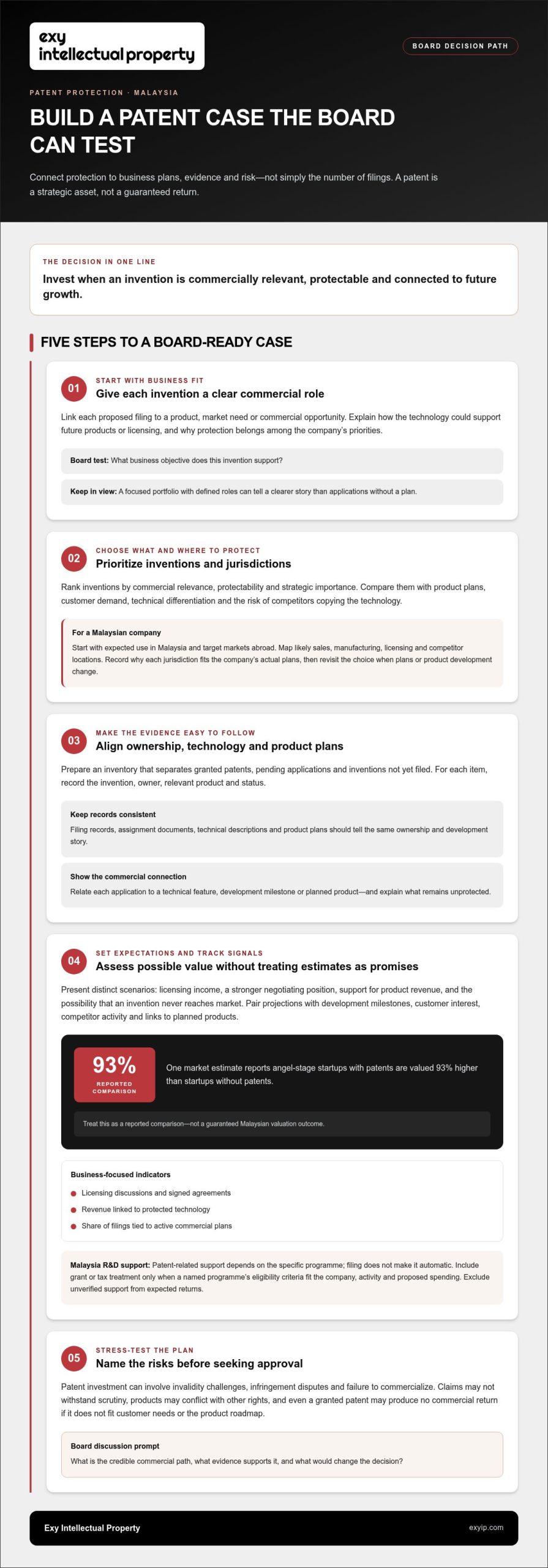
A patent portfolio is a group of patent rights and applications linked to a company’s inventions. It can affect valuation by showing investors what technology the business controls and how that technology supports future products or licensing. One market estimate reports that angel-stage startups with patents are valued 93% higher than startups without patents. Treat this as a reported comparison, not a guaranteed Malaysian valuation outcome.
Connect each invention to a product, market need, or commercial opportunity. A portfolio’s value depends on more than its size: investors may consider the technology’s relevance, ownership, potential use, and remaining development work. A focused group of filings with defined commercial roles can tell a clearer story than applications without a plan.
Measuring Returns and Building the Board Case
Patent ROI compares the business value created or protected with the resources committed to obtaining and managing rights. To make the case, present distinct scenarios: licensing income, a stronger negotiating position, support for product revenue, and the possibility that an invention never reaches market. Pair projections with evidence such as development milestones, customer interest, competitor activity, and links between the invention and planned products.
Track practical indicators, including licensing discussions, signed agreements, revenue linked to protected technology, and the share of filings tied to active commercial plans. In Malaysia, patent-related R&D support depends on the specific programme, it is not an automatic benefit of filing. Include grant or tax treatment in projections only when a named programme’s eligibility criteria fit the company, activity, and proposed spending. Exclude unverified support from expected returns.
Prioritizing Inventions and Patent Jurisdictions
Rank inventions by commercial relevance, protectability, and strategic importance. Compare each candidate with product plans, customer demand, technical differentiation, and the risk of competitors copying it. Map likely sales, manufacturing, licensing, and competitor locations to identify jurisdictions that align with the company’s actual plans.
For a Malaysian company, start with the invention’s expected use in Malaysia and its target markets abroad. Choose jurisdictions where protection could support sales or negotiations, rather than simply where the company hopes to expand. Record the reason for each choice and revisit it when market plans or product development change.
Assessing Patent Investment Risks
Patent investment carries risks, including invalidity, infringement disputes, and failure to commercialize. Claims may be challenged if they do not withstand scrutiny, and a company may need to assess whether its products conflict with other rights. Even a granted patent may produce no commercial return if the invention does not fit customer needs or the product roadmap.
Invention-marketing companies present a separate risk. Individuals and companies usually buy patents after they have been granted; purchases of ideas or pending applications are uncommon and often yield little. Before relying on a promised sale, examine the buyer, proposed transaction, evidence of demand, and claims about likely returns. Board approval should rest on a credible commercial path, not a sales pitch.
Investor due diligence and patent protection
During due diligence, investors assess whether a company owns the intellectual property behind its products and can explain its commercial role. A patent application may support that account, but ownership records, application documents, and development plans must align.
What investors examine
Start with an inventory that separates granted patents, pending applications, and inventions not yet filed. For each item, record the invention, owner, relevant product, and status. A Malaysian startup developing diagnostic equipment, for example, should be able to show how each application relates to the technology it protects.
Investors may examine whether inventors and the company have clear ownership arrangements. They may also assess whether patent claims relate to the product being developed, rather than a broad idea with no defined use. Keep filing records, assignment documents, technical descriptions, and product plans consistent so investors can follow the ownership and development story.
One market estimate claims that filing at least one patent application reduces the time to VC investment by 76%. Treat that figure as a reported claim, not a forecast for an individual Malaysian company. Investors still weigh commercial prospects, team capability, market demand, and the quality of the underlying technology.
Presenting evidence and gaps
A case study described a seed-stage AI diagnostics startup with three early patent filings. The lesson is not to match that filing count. Instead, show how each application relates to a specific technical feature, development milestone, or planned product, and explain what remains unprotected.
Prepare a diligence file that answers four practical questions: what has the company protected, who owns each right, how could it support revenue, and what work remains? Include application records, inventor information, development evidence, and relevant licensing discussions. If an investor asks about a gap, explain why it matters to the business and what decision was taken to address it.
Investors may ask how many patents the company has sold, the amounts received, how those transactions worked, and what further spending may be required. If there have been no sales, distinguish that fact from other forms of value, such as protection supporting a product or licensing negotiation. Clear answers prevent the company from presenting potential patent value as income already earned.
For a Malaysian company seeking investment, connect each patent to a credible commercial plan and a clear funding purpose. Show which product milestone the investment supports and what evidence will demonstrate progress. This turns a filing list into a diligence narrative built on documented ownership, relevant technology, and a reasoned path to commercialization.
For a Malaysian company seeking investment, connect each patent to a credible commercial plan and show how ownership, product use, and intended next steps fit together. The case-study seed-stage AI diagnostics startup’s 3 early patent filings show why filing count alone does not explain value; connect each filing to its intended role and explain what remains. Be ready to check how many patents the company has sold, the amounts they sold for, how the process works, and what further spending may be required. If no patent sales have occurred, state that plainly and distinguish proceeds received from value that has not yet been realized.
Patents as an investment in technology
A patent can link technology development with commercial rights. For the board, the key question is how protection supports the technology’s path from research to a product, partnership, or licence. That connection matters when deciding whether to fund development, negotiate access, or plan for future revenue.
Kodak offers an example of patents supporting licensing activity. Between 2003 and 2011, Kodak made about $3 billion licensing its intellectual property. Almost $1 billion came from licensing a pair of patents to LG and Samsung during that period. These figures show how protected technology can have commercial value beyond the company’s own products. They do not predict the return another company will earn.
Nortel’s patent portfolio provides a different example. In 2011, Nortel sold 6,000 patents to Apple and Microsoft. The transaction shows that patents may hold strategic value for companies seeking technology rights, not only for the original inventor. For a board, the relevant lesson is to connect a proposed filing to a real technology need, such as protecting a product feature or supporting negotiations with a potential licensee.
Patent protection can shape how a business invests in research. Consider a Malaysian technology company developing a new processing system. It could map each proposed patent to the system’s technical functions, product roadmap, and next development milestone. The map helps directors see whether a filing supports a commercial objective or is disconnected from the work the company plans to bring to market.
Licensing offers another route from protected technology to commercial activity. A licence permits another party to use specified intellectual property under agreed terms. A patent may support discussions with companies seeking access to a technical solution, while the patent holder retains ownership. Prospects depend on the technology, its relevance to a potential licensee, and the strength of the patent rights.
Assess technology progress separately from patent progress. Track whether development milestones are met, the protected invention remains part of the product plan, and licensing discussions advance. If the product changes, review whether the patent still covers technology central to the revised design. This keeps board decisions grounded in current engineering and commercial plans.
Patents do not fund research by themselves. Their role is to support a business strategy for developing, protecting, and commercializing technology. Present the invention’s purpose, its connection to planned products, and the opportunities it may support. Kodak and Nortel illustrate distinct outcomes, licensing and portfolio sale, not a standard return that every patent owner can expect.
A patent licence can generate thousands to millions of dollars in royalty income per year, depending on the technology, industry, and strength of the patents. This possibility is not a forecast. Boards should weigh expected licensing income against development needs and consider whether the protected technology remains commercially relevant.
How can patent investment be measured by ROI and other KPIs?
Measure patent investment with a consistent record of decisions and outcomes, not filing counts alone. This gives directors a clearer view of whether the programme is managed in line with business priorities. If you’re convincing your board to invest in patents, start by defining what each indicator measures.
Keep a patent-level ledger recording the decision date, responsible business unit, status, and reason for pursuing or stopping each matter. Separate direct financial outcomes from strategic indicators, and document the evidence for each entry. This makes later reviews more useful and helps prevent the same benefit from being credited to multiple patents or projects.
Choose indicators that strengthen oversight
Use operational indicators to assess how well the company manages its patent portfolio. These measures can help directors spot decision bottlenecks, outdated records, or unclear accountability before those issues weaken the investment case.
- Decision traceability: Record whether each patent decision has a documented rationale and an accountable owner.
- Portfolio review coverage: Track whether each portfolio item has received a scheduled business review.
- Record completeness: Monitor whether ownership, inventor, status, and decision records are current and consistent.
- Portfolio concentration: Identify whether the company’s rights depend heavily on one technology area or business unit.
- Decision follow-through: Record whether directors’ approved actions are completed and reflected in portfolio records.
Give each indicator a clear definition and data owner. For example, legal staff can maintain status and ownership records, while finance can validate recorded financial outcomes. A shared reporting format prevents teams from counting different events under the same label. It also lets directors compare reviews over time without mistaking better recordkeeping for stronger commercial performance.
Use a portfolio dashboard to distinguish financial return from governance quality. A patent may generate no direct income while still serving a documented strategic purpose; another may remain in the portfolio without a current rationale. Flag these cases separately rather than blending them into one score. Directors can then consider whether the original rationale still holds and what decision should follow.
When convincing your board to invest in patents, present the measurement method alongside the proposed decision. Explain how records will be maintained, who will review them, and what would trigger reassessment. This makes oversight part of the investment, not an afterthought. Consistent measures help directors distinguish a well-managed portfolio from one that simply accumulates filings.
How do patents compare with trade secrets, trademarks, and defensive publication?
Choose protection based on what gives an invention commercial value and how the business plans to use it. A Malaysian software company, for example, might assess a technical process, confidential implementation details, its product name, and information it may disclose publicly. Patents, trade secrets, trademarks, and defensive publication serve different purposes. They are not interchangeable, and one innovation may call for more than one approach.
Patents protect inventions
A patent can give its owner exclusive rights over an invention covered by its claims. This may suit a technical feature the company intends to commercialize and can describe for examination. A medical-device business, for instance, might consider patent protection for a device mechanism while planning product development or licensing. The board should weigh the invention’s commercial relevance against the disclosure involved in seeking patent protection.
Trade secrets protect confidential know-how
A trade secret is confidential information with business value. A Malaysian food manufacturer might protect an undisclosed production method rather than reveal its details publicly. This approach depends on maintaining secrecy; if the information becomes public or is independently developed, the business may lose its practical advantage. It may suit know-how that is difficult to discover from the finished product, but it does not provide patent-style exclusive rights.
Trademarks protect market identity
A trademark distinguishes a business or its products from others. It protects a different asset from a patent: the name, sign, or branding customers associate with a product, rather than the technology inside it. For example, a company selling a patented water filter could seek a trademark for the product name. When assessing product investment, the board should distinguish technology protection from protection of the identity used to build customer recognition.
Defensive publication creates a public record
Defensive publication means disclosing an invention publicly to help prevent another party from claiming it as a new invention. A company might choose this route for a feature it does not plan to commercialize exclusively. Unlike a patent, publication does not give the company an exclusive right to stop others using the disclosed idea. It also makes secrecy harder, so disclosure should follow a deliberate business decision.
Compare the options using the same questions: does the company need exclusivity, can it maintain confidentiality, and does the asset distinguish its brand? A Malaysian engineering business could consider a patent for a product mechanism, keep a difficult-to-reverse manufacturing detail confidential, and register the product name as a trademark. Defensive publication may suit a separate improvement it wants to disclose without seeking exclusivity. The right mix depends on each asset’s role, not a single rule for every invention.
Before recommending a patent route, use a patent novelty search to assess existing disclosures and inform the protection strategy.
Exy Intellectual Property: Trademark Registration
Exy Intellectual Property helps businesses align patent decisions with protection for their wider intellectual property. Turn to its Patent Filing and Patent Drafting services when an invention supports a defined commercial plan and the board needs a clear path from technical work to protection. A Patent Novelty Search can help assess existing disclosures before deciding how to proceed.
Trademark Registration protects a different business asset: the name or sign customers use to identify your products. Industrial Design Registration and Copyright Voluntary Notification may also fit other parts of a company’s intellectual property strategy. Matching each asset to the appropriate protection helps directors make more focused decisions about innovation and brand identity.
Contact Exy Intellectual Property to discuss how patent and trademark protection can support your business objectives.
Turn the Board’s Decision into a Clear IP Strategy
Once directors agree that an invention matters to the business, define what the company wants protection to achieve. This might mean supporting a product roadmap, preparing for licensing discussions, or strengthening how the business explains its technology to investors. Assign responsibility for tracking progress, and revisit the decision when commercial plans or the invention change.
If you’re responsible for convincing your board to invest in patents, frame the next discussion around a specific business decision, not an abstract promise of future value. Set out the intended outcome, the evidence that would indicate progress, and the questions that still need reasoned answers. This gives directors a practical basis for deciding how intellectual property fits the company’s priorities.
Exy Intellectual Property can help businesses consider how protection choices fit their commercial objectives. Contact Exy Intellectual Property to discuss your company’s intellectual property strategy and possible next steps.
Frequently Asked Questions
What business value can patents create for a company?
Patents can give a company a defined asset to address in commercial partnerships and licensing discussions. Before beginning joint product development, for example, a Malaysian business can identify which patented technology it contributes, how new inventions will be handled, and what permissions each partner needs. Clarifying these points can help directors assess whether the proposed collaboration supports the company’s long-term commercial interests.