


A reliable IP budget is a plan, not just a figure: tie it to business goals, the intellectual property you already hold, the value it can protect or create, and a reserve for surprises. To understand how to get a budget for IP protection, map those priorities into a spreadsheet forecast and review how they may change over the next 2-3 years. This gives you a practical way to keep spending visible and focused in Malaysia.
It’s reasonable to want a clear view of where the money goes and how each commitment supports the business. The challenge is balancing current applications and ongoing rights with future plans, rather than trying to protect every asset in the same way.
This guide sets out practical steps to align IP spending with business objectives, assess the portfolio and its value, plan for unexpected needs, and build a forecast you can update. These steps give you a clearer basis for prioritising protection and discussing the budget with decision-makers.
Key Takeaways
- Link IP priorities to business goals and focus protection on the assets that matter most.
- Build an inventory of existing rights, pending applications and future plans before setting budget categories.
- Compare each asset’s business impact, competitive risk and potential to support revenue or partnerships.
- Allow room in your plan for unexpected developments, rather than relying only on past spending.
- Use a spreadsheet to track planned and actual spending, model different business scenarios and refine future forecasts.
1. Aligning IP spending with business objectives
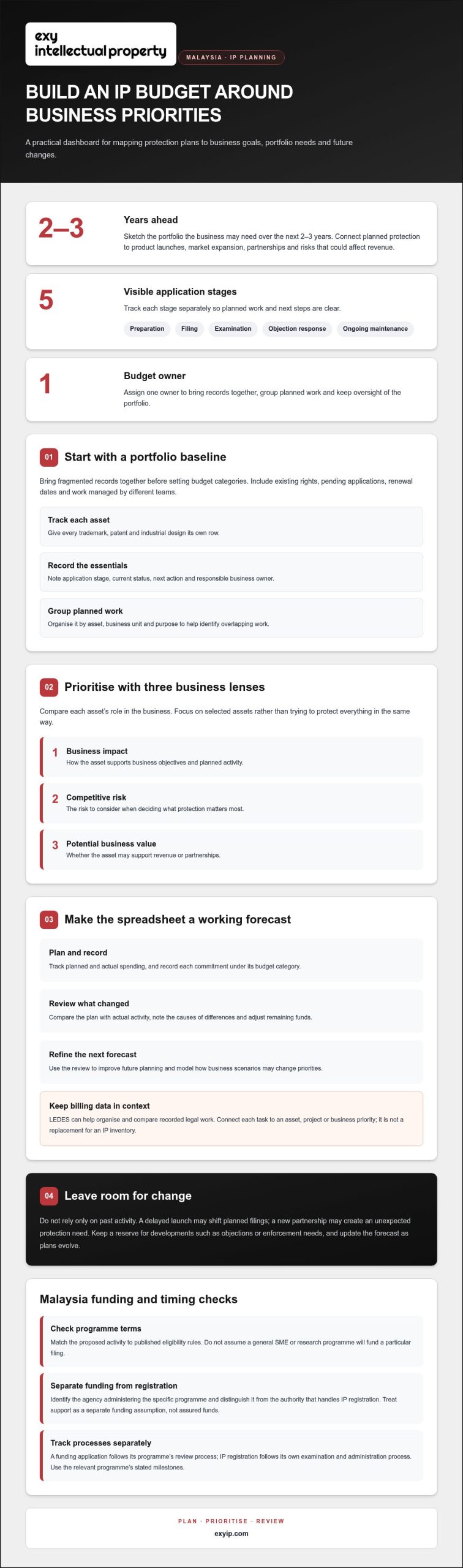
Start with business priorities, not a list of possible filings. Map planned intellectual property spending to product launches, market expansion, partnerships, and risks that could affect revenue. Then sketch the portfolio the business may need 2-3 years ahead. A company preparing to enter new markets, for example, can assess which brand assets or inventions support that plan before assigning budget. Teams deciding how to get budget for IP protection can begin by identifying these commercial priorities.
Centralise oversight before setting limits. An audit can bring fragmented records together, including existing rights, pending applications, renewal dates, and work managed by different teams. Assign one budget owner to gather these records and group spending by asset, business unit, and purpose. This makes IP management easier to track and helps leadership identify overlapping work across teams.
Use a hybrid process that connects leadership’s financial limits with portfolio needs. Senior management sets the overall direction based on business plans and past spending, while the IP team prepares detailed estimates for planned work. Compare the two, discuss gaps, and agree which assets support the strongest business objectives. Prioritise selected assets instead of trying to protect everything. This is a practical step in deciding how to get budget for IP protection.
Compare planned budgets with actual spending during the year. Record each commitment under its budget category, then review differences and their causes. A delayed launch may shift planned filings, while a new partnership may create an unexpected protection need. Reconciliation helps explain variances, adjust remaining funds, and improve the next forecast. Use the review to identify opportunities as well as overspending.
LEDES is a billing standard used in legal spend management. When legal invoices use LEDES, its structured billing data can help organise and compare recorded work. Treat it as one tracking input, not a replacement for an IP inventory: connect each task to an asset, project, or business priority.
For grants related to Malaysia, start by defining the activity, such as protecting a brand or supporting innovation. Then compare it with a programme’s published eligibility rules. Prepare the business details, project rationale, and supporting documents required by that programme.
Look for current support that expressly covers intellectual property protection or related innovation activity. Do not assume a general SME or research programme will fund a particular filing. Eligible activities depend on each programme’s terms.
There is no single funding agency to treat as the source for every Malaysian IP application. Identify the agency administering the specific funding or incentive programme, and distinguish it from the authority that handles IP registration.
SME grants or tax incentives may be relevant when their published terms cover the business activity and expense in question. Before including them in a budget, match the proposed IP work to those terms and record the result as a separate funding assumption.
Malaysian Tax Deductions & Grant Ecosystem (LHDN & MATRADE)
In Malaysia, IP budgeting can be optimized through targeted fiscal relief. Under the Income Tax (Deduction for Expenditure on Registration of Patent and Trade Mark) Rules, qualifying Malaysian SMEs can claim tax deductions against statutory business income for expenses incurred in registering patents and trademarks locally. Furthermore, for international expansion, export-ready Malaysian companies can leverage MATRADE’s Market Development Grant (MDG), which reimburses eligible expenses incurred for international trademark, patent, and industrial design registrations.
Application and registration timelines depend on different processes. A funding application follows its programme’s review process, while IP registration follows its own examination and administration process. Track each separately in the budget schedule, using the relevant programme’s stated milestones rather than assuming a fixed timeline.
2. Assessing portfolio maintenance and professional service costs
Start with an asset inventory showing what the business already protects and what remains in progress. In a spreadsheet, give each trademark, patent, and industrial design its own row. Record the application stage, current status, next action, and responsible business owner. This makes the portfolio easier to review and helps distinguish active rights from future protection plans.
Break each application into practical stages, such as preparation, filing, examination, responding to objections, and ongoing maintenance. Keep each stage visible instead of grouping all activity under one label. Describe the professional work involved separately, so decision-makers can see which tasks need technical input, document preparation, or follow-up.
How much does it take to register a trademark, patent, or industrial design in Malaysia? The resources required depend on the type of right, the application’s scope, and the work needed to prepare and progress it. List each application separately and refer to the current registration process when planning its stages.
Before filing, search existing and previously protected intellectual property. This can help identify similar rights before the business commits time to an application. If an objection arises, track the response as a separate work item. A patent novelty search can inform decisions about an invention, while a precise asset description helps define the preparation required.
Does Malaysia’s IP registration authority offer reductions or financial assistance? Don’t assume that assistance applies to every applicant or application. Record programme support separately from the registration plan, and base the forecast on the relevant programme’s published terms.
How can Malaysian SMEs apply for government grants to register patents, trademarks, or industrial designs? Find a programme whose published terms cover the proposed activity, then prepare the requested business and project documents. Keep the application timeline separate from the IP filing plan, and treat approval as a possibility, not an assured source of funds.
Planning application work in stages can help a business manage commitments and retain flexibility for unexpected objections or enforcement needs. Update the spreadsheet when an application advances or requires additional work. Relying on a grant can create timing uncertainty. Delaying a filing may leave an important asset without its intended protection while funding is pending.
What are the risks of relying on grants or delaying IP registration in Malaysia? A grant may not align with an application’s eligibility or timing, while delay can leave a valuable asset exposed. Keep priority applications in the core plan and record potential grant support separately.
For guidance on how an application fits an IP plan, consider trademark filing guidance.
Statutory Maintenance Cycles: Malaysia vs. Foreign Jurisdictions
Maintenance timelines differ fundamentally across borders. While the United States collects patent maintenance fees at 3.5, 7.5, and 11.5 years post-grant, Malaysia operates an annual patent renewal system under Section 35 of the Patents Act 1983. Annual patent renewal fees begin after grant but are calculated retroactively based on the anniversary of the original filing date, with fee tiers escalating as the patent matures over its 20-year statutory lifespan. In contrast, under Section 39 of the Trademarks Act 2019, trademark registrations are maintained on a 10-year renewal cycle.
Audit IP portfolios, innovation activities, and pending invention disclosures; inventory assets before budgeting, and reserve funds for unexpected expenses. In the United States, patent maintenance fees are due 3.5, 7.5, and 11.5 years after grant.
3. Evaluating IP value against business priorities
Assess intellectual property by its role in the business, not simply by whether it is registered. For each asset, describe what it protects, who relies on it, and which business activity it supports. A trademark used on a core product line plays a different role from a mark retained for a discontinued product. Record that distinction in the decision-making process.
Use a scorecard to compare assets consistently. Consider their connection to active revenue, relevance to strategic partnerships, exposure to imitation, and expected renewal needs. Give each factor a clear rating, such as high, medium, or low, and record a short reason. A product team might rate a design highly while its product remains central to the current range, then reassess if the range changes.
Separate direct commercial contribution from strategic value. Some intellectual property supports sales today; other assets may strengthen a negotiation, support licensing, or preserve options for future commercialisation. Note what could make a less active asset valuable, such as a planned partnership or entry into a new market. This gives leadership a reason to retain or revisit the asset without assuming immediate proceeds.
Then assess the downside of reducing attention to an asset. Could the business lose a useful position against a competitor, weaken a strategic partnership, or miss an opportunity to develop a new product? Record the likely business effect and the evidence behind it, such as product plans, sales activity, or partnership discussions. A documented rationale makes decisions easier to review when circumstances change.
Use disclosure decisions to make innovation review more disciplined. As a budgeting rule of thumb, for every 20 invention disclosures, 3-5 should advance to patent filing. Treat that ratio as a prompt for discussion, not an automatic quota. Compare each disclosure’s business purpose, technical distinction, and development plans before deciding whether it merits further attention.
A full economic, brand, technology, and market review of every patent or trademark does not need to happen annually. Schedule deeper IP audits and valuation work when the business can commit sufficient time and expertise. Between reviews, update scorecard entries when product plans, market conditions, or partnership priorities change. This keeps decisions current without requiring teams to reassess every asset in equal depth.
Finally, identify assets with weak links to current or future business activity. Mark them for deliberate review instead of letting them remain active by default. The outcome should be a clear record of which rights support current operations, which preserve a credible opportunity, and which no longer fit the company’s direction. This helps decision-makers adjust the portfolio using a practical, evidence-based rationale.
4. Preparing for unexpected IP developments
Past IP activity may not predict what the business will need next. Build scenarios around changes that could affect your protection strategy, then record the event that would trigger each response. This gives leadership a planning tool for changing circumstances, rather than relying only on historical patterns. Keep scenario assumptions visible so teams can distinguish current commitments from possible future work.
For example, consider an acquisition of a startup with a technology stack that relies heavily on open-source software. Before the acquisition changes business operations, map the relevant software, third-party terms, and ownership questions that may need review. Identify who will assess the technology and how the findings could affect the company’s IP roadmap. This scenario helps teams plan for integration questions without treating the acquisition as an ordinary application or renewal.
Also model a challenge to the company’s largest patent family. Note which products, partnerships, or market plans depend on those rights. Identify who would coordinate the response and which internal teams would need to provide technical or commercial information. This creates a practical decision path for a high-impact event while keeping it distinct from routine patent prosecution and portfolio reviews.
Use a 12-month buffer when optimizing prosecution budgets. Maintain a rolling view of expected prosecution activity across the next 12 months, and update it as applications progress or priorities change. Mark potential decision points, such as whether to continue an application or respond to an examination issue. The buffer helps teams see when several decisions may overlap and plan their attention accordingly.
International plans can introduce further uncertainty. A new market launch, distributor discussion, or product change may raise questions about where protection is relevant. Record the event, the affected asset, and the person responsible for assessing it. This links possible international work to a real business trigger instead of treating every potential market as an immediate priority.
Review scenarios during regular planning meetings. If an acquisition, patent challenge, or launch plan changes, revise the assumptions and identify which response is relevant. Keep a written record of decisions, including why a scenario remains inactive or moves into active planning. This gives leadership a clear view of how unexpected developments may affect the IP roadmap.
Finally, identify who can approve a change in priorities and how that decision reaches the teams managing applications. A defined escalation path helps the business respond promptly when a challenge or transaction affects an important asset. Give each scenario an owner and a next step, so planning leads to coordinated action rather than an unused document.
5. Spreadsheet-based IP budget forecasting
A spreadsheet turns business plans into a forecast leadership can review and revise. Create one row for each planned filing, renewal, research task, or innovation project. Add columns for the asset, responsible team, expected timing, estimate, business purpose, and current status. A spreadsheet can clarify how to get budget for IP protection by making planned work and assumptions visible. Separate confirmed work from future possibilities so decision-makers know what requires approval.
Build the forecast from operational information, not only last year’s spending. Combine historical records with portfolio data and input from business partners close to day-to-day work. Include research and development, design activity, and planned patent or trademark filings. For example, a product team may identify a design project that creates new IP needs before those needs appear in registration records.
Use formulas to summarise spending by category, project, and period. Compare planned amounts with actual outlays as invoices and filing activity are recorded. Add a variance column, then note whether each difference came from a shifted launch, a new application, or a change in scope. This creates a record leadership can use to refine assumptions and explain decisions.
Model scenarios separately from the base forecast. One example is a 30% increase in research and development headcount. Show how that change could affect invention disclosures, design work, and possible patent filings. A second scenario could move a planned launch into a new market, prompting the team to revisit which brand or invention assets need attention. Keep each scenario’s assumptions visible.
For a Malaysian IP protection funding application, prepare a business profile, a clear project description, details of the relevant assets, and an itemised estimate linked to each proposed activity. Add supporting records that explain the project’s business purpose and planned outcomes. Match the submission to the specific programme’s published document requirements, since application materials can vary by programme.
Structuring Multi-Year Agency Funding Roadmaps
When forecasting external co-funding into your spreadsheet, isolate specific administering agencies: Cradle Fund (CIP Spark / CIP Sprint) for early-stage tech development, MIDA for R&D tax incentives, and MDEC for digital innovation grants. Keep external grants flagged as conditional assumptions rather than guaranteed cash flows to avoid underfunding critical statutory prosecution deadlines
Use separate spreadsheet fields for estimates, confirmed commitments, and possible funding. Record the source and date of each estimate, its currency in RM, and any assumptions behind it. For international patent planning, flag translation requirements as a separate category; patent translations into Chinese, Japanese, Korean, or Russian account for approximately 65% to 80% of total cost. Teams asking how to get budget for IP protection can use these fields to show what supports each forecast assumption.
Review the file with finance, product, and legal teams before presenting it. A patent lead may identify a filing milestone, while product leadership can explain its connection to a launch. Record decisions beside the relevant rows, then update the forecast when plans change. This shared view connects innovation activity with budget choices and helps the team assess progress towards business objectives.
To connect your forecast with a wider IP financing strategy, explore IP financing options.
Exy Intellectual Property: Trademark Registration
Exy Intellectual Property can help businesses plan trademark registration around their commercial priorities and intended brand use. Turn to the official Trademark Registration service when a name or sign is central to your business and you’re ready to assess protection as part of your IP budget.
For a broader protection plan, Patent Filing and Industrial Design Registration address different types of business assets, while Copyright Voluntary Notification may suit copyright-related needs. Which work to prioritise depends on the assets involved, business plans, and the risks the business aims to address.
A clear budget and asset list can make the next discussion more focused. Contact Exy Intellectual Property to discuss which protection steps align with your business priorities.
Make your next IP decision part of the plan
The next step is to turn your budget forecast into a decision the business can act on. Choose the asset that matters most to an upcoming launch, partnership, or market opportunity, then explain the business case for protecting it. This gives finance and leadership a clear basis for deciding what to prioritise now and what to revisit later.
Understanding how to get budget for IP protection also means connecting planned work to the right support. Exy Intellectual Property offers Trademark Registration, Patent Filing, and Industrial Design Registration for businesses protecting different types of assets. A focused discussion can help you consider which service aligns with your IP priorities and commercial plans.
Bring your current priorities and forecast into the conversation. Contact Exy Intellectual Property to discuss a practical next step for your business. Thoughtful planning can help you move forward with greater clarity.
Frequently Asked Questions
How Do You Keep an Eye on Your IP Budget?
Assign one person to maintain the budget register and set a regular review date, such as the first working day of each month. Check upcoming commitments against invoices, project changes, and available funds. Use consistent labels for each asset and business unit, and limit editing access to the people responsible for updates. A short monthly report can flag decisions leadership needs to make before planned work moves forward.
Wait, there are multiple approaches?
Yes. Top-down budgeting starts with leadership’s financial limits; bottom-up budgeting starts with requests from teams handling IP work. A hybrid process combines both. For example, a business planning a new product can set a spending boundary first, then ask product and legal teams to estimate protection needs within it. This creates a budget that reflects operational realities while giving decision-makers a clear basis for approval.
What IP protection grants or funding are available to businesses in Malaysia?
Look for current grants or incentives whose published terms expressly cover intellectual property protection or related innovation activity. Check eligibility and required documents, and treat funding as a separate, uncertain budget assumption.