


A patent portfolio can support growth or consume attention without advancing it. Managing a patent portfolio for growth matters to Malaysian businesses that invest in R&D, hold patents, plan to enter new markets or want to earn revenue through licensing. The goal is to keep protection aligned with commercial priorities, not simply accumulate filings.
That requires regular decisions about which inventions to protect, where protection matters and whether each patent still supports the business. Patent portfolio analysis can also uncover licensing opportunities, identify gaps and help focus future R&D on areas with commercial potential.
This article explains who benefits from a portfolio strategy and how to align patents with business plans, assess competitive coverage and review portfolio value over time. It also considers how international management and AI-enabled tools can inform decisions, while keeping legal judgment central.
Key Takeaways
- Connect patent decisions to business plans, R&D priorities and the markets your company intends to serve.
- Assess whether patents could support licensing, partnerships or other commercial opportunities, rather than treating every filing as a cost of protection.
- Map patent coverage against competitors’ products and likely innovations to spot gaps and strengthen strategic protection.
- Review each patent’s scope, market relevance and ongoing obligations to identify assets to maintain, develop or let lapse.
- Use AI-enabled tools to support portfolio analysis and triage, while keeping legal judgment central to important decisions.
1. Patents as a source of licensing revenue and investor appeal
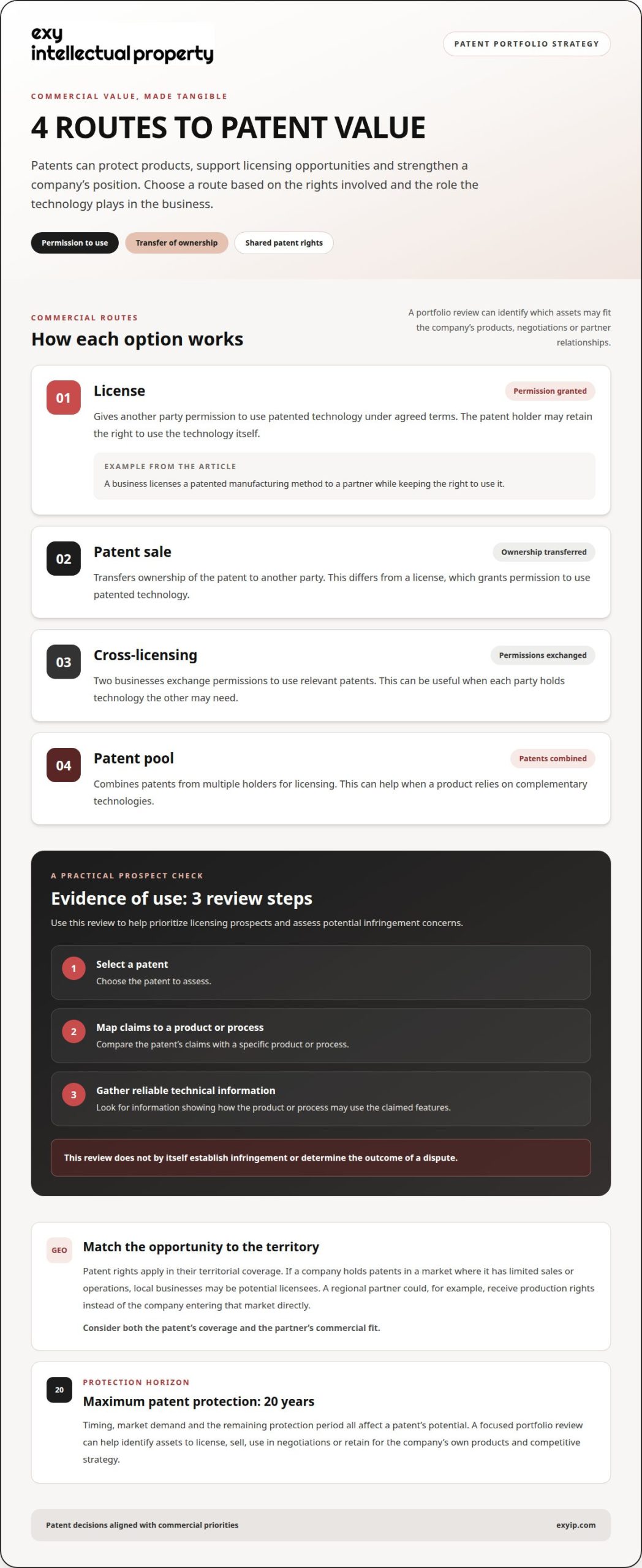
Patents can support growth by protecting products, creating licensing opportunities and strengthening a company’s position against competitors. For example, a business might license a patented manufacturing method to a partner while retaining the right to use it itself. A portfolio can also help investors assess how a company protects its technology and plans to commercialize it.
Start with a practical review of revenue potential. List each patent’s claims, the products or processes it covers and the markets where it applies. Then compare those claims with what your business sells and what other companies make. The World Intellectual Property Organization (WIPO) notes that a patent portfolio can strengthen bargaining power in licensing negotiations.
Look beyond direct competitors for licensing or acquisition opportunities. A customer may need a patented feature for its product; a supplier may have technology that fills a gap in your development plans. Mapping patents across competitors, customers and other value-chain participants can reveal useful connections. If a gap is strategically important, consider a license, partnership or acquisition.
There are several routes to commercial value. A license gives another party permission to use patented technology under agreed terms. A patent sale transfers ownership, while cross-licensing lets two businesses exchange permissions to use relevant patents. Patent pools combine patents from multiple holders for licensing, which can help when a product relies on complementary technologies.
Evidence-of-use analysis can help identify licensing prospects. Select a patent, map its claims to a specific product or process, then gather reliable technical information showing how that product may use the claimed features. This review helps prioritize outreach and assess potential infringement concerns. By itself, it does not establish infringement or determine the outcome of a dispute.
Geography matters. If a company holds patents in markets where it has limited sales or operations, it can assess whether local businesses might benefit from a license. For example, a manufacturer may license production rights to a regional partner rather than enter that market directly. The patent’s territorial coverage and the partner’s commercial fit guide the assessment.
Keep commercial prospects in perspective. Patent protection lasts for a maximum of twenty years, so timing, market demand and the remaining protection period affect a patent’s potential. A focused portfolio review can identify assets to license, sell or use in negotiations, alongside patents better retained for the company’s own products and competitive strategy.
2. Aligning patent filing strategy with business plans and R&D
A patent strategy works best when it follows the company’s commercial plan. List planned products, target markets and research priorities, then map each invention to those goals. For example, a manufacturer developing a new production process can ask whether it supports a product launch, improves output or creates a licensing opportunity.
For Malaysia, treat filing, examination and maintenance as separate portfolio tasks. Plan each application, follow its examination progress and track renewal obligations for every patent and country. Renewal obligations can require ongoing attention, so assign responsibility for monitoring them rather than relying on occasional reviews.
Costs depend on technical complexity, drafting work, examination steps, jurisdictions and later enforcement activity. The amount is determined for each case after a quote request, not inferred from the number of inventions alone.
Building and managing a portfolio follows a practical sequence: identify inventions, compare them with business priorities, assess filing options and review the resulting patents against commercial plans. Bring R&D, technical, finance and marketing perspectives into these decisions. This connects prosecution choices with product plans, investment priorities and the commercial success the company seeks.
Prioritize inventions by asking what business problem each solves, whether it supports a planned product and whether competitors could copy or commercialize it. Then weigh its expected market relevance against the work required to protect it. An invention central to a product roadmap may deserve more attention than an isolated technical improvement with no clear commercial role.
Pruning is part of strategy, not a sign that earlier innovation lacked value. Review each patent against current products, planned R&D and target markets. If a patent no longer supports a business objective, compare its strategic value with its ongoing renewal obligations. Retain assets that protect important activity; consider allowing less relevant rights to lapse.
Emerging technologies can change those priorities. A company developing software for AI applications, for example, should review whether existing inventions relate to its new technical direction. Patents connected to 5G technology, AI or renewable energy may see increased demand as those industries grow. Regular portfolio reviews help identify relevant assets and guide new filings without assuming every trend fits the business.
Keep the strategy adaptable as market demand, technology and business plans shift. A patent filing strategy can support this process by connecting invention assessment, drafting and filing decisions to the company’s priorities.
3. Strategic coverage and competitive moat analysis
A competitive moat depends on protecting technology that matters in the market. Map patent claims against products competitors would want to make or sell. For example, a Malaysian manufacturer can compare its process patents with rival products and identify features that remain uncovered. This shows where intellectual property supports differentiation and where another filing or business response may merit consideration.
Monitor competitors’ patent portfolios for changes in technical direction. Track new filings, published applications and granted patents in relevant technology areas. A competitor investing in battery storage, for example, may signal a shift in product development. Compare that signal with your R&D plans, then decide whether to adjust research priorities, explore a partnership or assess potential infringement concerns.
Patent analytics can turn filing records into a clearer competitive map. Group patents by technology, product function, applicant and market, then look for clusters and gaps. If several competitors file around one component while your portfolio covers only a neighboring feature, the map can prompt a closer review. These insights support more focused filing, enforcement and collaboration decisions.
Coverage should reflect how a product works, not just its headline invention. Break it down into key components, processes and technical functions. Then connect each element to relevant patent claims and the competitors likely to offer similar products. This can show whether protection covers the core feature, a supporting process or adjacent technology that may matter to future products.
A competitor-focused strategy also helps distinguish defensive assets from growth opportunities. For example, a patent covering a process used across several products may offer broader negotiation options than one tied to a narrow feature. Compare each asset’s claims with competitor activity and business priorities. Use the results to guide new filings, licensing discussions or a review of protection gaps.
Benchmarking adds context to the review. Compare your portfolio with competitors’ prosecution success, prosecution breadth and external recognition. These measures help assess relative portfolio quality, but read them alongside commercial relevance. A large set of patents does not automatically protect the products that matter. Compare claim scope and technology fit, then identify assets that merit further attention.
Finally, connect coverage choices to operational efficiency. A patent in a crowded technology area may need a clearer role than an asset with distinct market relevance. Review each patent’s relationship to competitor activity and product plans before deciding whether it remains strategically relevant. This helps focus attention on assets that support company priorities, while analytics highlight areas for research, filing or partnership opportunities.
4. Auditing portfolio size, reach, persistence and vitality
For managing a patent portfolio for growth, an audit should connect each asset to a business priority. Most companies should conduct a full audit every 12-18 months, with ongoing monitoring between reviews. Record each patent’s country, protection scope, products covered and current commercial relevance. These details help teams understand portfolio size, reach, persistence and vitality, then assess whether each right still supports the company’s position.
To assess strengths and gaps, compare patents with business goals, product coverage and competitor activity. Check whether claims protect important features, where protection applies and which products depend on those features. Benchmark portfolio quality against prosecution breadth, prosecution success and external recognition. This can reveal uncovered technologies, overlapping assets and patents that no longer fit the company’s direction.
Persistence asks whether each patent remains active. Vitality considers its commercial or strategic relevance. For example, a patent covering a discontinued product may need review, while a related patent could protect a planned successor. Record the reason for each decision to retain, reassess or let an asset lapse. This creates a clear record of how the portfolio’s position changes over time.
An oversized or poorly managed portfolio can divert staff attention from stronger assets. It may also hide protection gaps, duplicate coverage or leave teams unsure which patents support key products. Review dormant patents against current products, licensing plans and future research. If an asset serves none of these purposes, consider whether it still has a meaningful role in the company’s plans.
Market monitoring keeps audit findings current. Track competitor filings, product changes and shifts in technology demand. A change to a company’s manufacturing process, for example, may affect an existing patent’s relevance. Pair these signals with portfolio records so decisions reflect both the patent’s legal position and the business activity it covers.
Patent valuation can help corporate teams prioritize assets without reducing every decision to one definitive figure. Assess strategic fit, commercial use, geographic reach and potential contribution to value capture. A documented rationale explains why one patent receives priority while another is reviewed for licensing, development or lapse. This makes managing a patent portfolio for growth more practical and accountable.
Choose portfolio software that supports reliable records, status tracking and traceable decisions. Teams should be able to review country coverage, claim scope, products and relevant dates in an auditable workflow. Attorneys and business staff need to identify the source of each entry and its latest review. Software that cannot show how records changed weakens auditability and makes past decisions harder to understand.
Organize the review around historical, current and future positions: audit existing rights, benchmark them, then identify opportunities. This sequence links portfolio size to business priorities and helps teams focus on valuable assets. A consistent record of decisions also gives business leaders a clearer basis for revisiting priorities as products and markets evolve.
5. Global IP trends and AI-enabled patent management
Global growth changes where patent protection can support a business. A Malaysian company planning exports should identify priority markets, products and production partners before choosing jurisdictions. International portfolio management can protect key markets while avoiding unnecessary coverage elsewhere. Ask where protection would support sales, manufacturing, licensing or a partnership. That answer should guide filing decisions, not a broad aim to register everywhere.
Build a jurisdiction map around specific business activity. Match each target country to expected sales, manufacturing locations, competitors and supply relationships. For example, a company selling equipment abroad may prioritize markets where it expects meaningful sales or local production. Compare the map with existing patent coverage and planned launches. This makes gaps visible and helps avoid filings with no clear connection to commercial goals.
AI-enabled patent management can help sort large document collections and flag relevant records. Software can improve freedom-to-operate triage by identifying patents for closer review. A team assessing a new component, for example, can use search results to focus on potentially relevant claims. Software supports early analysis; it does not replace legal judgment about claim meaning, infringement or filing decisions.
Set a review process before adopting an AI tool. Define the question it should answer, such as locating patents related to a planned product or grouping filings by technology. Have a qualified reviewer assess the results against source documents and the product’s technical features. Record the query, relevant documents and review outcome. This creates an audit trail and helps teams separate useful signals from incomplete or irrelevant matches.
Use AI outputs to inform, not dictate, portfolio choices. A flagged patent may warrant closer review, but teams should consider its claims, jurisdiction, status and relevance to the product. A missed document can also distort a preliminary assessment. Keep a human review step for decisions about filing, commercial partnerships and potential disputes. The benefit is faster triage, with attorneys applying legal analysis to the relevant evidence.
For Malaysian businesses expanding internationally, the takeaway is selective coverage supported by disciplined tools. Choose jurisdictions based on commercial plans, then connect patent records to products, competitors and market changes. Review whether each filing still serves its intended role as plans evolve. A targeted global patent registration strategy can help align protection decisions with expansion priorities.
Then prioritize jurisdictions according to business activity. Companies operating globally or planning to expand can use international patent portfolio management to protect key markets while avoiding unnecessary costs.
Exy Intellectual Property: Trademark Registration
Exy Intellectual Property helps businesses protect inventions and the signs customers associate with them. A patent portfolio review may show that technical protection is only part of the picture: a product’s name or logo can also matter as it enters new markets. Trademark Registration addresses that distinct brand-protection need, while Patent Filing supports protection for new inventions.
Turn to these services when a product launch, new invention or market expansion prompts a review of intellectual property priorities. For example, a Malaysian business preparing to commercialize a patented product can consider whether its product name also needs protection. Choosing the right protection starts with identifying what the business is seeking to protect, whether an invention, a brand sign or another eligible creation.
For guidance on patent and trademark protection for your business, contact Exy Intellectual Property.
Turn portfolio insight into a clear next move
Make the next portfolio decision clear to the people responsible for carrying it out. Record the business objective, the patent or invention involved, the decision owner and the next review point. This helps teams turn an intellectual property decision into action.
A disciplined approach to managing a patent portfolio for growth keeps responsibility connected to changing business priorities. As plans develop, revisit the rationale behind each decision and update it when the company’s direction changes. A portfolio strategy should guide action, not sit apart from everyday commercial planning.
Exy Intellectual Property can support relevant protection steps through Patent Filing, Trademark Registration and Industrial Design Registration. If you’re ready to discuss your business’s intellectual property priorities, contact Exy Intellectual Property.
Clear decisions create a stronger basis for the next stage of growth.
Frequently Asked Questions
Who needs a portfolio strategy?
Any business whose products, services or research depend on inventions can benefit from a patent portfolio strategy. It is especially useful when a company has several inventions, plans to launch new products, collaborates with technical partners or expands into other markets. A small business with one core technology can also benefit from deciding which developments to protect and how those rights fit its commercial plans.
What is a growth-oriented patent portfolio strategy?
A growth-oriented patent portfolio strategy links patent decisions to the business’s route to market. It identifies inventions that support product development, partnerships, licensing or expansion, then assigns each asset a clear role. For example, a company preparing to supply equipment to a new market could assess whether its patents support that plan and whether additional technical developments need protection before launch.
How can businesses measure patent portfolio ROI and performance?
Measure performance by tracking how patents contribute to business outcomes, not by counting filings alone. Record licensing income, partnerships supported, products protected, relevant market coverage and decisions informed by the portfolio. Compare those results with the resources devoted to filing and maintaining rights. For example, a patent tied to a commercial product may have a clearer contribution than an asset with no identified use or strategic purpose.
How do patent portfolio strategies differ for startups, SMEs, and large companies?
Startups often focus on protecting inventions central to a product and supporting discussions with investors or partners. SMEs may prioritize patents tied to core products, planned expansion and licensing prospects. Large companies can coordinate assets across business units, technologies and jurisdictions while addressing overlaps and gaps. In each case, strategy should reflect available expertise, product plans and the role patents play in commercial decisions.
What are the costs of filing, maintaining, and enforcing patents?
Filing and enforcement costs depend on technical complexity, drafting, examination steps, jurisdictions and later enforcement activity; they are determined for each case after a quote request.