

A patent is not always the stronger choice. Knowing when to use a trade secret instead of a patent comes down to whether the information can stay confidential, how long it may hold commercial value, and whether others could discover it independently. In Malaysia, a patent grants exclusive rights to exploit and commercialise an invention for approximately 20 years, while a trade secret can remain protected indefinitely if it stays secret.
Weigh both options carefully: a patent requires public disclosure, while a trade secret relies on keeping valuable information confidential through practical safeguards. Neither approach is right for every invention.
This guide explains what qualifies as a trade secret and how secrecy, duration, reverse engineering and independent development shape the decision. It also covers when patent protection may offer a stronger position, when a combined strategy could work and how to assess the options for a business in Malaysia.
Key Takeaways
- Choose secrecy when the information is hard to discover, can stay confidential, and may retain value beyond a patent’s approximately 20-year term in Malaysia.
- Trade secret protection depends on practical safeguards, such as restricted access and confidentiality agreements.
- Secrecy won’t stop a competitor from independently developing the same solution or lawfully reverse engineering it.
- A patent may offer stronger protection when independent development is a concern, but it requires public disclosure and must meet Malaysia’s patentability criteria.
- Consider a layered approach: patent what can be disclosed while protecting valuable underlying know-how as a trade secret.
Protection against independent development and reverse engineering
In Malaysia, a patent is a registered right under the Patents Act 1983 and Patents Regulations 1986. It requires public disclosure and can prevent others from exploiting the patented invention, even if they developed it independently. A trade secret relies on confidentiality and legal protection through contracts and common law. It can protect valuable information, but it cannot block independent discovery.
This distinction matters when assessing reverse engineering. If a competitor can buy a product, take it apart and work out how it functions, secrecy may offer limited protection. A production method kept inside a facility may be harder to uncover. Ask whether someone could discover the information from a product, process or public disclosure. If so, a patent may provide a stronger exclusive right.
A trade secret strategy depends on active controls. Identify confidential information, restrict access to staff who need it and mark relevant files as confidential. Use non-disclosure agreements and confidentiality clauses in employment agreements before sharing details with employees, contractors or potential business partners. For example, a company could limit access to a formula and store production records in a restricted digital folder. These steps help maintain secrecy, but cannot prevent lawful independent development.
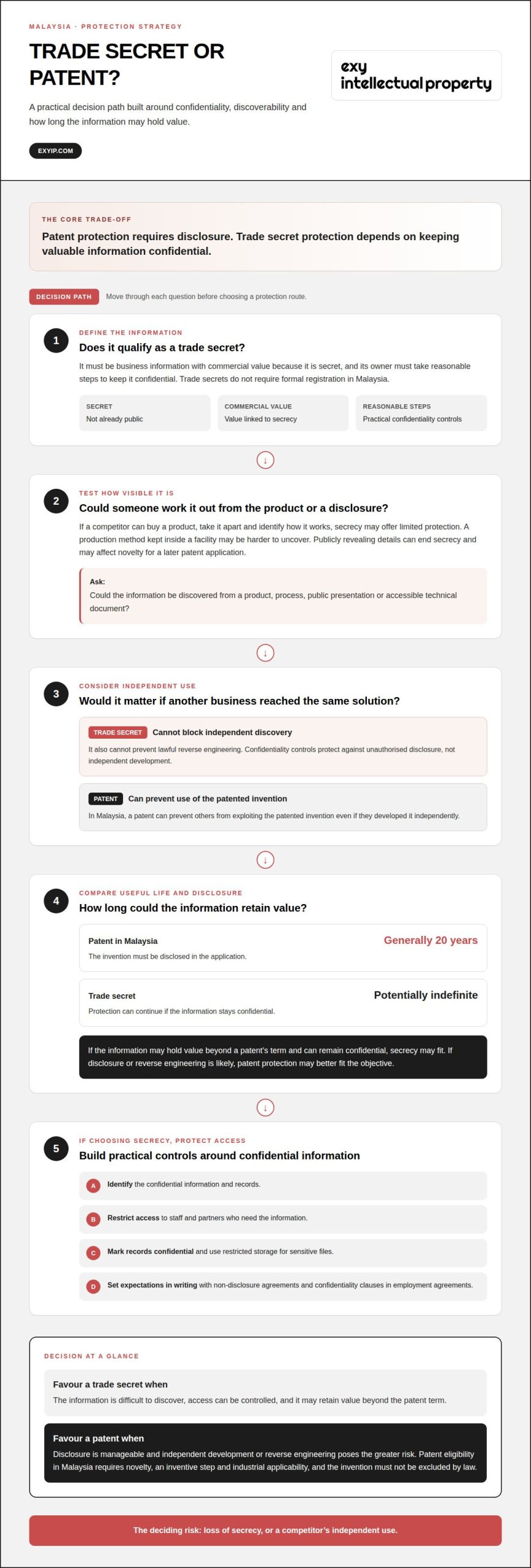
Duration also changes the decision. Malaysian patent protection generally lasts 20 years, while a trade secret can potentially remain protected indefinitely if it stays confidential. Patent protection requires disclosing the invention in the application. A process expected to retain value beyond 20 years may suit secrecy if the business can keep it confidential. If disclosure or reverse engineering is likely, the patent route may better fit the commercial objective.
Spain illustrates how national legal frameworks differ. Law 1/2019 protects confidential business information against unauthorised obtaining, use, or disclosure. Spanish patents are regulated by Law 24/2015 and require novelty, an inventive step, and industrial application. These Spanish rules do not determine protection in Malaysia, but they show why a strategy for one country should not be assumed to apply elsewhere.
For a Malaysian business, weigh the information’s visibility, useful life, access needs and risk of independent discovery. Consider whether staff or partners must see the details, whether a product reveals its method and whether public disclosure is commercially acceptable. When deciding when to use a trade secret instead of a patent, prioritise the risk that matters most: loss of secrecy or a competitor’s independent use.
| Option | Disclosure | Independent development | Duration |
|---|---|---|---|
| Trade secret | Must remain confidential | Does not prevent it | Potentially indefinite while secret |
| Patent | Invention is disclosed | Can prevent use of the patented invention | Generally 20 years in Malaysia |
Choose secrecy when information is difficult to discover and access can be controlled. Favour patent protection when disclosure is manageable and independent use poses the greater risk.
What is a trade secret?
A trade secret is business information with commercial value because it is secret, and whose owner takes reasonable steps to keep it confidential. In Malaysia, it does not require formal registration. Examples include an undisclosed manufacturing method, a customer formula or internal pricing logic that gives a business a competitive advantage. Information already made public cannot remain secret from the public.
For Malaysian businesses, practical steps include identifying confidential information, limiting access to people who need it and marking records confidential. Non-disclosure agreements and confidentiality clauses in employment agreements set expectations before employees or business partners receive sensitive details. For example, a company sharing a production method with a contractor can define permitted use and prohibit unauthorised disclosure in a written agreement. Access controls support these agreements, but do not prevent independent discovery.
Public disclosure changes the options. In Malaysia, patent applications require disclosure of the invention, while trade secret protection depends on keeping information confidential. Publishing invention details can affect novelty in a later patent application and prevent an exclusive patent right over the disclosed invention. A product demonstration, public presentation or freely accessible technical document may expose details on which secrecy depends.
Patent protection also carries an eligibility risk. Under Malaysia’s Patents Act 1983 and Patents Regulations 1986, an invention must be novel, involve an inventive step, be industrially applicable, and not be excluded by law. An earlier disclosure may undermine novelty; failure to meet another requirement can also prevent patent protection. A trade secret does not need to meet technical patentability requirements, but it offers no registered exclusive right against someone who independently develops the same information.
How does public disclosure affect patent rights and trade secret protection in Malaysia? Disclosure can undermine the novelty needed for a later patent application and end secrecy for information made public. Before discussing an innovation outside a trusted group, decide which details can be shared and which should remain confidential.
For a practical decision, separate information that must be disclosed from know-how that can remain internal. A business might seek patent protection for a device while keeping a non-public calibration process confidential. This requires careful coordination: the patent application must explain the invention, and confidential material should not be included casually. Deciding when to use a trade secret instead of a patent depends on whether secrecy can be maintained without undermining commercial plans.
- Identify the specific information that creates commercial value.
- Record who needs access and restrict disclosure to those people.
- Use written confidentiality agreements before sharing sensitive details.
- Assess whether patent eligibility and public disclosure fit the invention.
When patent eligibility or disclosure strategy needs review, patent filing guidance can help align the application with the invention’s confidential elements.
Reverse engineering and independent development
In Malaysia, trade secret protection does not prevent a competitor from independently developing the same solution or lawfully discovering it through reverse engineering. A patent can prevent unauthorised use of the patented invention, even by someone who developed it independently.
Reverse Engineering
Reverse engineering means examining a product to work out how it functions. For example, a competitor might buy a commercially available device, inspect its components and infer a production method. If the secret is visible in the finished product, keeping internal records confidential may not preserve its secrecy. Reverse engineering starts with access to the product, not confidential files.
Consider a Malaysian manufacturer whose product reveals its mechanism when disassembled. A trade secret cannot prevent lawful discovery of information that can be worked out from the product. Patent protection may be more suitable if the invention meets patent requirements and the business needs an exclusive right against others’ use. By contrast, a hidden production sequence may be harder to infer from the item sold, making controlled access more relevant.
Independent Development
Independent development occurs when another business reaches the same solution through its own work, without using confidential information. For example, two engineering teams could separately design similar components in response to the same industrial problem. A trade secret does not give its owner grounds to stop the second team from using its independently developed result. A patent can provide broader protection against use of the claimed invention.
This distinction affects how a business documents its intellectual property. Dated design records, development notes and employee project files can help show how an internal team created an invention. They do not create an exclusive right, but can clarify whether information came from internal work or unauthorised access. If employees move between projects, access permissions and clear project boundaries can reduce accidental sharing of confidential material.
To assess a particular invention’s exposure, map its route from development to sale:
- Identify which features are visible in the finished product.
- Separate product details from internal methods and technical know-how.
- Record independent development work and control access to confidential files.
- Assess whether patent protection is needed to address independent use.
The decision turns on what a competitor can learn without access to internal information. A readily observable mechanism faces a different risk from a process kept inside a controlled industrial facility. Where independent development would undermine the business’s position, patent protection may fit better. Where key information remains hidden, secrecy can retain commercial value.
Trade secret duration and secrecy requirements
In Malaysia, patent protection generally lasts 20 years. A trade secret can potentially remain protected indefinitely, but only while the information stays confidential. The choice therefore depends on whether the invention’s commercial value is likely to outlast the patent term and whether the business can maintain secrecy throughout that period.
A patent application exchanges public disclosure for time-limited protection. Once the patent term ends, the invention enters the public sphere, where it can be used freely. By contrast, a confidential production technique may retain value after 20 years if access remains controlled. If employees, contractors, or commercial partners need broad access, keeping that information secret becomes harder.
Secrecy needs ongoing management, not just a one-time label. Identify confidential material, limit access to people who need it and use confidentiality agreements before sharing details. For example, a manufacturer could restrict access to a production sequence and record who receives the relevant documents. If the information becomes public, trade secret protection may end, even if the business intended to keep it confidential.
How long does patent protection last in Malaysia, and how long can trade secret protection last? Patent protection generally lasts 20 years, while trade secret protection can potentially continue indefinitely as long as the information remains confidential.
Consider patent duration and renewal together. A patent is not a permanent right: when its term ends, the invention is available for public use. For a business planning a product with a long commercial life, the application date and expected market lifespan matter. The patent route may suit an invention whose value can be captured during its protected term; secrecy may suit know-how that remains useful and can stay concealed.
What are the costs and steps to apply for a patent in Malaysia? Budget planning depends on factors such as technical complexity, drafting work and whether protection is sought beyond Malaysia. The practical sequence is to assess eligibility, prepare a clear technical account of the invention, draft the application and file it for examination. Patent eligibility requires novelty, an inventive step, industrial applicability and that the invention is not excluded by law.
These criteria help focus the decision. A novelty search can help identify whether earlier disclosures may affect an application, while careful drafting defines what the patent seeks to protect. If an invention’s value partly comes from undisclosed operational know-how, separate that information from details required for public disclosure. This can support a mixed intellectual property strategy without assuming every valuable detail belongs in the application.
- Estimate how long the invention may retain commercial value.
- Identify which details must be disclosed for patent protection.
- Set access controls for confidential know-how and review them as teams change.
- Consider how expiry would affect use of the invention in the public sphere.
Advantages and disadvantages of each option
For a Malaysian business, the better choice depends on what creates its advantage and how competitors could obtain it. A patent offers an exclusive right over a qualifying invention, while trade secret protection depends on keeping information confidential. Each approach addresses a different business risk.
A patent’s main advantage is that it can prevent others from using the patented invention, including independent developers. This can suit a product whose key mechanism is visible once sold. Patent protection also creates a defined term: generally 20 years in Malaysia. Its trade-off is public disclosure through the application, followed by the invention entering the public sphere after protection ends.
Trade secrets do not require an application or formal registration. They may suit a valuable internal method that is difficult to discover from a product and can be kept confidential. Protection can potentially continue indefinitely while secrecy lasts. However, trade secrets do not prevent lawful reverse engineering or independent development, and disclosure can destroy the advantage. A process known to many employees, for example, may be harder to keep secret than one restricted to a small team.
The two options also place different demands on a business. A patent requires the invention to meet Malaysia’s patentability criteria and the application to disclose technical details. Trade secret protection instead calls for practical controls, such as limiting access and using confidentiality agreements. These controls need ongoing attention as employees change roles or business partners receive information.
Use these decision points to compare the options:
- Visibility: If a competitor can identify the mechanism by examining the product, secrecy alone offers limited protection.
- Useful life: If the information could remain commercially valuable beyond a patent’s 20-year term, assess whether confidentiality can be maintained that long.
- Independent development: If a rival could reach the same solution independently, a patent provides stronger protection against that use.
- Disclosure: If public explanation is acceptable, patent protection can exchange disclosure for an exclusive right.
- Operational control: If access can be restricted and monitored, trade secret protection can preserve know-how without formal registration.
A layered strategy can separate different parts of an invention. A company could seek patent protection for a device’s disclosed features while keeping a hidden production technique confidential. This works only if the application does not reveal the know-how the business intends to keep secret.
For a tailored assessment of patentability and disclosure choices, request a patent novelty search before deciding which protection strategy fits your invention.
Exy Intellectual Property
Exy Intellectual Property helps businesses assess how patent protection fits alongside confidential know-how. Its legal advisory can help weigh an invention’s commercial value, disclosure requirements and the risk of competitors discovering the information. Where patent protection is appropriate, Patent Filing and Patent Drafting support the application process.
This guidance is useful before sharing technical details publicly, including in discussions with potential partners, or when deciding which parts of an innovation to disclose. It can also help clarify whether a patent-led or layered intellectual property strategy better fits the business’s plans.
Contact Exy Intellectual Property to discuss a protection strategy for your invention.
Put Your Protection Strategy Into Action
A sound decision about when to use a trade secret instead of a patent should support your next commercial move, not just protect an idea on paper. Before sharing technical details, map which information supports your advantage, who needs access and how your plans may change as the business grows. This gives you a clearer basis for deciding what to protect and when to act.
Exy Intellectual Property helps businesses consider their intellectual property needs through services including Patent Filing, Trademark Registration and Industrial Design Registration. These rights protect different business assets, so the right combination depends on what you create and how you plan to bring it to market.
If you’re ready to discuss a protection strategy for your innovation, contact Exy Intellectual Property. A considered next step can help you move forward with greater clarity.
Frequently Asked Questions
How are they legally protected?
In Malaysia, patents are governed by the Patents Act 1983 and Patents Regulations 1986, while trade secrets generally rely on contracts and common law. A patent application sets out the invention and, if granted, provides legal rights over its claimed subject matter. A business protecting confidential information can use employment confidentiality clauses and non-disclosure agreements. For example, a supplier agreement can limit a partner’s use of shared manufacturing information to a defined project.
To patent or to keep secret?
Patent an invention when you need rights that can address competitors’ independent use and can disclose its technical details. Keep information secret when its value depends on confidentiality and outsiders cannot readily discover it. For example, a visible product mechanism may be difficult to protect through secrecy, while an internal production setting may remain confidential. Consider how employees, suppliers and customers interact with the information before choosing a route.
What Protection Can They Offer?
A granted patent can give its holder an exclusive right to prevent unauthorised use of the invention it covers. Trade secret protection can help address unauthorised acquisition, use or disclosure of confidential business information. For instance, if a former business partner uses a confidential formula outside agreed terms, the contract and applicable legal principles may matter. Neither option provides identical coverage, so identify the specific conduct you need to prevent.
What inventions and information can be protected as trade secrets instead of patents?
Trade secrets can cover commercially valuable information kept confidential through reasonable safeguards, including a recipe, production workflow or internal testing method. Unlike a patent, the information need not qualify as a novel invention with an inventive step and industrial applicability. A restaurant’s preparation process, for example, may be confidential know-how if access is controlled. Information already made public cannot remain secret simply because its owner labels it confidential.
What are the risks of choosing trade secret protection over a patent?
The main risks are losing confidentiality and having limited control over independent discovery. If a product reveals its method, a competitor may lawfully work it out through reverse engineering. A rival may also develop the same solution independently. Trade secret protection can be difficult to enforce, and the owner must show that the information was confidential and mishandled. A business whose invention is readily observable may therefore lack the exclusionary protection a patent can provide.
Can the same invention be protected by both a patent and trade secret in Malaysia?
Yes, a business can use a layered strategy, but it must separate disclosed invention features from confidential know-how. For example, a patent application may describe a machine’s structure while the business keeps a non-essential production sequence confidential. Anything revealed in the application cannot remain secret in the same way. Plan disclosure carefully so confidential details are not included unnecessarily and the patent still describes the invention adequately.