

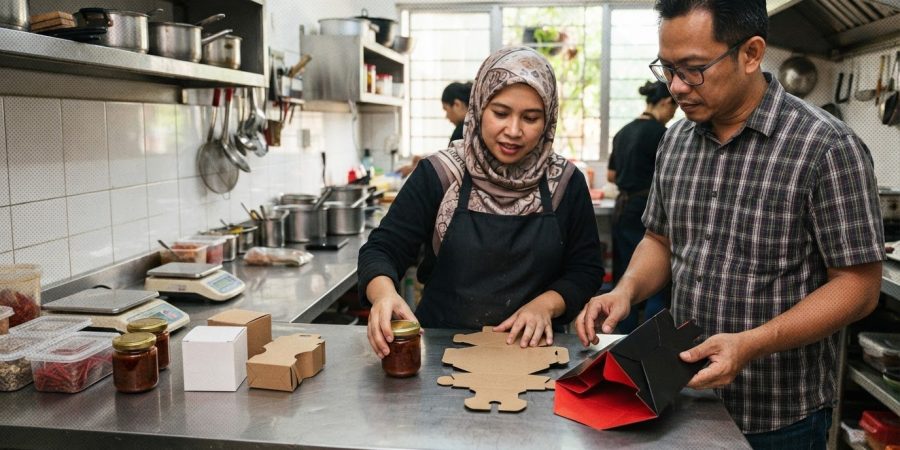
A recipe can be patented in Malaysia only if it qualifies as a new or novel invention that solves a specific problem; keeping it confidential does not make it patentable. A granted patent gives its owner the right to exploit the invention for twenty years in the country where the application was filed. For IP protection for F&B businesses in Malaysia, the right approach depends on what you’re protecting and how it creates value.
Consider more than the recipe itself. Your brand name, packaging, menu artwork, food photography and confidential business information may each need a different form of protection. This article explains how trademarks, industrial designs and copyright apply to F&B businesses, when NDAs and contracts can help safeguard confidential information, and what makes a recipe or food process a possible patent candidate.
Confidentiality also needs clear agreements and controlled access to sensitive information. Together, these protections can help you manage intellectual property as your business develops, collaborates with others or expands.
Key Takeaways
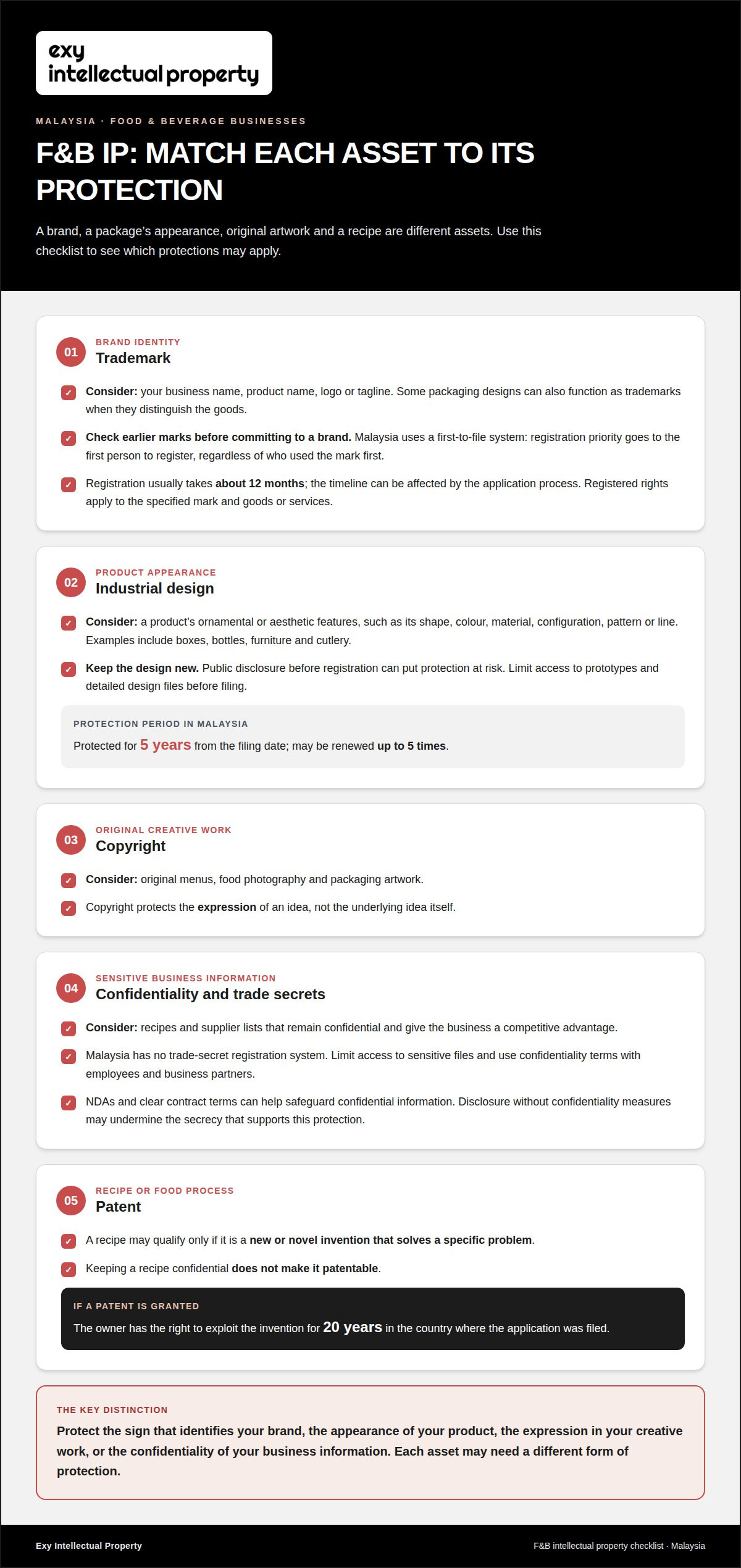
- Match each asset to the right protection: trademarks distinguish your brand, while industrial designs focus on a product’s appearance.
- Protect original menus, food photography and packaging artwork through copyright, while remembering that copyright protects expression rather than an underlying idea.
- A recipe may qualify for patent protection only if it meets the requirements for an invention; confidentiality may be a better fit for some recipes.
- Use NDAs, clear contract terms and controlled access to help keep recipes and other sensitive business information confidential.
- Plan intellectual property protection alongside expansion, collaborations and licensing so your rights support the way your business grows.
Trademark registration for business names and products
A trademark helps customers distinguish an F&B business, product or service from others. In Malaysia, registration can protect a brand asset, while confidential recipes and business information require separate safeguards.
Checking Existing Trademarks
An existing-trademark check compares a proposed brand name and related signs against earlier marks before an F&B business commits to them. An IP professional from Exy Intellectual Property can search official registry records, assess similar names and logos, and consider the goods or services associated with the proposed mark. This can identify potential conflicts and reduce the risk of investing in branding that may face an objection or dispute.
Malaysia uses a first-to-file system for trademarks: registration priority goes to the first person to register, regardless of who used the mark first. Registration usually takes about 12 months to complete. The timeline can be affected by the application process.
For food products linked to a Malaysian region, geographical indication protection has its own requirements. Geographical indication protection may involve requirements related to producers and the area where goods are produced. A registered geographical indication is protected for ten years from its filing date and may be renewed every ten years.
Brand and Packaging Trademark Protection
Trademark protection covers signs that identify commercial origin, such as an F&B business name, product name, logo or tagline. Certain packaging designs may also function as trademarks when they distinguish the goods. Registration can give the owner exclusive rights to the registered mark for the specified goods or services, supporting brand consistency as the business enters new countries or product lines.
Malaysia also protects unregistered well-known trademarks through the law of passing off, which addresses harm to business goodwill and reputation caused by dishonest competitors. This protection is distinct from registration and depends on the circumstances. For a new café or packaged-food brand, registration provides a clearer formal record than relying solely on recognition or market reputation.
Bad-faith filings are a risk when someone seeks to register a mark they know is associated with another business, or chooses a confusingly similar name to benefit from its reputation. A search before launch can identify earlier marks; careful selection helps avoid copying another brand’s name, logo or distinctive packaging. This matters especially when a business plans to expand, franchise or license its brand.
Recipes, supplier lists and pricing policies are different from trademarks. They may qualify as trade secrets if they remain confidential and give the business a competitive advantage. Malaysia has no trade-secret registration system, so F&B businesses should limit access to sensitive files and use confidentiality terms with employees and business partners. Disclosing a recipe without confidentiality measures may undermine the secrecy that supports this protection.
Industrial design protection for packaging and products
An industrial design protects a product’s ornamental or aesthetic appearance, including its shape, colour, material, configuration, pattern or line. For Malaysian F&B businesses, examples include commercially mass-produced boxes, bottles, furniture and cutlery.
Packaging Design Protection
Industrial design protection can cover a package’s visual features, rather than its brand name or recipe. A distinctive bottle shape or takeaway box configuration may help a product stand out on shelves and during delivery. Identifying the precise appearance to protect helps distinguish the design from the label or logo displayed on it.
In Malaysia, an industrial design is protected for five years from the filing date and may be renewed up to five times. This makes filing and renewal planning relevant for packaging that remains in commercial use. For example, consider the design’s expected product life when planning how to maintain its protection.
Novelty comes first. The design should be new and novel, so public disclosure before registration can put protection at risk. Avoid publishing product photographs, displaying prototypes at trade events or sharing detailed design files before filing. If employees or packaging partners need access, confidentiality terms and restricted file access can help prevent premature public disclosure.
A design application concerns the appearance presented for protection. For a new jar, identify the visual features that distinguish its shape, configuration or pattern, then prepare clear representations of those features. This matters because industrial design protection covers appearance, not a functional food formula or the name printed on the container.
Boxes, bottles and cutlery are practical examples of articles whose appearance may matter commercially. A food business developing a new takeaway container can consider whether its shape, pattern or configuration forms a distinctive design. Keeping development files and versions organised helps clarify which design the business intends to protect before launch.
Copyright and Industrial Design for Packaging
Copyright and industrial design protection address different aspects of packaging. Copyright may protect original label artwork, such as an illustration, while industrial design protection concerns a product’s ornamental appearance, such as a bottle shape or box configuration.
A package can therefore contain separate intellectual property assets. For example, a label illustration and the three-dimensional shape of its container raise different protection questions. Keeping artwork files, design drafts and creator records organised helps identify the elements involved and who created them.
For Malaysian F&B businesses, the choice depends on what makes the package distinctive: graphic expression, product appearance, or both. Copyright concerns original creative expression; industrial design protection concerns a product’s visual features. Treating each element separately helps align the protection sought with the asset the business plans to use.
An IP professional can assess a proposed design’s novelty and review its presentation before filing. This is especially useful while a bottle or box remains confidential and employees, designers or manufacturers contribute to its development. Early planning can reduce the risk of public disclosure before the business considers design protection.
Intellectual property strategy for business expansion
For an F&B business, intellectual property rights should support both current operations and planned growth. A useful strategy connects each asset to how the business will protect, use or commercialize it.
Intellectual Property Protection Types
Malaysia’s intellectual property system covers patents, trademarks, industrial designs, copyright, geographical indications and layout designs of integrated circuits. Each protects a different kind of asset, so a creative food business may need several forms of protection rather than one general filing.
For example, a restaurant ordering system may involve a patentable invention, while its name may be a trademark and its menu artwork may qualify for copyright. A recipe may be considered for patent protection if it meets the requirements for an invention; otherwise, confidentiality measures may be more relevant. Matching each asset to the right protection helps focus business decisions.
Intellectual Property and Business Value
Intellectual property can contribute to business value by securing rights tied to a product, process or brand. A protected noodle-making machine, distinctive restaurant brand or original food photograph can form part of the assets a business owns and uses commercially.
That value depends on how the rights support revenue, growth or collaboration. For example, records showing who owns a recipe process or packaging artwork can clarify which assets are included in a proposed investment or business transfer. An intellectual property valuation can help assess the commercial value of those rights for a transaction or financing discussion.
Commercialization and Enforcement of Intellectual Property
Commercialization brings intellectual property to market through uses such as licensing, assignment or sale. A Malaysian F&B business might license its trademark for an outlet or license a process to a production partner. Clear agreements should identify the rights involved, permitted uses, territory and payment arrangements.
Intellectual property can also be transferred, sold, licensed or used as security, such as through a charge. MyIPO has developed a pilot IP Rights Marketplace to improve access and visibility for owners seeking to license or sell rights. To enforce a right, businesses need clear ownership records and evidence showing how the disputed use relates to their protected asset.
Malaysia’s Intellectual Property System and MyIPO
The Intellectual Property Corporation of Malaysia, known as MyIPO, administers Malaysia’s intellectual property system. The Trademarks Act 2019 and Patents Act 1983 are among the laws that provide safeguards for intellectual property. Understanding which right applies helps a business plan protection before launching in a new market.
For overseas expansion, Malaysia participates in international filing systems, including the Madrid Protocol for trademarks and the Patent Cooperation Treaty for patents. These systems can support applications across countries, but protection remains tied to the rights and territories pursued. Planning an expansion means aligning filing choices, ownership documents and disclosure agreements with the business’s markets and partners.
Copyright in menus, recipes, apps and food photography
Copyright protects original creative expression, not every idea or business method. In Malaysia, F&B businesses may protect original menu designs, recipe books, food photographs and packaging artwork. A restaurant’s designed menu, for example, can contain protected visual and written expression, while the general idea of listing dishes remains available to others.
Protection applies without copyright registration, although owners may file a Copyright Voluntary Notification at MyIPO. This can create an official record of the claimed work. Official certification of registered copyright may serve as prima facie evidence of the particulars of the copyright and is admissible in all courts. Such a record can help clarify ownership if a dispute arises over a photograph or menu design.
For digital F&B businesses, original app screens, illustrations and written content may qualify as creative works. A food photograph commissioned for a delivery app, for instance, should have clear authorship and ownership records. Keep original files, drafts and agreements with photographers or designers so the business can identify who created each work and what rights were agreed.
Using another company’s brand, packaging, images or recipes can create different risks. A similar brand may cause a likelihood of confusion, while copying original photographs or artwork may raise copyright concerns. A recipe’s underlying information is not protected by copyright simply because it appears in a competitor’s book, but copying the book’s wording or photographs may cross that line.
Copyright has limits when it comes to operational manuals. It can prevent reproduction of a manual’s text or illustrations, but it does not stop competitors from using the information or explaining it in their own words. For example, a restaurant may protect the original diagrams and written instructions in its staff manual, while the general technique described remains usable.
Recipe materials need careful separation. A recipe book’s original descriptions, photographs and page layout may be protected expression, but the recipe itself may need confidentiality measures if its value depends on secrecy. Sharing a confidential formula with a photographer, app developer or production partner without suitable terms can weaken practical control over that information.
For a food business, identify the work, its creator and the rights needed for commercial use. A Copyright Voluntary Notification at MyIPO may support a record of ownership, while contracts clarify permissions for commissioned work. These distinctions help protect creative assets and attract customers without treating ideas or procedures as copyrighted expression.
NDAs and contractual protection in Malaysia
A recipe may be a business asset because its confidentiality gives an F&B company a competitive advantage. In Malaysia, trade secrets have no registration system, so owners rely on practical secrecy measures and agreements. A non-disclosure agreement (NDA) can set out how a beverage formula or supplier list may be handled when shared with another party.
The agreement should clearly identify the confidential information. For example, a sauce formula, production method, customer list or pricing policy can be described as confidential material. It should also state the permitted purpose for disclosure, such as testing a product with a manufacturer. Clear terms help both parties understand what information is covered and how it may be used.
Access controls matter too. Marking a file “confidential” is not enough if too many people can open it. A restaurant can limit a recipe document to employees who need it, store it in a restricted location and record which external parties receive copies. Combining those controls with an NDA supports a consistent approach to intellectual property protection.
Employment and collaboration contracts can address confidentiality alongside ownership. For example, a contract with a chef, photographer or product developer can specify how recipe notes, menu artwork or testing records are treated. Assignment terms can clarify who owns work created during a collaboration. Define the relevant materials and agreed rights before work begins, rather than relying on assumptions after a disagreement.
Disclosures to third parties need particular care. A beverage company sharing a formula with a bottling partner can use an NDA that limits use to the agreed production purpose. A supplier agreement can also identify confidential specifications and restrict access to staff involved in the work. Separate agreements may be needed for different recipients because each party’s role and access can vary.
Non-compete terms may be considered alongside confidentiality agreements, but they are not a substitute for protecting specific secrets. A broad restriction does not identify which formula, process or customer information must remain confidential. For an F&B business, targeted confidentiality clauses and controlled access provide a clearer framework for protecting information during employment, investment discussions or supplier negotiations.
Disclosure can undermine secrecy. A recipe shared without confidentiality terms may no longer qualify as a trade secret, and a competitor may reproduce it through tasting and experimentation. Before sharing a formula with an investor or manufacturer, identify the information, limit access and put suitable written terms in place. These measures support protection, but do not make every disclosed idea exclusive.
For a dispute involving confidential business information or other intellectual property rights, specialist advice can help assess the available response. Discuss an intellectual property dispute when a partner, employee or competitor may have used protected information without permission.
Exy Intellectual Property
Exy Intellectual Property helps Malaysian F&B businesses assess which intellectual property protections suit their brands, products and creative work. Turn to the firm when preparing a brand launch, developing a new product or formalising ownership of original materials.
Its services include Trademark Registration, Patent Filing, Industrial Design Registration and Copyright Voluntary Notification. These can support different needs, from protecting a business name to recording copyright details or seeking protection for a product’s appearance. The right route depends on the asset and how the business plans to use it.
For a confidential recipe or a design being shared with business partners, consider disclosure timing alongside any relevant filings. Exy Intellectual Property can advise on suitable protection and the next steps for your business. Contact Exy Intellectual Property to discuss your F&B intellectual property needs.
Set your protection priorities before the next move
Growth can change which business assets matter most. A new product launch, supply partnership or move into another market may affect how you manage ownership, disclosure and commercial use. Set priorities around the decisions ahead, not just assets already in use. This gives your team a clearer basis for planning and keeps intellectual property considerations connected to business goals.
A considered approach to IP protection for F&B businesses in Malaysia starts with the specific assets your business plans to develop, share or commercialize. The next step may be assessing ownership, preparing an application or agreeing terms before sharing information with a business partner. The details depend on your plans and the intellectual property involved.
Exy Intellectual Property can help you consider suitable protection for your business. Contact Exy Intellectual Property to discuss your next step and move forward with greater clarity.
Frequently Asked Questions
Can You Patent Your Recipes?
Potentially, if the subject matter claimed meets Malaysia’s patent requirements; commercial popularity alone is not enough. An assessment can focus on the technical feature that distinguishes the recipe or preparation method from existing public information. Before discussing a formula beyond those who need to assess it, organise its development history, test records and any earlier disclosures. These details help an IP professional assess what an application could protect.
What types of intellectual property can F&B businesses protect in Malaysia?
Available categories include patents, trademarks, industrial designs, copyright, geographical indications and layout designs of integrated circuits. For IP protection for F&B businesses in Malaysia, the useful question is which business activity each right should support. A business preparing for investment, a product launch or market expansion can map its assets against those goals, then prioritise protection and ownership records.
How can an IP professional register a trademark for a food or beverage brand in Malaysia?
An IP professional can define the mark’s intended commercial scope before preparing the filing. For example, a business operating a café and selling packaged sauces may need an application strategy that accounts for both service and product activities. The professional can also review which versions of the name or logo the business actually uses, keeping the filing aligned with its brand rollout rather than an unused concept.
How can Malaysian F&B businesses protect recipes, formulations, and trade secrets?
Organise sensitive information so access matches each person’s role. A production manager may need a complete formula, while a delivery partner may need only handling instructions. Separate those materials, record who receives each version, and remove access when someone’s role changes. For IP protection for F&B businesses in Malaysia, this information management helps owners understand where sensitive material has gone.
Can food packaging, logos, menus, and product designs be protected by copyright or industrial design rights in Malaysia?
Yes, a single product launch can involve several separately created assets. For example, a commissioned package may include a designer’s label illustration, a container developed by a manufacturer and photographs produced for online listings. Keep the source files and creation records for each element. This makes it easier to identify what the business created, what a contractor supplied and which permissions apply to commercial use.
How do patents apply to food products, recipes, and processing methods in Malaysia?
Patent applications can concern inventions in product or process form. A food company considering a new production method can assemble process diagrams, prototype details and test results for technical assessment. An IP professional can use those materials to identify the feature an application should focus on and conduct a patent novelty search. Keeping development records together also helps explain how the proposed invention differs from existing operations.
What steps can an IP professional take to enforce IP rights against counterfeit food products or brand infringement in Malaysia?
An IP professional can organise evidence showing what appeared, where it was offered and how it relates to the business’s rights. Useful records can include dated photographs of product labels, purchase documents, packaging samples and saved online listings. A consistent evidence file helps distinguish suspected counterfeit products from legitimate stock and supports an informed assessment of possible responses, including specialist intellectual property litigation where appropriate.
What IP clauses should Malaysian F&B businesses include in franchise, licensing, supplier, and employee agreements?
Consider terms that define permitted channels, product territories, quality review, sublicensing and use of updated brand materials. A franchise agreement, for example, can explain how an outlet receives current menu artwork and how approval applies to local promotional materials. Supplier terms can address access to production specifications, while employee documents can set out the return or deletion of business files when duties change or employment ends.