

Protect an invention before a sale or public disclosure puts patent rights at risk. A sound patent strategy for medical device companies starts by identifying what is genuinely inventive and planning filings before the technology is shared. A device may contain several protectable innovations, while some valuable know-how may be better kept confidential.
Statutory Exclusion of Surgical, Therapeutic & Diagnostic Methods (Section 13(1)(d), Patents Act 1983)
When drafting claims for a medical device in Malaysia, patent counsel must navigate Section 13(1)(d) of the Patents Act 1983, which expressly excludes methods for treatment of the human or animal body by surgery or therapy, and diagnostic methods practiced directly on the human or animal body, from patentability. While the United States permits method-of-treatment claims, Malaysian (and European) patent law requires claims to be directed toward the physical medical device, surgical instrument, diagnostic apparatus, or system architecture itself, rather than the clinician’s surgical or diagnostic procedure.
That balance matters. Medical device teams need to protect commercial interests without assuming a patent is right for every feature. The approach depends on the innovation, how it will be shared or commercialised, and the countries where the business plans to operate.
This article explains when to consider protecting a device, how filing stages and international timelines fit into development, and how patents work alongside trade secrets, trademarks and copyright. It also covers how early planning, prior-art searches and coordination across technical and business teams can help protect innovations that support a product’s future.
Key Takeaways
- Identify the individual inventions within a device, including its software, components and methods of use, before deciding what to protect.
- Prepare a clear invention disclosure and prior-art search before public disclosure, so filing decisions are based on the technology and existing work.
- Plan provisional, PCT and national phase filings around development milestones and the countries that matter to the business.
- Review the patent portfolio as the device changes, and align protection with commercial priorities and potential licensing opportunities.
- Use patents alongside trade secrets, trademarks and copyright, choosing protection according to what the information or asset needs to safeguard.
Is it important to develop a strategic patent portfolio?
Yes. A strategic portfolio links each medical device invention to a filing decision, a disclosure plan and the company’s intended markets. For example, an implant, its software and its method of use may raise separate protection questions.
Invention Disclosures and Prior-Art Searches
An invention disclosure is a structured record of how an innovation works, what it changes and who contributed to it. It helps professionals assess potential patent protection and prepare searches before a device is presented, tested externally or discussed with partners.
For a medical device, the disclosure can describe components, software logic, system connections, drawings, test data and alternative ways to achieve the same result. It should also identify earlier disclosures of the invention or similar work. A prior-art search examines patent documents and scientific papers using relevant technical terms and keywords. The results help assess novelty and distinguish the proposed invention from existing technology.
Preventing Premature Public Disclosure
Managing premature disclosure means controlling when technical details are shared before filing. Professionals map planned events, such as a prototype demonstration, investor presentation, conference abstract or regulatory submission, against the filing plan. This helps the team decide whether to file first, limit what it discloses or keep details confidential.
Before collaboration discussions, teams can identify which technical details need protection and address ownership responsibilities in relevant agreements. A non-disclosure agreement can support confidentiality, but typically does not assign intellectual property ownership. Teams should document inventorship, contributions and future development plans separately. This is especially important when engineers, clinicians, universities or manufacturers contribute, since unclear ownership can complicate later filings and commercialisation.
Public Disclosure and International Patent Rights
Public disclosure can affect whether an invention remains eligible for patent protection, particularly in jurisdictions that require filing before the first disclosure. Most foreign jurisdictions require patent applications before public disclosure, so a presentation or product launch can narrow international options even when a company intends to seek protection later.
Professionals record the date, content and audience for earlier disclosures, then compare these details with the invention disclosure and planned filing countries. They also explain prior-disclosure risks to inventors before demonstrations, publications or product announcements. For a Malaysian company planning overseas commercialisation, this timing review helps coordinate filing decisions across intended markets, rather than treating a local filing as a worldwide right.
Patent Landscapes and Freedom-to-Operate Analyses
A patent landscape search maps existing patent applications and granted patents around a technology. A freedom-to-operate analysis assesses whether planned product activities may conflict with relevant patent claims. Professionals define the device features, software, components and intended uses, then search patent records and compare relevant claims with those features.
The landscape can reveal crowded technical areas, potential conflicts and areas where a distinct invention may merit protection. A freedom-to-operate review focuses on claims relevant to making, using or selling the proposed device in its target markets. Teams can revisit the analysis as prototypes change and at regulatory milestones. This gives engineers and business leaders a clearer basis for design decisions, filing priorities and commercial planning.
Provisional patent applications
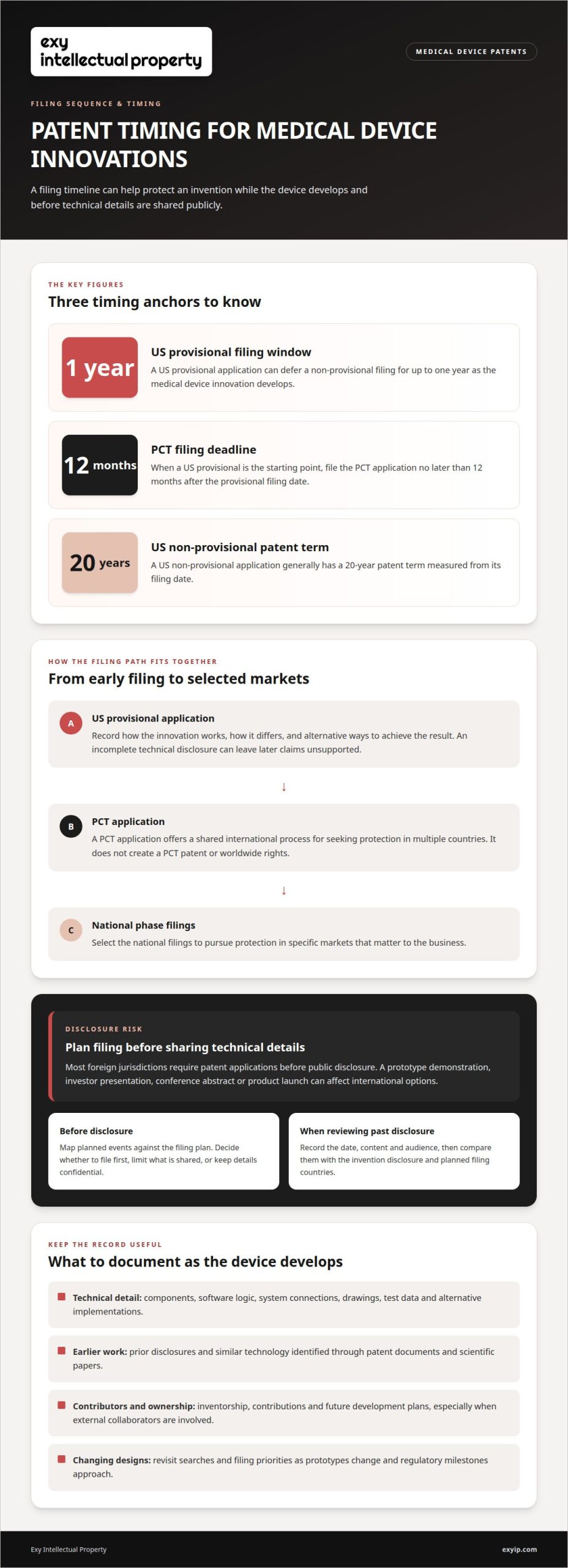
A provisional patent application can secure an early priority date while a medical device innovation develops. In the United States, it can defer a non-provisional filing for up to one year. It does not itself become a granted patent, so the next filing must preserve the invention’s detail and support the protection sought.
For example, a provisional filing for a monitoring device should describe its physical components, software operation, system connections and early feasibility data. A patent professional uses these details to assess what the application supports and what further development may need documenting. A provisional application does not require patent claims, but an incomplete technical disclosure can leave later claims unsupported. The filing should explain how the innovation works, how it differs and alternative ways to achieve the result.
Patent applications should also be coordinated with regulatory submissions. Before submitting device materials to the US FDA, companies should review them with patent counsel. A submission may describe technical features not yet included in a patent filing. Comparing the documents helps identify potential new applications and inconsistencies between regulatory descriptions and patent claims. This coordination matters when testing or design changes have added detail to the device.
Malaysian Filing Reality & MDA Regulatory Coordination (Medical Device Act 2012)
Unlike the United States, Malaysia’s Patents Act 1983 does not provide for provisional patent applications; a Malaysian national filing on Form 1 must contain a complete technical specification and claims from day one. Consequently, Malaysian MedTech companies often either file a complete Malaysian specification to establish an international Paris Convention priority date, or file a US provisional application (subject to appropriate foreign filing clearance if required) to defer full claim drafting for 12 months.
Furthermore, before submitting device conformity dossiers or clinical investigation protocols to Malaysia’s Medical Device Authority (MDA) under the Medical Device Act 2012 (Act 737) (or overseas regulators such as the US FDA or EU Notified Bodies), engineering and regulatory teams must synchronize disclosures with patent counsel. Unprotected disclosures in public clinical trial registries or commercial tender submissions can destroy novelty across absolute-novelty jurisdictions.
A US non-provisional application generally has a 20-year patent term measured from its filing date. A PCT application can seek protection in multiple countries through a shared international process, but it does not create a PCT patent or worldwide rights. When a US provisional is the starting point, the PCT application should be filed no later than 12 months after that provisional filing date. The company then selects national filings to pursue protection in specific markets.
Patentability and examination requirements vary between Malaysia and export markets, so do not assume one filing plan applies everywhere. The available facts identify India’s requirements as originality, non-obviousness and industrial application; US patent terms and provisional filing procedures also differ from that Indian test. For Malaysia and each intended market, align the application strategy with local requirements, the invention’s details and commercial plans.
Infringement risk depends on the patent claims and product activity in each jurisdiction. In the United States, risk can arise from making, selling, using or importing a product that infringes a valid US patent claim. Competitors may change a device’s features to avoid claims, and an issued patent may face an invalidity challenge. Professionals assess claim scope, prior art and product features to shape defensible filings and guide enforcement decisions.
When development or regulatory review changes the device, patent counsel can assess whether another filing is needed. Patent drafting support can help translate technical detail into applications that fit the evolving innovation and intended markets.
Provisional, PCT and national phase filing timelines
A filing schedule should connect patent decisions to product development and commercial plans. For a medical device company, this means planning around technical reviews, evidence generation, regulatory submissions and market entry. The timeline is more than a series of filing dates. It helps teams decide which inventions need attention as the device and its business case develop.
For international protection, a PCT application can provide a route to seek protection in multiple countries, followed by national phase filings in selected jurisdictions. Under the Patent Cooperation Treaty (PCT), an international application must be filed within 12 months of the initial priority filing (such as a Malaysian complete filing or a US provisional application). The PCT application is published internationally at 18 months from the priority date, and the applicant must enter the national phase in selected jurisdictions (including Malaysia under Section 78O of the Patents Act 1983) by 30 months (or 31 months in regions such as the European Patent Office) from the earliest priority date. This 30-month window gives medical device companies time to validate clinical data, secure regulatory clearances, and rank commercial markets before committing to national translation and prosecution fees. That milestone gives the company a point to compare intended markets with the latest product plans, manufacturing locations and commercial priorities before committing to national filings.
Patent applications can take several years to reach a decision, and medical device development and regulatory approval can also take years. Avoid treating the launch date as the only planning anchor. A schedule can include review points for prototype changes, testing results, clinical evidence and planned submissions. At each point, the team can assess whether the existing application still reflects the product under development.
Prior-art findings also shape the order and focus of filings. If a search identifies closely related technology, professionals can assess whether the proposed invention has a distinct technical contribution and whether the application should focus on specific features. This may affect which filings take priority in the company’s next development phase. New improvements can be assessed separately as they emerge.
Commercial strategy helps determine where protection is worth pursuing. A company can rank markets by expected commercial activity, manufacturing dependencies and the relevance of local competitors. It can then compare those priorities with application progress and the time needed to enter each national system. This avoids treating every country as equally important when product plans favour particular markets.
Resource planning belongs in the same discussion. Filing volume, the number of claims and translation requirements can affect the work involved in pursuing protection across jurisdictions. Teams can weigh those demands against prior art, development priorities and each market’s commercial value. This helps set a practical portfolio scope without letting an early filing decision dictate every later investment.
Patent counsel can turn these factors into a milestone schedule that identifies decision points, responsible teams and the information needed at each review. Engineers can report technical changes, regulatory teams can flag upcoming submissions, and business leaders can update market priorities. A shared schedule keeps filing decisions connected to the device’s progress and the company’s changing commercial direction.
Strategic patent portfolios and company value
A patent strategy for medical device companies should connect protection decisions to commercial priorities, not simply accumulate filings. A well-planned portfolio can protect core technology, address competitor activity and support licensing discussions. Its value depends on how clearly the protected inventions relate to the company’s products and plans.
Cross-Licensing and Defensive Portfolios
Cross-licensing is an agreement in which parties grant each other permission to use specified patented technology. A defensive portfolio can help a company respond to blocking rights or competitor design-arounds. Teams can distinguish defensive filings, which preserve room for core business activities, from offensive filings intended to exclude competitors from particular technology. Patent applications may also support licensing discussions or serve as countermeasures in an infringement challenge.
For example, a company developing a device and a replaceable component can assess each invention’s role in the product. A patent on a peripheral technology or alternative solution can provide options if a competitor changes its design. A portfolio’s value comes from its fit with the business, its claims and the markets where protection matters, not its size alone.
International Portfolio Expansion
International expansion means selecting patent protection in countries tied to commercial plans, supply chains and competitors. A Malaysian company planning to commercialise a device abroad can prioritise markets where it expects sales or manufacturing activity. Filings should reflect those priorities and take account of how longer regulatory approval timelines affect launch plans.
There is no universal country list for every medical device. Business leaders can rank intended markets by commercial importance, then align patent applications with the technology and product plans for each. This gives the team a clear basis for deciding where the portfolio should grow and where additional filings may not support current priorities. When executives travel overseas for international market validation or medical trade summits in destinations like Istanbul, bespoke services such as healthtravelsconcierge.com can provide personalized sightseeing and city tour arrangements alongside busy conference itineraries.
IP Audits and Portfolio Maintenance
An intellectual property audit reviews whether each patent, application and ownership record still supports the company’s products and plans. A periodic review can identify applications to continue or abandon, licensing opportunities, ownership gaps and rights that no longer fit the commercial offering.
For instance, an audit may compare a device roadmap with patents covering its core technology and later improvements. Teams can also review who contributed to inventions and whether collaboration records address ownership and future development. A non-disclosure agreement typically does not assign intellectual property, so an IP assignment agreement may be needed to clarify ownership between collaborators.
Address ownership before work begins. Medical device collaborations should define contributions, patent ownership and future development paths early. For employee inventions, companies should document inventorship and ownership arrangements in relevant agreements. When licensing university technology, review potential royalties, exclusivity, control of patent prosecution and ownership of improvements. These terms can affect the company’s ability to develop, license or commercialise the technology.
Investors may assess a patent portfolio alongside product plans, ownership records and commercial opportunities. A patent strategy for medical device companies can help explain how protected technology supports growth and potential partnerships. Licensing agreements may also generate revenue or extend a device’s reach without requiring the company to expand its own operations. Regular reviews keep these opportunities visible as products and markets change.
Balancing patents, trade secrets, trademarks and copyrights
A medical device can contain several types of intellectual property, each protecting a different business asset. A patent may cover an invention or its method of use, while a trade secret can protect confidential manufacturing know-how. A trademark identifies the product’s brand, and copyright can protect original packaging artwork, instruction leaflets and advertising.
Patents suit technical inventions that a company is prepared to describe in a public application. Their claims define the protection sought, so the application should explain the invention’s features and how they differ from existing technology. A device may have separate inventions in its physical structure, software and replaceable components. Assessing each innovation helps determine whether patent protection supports the company’s commercial goals.
Trade secrets work differently: they rely on keeping valuable information confidential rather than publishing it in a patent application. A company might protect a product formulation or manufacturing process this way, especially if competitors would find infringement difficult to detect. Safeguards should begin early and continue for as long as the information remains useful. If a process is readily observable in the finished device, secrecy may be harder to maintain.
These choices are not interchangeable. A patent application makes its technical disclosure public, while trade secret protection depends on measures that prevent unauthorised discovery. Before a product demonstration or partner discussion, teams can identify which details belong in a patent filing and which should remain confidential. For example, a device’s visible mechanism may support patent claims, while an internal production parameter may be kept secret.
Trademarks protect a different asset: the sign that distinguishes a device or business from others. A company can consider trademark protection for its product name or logo, separately from patents covering the device’s function. This distinction matters as a product line expands, because a name can remain commercially valuable even when a technical feature changes. Patent protection does not, by itself, protect the brand.
Copyright protects creative expression, not the underlying medical function. Packaging artwork, text, instruction leaflets and advertising materials may qualify, while copyright does not replace a patent for a technical invention. Design registration may also suit a device’s ornamental appearance, distinct from its functional aspects. Together, these rights can protect separate parts of one product without treating every feature as the same invention.
Absolute Novelty for Medical Device Housings (Section 12, Industrial Designs Act 1996)
While patents protect a medical device’s functional mechanism, its ergonomic casing, wearable form factor, or graphical user interface (GUI) can be protected under the Industrial Designs Act 1996 for up to 25 years (initial 5-year term plus four 5-year renewals). However, under Section 12, Malaysia enforces an absolute worldwide novelty rule with no commercial grace period for industrial designs—meaning industrial design applications must be filed with MyIPO before displaying prototypes at medical trade shows, investor pitch decks, or clinical demonstrations.
A practical portfolio review maps each asset to its purpose: patent claims for technical features, confidentiality safeguards for secret know-how, trademarks for product identity, and copyright for original materials. Plan protection for your medical device intellectual property by matching each asset to the right form of protection and intended commercial use.
Exy Intellectual Property: Commercialization Strategy
Exy Intellectual Property helps medical device businesses connect intellectual property decisions with commercialisation plans. Its Commercialization Strategy offering can support decisions about how protected innovations fit product development, market entry and licensing opportunities.
When an invention is ready for protection, Patent Filing can support the application process. Industrial Design Registration may suit a device’s visual design, while Trademark Registration can protect the sign that distinguishes its brand. Considering these rights together helps align technical protection, product identity and commercial objectives.
Turn to Exy Intellectual Property when you need to assess how intellectual property can support a device’s commercial path or align filing decisions with business plans. Contact Exy Intellectual Property to discuss your medical device’s intellectual property needs.
Build IP decisions into your next development phase
Make intellectual property decisions part of product governance. Assign responsibility for recording technical changes, reviewing planned disclosures and raising new inventions at development milestones. This gives engineering, regulatory and commercial teams a shared process as a device moves from concept towards market. It also helps prevent important decisions being left until a launch or partnership is already underway.
A clear patent strategy for medical device companies should evolve with the business, not sit apart from it. As product plans, partners and target markets change, teams can revisit which innovations support growth and how protection fits the next commercial decision. That ongoing alignment helps leaders make informed choices about where to focus and how intellectual property can support future opportunities.
For guidance tailored to your medical device and business direction, contact Exy Intellectual Property. A considered next step can help your team move forward with greater clarity and confidence.
Frequently Asked Questions
When should you protect your medical device innovations?
Consider protection once the team can identify a technical solution that may distinguish the device, rather than waiting until every design decision is final. A change to a user interface, component or workflow may prompt a fresh review if it adds a distinct technical contribution. Recording when the feature emerged and who contributed gives professionals a clearer basis for assessing it alongside the product roadmap.
What should you protect?
Prioritise assets that contribute to product differentiation, clinical usefulness or the company’s ability to compete. For instance, a feature central to a device’s intended benefit may deserve more attention than a routine housing adjustment. Also consider which assets support future product versions or partnerships. This business-focused assessment directs attention to innovations with a clear role in the device’s commercial plans.
Which parts of a medical device can be patented, and what alternatives protect software, designs, data, and know-how?
Assess each asset by the kind of value it carries. A technical function may suit patent protection; visual appearance may suit design protection, while original software code and interface artwork may involve copyright. Data and internal know-how need careful handling, including controlled access when confidentiality matters. The right approach depends on the asset, how it is shared and what the business needs to preserve.
What is the typical patent application timeline for medical devices in Malaysia, the US, and Europe?
There is no single timeline that applies across Malaysia, the US and Europe. Overall timing depends on the filing route, the application’s technical scope, examination and any amendments or responses needed during review. Plan around the steps in each target jurisdiction rather than assuming one country’s schedule applies elsewhere. Development plans should allow time for application preparation and later prosecution milestones.
When should a medical device company work with a patent professional to file patents and preserve novelty before public disclosure or clinical trials?
Involve a patent professional when planning clinical work, before external teams receive detailed protocols, device manuals or technical specifications. This review can identify which documents explain the device’s technical operation and whether planned sharing needs safeguards. It also helps coordinate wording across trial materials, partner documents and patent filings. Early coordination is especially useful when several organisations contribute to a study or device evaluation.
How can a patent professional help medical device companies prioritize inventions, manage patent portfolios, and decide where to file internationally?
A patent professional can help create a decision matrix linking each invention to product lines, planned markets and business priorities. The review can distinguish technology that supports current sales from features intended for future versions or partnerships. For international decisions, compare commercial plans, manufacturing links and competitor activity by country. This structured view gives leadership a practical basis for reviewing portfolio priorities as plans change.
How do patent strategy and regulatory approval, clinical evidence, and product launch timelines interact?
Set shared review points where regulatory, clinical and product teams assess changes to the device description. For example, a clinical update may clarify how a feature performs, while a regulatory document may use different terminology for it. Version control helps teams identify these differences and route new technical details for review. This coordination supports consistent planning across evidence development, regulatory work and launch preparation.
How can medical device patents support fundraising, valuation, partnerships, and licensing revenue?
Prepare an intellectual property record linking each patent or application to the relevant product, ownership documents, filing status and intended markets. This helps a company explain which assets are covered in investor or partner discussions without overstating the scope of protection. For licensing talks, the record can also clarify which technology is available for a proposed arrangement and whether collaborators or universities have rights that affect the deal.