

Registration is not the whole strategy for protecting fashion designs from being copied. In Malaysia, industrial design registration may protect a product’s external appearance, copyright may protect fabric prints, and trademark protection may distinguish a fashion brand. The right route depends on what has been copied.
It is also sensible to plan protection before sharing sketches or concepts with manufacturers and other partners. A confidentiality agreement can set expectations for how shared material may be used, helping reduce the risk of disputes as a design moves from idea to production.
This guide explains the main forms of protection available in Malaysia, when confidentiality and intellectual property agreements matter, and how counterfeits differ from lookalike dupes. It also covers the duration of design protection and possible remedies when someone uses protected work without permission. Understanding the options helps you make informed decisions about protecting each design, your brand, and the value behind every collection.
Key Takeaways
- Identify which parts of a fashion design need protection, such as a product’s appearance, a fabric print or a brand identifier.
- Use confidentiality and intellectual property agreements when sharing sketches or design plans during development.
- Assess whether a lookalike is a counterfeit or a dupe by considering branding, consumer confusion and any exclusive rights involved.
- Understand how registration terms and the type of right affect protection duration and the remedies that may be available.
- Professional industrial design registration can help protect eligible visual features as part of a broader fashion IP strategy.
How Can a Professional Help Protect My Design?
A professional can assess which parts of a fashion design may qualify for protection in Malaysia. They can organize application materials and creation records to define the design and document how it developed.
Visual Features Covered by Registration
Industrial design registration may protect a product’s visual appearance, including its shape, configuration, pattern, and decorative elements. It is relevant when a garment or accessory has distinctive visible features that a business wants to protect.
For example, an application may focus on the appearance of a particular bag, not the general idea of a bag. A professional can review the images and identify the features that define the design. Design registration does not protect a product’s feel or the materials used, so distinguish these from its visual features.
Professional Registration of Fashion Designs in Malaysia
Industrial design registration seeks protection for a product’s visual features in the jurisdiction where the application is made. A Malaysian application should clearly show the appearance claimed and identify the item. The images, description, creator information, and applicant details help define the design and identify who seeks protection.
A professional can organize these materials and assess how the design should be represented. Dated sketches, development files, and sample records can also document how an original design took shape. Comparing early sketches with the final sample, for instance, may show how its visible features developed. Registration in Malaysia covers Malaysia, not other countries automatically.
Registration Duration and Renewal
The registration period is how long protection remains in force under the applicable rules. Knowing when protection begins and whether renewal action is required helps a business manage its designs.
For a Malaysian design, a professional can review the registration record and applicable term, then track relevant dates and renewal requirements. The duration depends on the governing registration rules, so do not apply another country’s term to a Malaysian registration. Keeping filing and renewal records together helps the business manage its design portfolio.
Statutory Term & Absolute Novelty Rules (Industrial Designs Act 1996)
Under Section 25 of the Industrial Designs Act 1996, a registered Malaysian industrial design is protected for an initial period of 5 years from the filing date, and may be renewed for four further consecutive five-year terms—providing a maximum statutory protection period of 25 years.
Crucially, under Section 12, Malaysia enforces a strict worldwide novelty standard with no commercial grace period for fashion launches. Publishing collection lookbooks, posting social media teasers, or showcasing runway samples before submitting the MyIPO design application destroys novelty and invalidates future registration. Applications must be filed while designs remain strictly confidential.
Comparing Fashion Intellectual Property Protections
Copyright, industrial design registration, and trademark protection cover different subject matter. In Malaysia, copyright can protect fabric prints because prints are not considered products themselves. Industrial design registration concerns a product’s visual features, while a trademark distinguishes a business or its products from others.
For standard jeans or T-shirts, a brand name or logo may be the relevant focus. A professional can assess whether the concern involves a print, a product’s appearance, or a brand identifier. This distinction clarifies what an application seeks to protect and what evidence supports the design’s development.
The Mass-Production Trap: Copyright vs. Industrial Design Overlap (Sections 7(5) & 13B, Copyright Act 1987)
While original 2D fabric prints, textile patterns, and graphic illustrations qualify for automatic copyright protection upon creation under the Copyright Act 1987, Malaysian fashion businesses must navigate a critical statutory boundary once a collection scales:
- Registered Designs Exclusion (Section 7(5)): Any design registered under the Industrial Designs Act 1996 is excluded from copyright protection for its industrial application.
- The 50-Article Industrial Application Limit (Section 13B): Where an artistic work is eligible for industrial design registration but is reproduced industrially (more than 50 articles) without being registered as an industrial design, copyright enforcement against third-party 3D or industrial reproductions is severely curtailed.
Consequently, fashion labels producing commercial runs exceeding 50 units should file formal Industrial Design Registrations with MyIPO for distinctive surface patterns and garment configurations rather than relying solely on unregistered copyright.
Confidentiality and intellectual property agreements
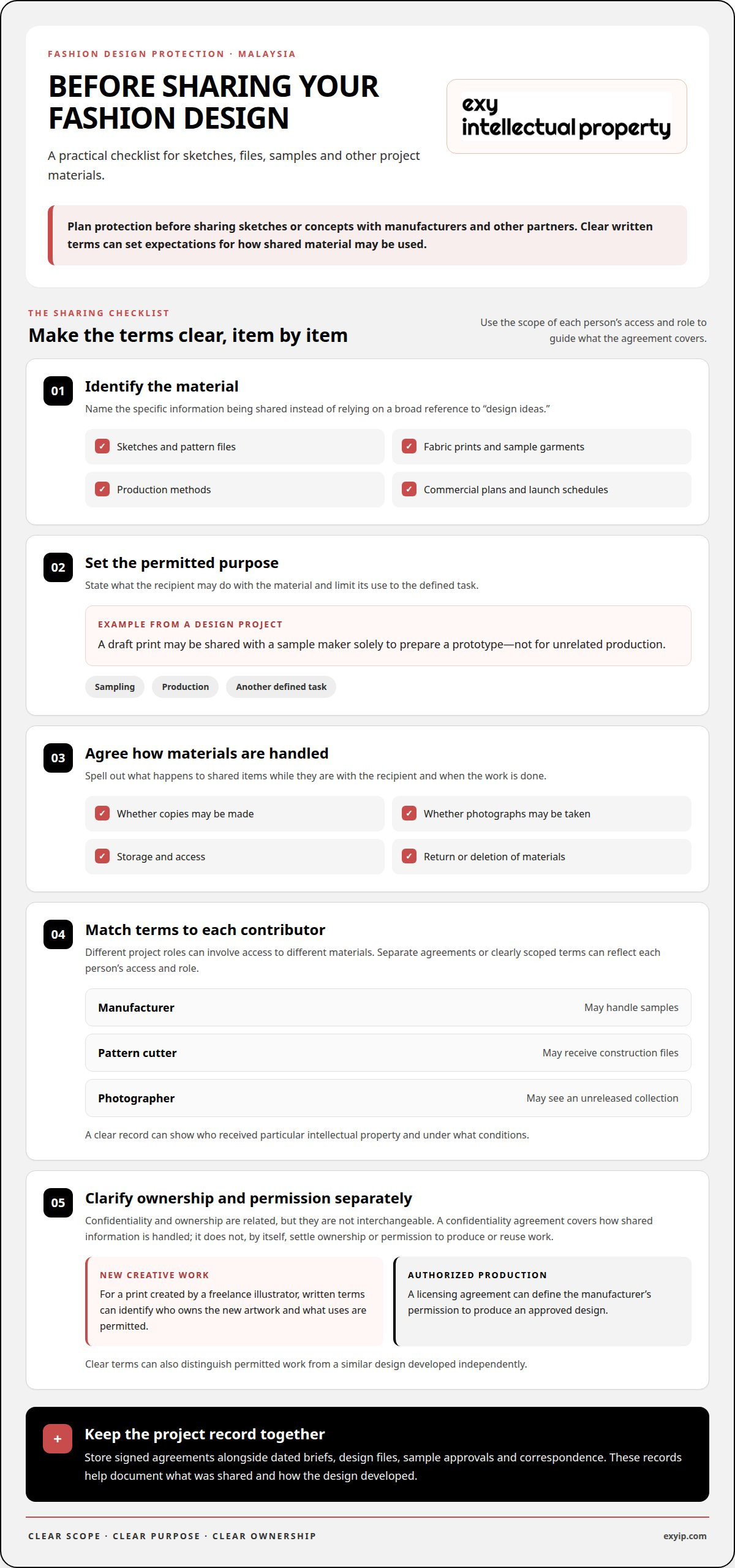
Before sharing fashion sketches or business plans with a manufacturer, use a confidentiality agreement to set clear expectations. It can identify the confidential information, who may access it, and the purpose for which it may be used. For example, a designer could share a draft print with a sample maker solely to prepare a prototype, rather than for unrelated production.
Specific descriptions matter. An agreement can identify sketches, pattern files, fabric prints, sample garments, production methods, and launch schedules as confidential material. It can also address whether the recipient may copy, photograph, disclose, or retain those materials. Naming the information helps both sides understand what the agreement covers, rather than relying on a broad reference to “design ideas.”
Fashion projects often involve several contributors. A manufacturer may handle samples, an on-the-ground sourcing partner may coordinate factory relations, a pattern cutter may receive construction files, and a photographer may see an unreleased collection. Separate agreements or clearly scoped terms can reflect each person’s access and role. This gives the business a clearer record of who received particular intellectual property and under what conditions.
- Describe the material: identify the relevant sketches, files, samples, or commercial plans.
- Set the permitted purpose: explain whether the recipient may use materials for sampling, production, or another defined task.
- Address handling: state how copies, photographs, storage, return, or deletion will be managed.
- Clarify ownership: distinguish the designer’s existing work from new material created during the project.
Confidentiality and ownership are related, but they are not interchangeable. A confidentiality agreement addresses how shared information is handled. It does not, by itself, clarify whether a manufacturer may produce garments, whether a collaborator owns newly created artwork, or whether the business can use a contribution in future collections. These points require clear intellectual property terms.
For example, a freelance illustrator might create a print based on a designer’s brief. The written agreement can identify who owns the new artwork and what uses are permitted. If a manufacturer needs permission to produce an approved design, a licensing agreement can define the authorized use. Clear terms also help distinguish permitted work from a similar design developed independently.
Keep signed agreements alongside dated briefs, design files, sample approvals, and correspondence. For companies looking to handle commercial agreements systematically, engaging qualified Malaysian commercial and IP legal counsel ensures terms and permissions remain consistently managed. A professional can align those records with the project’s relationships and intended uses. This structure helps the business explain what was shared, who could use it, and which permissions applied if a disagreement arises.
Counterfeiting versus copying and dupes
A counterfeit typically misleads buyers about a product’s brand or authenticity. A dupe usually resembles a popular fashion item but is sold under a different brand. These everyday descriptions help frame the issue, but legal assessment in Malaysia depends on the conduct, evidence, and rights involved.
For example, a bag carrying an unauthorized version of a designer’s trademark raises a different concern from an unbranded bag with a similar shape. The first may mislead shoppers about who made or endorsed it. The second may resemble the original without claiming the same source. Similarity alone does not establish the same legal issue in both cases.
Copying can involve a garment’s appearance, a fabric print, product images, or branding. The relevant protection depends on what was copied. A registered industrial design concerns protected visual features, while a trademark distinguishes a business or its products. Copyright may apply to fabric prints. Comparing the original with the alleged copy helps identify the subject matter at issue.
Where a fashion label lacks registered industrial design or trademark rights, lookalike ‘dupes’ that mimic distinctive trade dress, signature stitching, or packaging get-up may be challenged through the Malaysian common-law action of Passing Off (expressly preserved under Section 159(2) of the Trademarks Act 2019). To succeed in a passing-off claim in the High Court, the brand owner must establish three elements: (1) local goodwill or reputation attached to the product’s distinctive appearance, (2) misrepresentation by the rival leading consumers to believe the dupe originates from or is endorsed by the original designer, and (3) actual or likely damage to the brand’s goodwill. Evidence should focus on how the products are presented and whether buyers could mistake their source, rather than treating every resemblance as proof of wrongdoing.
- Compare the products: record similarities in shape, pattern, print, labels, and presentation.
- Separate the concerns: note whether the issue involves a mark, visual design, print, or several elements.
- Preserve examples: keep dated product listings, packaging images, advertisements, and purchase records.
- Record the context: note where the items appeared and how sellers described their origin.
These records help distinguish a counterfeit claim from a dispute about a similar-looking product. A copied logo or misleading product page may call for a different analysis from an independently made item that shares broad style features. Compare the actual design elements and commercial presentation, not just the general impression that two pieces look alike.
That distinction matters before accusing another business of copying. A careful review identifies the right at issue, the specific material used, and any evidence of consumer confusion. It also helps avoid treating a dupe as automatically unlawful or assuming that calling something a counterfeit resolves every question. In Malaysia, the facts and applicable protection shape the assessment.
Design protection duration and infringement remedies
In Malaysia, the term and available response depend on the right involved and its registration record. A professional can assess those details alongside evidence of suspected copying.
Design Protection Periods
A design protection period is how long protection remains in force under the applicable Malaysian rules. Knowing the relevant term helps a fashion business plan renewals, product launches, and continued use of its design.
Start with the registration record. It identifies the application and registration details a professional can use to assess the applicable term and any renewal requirements. Do not rely on a general duration from another jurisdiction, since foreign registration terms do not establish the term for a Malaysian registration.
For a fashion label managing several designs, organize each record by design, filing details, and relevant renewal dates. A jacket design and a handbag design, for example, may have separate records and timelines. Keeping these details together helps the business identify which registered designs remain relevant to its current collection and plan any required action in time.
Design protection is also territorial. A Malaysian registration relates to Malaysia, so a business selling in other markets needs to consider protection in each relevant territory. A professional can review the portfolio and explain how its records relate to planned markets and the business’s product schedule.
Responding to Copying and Infringement
Responding to copying means comparing the suspected use with the rights and evidence available in Malaysia. This matters because a copied design feature, fabric print, or brand identifier may raise different questions.
A professional can start by identifying the original material and the specific features appearing in the competing product. Useful records may include dated design files, sample approvals, registration documents, product photographs, and sales listings. For example, a listing showing a garment alongside a copied print can help establish what was offered and how it was presented.
Next, assess which right applies and whether the evidence supports an infringement concern or a possible unfair competition claim. A business without registered intellectual property protection may claim unfair competition if it can show that a copy creates consumer confusion. Product labels, seller descriptions, and presentation can help explain whether buyers might mistake the source.
Preserve relevant online listings and product records before they change. Then have the evidence reviewed against the Malaysian rights and registration materials involved. A professional can explain possible responses, including seeking a resolution or pursuing formal legal action. The appropriate route depends on the right, evidence, conduct, and territory, so similarity alone is not proof of infringement.
What legal protections are available for fashion designs in Malaysia?
For a Malaysian fashion business, the practical task is to match each asset to the right protection route and keep its supporting records together. A collection may involve original artwork, product features, brand elements, and contributions from outside designers, each requiring a clear record of ownership and use.
Plan protection around each collection
Build an asset map before a collection moves into production. Record garments, prints, logos, and other creative elements separately, then note who created each one and how the business intends to use it. This avoids treating an entire collection as one indivisible creation when different contributors or permissions may be involved.
For example, a collection might pair a house-designed print with a garment developed alongside a freelance creator. Keeping the artwork file, creator details, and relevant project terms together gives the business a clearer record of its rights and intended use. This organization also helps professionals assess which protection route fits each asset.
Clarify ownership and third-party permissions
Before a design enters production, identify any elements supplied by another person or business. For instance, a fabric print sourced externally should have documented permission for the planned use. A license agreement can set out that permission and its scope, helping the business distinguish approved use from material it owns.
Keep those permissions with the collection’s design files and production records. If a later season reuses a print or changes how it is applied, the original terms can help clarify whether that use was contemplated. This record-based approach supports sound planning without assuming that access to a file means unrestricted permission.
Coordinate brand and design decisions
Consider how consumers encounter the collection as a whole. A product’s presentation may combine its appearance, labels, packaging, and brand name, so separate decisions can affect the overall protection strategy. In Malaysia, fashion brands may consider a 3D trademark for an external appearance, while a claim without registered intellectual property may depend on showing consumer confusion.
These possibilities call for a focused assessment of the feature and how it appears in commerce. A professional can help distinguish the intended role of each element and align the application strategy with the collection’s actual use.
Keep a usable record for future decisions
Organize the collection’s design files, creator information, permissions, product versions, and release records so they can be reviewed together. If a question arises about a new season, a manufacturing relationship, or a similar product on the market, this connected record helps identify the relevant asset and its history.
For fashion businesses planning a collection, get legal guidance on fashion design protection to assess how its distinct assets and permissions fit together.
Exy Intellectual Property: Industrial Design Registration
Exy Intellectual Property helps fashion businesses assess and pursue industrial design registration for eligible product appearances in Malaysia. Turn to the firm when a garment or accessory’s visual features need a structured registration strategy, or when you want to clarify how the design fits your wider intellectual property portfolio.
The process can consider the design material, the features you want protected, and the applicant information needed for the application. Trademark registration may address a brand name or logo, while copyright registration and protection may be relevant to eligible creative work. The right route depends on what you want to protect and how it will be used in your business.
To discuss industrial design registration for your fashion design, contact Exy Intellectual Property.
Build protection into your next collection
Make intellectual property planning part of each collection’s development, rather than waiting for a dispute. As designs and business plans evolve, keep ownership records and agreements aligned with how each creation will be developed and used. This forward-looking approach supports protecting fashion designs from being copied and helps your business make informed decisions as its collections grow.
Exy Intellectual Property can help assess your fashion design protection needs and identify a practical next step based on your assets and plans.
If you’re ready to discuss your designs, contact Exy Intellectual Property. A considered plan can help you move forward with greater clarity and confidence.
Frequently Asked Questions
Can I Protect the Prints on My Fabric?
Treat each original print as a distinct creative asset in your collection records. Preserve the editable artwork, repeat tile, proof sheets, and dated revisions together. If a print has several colourways, label each version and link it to the corresponding production sample. This makes it easier to identify which artwork appeared on a garment and which file or version matters if a concern arises.
Counterfeiting or Copying: Where Is the Line?
Assess the complete sales presentation, not just the garment’s appearance. A product listing, labels, packaging, seller description, and product photographs can all provide useful context. Save these materials with the date and the platform or shop where the item appeared. This creates a clearer record for a professional to review and helps distinguish a concern about the product itself from one about how it was marketed.
Fast Fashion and Intellectual Property: When Is It Considered Copying or Inspiration?
Fast production alone does not establish whether a design was copied or developed independently. Consider the specific elements at issue and the available development history. For example, a garment may follow a broad seasonal direction, while a more specific combination of details may warrant closer review. Keep reference materials and internal design drafts organized separately so the creative process can be explained clearly if questions arise.
What information is needed to register my design?
Along with the design images, item description, creator, and applicant details, prepare the exact version intended for the application. Include views that consistently show the same garment or accessory, and identify any variations that should be treated separately. Tell the professional whether the design has already appeared in a catalogue, sample sale, or public launch. That context helps shape the application materials around the design being presented.
How Unique Does My Design Have to Be?
There is no simple percentage that measures how unique a fashion design must be. The assessment focuses on the design’s relevant visual features and applicable registration criteria. A professional can consider those features alongside earlier designs and explain which parts distinguish the proposed design. For example, changing a colour may carry different weight from changing the product’s overall configuration or a distinctive pattern.
Is it legal to be inspired by another brand’s design to create a similar product?
Inspiration does not automatically make a similar product unlawful, but reproducing a protected feature or creating confusion about commercial source can raise concerns. A designer developing a product from a trend can keep independent concept drafts and avoid relying on another brand’s product images as production specifications. Before release, a professional can assess the particular design elements and how the finished item will be presented to buyers.
Is plagiarism and copying inevitable in the fashion industry?
No. Shared trends and independent design choices can produce similarities, but that does not make every copying concern unavoidable. Businesses can support original work with clear creative briefs, assigned responsibility for design decisions, and reviews of third-party contributions before approval. For example, a team can record why a design choice was made and which references informed it, helping distinguish a deliberate creative direction from unexamined imitation.
What is the difference between counterfeiting and copying in fashion?
The practical distinction is whether the main concern involves false brand identity or reproduction of a design element. To classify a suspected item, compare its branding, product details, and sales presentation with the original. Record which elements appear to match and which do not. This focused comparison gives a professional a useful starting point without assuming that a lookalike product is automatically a counterfeit.