

A granted patent can still be challenged. What invalidates a patent in Malaysia includes a lack of novelty or inventive step, lack of industrial applicability, an excluded subject matter, or failure to meet another statutory requirement. Malaysian law also provides a one-year grace period for certain disclosures made directly or indirectly by the applicant or their predecessor in title before the application date.
A public disclosure is not automatically decisive. Its timing, source and connection to the claimed invention all matter, and the evidence must be assessed against the applicable legal requirements. An earlier publication, product demonstration or technical document may raise different issues depending on what it disclosed.
This article explains the main grounds for invalidity under Malaysian law, how prior art and obviousness are assessed, and when the grace period may apply. It also outlines who can seek invalidation and how a challenge may affect a patent, helping you assess potential legal risks when making decisions about an invention or its protection.
Key Takeaways
- Assess the timing and source of any disclosure before treating it as a bar to patent protection; certain disclosures by the applicant or predecessor may fall within a one-year grace period.
- Consider whether the claimed invention adds an inventive step, rather than simply combining what was already known.
- Evaluate prior art against the specific claims: a single source may anticipate an invention if it discloses the claimed subject matter.
- Check other statutory grounds too, including entitlement to the patent and whether its description and claims meet legal requirements.
- An aggrieved person may seek invalidation through the court, and the challenge should identify the grounds and supporting prior art clearly.
One-year grace period for certain disclosures
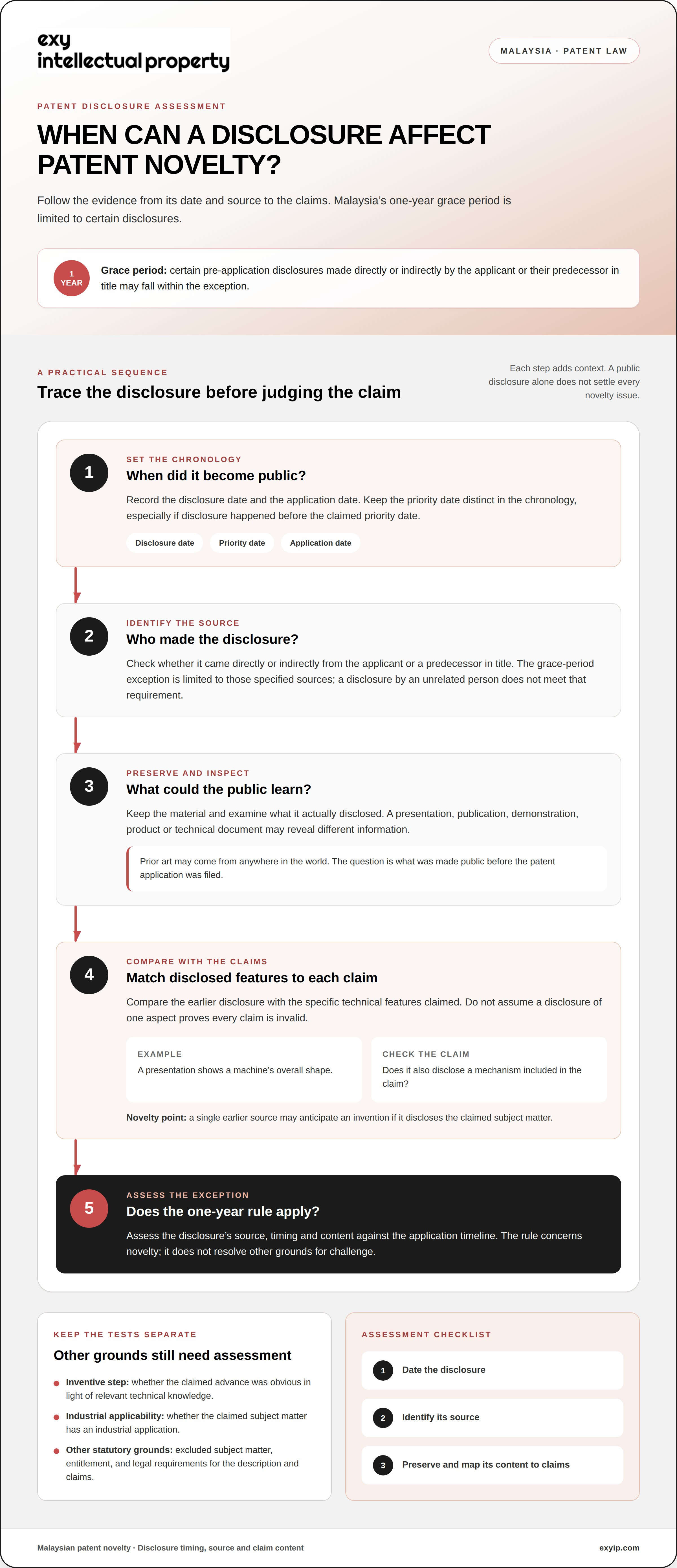
Malaysia’s Patents Act 1983 provides a one-year grace period for certain pre-application disclosures. It covers disclosure made directly or indirectly by the applicant or their predecessor in title before the application date. The exception is limited. It does not mean every public disclosure is allowed without affecting novelty, or that every patent claim receives protection.
Start with the timeline. Record when the information became public, who disclosed it and the application date. Then establish whether the disclosure came directly or indirectly from the applicant or a predecessor in title. These details matter because the grace period applies to those specified sources. On its face, a disclosure by an unrelated person does not meet that requirement.
Worldwide prior art matters too. An invention may fail the novelty requirement if it was disclosed to the public anywhere in the world before the patent application was filed. The key question is what the public could learn from the disclosure. A presentation, publication, demonstration or product may reveal different information, so assess each for what it actually made public.
Keep the priority date distinct from the application date in your chronology. If a public disclosure occurred before the claimed priority date, record that timing alongside the later filing date. The grace-period rule described here concerns disclosure before the application date. Do not assume that finding a disclosure within one year resolves every novelty issue: its source and the subject matter disclosed still matter.
The claims define the invention being assessed. Compare each claim’s technical features with the content of the earlier disclosure. For example, a public presentation might show a machine’s overall shape but not explain a mechanism later included in a claim. Assess the disclosure against the claimed features rather than treating it as proof that every claim is invalid. A single earlier source can be relevant to novelty if it anticipates the claimed invention.
A practical assessment follows a clear sequence: establish the disclosure date, identify its source, preserve the material and map its contents against the claims. Then assess whether the one-year exception applies to the disclosure and application timeline. The exception concerns novelty; it does not resolve other grounds for challenge, such as inventive step or insufficient description. A disclosure alone also does not establish infringement, which concerns conduct involving a patent right.
If an invention has already been discussed publicly, a Patent Novelty Search can help identify relevant earlier disclosures and compare them with proposed claims. This supports an informed assessment of novelty before filing. The grace-period question still depends on the disclosure’s source, timing and content.
Inventive step and obviousness
Section 15 of Malaysia’s Patent Act 1983 allows a patent challenge when an invention lacks an inventive step. The question is not simply whether its components were known. The issue is whether the claimed advance was obvious in light of the relevant technical knowledge. A familiar component can still contribute to an inventive solution when its combination produces a non-obvious technical result.
Assess the claims, not just the invention’s general purpose. For example, a claim might combine a known sensor with a control mechanism to solve a specific operating problem. The analysis considers whether the combination represents an inventive advance or follows plainly from existing knowledge. A patent may be vulnerable if the claimed contribution is only an obvious change rather than a meaningful technical development.
Evidence from a person skilled in the art, often called a POSITA, may assist with patent construction, novelty and inventive step. A Malaysian court may consider this evidence but is not bound by it. Technical explanations should connect the claimed features to the problem addressed and explain why the proposed solution was or was not obvious. Evidence can inform the assessment, but does not decide the legal question by itself.
Patentability also requires more than an inventive step. Section 16 of the Patent Act 1983 concerns industrial applicability. A patent may be challenged if the invention is not industrially applicable. In practical terms, the claimed subject matter must have an industrial application, rather than remain an abstract proposal with no workable use. The claims and description should be read together to understand the asserted application.
Sections 11 and 13(1)(a) to (d) address patentable inventions and excluded categories. A Malaysian patent may be challenged if the invention falls within an excluded category under section 13(1)(a) to (d). An invention is also ineligible if performing any act in respect of it would be contrary to public order or morality. These are separate questions from whether the invention is obvious or industrially applicable.
When reviewing an application, distinguish the grounds rather than treating every weakness as obviousness. Identify the technical contribution in the claims, assess its relationship to relevant knowledge, and consider industrial application and statutory exclusions separately. A patent novelty search can help identify earlier technical material, although novelty and inventive step remain distinct legal tests.
For applications filed on or after 1 August 2001, a Malaysian patent may receive protection for up to 20 years from its filing date. That term does not cure a failure to meet patentability requirements. An early patent novelty search can help inform filing decisions by locating material relevant to the claimed technical advance.
Novelty and prior art
Section 14 of Malaysia’s Patent Act 1983 sets the novelty requirement. It asks whether the invention was already disclosed to the public before filing.
The Novelty Requirement
Novelty means the claimed invention must not already appear in public prior art. For an applicant, this makes the timing and content of earlier publications, products, demonstrations and drawings important. A disclosure anywhere in the world may be considered, not only material published in Malaysia. Assess each claim against what the public could learn from the earlier material.
Section 14(2)(a) provides that an invention is not new if disclosed to the public anywhere in the world before the patent application was filed. The disclosure may be written or practical. An international technical paper, a product offered publicly, or a working machine shown outside Malaysia could therefore be relevant. The key is whether the material was available to the public and disclosed the features claimed.
Novelty is assessed claim by claim. A document may describe a device’s general purpose without revealing the specific arrangement claimed in a patent. For example, drawings of a machine may show its external form but omit an internal mechanism. This distinction matters: a challenge must connect the prior art to the actual claim, rather than rely on broad similarities in function or appearance.
Anticipation by Prior Art
Prior art anticipates a claim when a single earlier source discloses the relevant features of the claimed invention. This matters because separate sources cannot simply be combined to establish lack of novelty. The comparison should identify what the source teaches and whether it made the claimed subject matter available to the public before filing.
A Malaysian court considered this issue in YKL Engineering Sdn Bhd v Sungei Kahang Palm Oil Sdn Bhd & Anor, reported at [2022] 8 CLJ 32. A prototype fruit bunch splitter had been installed at third-party premises in 2002. The Federal Court held that the installation was an enabling disclosure that destroyed the patent’s novelty. The example shows that a public use can matter, even without a conventional publication.
Evidence should make the disclosure and its timing clear. A party challenging a patent should identify the specific prior art relied on, so the patent owner and expert can prepare for trial. Relevant records may include dated documents, product information, photographs, drawings or evidence describing a public demonstration. The defendant’s evidence must establish what was disclosed, when it became public, and how it relates to the claims.
In YKL Engineering, novelty turned on whether the prototype installation enabled the public to learn the claimed subject matter. That is more precise than asking whether similar technology existed. For an international publication or earlier product, the same careful comparison helps distinguish a genuinely anticipated claim from one that shares only general features with prior art.
Grounds for patent invalidation under Malaysian law
The Patents Act 1983 allows a Malaysian patent to be challenged on several grounds, beyond novelty or inventive step. The relevant question is whether the patent meets the Act’s requirements and was granted to the person entitled to it.
According to the Commissioner of Law Revision, Malaysia, any aggrieved person may bring court proceedings against the patent owner to seek invalidation. Malaysia has separate routes for opposing a patent and seeking its invalidation in court. Other countries have their own procedures and deadlines, so Malaysian routes should not be assumed to apply internationally.
Other statutory grounds concern the invention and its patent documents. A challenge may argue that the subject matter does not qualify as an invention under section 12, falls within an excluded category under section 13(1)(a) to (d), or cannot be applied industrially under section 16. It may also raise whether performing an act concerning the invention would be contrary to public order or morality.
Entitlement is a separate issue. A patent may be challenged if the right to it did not belong to the person to whom it was granted. Records about the invention’s development, assignment or ownership may help explain that question. The Patent Registrar’s examination may also be relevant: subsection 29A(4) addresses incomplete or incorrect information provided by the patent holder or agent.
Section 23 concerns the patent description and claims. A challenge may allege that these do not comply with its requirements, or that necessary drawings for understanding the invention were not furnished. The evidence should connect the alleged defect to the patent’s actual documents. For example, a drawing may be material where the written description does not explain a claimed component clearly.
Under section 59(3), a court may invalidate only the affected claims when the defect applies to part of a patent. Dependent claims are also invalidated when their independent claim is invalidated, unless redrafted as independent claims incorporating all features of that independent claim. Section 57 addresses the date and effect of invalidation. The court’s ruling and the wording of any licensing agreement matter when assessing consequences for damages, permissions or past conduct; invalidation does not itself answer every contractual question.
A challenge needs evidence tied to a specific ground, such as the patent claims and description, relevant drawings, ownership records, Registrar information or identified prior art. The challenger should specify the prior art relied on so the patent owner and its expert can prepare for trial.
An aggrieved person applies to court under section 59, setting out the grounds and supporting evidence. The cited provisions do not give a general deadline for every challenge; procedural timing turns on the court process, evidence and scope of the dispute.
Who can challenge or seek revocation of a patent in Malaysia, and when?
Under section 59 of Malaysia’s Patents Act 1983, an aggrieved person may apply to court to invalidate a patent. The Commissioner of Law Revision, Malaysia, also states that any aggrieved person may bring court proceedings against the patent owner. The route is therefore a court challenge, not simply an objection made privately to the patent holder.
“Aggrieved person” is the statutory threshold. A challenger should be able to connect the patent to an interest affected by its continued validity, then identify a legal ground for the challenge. Materials for a dispute might include the patent’s claims and description, ownership documents or prior art supporting a novelty challenge. The evidence should relate to the ground raised, rather than rely on general disagreement with the patent.
Malaysia also has a patent opposition provision. Section 55A concerns opposition, while section 59 concerns an application to court for invalidation. The appropriate route depends on the circumstances of the challenge. The provisions identify their purposes, but the grounds and stage relevant to a particular dispute should be assessed against the patent’s circumstances. The section 59 route is the one expressly described as an aggrieved person’s court application to invalidate a patent.
Timing depends on the route being considered and the supporting facts. For example, someone relying on prior art may need to connect its disclosure to the patent claims and establish its relevance. A challenge based on entitlement instead turns on who owned the right to the patent when it was granted. The cited provisions do not state a general filing deadline for every court challenge, so do not assume a single deadline applies.
Build the case around identifiable material. For a novelty challenge, specify the prior-art source and the features it discloses. For an entitlement dispute, gather records showing how rights in the invention were held or transferred. For a challenge to the patent documents, identify the relevant claims, description or drawings. In YKL Engineering Sdn Bhd v Sungei Kahang Palm Oil Sdn Bhd & Anor, the court considered evidence about a prototype installation when assessing novelty, illustrating the importance of evidence tied to the alleged disclosure.
The court may invalidate only affected claims when part of a patent is invalid under section 59(3). A challenger should therefore identify the claims in dispute and explain how the evidence supports the pleaded ground. This focus can also clarify the potential effect on the patent owner and others relying on particular claims.
Where earlier technical material is central to a proposed challenge, a patent novelty search can help identify relevant prior art for review.
The challenger should establish that they are an aggrieved person, identify the legal ground and affected claims, and bring a court application supported by evidence relevant to that ground; opposition under section 55A is a separate route.
Exy Intellectual Property
Exy Intellectual Property helps businesses make informed decisions about protecting inventions in Malaysia. If you are assessing a patent’s validity, the grounds discussed above can clarify the issues to consider, including prior disclosures, claim scope and ownership. For an invention not yet protected, Exy Intellectual Property provides Patent Filing and Patent Registration support.
The right next step depends on where you are in the process. A business preparing an application can focus on defining the invention and its claims; a business reviewing an existing patent should first identify the specific legal concern and relevant documents. Patent protection is not the same as resolving a court dispute, so keep the purpose of each step clear.
For guidance on patent protection or filing in Malaysia, contact Exy Intellectual Property.
Plan your next IP decision
Understanding what invalidates a patent in Malaysia can help you make a considered decision about protecting, developing or the commercialization of an invention. Match the legal concern to your business objective: preparing a filing, reviewing an existing right or planning how intellectual property can support future growth. Clear records of the invention, its development and intended use can make the next steps more focused.
Exy Intellectual Property supports businesses with connected protection needs, including Patent Filing, Trademark Registration and Industrial Design Registration. These options protect different forms of intellectual property, so the right fit depends on what the business has created and how it plans to use it. A patent question may sit alongside brand or product-design priorities, making it useful to consider the wider portfolio rather than treating each right in isolation.
For guidance on your next intellectual property decision, contact Exy Intellectual Property. A considered plan can help you move forward with clarity and keep protection aligned with your commercial aims.
Frequently Asked Questions
What are the grounds for invalidating a patent in Malaysia under the Patents Act 1983?
The grounds are the statutory defects discussed in this article. A useful first step is to identify exactly which claims and parts of the patent are in dispute. A focused challenge ties each allegation to specific claim wording and supporting material. This helps distinguish a concern affecting the entire patent from one relating to particular claims, and gives the other party a clear understanding of the case to answer.
How does lack of novelty invalidate a Malaysian patent?
A novelty challenge depends on evidence tied to the relevant time and claim. Preserve the original publication or product material, its date, and records showing when and how it became accessible. For online material, retain a copy identifying the page and publication details. A clear evidence trail helps the court assess the material’s timing and contents, rather than relying on an undated summary or recollection.
Can excluded subject matter or insufficient disclosure invalidate a Malaysian patent in Malaysia?
Yes. For a practical review, compare the patent’s claims with the explanation of how to carry them out. Identify any technical term, step or feature whose meaning depends on details the patent does not explain. Keep the analysis tied to the actual text and supporting material, rather than making general claims that the invention is unclear. This creates a precise record of the alleged problem for legal assessment.
How does a Malaysian court or the Intellectual Property Corporation of Malaysia revoke a patent?
A patent invalidation challenge is decided through the legal process described in this article. Do not assume that the Intellectual Property Corporation of Malaysia itself makes the court’s decision. Before proceeding, organize the patent documents, grounds relied on and evidence supporting each allegation. Keep relevant correspondence and records in a single chronology, so the history of the dispute and the outcome sought are clear.
What happens to patent rights, damages, and licensing agreements after a Malaysian patent is invalidated?
If only part of a patent is invalid, the court may invalidate only the affected claims. Dependent claims are also invalidated when their independent claim is invalidated, unless they are redrafted as independent claims incorporating all features of that claim.