


What if your most brilliant invention has already been claimed by someone else? It’s a chilling thought for any innovator. You don’t want to waste precious capital on a concept that isn’t actually patentable, yet the sheer volume of global data often feels overwhelming. A thorough patent search is the only way to move from uncertainty to security. It’s natural to feel hesitant when faced with dense technical terminology and the uncertainty of searching through international databases. We understand that you need more than just a filing service; you need a strategic partner to safeguard your commercial vision.
By mastering this process, you can validate your invention’s novelty and build a secure foundation for your intellectual property strategy. This guide provides a clear roadmap to help you navigate these complexities with confidence. We’ll explore how to identify existing protections, avoid infringement risks, and ensure your path to registration is both clear and commercially viable. You’ll gain the clarity needed to transform a raw idea into a protected, valuable asset for your business journey in 2026.
Key Takeaways
- Understand that prior art encompasses more than just existing patents; it includes all publicly available technical knowledge that could impact your invention’s novelty.
- Identify the essential global databases, including MyIPO and WIPO Patentscope, to ensure your innovation is unique within the international landscape.
- Recognize when to transition from a preliminary DIY investigation to a professional patent search to uncover hidden risks and prevent future litigation.
- Learn how to utilize IPC and CPC classification codes to conduct a more precise and effective search of your technology’s specific field.
- Discover how to transform raw data into a strategic filing by identifying market gaps and drafting your application to maximize commercial value.
What is a Patent Search and Why Does Your Invention Need One?
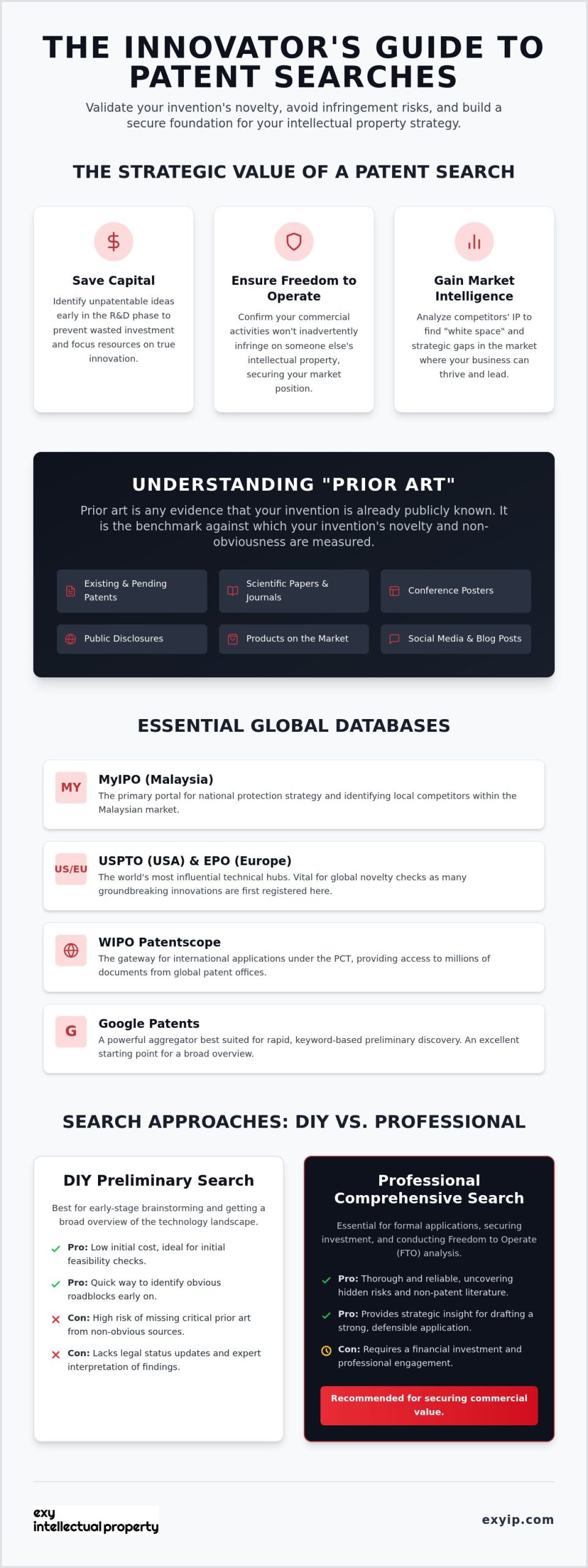
Protection. Strategy. Security. A patent search is a comprehensive investigation into the landscape of existing technical knowledge, commonly referred to as “prior art.” Its primary function is to determine whether your invention meets the legal criteria for novelty before you commit significant resources to a formal application. By conducting this search, you move beyond guesswork and begin building a commercially grounded defense for your innovation. It’s the difference between a speculative filing and a strategic asset.
Understanding the Concept of Prior Art
Prior art is a broad term that identifies any evidence that your invention is already known to the world. It’s a common misconception that this only includes existing patents or pending applications. Published scientific papers, conference posters, and even products already on the market all qualify as prior art. If a technical solution is accessible to the public in any form, it exists in the prior art landscape. This repository of knowledge serves as the benchmark for your invention’s validity.
This has a direct impact on the “non-obviousness” requirement. For an invention to be patentable, it can’t be an obvious next step for someone skilled in that specific technical field. Even a single public disclosure, such as a presentation at a trade show or a detailed social media post, can invalidate your future patent rights. We often see innovators lose their competitive edge simply because they shared too much too soon. A search reveals these hidden obstacles before they become legal liabilities.
The Business Benefits of a Preliminary Search
Efficiency saves capital. Identifying unpatentable ideas early in the R&D phase prevents you from pouring investment into a concept that cannot be protected. Instead of facing a rejected application or a costly infringement lawsuit, you can refine your invention’s unique features based on existing technology. This proactive approach ensures your development team focuses on true innovation rather than reinventing the wheel.
A patent search also establishes your Freedom to Operate (FTO). This is a critical foundation for any tech founder in Malaysia. It ensures that your commercial activities won’t inadvertently step on someone else’s intellectual property. Beyond risk mitigation, this process offers vital market intelligence. By analyzing what your competitors are developing and where they’ve secured protection, you can find the “white space” in the market. You aren’t just searching for what is there; you’re looking for the gaps where your business can thrive and lead.
The Essential Databases for a Global Patent Search
Precision. Breadth. Reliability. A comprehensive patent search requires a multi-layered approach that spans local, regional, and international records. Relying on a single source is a significant commercial risk. To build a truly secure intellectual property strategy, you must consult a variety of databases that serve different technical and legal purposes. This ensures that no relevant prior art is overlooked, regardless of where it was first published.
- MyIPO (Malaysia): The primary portal for national protection strategy. It’s essential for identifying local competitors and existing rights within the Malaysian market.
- USPTO (USA) and EPO (Europe): These are the world’s most influential technical hubs. Many groundbreaking innovations are first registered here, making them vital for global novelty checks.
- WIPO Patentscope: This is the gateway for international applications under the Patent Cooperation Treaty (PCT). It provides access to millions of documents from participating national and regional offices.
- Google Patents: A powerful aggregator best suited for rapid, keyword-based preliminary discovery. It’s an excellent starting point for a broad overview.
- Espacenet: Developed by the European Patent Office, this tool excels at leveraging advanced technical classifications for high-precision results.
Official Portals vs. Aggregators
Tools like Google Patents are incredibly accessible. They offer a user-friendly interface that’s perfect for early-stage brainstorming. However, aggregators are often best for starting, not finishing. They may lack the real-time legal status updates found in official government portals. For instance, the MyIPO database remains the definitive source for verifying the current standing of a patent in Malaysia. When you are preparing for a formal filing, the legal certainty provided by official portals and WIPO’s PCT records is non-negotiable. If you’re ready to move beyond preliminary findings, our team can provide a rigorous patent novelty search to ensure your technical foundation is sound.
Navigating Technical Classifications
Keywords alone are often insufficient for technical searches. Inventors frequently use different terminology to describe the same concept, which can lead to “hidden” prior art that a simple word search won’t find. This is where the International Patent Classification (IPC) system becomes vital. IPC codes are a hierarchical system used to categorize inventions based on their technical features rather than just their description. By identifying the relevant IPC or CPC (Cooperative Patent Classification) codes, you can filter through millions of documents with surgical precision. This methodology allows you to find inventions that are functionally identical to yours, even if the language used in the documentation is entirely different. Mastering these codes is the hallmark of a professional-grade search.
DIY vs. Professional Patent Novelty Searches: When to Seek Expert Help
Confidence is a double-edged sword in innovation. While a DIY patent search is an excellent first step for brainstorming, it rarely provides the legal certainty required for a major commercial launch. The primary limitation of a self-conducted search is that “not finding it” doesn’t mean your invention is unique. It often means the relevant prior art is buried in a database, language, or technical classification you haven’t accessed. A professional approach replaces this uncertainty with a structured, defensible roadmap for your intellectual property.
A comprehensive Patent Novelty Search report from an expert agent includes a deep dive into global records, technical analysis of similar inventions, and a strategic assessment of your chances for registration. This early investment acts as a form of insurance. By spending a fraction of your budget on a professional search now, you avoid the much higher costs of a rejected application or a legal battle later in the product lifecycle. It’s a pragmatic choice for any serious business.
The Risks of an Incomplete DIY Search
Latent prior art is the greatest threat to a DIY effort. These are technical disclosures hidden in obscure foreign databases or non-English publications that standard search engines might miss. Even if you find a relevant document, the challenge lies in interpretation. Patent claims are written in a precise, legal-technical language where a single word can change the entire scope of protection. Misreading these boundaries can lead to a disastrous infringement on existing rights.
Psychology also plays a role. Inventors often suffer from confirmation bias. You’re naturally inclined to look for evidence that supports your invention’s novelty rather than data that contradicts it. A professional patent search provides an objective, external perspective. They aren’t looking for a “yes”; they’re looking for the truth of the landscape. This objectivity is what protects your business from expensive mistakes and provides the legal weight needed to support your future filing.
How Exy IP Enhances the Search Process
Expertise matters. We utilize proprietary databases and professional search algorithms that offer far greater depth than public portals. Our team doesn’t just deliver a list of results; we provide a strategic analysis of Freedom to Operate risks specifically for the Malaysian market. We act as your “Business-Savvy Guardian,” ensuring that your path to commercialization is clear of legal landmines. This proactive advisory is designed to secure your long-term success rather than just completing a task.
Strategic alignment is the final benefit. Our search findings lead directly into our professional patent drafting services. By understanding the prior art landscape in detail, we can draft your patent application to navigate around existing technology. This approach maximizes your chances of approval and ensures your final patent is a robust, valuable asset for your company’s growth. We don’t just find the gaps; we help you fill them with protected innovation.
A Step-by-Step Guide to Conducting Your Preliminary Patent Search
Methodical. Logical. Actionable. Conducting an initial patent search allows you to filter out obvious obstacles before engaging professional services. While this doesn’t replace a formal novelty report, it empowers you with a foundational understanding of your technical space. Following a structured process ensures you don’t miss obvious prior art that could derail your application early on.
- Step 1: Define core technical features. Break your invention down into its essential components. What specific problem does it solve, and what is the exact mechanism used?
- Step 2: Identify classification codes. Use the IPC or CPC systems to find the specific category your invention falls into. This narrows the field significantly and improves accuracy.
- Step 3: Execute keyword searches. Run queries across global databases like MyIPO and WIPO Patentscope. Use various combinations of technical terms and industry synonyms.
- Step 4: Filter for closeness. Review the results to see which existing patents share the most similarities with your design. Focus on the underlying functionality.
- Step 5: Document your findings. Keep a structured record of every relevant document you find. This report will be invaluable when you transition to the drafting phase.
Defining Your Search Parameters
Precision starts with your vocabulary. Don’t limit yourself to the terms you use internally. Brainstorm synonyms and technical phrases that other industries might use to describe similar functions. For example, a “fastening device” in the automotive sector might be called a “locking mechanism” in aerospace. You should also set geographic and date-range filters to keep your results manageable. Focusing on the last 20 years is usually sufficient for most modern technology, as older patents have likely entered the public domain and no longer offer active protection.
Evaluating and Filtering Results
Volume isn’t the goal; relevance is. When reviewing results, start with the abstract for a high-level overview. If it seems relevant, move to the claims section. The claims define the actual legal boundaries of the protection. You’re looking for “killer” prior art, which is a single document that describes every element of your invention. If your search reveals too many results, narrow your parameters by adding more specific technical keywords. Conversely, if you find nothing, broaden your terms to ensure you aren’t missing latent art. If the technical jargon becomes too dense, it’s time to request a professional patent novelty search to ensure no risks are overlooked.
Beyond the Search: Turning Data into a Strategic Patent Application
Discovery is only the beginning. The true value of a patent search lies in your ability to transform raw data into a tactical advantage. Once you understand the existing technical landscape, you can identify the “white space” where your invention can thrive without competition. This isn’t just about avoiding rejection. It’s about positioning your innovation as a unique, defensible asset in a crowded global market.
A well-documented search report also serves a critical commercial purpose. It significantly enhances your intellectual property valuation by providing objective proof of your invention’s novelty. For tech founders, this documentation is essential during funding rounds or acquisition talks. It demonstrates that you’ve secured a foundation for growth and mitigated the risk of future litigation. Investors value certainty. Your search results provide it.
Refining Your Invention Post-Search
Adaptability is a hallmark of successful innovators. If your patent search reveals similar technology, you don’t necessarily have to abandon your project. Instead, use that data to “pivot” your technical design. By understanding where others have succeeded, you can focus your application on the specific, novel elements that were not found in the prior art. This targeted approach results in much stronger patent claims that are better equipped to withstand future legal challenges or opposition from competitors. Highlighting these unique features ensures your filing is both robust and commercially relevant.
Integrating Search with Your Broader IP Strategy
Intellectual property does not exist in a vacuum. Your technical search results should inform your entire brand protection plan, including your trademark registration Malaysia strategy. For instance, if your search reveals a dominant competitor in your technical niche, you may need a more aggressive branding approach to differentiate your market presence. This holistic view ensures that your legal protections and commercial goals are perfectly aligned. Competitive benchmarking through patent data also reveals potential licensing opportunities that can generate revenue early in your venture’s lifecycle.
The final step is moving from discovery to filing. This transition requires the steady hand of an established specialist. Consulting with Exy IP allows you to finalize your commercialization roadmap with confidence. We help you use your search findings to draft a robust application that maximizes your protection and secures your professional interests. We are your proactive advisors, dedicated to the long-term health of your business. Your success is our primary objective.
Securing Your Innovation’s Commercial Future
Protection. Strategy. Security. We’ve explored how a meticulous patent search serves as the vital first step in transforming a technical concept into a protected corporate asset. By navigating global databases and leveraging technical classifications, you move from speculative development to strategic innovation. You now understand that while preliminary DIY efforts offer a broad overview, professional depth is what prevents costly litigation and secures your freedom to operate in the Malaysian market.
Exy Intellectual Property stands as your Business-Savvy Guardian. We provide the specialized technical expertise and strategic advisory necessary to navigate the complexities of 2026’s intellectual property landscape. Our focus remains on your long-term success; we ensure your inventions are not only filed but positioned for maximum commercial value. This proactive partnership allows you to focus on growth while we safeguard your technical legacy.
Take the next step toward a secure intellectual property foundation today. Secure your innovation with a professional Patent Novelty Search from Exy IP and proceed with the confidence that your vision is fully protected. Your path to market leadership begins with a foundation of certainty.
Frequently Asked Questions
How much does a professional patent search cost in 2026?
Professional costs vary based on the invention’s technical complexity and the search’s geographic scope. Instead of a fixed fee, we focus on the value provided through expert analysis and risk mitigation. A high-quality report prevents the much larger financial loss of a rejected application. It’s an investment in your company’s long-term security. We recommend contacting a specialist for a tailored quote based on your specific innovation.
Can I patent an idea if I found something similar during my search?
Yes, finding similar technology doesn’t automatically disqualify your invention. You can often patent improvements or unique modifications that provide a technical advantage over existing solutions. The key is identifying the specific novel features that distinguish your work from the prior art. We help you analyze these differences to draft claims that focus on your unique technical contributions. This strategic pivot ensures your filing remains valid and defensible.
How long does a comprehensive patent search usually take?
A thorough investigation typically requires several days to a few weeks to complete. This timeframe allows our experts to query multiple global databases and analyze dense technical documentation with precision. Rapid, automated searches often miss subtle prior art that could jeopardize your future rights. We prioritize accuracy over speed to ensure you receive a reliable foundation for your intellectual property strategy. Taking the time now prevents legal complications later.
Is a Google Patents search enough for an official MyIPO filing?
No, a Google Patents search is rarely sufficient for a formal MyIPO application. While it’s a great tool for preliminary discovery, it doesn’t always reflect the most recent local filings or the specific legal status of Malaysian patents. Official government databases provide the legal certainty required for a professional filing. Relying solely on aggregators leaves you vulnerable to hidden prior art. We use specialized technical support to bridge these gaps.
What happens if I skip the patent search and just file the application?
Skipping a patent search significantly increases the risk of your application being rejected by the patent examiner. If prior art is discovered during the examination phase, you’ve already spent non-refundable filing fees on a concept that might be unpatentable. Even worse, you could unknowingly infringe on an existing patent, leading to expensive litigation. A proactive search acts as a strategic roadmap, helping you avoid these commercially damaging landmines from the start.
Do I need to search for patents in every country individually?
You don’t necessarily need to search every country’s database one by one. Tools like WIPO Patentscope and the PCT system allow us to search millions of international records simultaneously. However, a focused search in key markets like Malaysia, the USA, and Europe is essential for a robust strategy. We tailor the search scope to match your business’s expansion goals. This ensures your innovation is protected wherever you plan to commercialize it.
What is the difference between a novelty search and a freedom to operate search?
Novelty searches determine if your invention is truly new and patentable. In contrast, a Freedom to Operate (FTO) search identifies whether your product or process infringes on existing, active patents owned by others. While a novelty search looks at all historical data, an FTO search focuses on current rights that could block your market entry. Both are vital for a comprehensive approach to protecting your commercial interests in Malaysia.
Can a patent search help me find potential business partners or licensees?
A professional patent search often reveals key players in your technical field. By identifying companies that hold similar patents, you can pinpoint potential collaborators, investors, or licensees who value your specific innovation. This market intelligence transforms a legal requirement into a powerful business development tool. It helps you understand the competitive landscape and find strategic gaps where your technology can lead the market.