


Protection. Strategy. Growth. What if your most valuable business asset isn’t the product you’re selling, but the technical logic that makes it function? It’s a question many Malaysian innovators face as they weigh the risks of public disclosure against the rewards of market dominance. You likely recognize that a great idea is vulnerable without a shield. Determining exactly what can be patented in Malaysia is the critical first step in building that defense. In 2026, the intellectual property landscape is more digital and strategic than ever. This guide provides the clarity you need to distinguish between patents, trademarks, and industrial designs with confidence.
We’ll move beyond legal definitions to give you a commercially grounded perspective on protecting your intellectual property. You’ll discover the specific criteria for patentability, the unique advantages of Malaysian Utility Innovations, and the strategic exclusions you must avoid to keep your application on track. We’ll also outline a clear roadmap for securing a filing date and explain how to transform your technical inventions into scalable business assets. This approach ensures your hard work results in a tangible, defensible advantage in an increasingly competitive global market.
Key Takeaways
- Identify the core legal requirements for what can be patented in Malaysia to ensure your technical solutions qualify as protected assets.
- Navigate the “Triple Test” of novelty, inventive step, and industrial applicability to build a robust defense for your intellectual property.
- Evaluate the strategic benefits of Utility Innovations for incremental tech improvements that don’t require a full inventive step.
- Learn the specific subject matter exclusions under the Patents Act 1983 to prevent investment in non-patentable concepts like scientific theories.
- Establish a clear commercialization roadmap by utilizing professional novelty searches to confirm your invention’s market value before filing.
Defining Patentable Inventions Under the Patents Act 1983
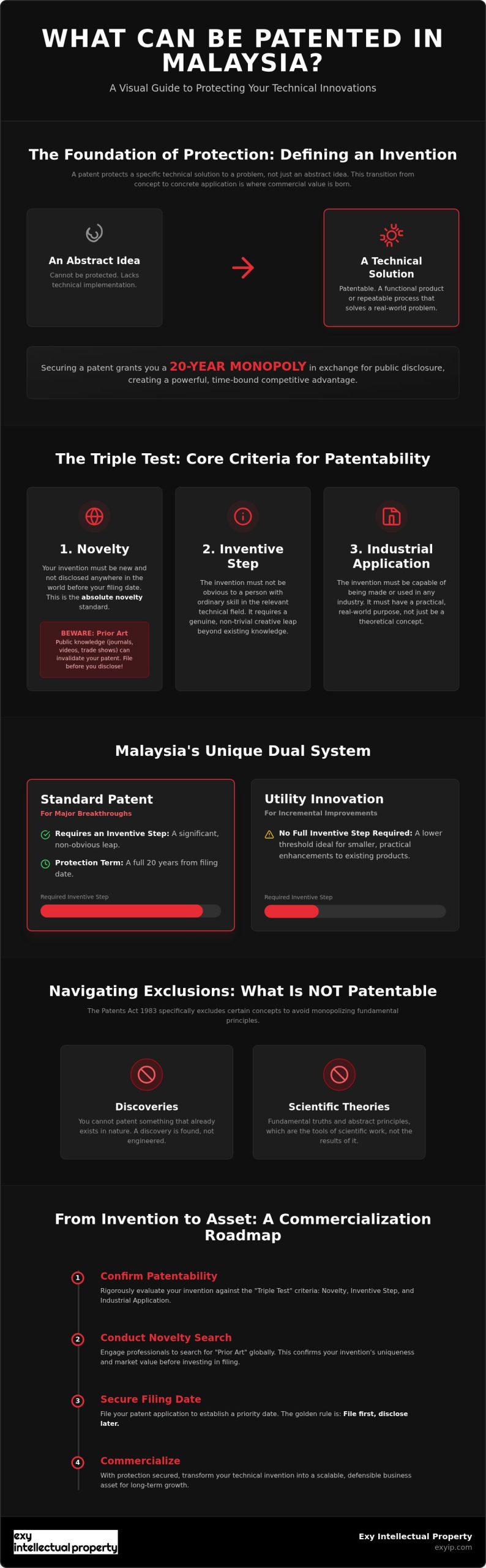
Clarity is the foundation of security. To understand what can be patented in Malaysia, you must first look to the primary legal framework: the Patents Act 1983. This legislation defines an invention not just as a creative spark, but as a specific technical solution to a problem. It’s a pragmatic definition. It ensures that protection is reserved for innovations that have a practical application in industry. When you secure a patent through Patent Registration, the government grants you a 20-year monopoly. In exchange, you provide a full public disclosure of the technology. This arrangement fosters innovation while giving your business a significant, time-bound competitive advantage.
Distinguishing between “mere ideas” and “practical technical solutions” is your first strategic hurdle. An idea that lacks a technical implementation cannot be protected. However, once that idea is translated into a functional product or a repeatable process, it enters the realm of patentability. This transition from the abstract to the concrete is where your commercial value is truly born. Your goal isn’t just to have an idea; it’s to solve a technical problem in a way that the law recognizes as unique and valuable.
The Legal Definition of an Invention
Technical character is the benchmark. In Malaysia, an invention must be a man-made creation that provides a new way of doing something or offers a new technical solution to a problem. Under the 1983 Act, an invention is patentable if it is new, involves an inventive step, and is industrially applicable. It’s vital to distinguish between a mere discovery, such as a naturally occurring substance, and an invention that has been engineered. A discovery is found; an invention is built. Understanding these foundational principles of The Triple Test: Novelty, Inventive Step, and Industrial Application helps you determine if your concept is ready for formal filing.
Product Patents vs. Process Patents
Protection takes two primary forms. Product patents cover physical entities. This includes tangible machines, manufactured items, or specific chemical compositions. If you’ve developed a new hardware component or a unique pharmaceutical compound, this is your path. Process patents, however, protect the “how.” They cover methods of manufacturing or the specific technical steps required to achieve a result. When considering what can be patented in Malaysia, you should look at both the end result and the journey taken to get there.
Savvy business leaders don’t just choose one. They often file for both. For example, if you’ve created a new biodegradable plastic (a product) and a more efficient way to synthesize it (a process), filing for both ensures comprehensive coverage. This dual-layered strategy prevents competitors from bypassing your protection by using a different method to create your product, or vice versa. It’s about closing every possible loop to safeguard your long-term commercial interests.
The Triple Test: Novelty, Inventive Step, and Industrial Application
The threshold for protection is rigorous. To determine what can be patented in Malaysia, the Intellectual Property Corporation of Malaysia (MyIPO) applies three mandatory criteria. This “Triple Test” ensures that only genuine innovations receive legal exclusivity. Failing any single pillar, including novelty, inventive step, or industrial applicability, results in an immediate rejection. It’s a high bar designed to protect the integrity of the market and reward only those who provide true technical value.
Global Novelty and the Danger of Prior Art
Absolute novelty is the standard. Your invention must not have been disclosed anywhere in the world before your filing date. This includes “Prior Art,” which encompasses any public knowledge, ranging from academic journals to a casual YouTube video or a personal blog post. Many founders accidentally destroy their own chances through “self-anticipation.” This happens when you showcase a prototype at a trade show or publish a detailed website before filing your application. While Malaysia offers a limited 12-month grace period for specific disclosures by the inventor, relying on it is inherently risky. It’s always safer to file first. Securing Your Innovation: The Path to Commercialization requires a disciplined approach to confidentiality from the very beginning of the R&D process.
Determining the ‘Inventive Step’ (Non-Obviousness)
Novelty alone isn’t enough. The solution must also involve an “inventive step.” MyIPO examiners use the “Person Skilled in the Art” (PSITA) standard to judge this. If your invention would be obvious to a professional with ordinary skill in your specific field, it won’t qualify. You must demonstrate a technical advancement or show that your invention produces unexpected results. This is why a professional patent novelty search malaysia is critical. It provides the data needed to argue that your solution is truly non-obvious. If you’re unsure where your tech stands, a thorough search can provide the necessary clarity before you commit your development budget.
Scalability and Industrial Applicability
Utility is the final requirement. Your invention must be capable of being manufactured or used in an industry. It has to work consistently. It must be reproducible. A purely aesthetic design or a feature that doesn’t contribute to the technical function won’t meet this criterion. In the Malaysian context, “industry” is interpreted broadly. It includes traditional manufacturing, but also extends to agriculture, services, and high-tech sectors. If your innovation solves a problem in a way that can be scaled and repeated, it likely satisfies this requirement. This ensures that patents are granted for practical tools that drive economic growth rather than theoretical concepts.
Patent vs. Utility Innovation: Malaysia’s Unique Dual System
Flexibility is a strategic asset. When evaluating what can be patented in Malaysia, many innovators assume they must present a world-changing breakthrough. However, the Malaysian intellectual property framework is unique because it offers a dual-track system. You can choose between a standard Patent and a Utility Innovation (UI). This distinction is vital for businesses that focus on practical, incremental improvements rather than radical scientific shifts. It allows you to protect the steady evolution of your products without the burden of proving a massive leap in technical logic.
What Qualifies as a Utility Innovation (UI)?
A Utility Innovation is a certificate granted for a “minor” invention. It must be new and industrially applicable; crucially, it does not need to satisfy the “inventive step” requirement. This makes it an accessible tool for protecting practical modifications. For instance, if you design a new shape for a handheld harvesting tool that makes it 20% more efficient, it might not be “non-obvious” enough for a full patent. It is, however, a perfect candidate for a UI. By securing this certificate, you prevent competitors from copying the specific technical advantage you’ve engineered. It’s often referred to as a “petty patent” for this reason.
Strategic Choice: When to File for a UI Instead of a Patent
Choosing the right path depends on your commercial goals and the nature of your tech. If your product has a short lifecycle, such as fast-moving consumer goods or simple mechanical devices, the faster processing time of a UI is often preferable. You gain protection quickly without the uphill battle of proving an inventive step. Deciding what can be patented in Malaysia requires a business-first mindset. If a full patent application faces rejection during examination due to an “obviousness” objection, you can often convert that application into a UI. This “conversion” strategy ensures your investment in filing isn’t wasted.
| Feature | Standard Patent | Utility Innovation (UI) |
|---|---|---|
| Protection Term | 20 years | 10 years (extendable by 5+5) |
| Key Requirement | Inventive Step (Non-obviousness) | Novelty and Industrial Applicability |
| Examination Speed | Slower, more rigorous | Generally faster |
| Best For | Major technical breakthroughs | Incremental improvements |
Protecting your assets requires a nuanced understanding of these options. While a UI offers a shorter initial term, the ability to extend it to a total of 20 years provides long-term security comparable to a patent. This dual system ensures that every level of innovation, from the revolutionary to the incremental, has a place in the Malaysian market. It’s about choosing the tool that best fits your specific commercial trajectory.
What Cannot Be Patented in Malaysia: Navigating Exclusions
Clarity is a form of protection. While the 1983 Act is designed to foster innovation, it also sets firm boundaries on the types of intellectual property that can be monopolized. Determining what can be patented in Malaysia requires a clear-eyed look at the statutory exclusions. Under Section 13 of the Patents Act 1983, certain subject matters are explicitly barred from protection. These exclusions exist to ensure that fundamental knowledge and essential human services remain accessible to the public. If your innovation falls into one of these categories, your application will face an immediate hurdle that no amount of drafting can overcome.
The following categories are strictly non-patentable in the Malaysian jurisdiction:
- Discoveries, scientific theories, and mathematical methods.
- Plant or animal varieties, including biological processes for their production (though man-made microorganisms are often an exception).
- Schemes, rules, or methods for doing business, performing purely mental acts, or playing games.
- Methods for the treatment of the human or animal body by surgery or therapy, and diagnostic methods practiced on the body.
The Grey Area: Software and Business Methods
Software occupies a nuanced position. In its “pure” form, such as raw source code, software is protected by copyright rather than patents. However, a software-driven process can be patented if it produces a “technical effect.” This means the software must solve a technical problem in a way that goes beyond the routine interaction between code and hardware. A “method of doing business” is generally excluded. Yet, if that method is integrated into a novel technical system that improves computer performance or network security, it may qualify. It’s about the technical result, not just the administrative logic. If you’re developing a high-tech platform, you should seek a professional Patent Registration strategy to ensure your software is framed as a technical solution rather than a mere business rule.
Medical Treatments and Biological Processes
The law distinguishes between tools and techniques. You cannot patent a specific surgical method or a way of administering therapy. These are excluded to prevent legal barriers from interfering with life-saving medical care. However, the “tools” used in these procedures are entirely patentable. A new surgical scalpel or a diagnostic machine is a product, not a method. Similarly, while “natural” biological processes are excluded, biotechnological inventions involving human intervention often qualify. This is why pharmaceuticals remain one of the most active patent categories. The chemical compound is a product, even if the method of “prescribing” it is a service. Understanding these distinctions ensures you don’t waste resources on unprotectable methods while overlooking valuable hardware or compositions.
Securing Your Innovation: The Path to Commercialization
Filing is just the beginning. While understanding what can be patented in Malaysia provides the necessary foundation, the real value is unlocked through expert execution. You don’t just want a certificate; you want a defensible market position. This is why professional patent filing services Malaysia are essential. A professional novelty search is your first line of defense. It ensures you aren’t pouring capital into a “known” idea that has already been disclosed or protected elsewhere. It’s a proactive step that protects your R&D budget from avoidable waste. By confirming your invention’s uniqueness early, you build your strategy on solid ground.
The Crucial Role of Patent Drafting
Precision is power. The strength of your protection depends entirely on the “Claims” section of your application. This is the legal “fence” that defines the boundaries of your monopoly. If the drafting is vague or overly narrow, competitors can easily bypass your patent with minor adjustments. This leaves you with a document that has no real market value. At Exy IP, we bring specialized technical expertise to this stage. We ensure that the technical logic of your invention is described with the precision required for complex tech sectors. We build a robust shield that stands up to scrutiny and protects your commercial interests.
From Protection to Profit: IP Valuation and Licensing
Patents are business assets. They should be viewed as dynamic financial instruments rather than just legal hurdles. In 2026, strategic intellectual property valuation is a critical tool for scaling your venture. It allows you to quantify the economic worth of your innovation. This data is vital when you’re seeking financing, negotiating a merger, or attracting venture capital. A well-valued patent portfolio strengthens your balance sheet and signals competence to investors.
Licensing transforms your IP into a passive revenue stream. It allows you to profit from your innovation in markets or industries you don’t directly serve. By treating your patents as assets to be leveraged, you shift from mere protection to active profit generation. Commercial success requires this long-term mindset. Beyond the initial filing, you must consider how your IP fits into your broader growth strategy. A patent that isn’t integrated into your business plan is a dormant asset. When you combine rigorous legal protection with a clear commercialization roadmap, you ensure that your technical breakthroughs drive sustained financial growth for years to come.
Empowering Your Technical Competitive Advantage
Innovation is the engine of your business, but legal protection is the fuel that keeps it running safely. You’ve explored the rigorous criteria of the triple test and the strategic flexibility offered by the dual system of Patents and Utility Innovations. Determining what can be patented in Malaysia is the essential first step toward transforming your technical breakthroughs into defensible market assets. Whether you’re navigating complex software logic or mechanical improvements, the right approach ensures your hard work isn’t left vulnerable to competitors.
At Exy IP, we act as your proactive advisor throughout the entire lifecycle of your invention. From expert Patent Drafting for High-Tech Industries to specialized IP Valuation Services and strategic commercialization advisory, we ensure your intellectual property drives long-term financial growth. Don’t leave your market position to chance. Secure your invention with a professional Patent Novelty Search at Exy IP today. Your ingenuity deserves a robust defense; it’s time to build the fence that protects your future success.
Frequently Asked Questions
Can I patent a mobile app in Malaysia?
You can patent the technical logic or process behind a mobile app if it solves a technical problem in a novel way. While pure code is protected by copyright, the underlying software-driven invention must produce a “technical effect” to qualify. This means the app must improve computer performance or solve a specific technical challenge. Determining what can be patented in Malaysia often requires distinguishing between a mere business method and a technical system.
How much does it cost to get a patent in Malaysia in 2026?
Official MyIPO filing fees in 2026 depend on the application type and submission method. For a standard patent application submitted online, the filing fee is MYR 500. A Utility Innovation application submitted online costs MYR 200. You must also account for a substantive examination fee of MYR 1,000. These are government fees; total investment will vary based on drafting complexity and professional advisory needs. Annual maintenance fees also apply starting from the second year.
What is the difference between a patent and an industrial design?
The primary difference lies in function versus appearance. A patent protects the technical way a product works or the process used to achieve a result. In contrast, an industrial design registration protects the aesthetic features, such as the shape, configuration, or pattern of an object. If your innovation improves efficiency or solves a technical problem, you need a patent. If you’ve created a unique visual look that doesn’t affect function, industrial design is the correct path.
How long does the patent registration process take at MyIPO?
The standard patent registration process at MyIPO typically takes between 36 to 60 months from the filing date. This timeline includes the formal examination and the substantive examination stages. However, MyIPO offers an “Expedited Examination” option for specific categories like green technology or national interest. While the “MyIPO NEXTGEN” agenda aims to digitalize and streamline services by 2026, thorough technical reviews remain a necessary part of the multi-year approval journey.
Can I file a patent in Malaysia if I already launched my product?
You should ideally file before any public launch to protect the invention’s novelty. Malaysia does provide a limited 12-month grace period for specific disclosures made by the inventor. However, relying on this is risky because many foreign jurisdictions don’t recognize such grace periods. If your product is already in the market, you should immediately assess what can be patented in Malaysia before the non-extendable 12-month window closes permanently.
Is a Malaysian patent valid in other countries?
Patents are territorial, meaning a Malaysian patent only provides protection within Malaysia. To secure rights in other countries, you must file separate applications in each jurisdiction. Many businesses utilize the Patent Cooperation Treaty (PCT) to streamline this process. The PCT allows you to file a single “international” application to reserve your filing date across over 150 member countries, giving you more time to decide which specific global markets to enter.
What happens if someone infringes on my patent in Malaysia?
You have the right to initiate legal proceedings in the Malaysian High Court against any party using your patented invention without permission. Available remedies include injunctions to stop the infringing activity and monetary damages. It’s also important to note that as of December 31, 2025, Malaysia has a post-grant opposition system. This allows interested parties to challenge a patent’s validity within six months of its grant publication, making early professional drafting even more critical.