


What if your most valuable commercial asset is currently invisible to the law? It’s a sobering thought for any executive. You’ve invested months into proprietary software, unique designs, or original content, yet you might lack the concrete evidence needed to defend them. In an era where digital piracy moves faster than ever, the threat of copyright infringement Malaysia is a constant reality that can erode your market share overnight.
We understand the frustration of seeing your hard work mimicked without credit or compensation. It’s often confusing to distinguish between a trademark and a copyright, and the fear of a long, uncertain court battle can lead to costly inaction. This guide changes that. We’ll provide a comprehensive breakdown of the Copyright Act 1987 as it stands in 2026, including the latest updates on AI generated works and digital enforcement.
You’ll learn exactly which works qualify for protection and how to utilize the Voluntary Notification process as your gold standard for evidence. Beyond mere defense, we’ll show you how to leverage your intellectual property for commercial growth through licensing and valuation strategies. Let’s transform your creative output into a secure, scalable business asset.
Key Takeaways
- Understand that while copyright protection in Malaysia is automatic upon creation, establishing legal ownership in court requires proactive documentation.
- Identify the broad range of protected assets, including computer programs and databases, to effectively mitigate the risks of copyright infringement Malaysia.
- Learn why the Copyright Voluntary Notification process is the definitive commercial standard for evidence, far surpassing outdated methods like “poor man’s copyright.”
- Master the “Substantial Part” test to accurately evaluate potential breaches based on the quality and significance of the work rather than just the quantity copied.
- Discover how to transform your creative assets into scalable revenue streams through strategic licensing, IP valuation, and commercialization frameworks.
Foundations of Copyright Protection in Malaysia
Copyright is a bundle of exclusive rights granted to creators of original works under the Copyright Act 1987. It’s a powerful legal tool. This legislation gives you the authority to control how your creative assets are reproduced, performed, and distributed. For a business leader, this means your software code, marketing materials, and internal training manuals aren’t just files; they’re protected property. Understanding this foundation is the first step toward securing your commercial interests.
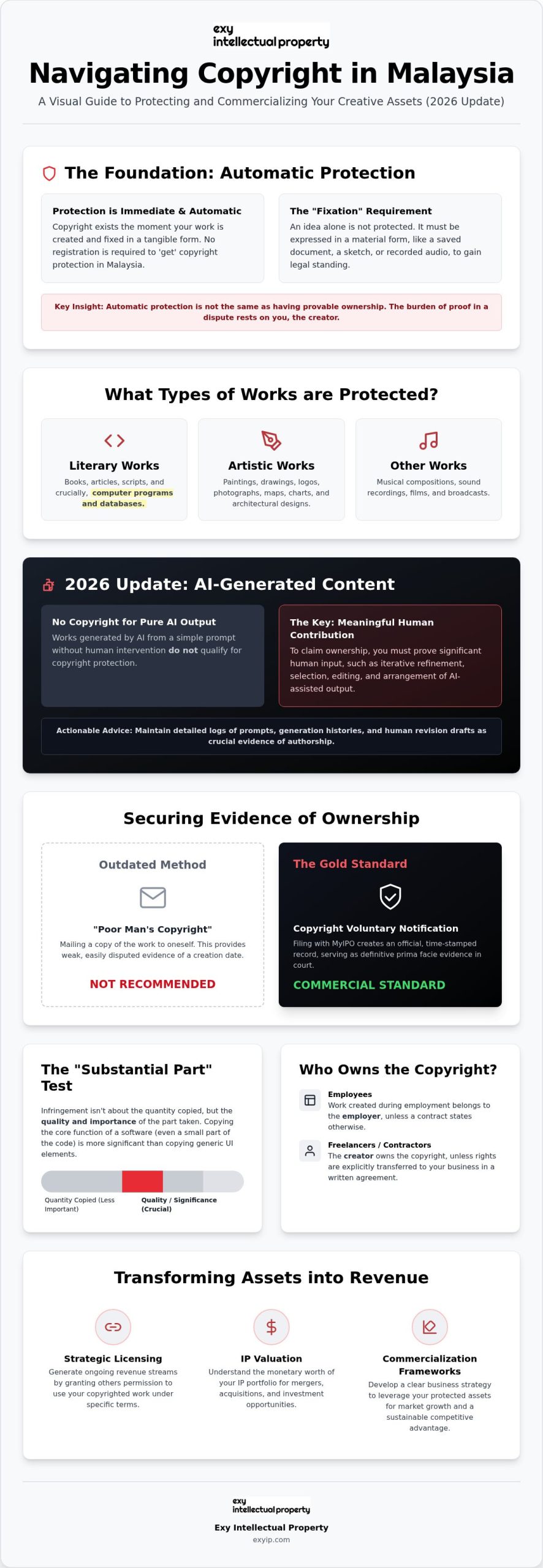
Protection is immediate. It’s automatic. In Malaysia, you don’t need to file an application to "get" copyright. Protection exists the moment your work is created and "fixed" in a tangible medium. Whether it’s a sketch on a napkin or a saved document on a cloud server, the law recognizes your right to that expression. However, this ease of entry creates a false sense of security. Many executives assume that because protection is automatic, it’s also easy to prove. This oversight often leads to significant hurdles when facing copyright infringement Malaysia, where the burden of proving ownership falls squarely on your shoulders.
Security starts with understanding what you actually own. You must distinguish copyright from trademarks and patents to avoid dangerous protection gaps. A trademark protects your brand identity, like a logo or slogan. A patent protects a novel invention or process. Copyright, conversely, protects the specific expression of an idea. If you confuse these categories, you might leave a proprietary software algorithm or a unique architectural design entirely exposed to competitors.
AI-Generated Content & Meaningful Human Contribution (2026 Updates)
In mid-2026, MyIPO issued a major public consultation proposing amendments to the Copyright Act 1987 to address artificial intelligence. Under current statutory principles and proposed codification, pure machine-generated output created via a bare prompt lacks human authorship and does not attract copyright.
To claim copyright over AI-assisted works (such as software, graphics, or written copy), businesses must demonstrate meaningful human creative contribution—such as iterative selection, refinement, and human edit trails. Maintaining prompt logs, generation histories, and human revision drafts is now essential to prove ownership.
The Requirement of Originality and Fixation
Ideas aren’t protected. Only the expression of those ideas in material form qualifies for legal coverage. To be eligible, a work must meet the threshold of "sufficient effort" to be considered original. This doesn’t mean it has to be a masterpiece; it simply means it wasn’t copied from somewhere else and required a degree of skill or labor to produce. If your work only exists in your mind, it doesn’t exist in the eyes of the law. You must fix it in a tangible medium to trigger protection.
Don’t let your creative value vanish into thin air. Always record brainstorming sessions, design drafts, or architectural sketches in a permanent digital or physical format. A dated digital file or a signed notebook provides the "fixation" necessary to defend your rights later.
Who Owns the Copyright? Employer vs. Creator
The default rule of ownership is straightforward but often misunderstood. Copyright typically belongs to the author of the work. However, there’s a vital exception for the corporate world. In Malaysia, the copyright for work created by an employee during the course of their employment belongs to the employer unless a written contract states otherwise. This is the statutory "work for hire" principle that ensures companies own the assets they pay their staff to create.
The situation becomes more complex with independent contractors. If you hire a freelancer to design your website or write your copy, they technically own the copyright unless you have a clear IP transfer clause in your agreement. We recommend auditing your service contracts today to ensure all creative rights are legally assigned to your business.
Scope of Protected Works and Duration of Rights
Copyright isn’t reserved for the gallery; it’s the engine room of modern commerce. In Malaysia, the law categorizes protected works into several distinct groups. Literary works are perhaps the most misunderstood. While they include books and scripts, they also encompass computer programs and databases. This makes your proprietary software code a literary work by legal definition, offering a first line of defense against copyright infringement Malaysia. Artistic works cover logos and photographs, but you must also consider industrial design infringement Malaysia when your creative output involves functional aesthetics. Musical works, sound recordings, films, and broadcasts round out the list, providing a shield for marketing agencies and digital content creators who produce video streams or audio ads.
Understanding these categories is vital for Protecting Intellectual Property in Malaysia effectively. Each category carries its own set of rules regarding how you can prevent unauthorized use. Protecting your work against copyright infringement Malaysia requires a clear understanding of where your rights begin and end. If a competitor uses your database structure without permission, it’s a clear case of infringement that can be addressed through the right legal channels.
Statutory Durations: How Long Does Protection Last?
Time is a critical factor in IP strategy. For literary, musical, and artistic works, protection lasts for the life of the author plus 50 years after their death. This long tail provides immense value for family estates and long-term brand equity. Published editions, sound recordings, and broadcasts have a shorter but still significant window; 50 years from the year of first publication or fixation. Tracking these timelines is essential for intellectual property protection for designers who want to ensure their portfolio remains a commercial asset for decades.
Moral Rights vs. Economic Rights
The law splits your authority into two categories. Economic rights are the tools of the entrepreneur. They give you the power to license, reproduce, and perform the work for profit. Moral rights, however, are personal to the creator. They include the right to be identified as the author and the right to prevent derogatory treatment that might harm their reputation. When your business undergoes an acquisition or merger, managing these rights is non-negotiable. You need to ensure that economic rights are fully transferred while respecting the lingering moral rights of the original creators.
Securing Evidence: The Role of Voluntary Notification
Automatic protection is a legal double-edged sword. While the law grants you rights the moment you create a work, it doesn’t provide a birth certificate for your intellectual property. This creates a challenging paradox for business leaders. You own the work, but proving that ownership during a dispute over copyright infringement Malaysia can be incredibly difficult without a formal paper trail. Relying on the automatic nature of the law often leaves companies vulnerable when a competitor claims they were the original creators.
Don’t rely on outdated myths. Mailing a sealed envelope to yourself, often called "poor man’s copyright," is insufficient in modern Malaysian courts. It lacks the official verification required to stand up against aggressive legal challenges. Instead, the Copyright Voluntary Notification system at MyIPO serves as the gold standard. By filing a notification, you create prima facie evidence of your ownership. This means the court accepts your claim as true unless the opposing party can provide overwhelming proof to the contrary. This documentation is equally vital when navigating a design patent registration MY or resolving trademark conflicts, as it establishes a clear timeline for your creative assets.
Filing Procedure & Form Requirements
Submitting a Voluntary Notification via MyIPO’s digital filing system requires completing Form CR-1 (detailing the work, category, publication status, and author/owner information). Where the application is filed via a appointed agent or corporate representative, Form CR-3 must also be executed alongside a Statutory Declaration affirming ownership.
The MyIPO Voluntary Notification Process
The process is methodical and designed to provide maximum legal security. It begins with filing a formal application and paying the necessary administrative fees. You must provide a clear copy of the work along with a Statutory Declaration. This declaration is a legal statement affirming that you are the rightful owner or have the legal authority to act on behalf of the owner. Using an advisor from Exy Intellectual Property is highly recommended here. We ensure the description of your work is legally robust, covering all technical or creative nuances that might be targeted during a copyright infringement Malaysia case.
International Recognition and the Berne Convention
Your protection doesn’t stop at the Malaysian border. Malaysia is a dedicated signatory to the Berne Convention. This international agreement ensures that your Malaysian copyright is recognized in over 170 countries worldwide. It’s a powerful tool for global expansion. A Voluntary Notification in Malaysia provides a solid foundation for enforcement in foreign jurisdictions. If your software or marketing content is pirated in Europe or North America, your MyIPO certificate acts as a credible starting point for international legal action. Treat your local notification as the cornerstone of a global brand protection strategy supported by Exy Intellectual Property.
Identifying and Addressing Copyright Infringement
Infringement is a direct hit to your bottom line. It occurs when a third party exercises your exclusive rights, such as reproduction or distribution, without your authorization. This is the core of copyright infringement Malaysia. For a business leader, identifying a breach early is the only way to prevent long term revenue loss. We view enforcement not just as a legal necessity, but as a guardian strategy to maintain the integrity of your market position.
The "Substantial Part" test is the legal yardstick used in Malaysian courts. It’s a common misconception that someone must copy your entire work to be liable. In reality, infringement is about quality and importance rather than just quantity. If a competitor takes the "heart" of your software code or the most distinctive elements of your marketing campaign, they’ve likely crossed the line. Even if they’ve only used a small fraction of the total work, the significance of that portion can trigger a legal claim.
You must also distinguish between primary and secondary infringement. Primary infringement involves the direct act of copying or performing the work. Secondary infringement targets the commercial supply chain. This includes importers, distributors, or sellers who deal with pirated goods while knowing, or having reason to believe, that the items are infringing copies. Stopping the source is vital, but cutting off the distribution network is equally effective in protecting your brand equity.
Defenses Against Infringement: Fair Dealing
The law does provide some breathing room through the "Fair Dealing" exception. This allows limited use of copyrighted material for specific purposes like research, private study, criticism, or news reporting. However, businesses shouldn’t rely on this for commercial gain. While the United States follows a broad and flexible "Fair Use" doctrine, Malaysia utilizes a more restrictive "Fair Dealing" framework that limits legal exceptions to specific, predefined purposes. If you’re using third party content for profit, you likely need a license.
Enforcement Strategies for Businesses
Swift action often prevents a minor leak from becoming a flood. A formal Cease and Desist letter from a specialized firm is usually the first and most cost effective step. It signals that you’re serious about your rights and often leads to a quick settlement. If the infringer persists, you can pursue civil remedies such as injunctions to stop the activity immediately, or claim damages and an account of profits to recover your losses. For large scale piracy or counterfeit operations, criminal enforcement through the Ministry of Domestic Trade and Cost of Living (KPDN) remains a powerful deterrent.
If you’ve discovered unauthorized use of your creative assets, you need a strategy that prioritizes your commercial interests. Contact us today to discuss how our team at Exy Intellectual Property can support your Intellectual Property Litigation needs and restore your competitive advantage.
Strategic Commercialization of Copyright Assets
Protection is the foundation, but commercialization is the ceiling. While securing your work against copyright infringement Malaysia is essential for defense, the true power of intellectual property lies in its ability to generate consistent revenue. Profit is the primary goal for any business leader. By transitioning from a defensive posture to a proactive commercial strategy, you can turn your creative works into high yield financial instruments. This shift requires a deep understanding of how your fixed assets, such as proprietary software or original branding, can be scaled through the right legal frameworks.
Asset management leads directly to a higher business valuation. When you treat your copyright portfolio as a quantifiable asset, you build a more attractive proposition for investors and lenders. This is particularly relevant when integrating your creative content into a broader franchise consultancy Malaysia strategy. In a franchise model, your copyright acts as the blueprint for consistency. It covers everything from operational manuals to unique marketing materials, ensuring that every branch maintains the standards of the parent brand.
Licensing and Franchising Agreements
Licensing is the most direct way to monetize your work without surrendering ownership. You must decide between exclusive and non-exclusive licenses. An exclusive license grants a single partner the right to use your work, often for a higher fee, while non-exclusive agreements allow you to partner with multiple entities simultaneously. Every robust license must include specific clauses defining the territory of use, the duration of the agreement, and the royalty structures. These controls ensure that you maintain brand consistency and prevent the dilution of your intellectual property while it scales in the marketplace.
IP Valuation: Unlocking Hidden Capital
Traditional accounting often misses the mark. Standard balance sheets frequently fail to capture the true value of creative works, leaving significant capital hidden from view. To fix this, Exy Intellectual Property uses specialized valuation methods to determine the economic worth of your portfolio. The Cost Approach looks at the expense of recreating the work; the Market Approach compares it to similar assets; and the Income Approach forecasts the future revenue the asset will generate.
Exy Intellectual Property assists in quantifying these values to support your corporate financing, mergers, and acquisitions. Knowing the exact worth of your copyright portfolio gives you the leverage needed during high stakes negotiations. It transforms your creative effort from an intangible concept into a concrete, bankable asset that drives long term growth.
Securing Your Creative Future in 2026 and Beyond
Protecting your intellectual property is no longer just a legal checkbox. It’s a strategic necessity. By mastering the foundations of the law and utilizing the Voluntary Notification process, you build a robust defense. This proactive stance ensures your business is never left vulnerable to copyright infringement Malaysia. You now have the tools to identify protected works, secure evidence of ownership, and transform your creative output into a quantifiable revenue stream.
We’re dedicated to helping you bridge the gap between protection and profit. Our firm provides specialized IP litigation and advisory services, alongside comprehensive IP valuation for tech and creative industries. With our established expertise in global IP protection, your professional interests are in safe, capable hands. Secure your creative assets with Exy IP’s Voluntary Notification services today. We look forward to supporting your long term commercial success and protecting the integrity of your vision.
Frequently Asked Questions
Do I need to register my copyright in Malaysia to be protected?
Protection exists automatically the moment your work is created and fixed in a tangible medium. You don’t need to register it to gain legal rights under the Copyright Act 1987. However, relying on automatic protection makes it difficult to prove ownership during a dispute. We recommend the Voluntary Notification process to establish a clear, dated record of your intellectual property. This proactive step simplifies enforcement and provides the security necessary for commercial growth.
What is a Copyright Voluntary Notification and why is it important?
A Copyright Voluntary Notification is a formal filing with the Intellectual Property Corporation of Malaysia (MyIPO) that establishes prima facie evidence of ownership. It’s important because it shifts the burden of proof in legal disputes. Without this certificate, you must provide extensive internal documentation to prove you are the creator. This notification acts as a birth certificate for your work, making it significantly easier to address cases of copyright infringement Malaysia with a clear, court-admissible record of ownership.
How long does copyright protection last for a company logo in Malaysia?
Protection for an artistic work, such as a logo, generally lasts for the life of the author plus 50 years after their death. If the logo is created by an employee during the course of their employment, the company typically owns the rights. It’s vital to track these timelines to maintain long term brand equity. Proper documentation ensures your visual identity remains a protected commercial asset that you can license or franchise securely.
Can I copyright an idea for a business or a new app?
You cannot copyright a raw idea, business concept, or the general functionality of an app. The law only protects the specific expression of those ideas once they’re fixed in a material form. This includes the app’s source code, written content, and unique graphic interface elements. To protect the underlying "idea" or invention, you should explore patent filing instead. Security starts with understanding which legal tool applies to each part of your innovation.
What should I do if I find someone using my copyrighted work online?
Your first priority should be documenting the unauthorized use with time stamped screenshots and URLs. Once you have evidence, you can issue a formal Cease and Desist letter through a specialized IP firm to demand the removal of the content. Most digital platforms also provide notice and takedown procedures under their terms of service. Swift action is necessary to prevent copyright infringement Malaysia from devaluing your original work or confusing your customer base.
Is my Malaysian copyright valid in other countries like the US or UK?
Yes, your Malaysian copyright is recognized in over 180 countries, including the US and UK, because Malaysia is a signatory to the Berne Convention. This international treaty ensures that works created by Malaysians receive the same protection in foreign jurisdictions as they do locally. While the laws are largely harmonized, the methods for enforcement may vary. Using your Malaysian Voluntary Notification as a foundation helps streamline international protection and licensing efforts.
What is the difference between copyright and a trademark in Malaysia?
Copyright protects original creative expressions like books, software, and photographs, while a trademark protects brand identifiers like names and slogans. A trademark’s primary function is to indicate the commercial source of a product or service to prevent consumer confusion. Copyright, conversely, focuses on the labor and skill invested in creating the work itself. Businesses often need both to fully secure their assets, such as a logo that is both an artistic work and a brand mark.
Can software code be protected under Malaysian copyright law?
Software code is explicitly protected as a literary work under the Copyright Act 1987 in Malaysia. This includes both the source code and the object code of your programs. Because software is often a company’s most valuable asset, securing it through formal documentation is a critical business strategy. Proper protection allows you to license your technology safely and prevents competitors from reproducing your proprietary systems without authorization or compensation.