


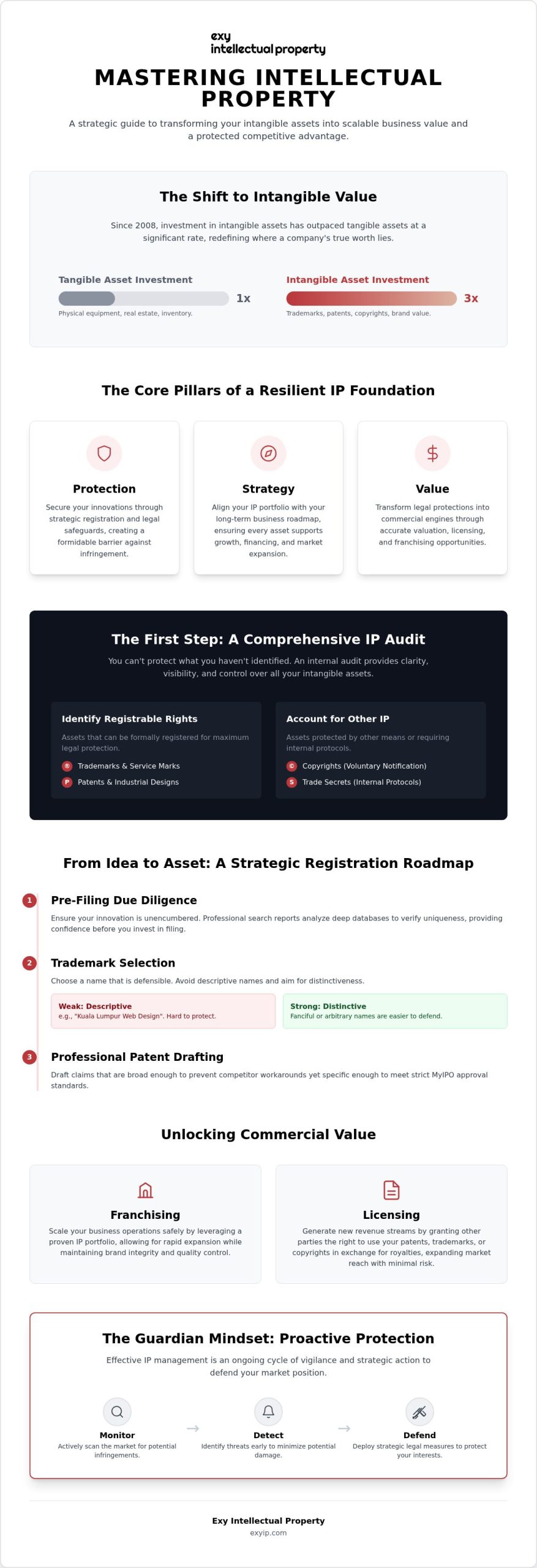
Since 2008, investment in intangible assets has grown three times faster than investment in tangible assets. Value. Security. Scalability. For many Malaysian entrepreneurs, your company’s true worth isn’t found in physical equipment but in the trademarks and patents you’ve meticulously built. It’s natural to feel a sense of unease regarding potential infringement or the complexity of filing across international borders. You’ve worked hard to create something unique; seeing it compromised because of a legal oversight is a risk you shouldn’t have to take. Mastering the best practices for intellectual property management ensures your innovation remains a protected competitive advantage.
We’re here to help you move beyond simple defense. This guide reveals the professional frameworks and commercial strategies used by Exy IP to transform your intellectual assets into scalable business value. You’ll discover a clear roadmap for protection that goes beyond basic registration to include strategic monetization through licensing and franchising. We’ll explore how to accurately value your intangible assets to secure financing and boost your company’s market worth. From navigating MyIPO regulations in 2026 to mastering global patent filings, this overview provides the clarity you need to lead with confidence.
Key Takeaways
- Learn how to identify and categorize your intangible assets through a structured internal audit to ensure every innovation is legally protected.
- Master proven intellectual property strategies to ensure your trademarks and patents serve as high-value growth engines.
- Understand the critical role of professional IP valuation in securing business financing and maximizing your company’s worth during mergers or acquisitions.
- Discover how to scale your operations safely using franchising and licensing frameworks that maintain your brand’s integrity while expanding its reach.
- Establish a proactive monitoring system to detect potential infringement early and learn when to deploy strategic legal measures to defend your interests.
Establishing a Business-Centric Intellectual Property Foundation
Protection. Strategy. Value. These are the pillars of a resilient business foundation. Intellectual property isn’t a static legal requirement; it’s a dynamic commercial engine that fuels long-term growth. In the Malaysian market, many businesses treat registration as a reactive task rather than a strategic priority. This often leads to missed opportunities and increased vulnerability. By shifting your perspective, you treat your IP as a core business asset that dictates market advantage. Adopting proactive intellectual property practices involves moving away from simply defending your ideas and toward actively managing them to maximize their commercial utility.
Every successful strategy begins with an internal IP audit. You can’t protect what you haven’t identified. Many companies possess unregistered trademarks or proprietary processes that remain "blind spots" until a competitor replicates them. This proactive identification is crucial. It prevents the devastating costs of rebranding or litigation that occur when a business discovers too late that its primary brand name or core technology is already in use by another party. Early-stage identification ensures you build your brand on a secure, unencumbered foundation.
The Audit: Identifying Your Core Intellectual Assets
Clarity. Visibility. Control. A professional audit evaluates the commercial impact of every asset on your revenue streams. It’s not just about what can be registered; it’s about what drives your business value. This process requires differentiating between registrable rights, such as trademarks and patents, and voluntary notifications like copyright. For instance, a unique manufacturing process in a local factory might be a trade secret that requires strict internal protocols rather than a public patent filing. By providing a comprehensive overview of intellectual property within your own walls, you ensure that every design element and proprietary process is accounted for, closing the gaps that competitors might exploit.
Navigating AI-Generated Content & Copyright (2026 Standards)
Auditing digital assets in 2026 requires navigating artificial intelligence guidelines. Under MyIPO examination principles, pure machine-generated output created via a bare prompt lacks human authorship and does not attract copyright. To qualify for a Voluntary Notification certificate or trade secret protection for AI-assisted works (such as code, graphics, or written copy), the applicant must document meaningful human creative contribution—including prompt iteration logs and human edit trails.
Aligning IP Protection with Your Business Roadmap
Anticipation. Growth. Security. Strategic protection must mirror your commercial timeline. If you’re planning a major product launch in late 2026, your IP filings should be completed well in advance to secure priority. This alignment supports your long-term goals, whether you’re aiming for a public listing on Bursa Malaysia or seeking international expansion. Leadership teams must adopt a "Guardian" mindset. This means viewing every innovation through the lens of its future valuation and its role in your exit strategy. Integrating a business-centric IP strategy ensures your portfolio becomes an attractive asset for investors and a formidable barrier for competitors.
Strategic Registration: Best Practices for Patents and Trademarks
Registration is the bridge between an idea and an asset. It’s where legal theory meets commercial reality. To secure your market position, you must execute registration with surgical precision. Best practices in IP registration start with rigorous due diligence long before any paperwork reaches MyIPO. This proactive approach ensures that your investments in research and development aren’t wasted on concepts that are already legally claimed by others. It’s about building a fortress around your innovation from day one.
Trademark selection demands an equally strategic eye. Many business owners make the mistake of choosing descriptive names that simply state what they sell. These are notoriously difficult to protect. Instead, aim for distinctiveness. A unique, fanciful, or arbitrary brand name is easier to defend and much harder for competitors to mimic. Professional drafting further strengthens this defense. It ensures your patent claims are broad enough to prevent competitor workarounds while remaining specific enough to meet strict approval standards in 2026.
The Pre-Filing Phase: Searches and Due Diligence
Precision. Verification. Confidence. A basic internet search is never sufficient for high-stakes innovation. Professional search reports analyze deep databases, including technical journals and expired patents, to provide a clear picture of the existing landscape. Conducting a comprehensive novelty search is a non-negotiable prerequisite for any technological innovation to ensure its patentability and avoid costly legal conflicts. This step allows you to analyze competitor IP landscapes and pivot your strategy if you encounter existing rights. By following established best practices for patents, you ensure your application stands up to scrutiny from examiners and potential litigants alike.
Mitigating Post-Grant Opposition Risks
In 2026, receiving a patent grant from MyIPO is no longer the final step in securing your monopoly. Under Sections 55A and 56A of the Patents (Amendment) Act 2022, third parties have a strict, non-extendable six-month window from the date a grant is published in the IP Official Journal (IPOJ) to file an administrative post-grant opposition directly with MyIPO. Ensuring your initial patent claims feature layered dependent claims protects your technical asset from post-grant competitor challenges.
Global Expansion: Securing Rights Across Borders
Scalability. Reach. Protection. Growth doesn’t stop at the Malaysian border. If your roadmap includes international markets, your protection strategy must follow. Utilizing the Madrid Protocol allows for efficient global trademark registration across multiple jurisdictions with a single application. This streamlines the process and reduces administrative overhead significantly. However, patents often require a more nuanced, territory-by-territory approach. Accessing strategic patent filing services Malaysia provides the local expertise needed to navigate regional variations in IP law across Southeast Asia and major global hubs. If you’re planning to export your products or services, verifying your international trademark availability is a vital first step to avoid infringing on foreign entities.
Accelerating Prosecution via Patent Prosecution Highway (PPH)
Standard substantive examination for patents in Malaysia typically spans 24 to 36 months. However, applicants can significantly accelerate this timeline down to under 12 months by filing a Patent Prosecution Highway (PPH) request with MyIPO. By leveraging favorable examination results from PPH partner offices (such as the USPTO, EPO, JPO, KIPO, or IPOS), MyIPO fast-tracks the local examination process.
Maximizing Asset Value through Professional IP Valuation
Growth. Recognition. Liquidity. Your intellectual property is often the most valuable asset on a modern balance sheet, yet it frequently remains under-leveraged. While registration provides the legal shield, valuation provides the commercial compass. Understanding the monetary worth of your trademarks and patents is a prerequisite for mergers, acquisitions, and successful business exits. Without a certified valuation, you risk leaving significant capital on the table during negotiations. Accurate reports ensure that your company’s true worth is recognized by potential buyers and partners alike.
Integrating certified IP valuation methodologies allows you to treat your IP as tangible collateral. In 2026, IP-backed financing has emerged as a sophisticated best practice for Malaysian SMEs looking to scale without diluting equity. By presenting a rigorous valuation report to financial institutions, you demonstrate that your intangible assets have measurable market value. This shifts the conversation from a legal expense to a capital asset. Regular valuation reports strengthen your investor appeal by providing a transparent view of your company’s growth potential and asset security.
Valuation Methodologies for Intangible Assets
IP valuation is the systematic process of quantifying the economic value of an intangible asset to facilitate informed commercial decision-making. There is no one-size-fits-all approach. Determining which methodology fits your specific asset type is critical for accuracy. For instance, a consumer brand might favor a market-based approach, while a unique software patent is often better suited to income-based modeling. Common methodologies include:
- Cost-based: Focuses on the actual expense required to recreate or replace the asset.
- Market-based: Establishes value by comparing the asset to similar third-party transactions in the industry.
- Income-based: Projects the future cash flows and revenue streams directly attributable to the asset’s use.
Leveraging Valuation for Financing and Growth
Strategy. Foresight. Expansion. You should approach trademark registration Malaysia with an eye toward future asset worth. A registered mark is the first step, but its value grows as it captures market share. Valuation reports are also vital for setting royalty rates in licensing agreements. They provide an objective baseline that protects your interests while incentivizing partners. Effectively communicating this worth to stakeholders ensures your leadership team and investors are aligned on the company’s true economic trajectory. By utilizing professional valuation, you transform abstract ideas into concrete financial instruments that drive your business forward.
Commercialization Strategies: Franchising and Licensing
Profitability. Expansion. Leverage. Protecting your assets is only the first half of the journey. The real power of intellectual property lies in its ability to be cloned, rented, or scaled for market dominance. By implementing commercial IP strategies, you shift from a defensive posture to an offensive market position. This synergy between robust legal protection and a scalable business model allows you to replicate your success across new territories without losing control of your original vision.
Applying robust licensing frameworks ensures that your contractual terms are both enforceable and attractive to potential partners. It’s about creating a win-win scenario where your IP generates revenue while your partners grow their own ventures under your umbrella. Whether you’re eyeing a nationwide franchise rollout or a niche licensing deal, your IP portfolio is the engine that drives these opportunities forward.
Franchising: Scaling the Business Model Safely
Scaling a local business into a national brand requires more than just a successful storefront; it requires a legally bulletproof package of intellectual assets. Before you offer your first franchise opportunity, every core trademark, logo, and proprietary process must be registered. Managing the transfer of know-how and trade secrets is a delicate balance. You must share enough for the franchisee to succeed while maintaining strict confidentiality to protect your competitive edge. Accessing franchise consultancy Malaysia ensures that your brand consistency is upheld through rigorous enforcement guidelines. This proactive stance prevents the dilution of your brand equity as your network grows, keeping your reputation secure across every RM spent on expansion.
Licensing: Generating Passive Revenue from IP
Licensing allows you to generate passive revenue by granting third parties the right to use your IP in exchange for royalties. Many Malaysian businesses sit on underutilized assets, such as specific software modules or unique aesthetic designs, that could be profitable in other industries. A high-performance licensing agreement clearly defines the territory, duration, and royalty structures to ensure both parties benefit. It’s equally important to protect the "look and feel" of your physical products. Securing industrial design protection in Malaysia prevents copycat products from appearing within your own supply chain or franchise network. This layer of security ensures that your innovation remains uniquely yours, even when handled by external partners. If you’re ready to turn your assets into income, consult with our commercialization experts to draft agreements that prioritize your long-term growth.
Proactive Protection and IP Litigation Best Practices
Vigilance. Defense. Resilience. Receiving your registration certificate from MyIPO is a significant milestone, but it isn’t the finish line. The true test of an asset’s value lies in your ability to defend it against encroachment. Adopting a proactive IP defense strategy means establishing a continuous monitoring system. This ensures that your market share isn’t eroded by competitors who might "borrow" your brand identity or technical innovations. It’s about maintaining the integrity of your portfolio through every stage of the business lifecycle.
Validity requires consistent upkeep. You must maintain rigorous documentation of "continuous use" to prevent your trademarks from being vulnerable to cancellation for non-use. In Malaysia, failing to renew your registration or a lack of use for a continuous three-year period can lead to the loss of your hard-earned rights. Specialized expertise is crucial here. General legal counsel might miss the nuances of IP-specific deadlines or the specific types of evidence required to prove use in a contested hearing. A specialized approach ensures your legal shield remains sharp and effective.
Monitoring and Enforcement Frameworks
Awareness is your first line of defense. Setting up digital alerts for trademark misuse and patent infringement allows you to catch bad actors before they gain market traction. For creative works, a copyright voluntary notification serves as vital prima facie evidence in Malaysian courts, significantly simplifying the burden of proof during a dispute. You should also consider collaborating with customs authorities to prevent counterfeit goods from entering the country. This proactive best practice protects both your revenue and your brand reputation from the damage caused by inferior imitations.
Navigating IP Disputes and Litigation
Preparation. Strategy. Resolution. When infringement is detected, a "Cease and Desist" letter is a critical first step. You must strategically decide whether to negotiate a settlement or proceed to full-scale litigation. Negotiation is often the most cost-effective route, saving your business significant RM in legal fees and avoiding lengthy court timelines. However, you must be prepared to litigate if a competitor refuses to stop their infringing activities. Building a "litigation-ready" portfolio from day one ensures you have the documentation needed to prevail. For complex disputes that require a business-savvy guardian, contact the experts at Exy Intellectual Property for specialized legal advisory that prioritizes your long-term commercial health.
Securing Your Commercial Future Through Strategic IP Management
Intellectual property is the heartbeat of your business’s market value. Transitioning from basic registration to a comprehensive commercial strategy is what separates market leaders from their competitors. By integrating the best practices for Intellectual Property Exy Intellectual Property provides, you ensure your innovations are not just protected but actively driving your company’s valuation. Whether you’re conducting an internal audit or preparing for international expansion, every step should be taken with a business-savvy guardian mindset that prioritizes long-term health over short-term fixes.
The path to scalability requires a partner who understands the intersection of law and entrepreneurship. You need access to specialized IP valuation experts, a global registration network, and business-centric legal advisory to navigate the complexities of the 2026 Malaysian market with absolute confidence. These resources turn your intangible assets into powerful financial instruments. Your ideas deserve the highest level of professional care to reach their full economic potential. Don’t leave your most valuable assets to chance. Secure your business assets with Exy Intellectual Property today. Your vision has the power to reshape your industry; we’re here to ensure it stays protected and profitable for years to come.
Frequently Asked Questions
What are the first steps in an intellectual property best practices checklist?
The first step is conducting a comprehensive internal IP audit. You need to identify every trademark, patent, and trade secret within your organization. Once identified, categorize these assets based on their commercial impact and registration status. This foundational step ensures you aren’t leaving valuable assets unprotected. Establishing a structured IP best practices framework allows you to build a secure roadmap for future growth and investment.
How often should a business perform an intellectual property audit?
You should perform an IP audit at least once a year. Regular reviews ensure your protection stays aligned with your evolving business goals. It’s also vital to conduct an audit before major milestones like international expansion, product launches, or seeking new investors. This proactive habit helps you identify new innovations that require filing and ensures your existing registrations remain valid. Consistent monitoring prevents costly legal gaps as your company scales.
Why is patent drafting considered a critical best practice for tech startups?
Professional patent drafting ensures your technical claims are robust enough to withstand legal challenges. For tech startups, your patent is often your most valuable asset. If the drafting is too narrow, competitors can easily work around it; if it’s too broad, it might be rejected by MyIPO. High-quality drafting bridges this gap. It provides the legal certainty investors look for when valuing your company during early-stage funding rounds.
Can I use my intellectual property as collateral for business financing?
Yes, you can leverage your intellectual assets to secure business financing. This process, known as IP-backed financing, is a sophisticated way to gain capital without diluting your equity. To do this, you’ll need a certified valuation report to prove the economic worth of your patents or trademarks to financial institutions. By following proactive IP management strategies, you transform abstract ideas into tangible financial collater for growth.
What is the difference between trademark registration and copyright voluntary notification?
Trademark registration protects brand identifiers like names, logos, and slogans from being used by competitors. Copyright voluntary notification, however, is used for original creative works such as software code, manuals, or artistic designs. While copyright exists automatically upon creation, a voluntary notification in Malaysia provides prima facie evidence of ownership. This documentation is incredibly helpful if you ever need to prove your rights in a court of law or during a dispute.
How does franchising consultancy help in protecting my brand identity?
Franchising consultancy creates a legal and operational framework for sharing your brand safely. It ensures that every franchisee adheres to strict brand guidelines, which prevents the dilution of your trademark’s value. A consultant helps you draft agreements that clearly define how your IP is used, monitored, and protected across the entire network. This structure allows you to scale your business model while maintaining absolute control over your brand’s reputation and identity.
What should I do if I discover someone is infringing on my intellectual property?
You should immediately document the infringing activity and consult with a specialized IP litigation expert. Don’t confront the infringer directly without legal advice. A professional will help you evaluate the situation and determine if a "Cease and Desist" letter is the right first step. Negotiation is often the goal to reach a settlement, but being "litigation-ready" ensures you have the evidence needed if the case proceeds to a Malaysian court.
How does IP valuation affect the sale price of a company?
A professional IP valuation often significantly increases the final sale price of a company. In many industries, intangible assets represent a larger share of economic value than physical equipment. By quantifying the future revenue potential of your trademarks and patents, you provide buyers with a clear justification for a higher acquisition cost. This transparency reduces perceived risk for the investor and ensures you receive the full RM value for your years of innovation.