


Value. Security. Growth. What if your most valuable asset isn’t the office you rent, but the innovation you’ve built? For many Malaysian entrepreneurs, the lack of physical property often feels like a dead end when seeking bank financing. It’s a common frustration. You’ve spent years developing proprietary technology, yet traditional lenders still ask for land titles as security. The legal landscape has evolved. Under the Patents (Amendment) Act 2022, using patents as collateral Malaysia is a viable path to securing growth capital. This guide provides a clear roadmap to navigate MyIPO requirements and prove your patent’s monetary value to lenders. You’ll learn how to leverage specialized valuation experts and the latest IP-backed financing programs to unlock the hidden capital in your portfolio. By the end, you’ll understand how to secure the funding your business deserves without relying on physical bricks and mortar.
Key Takeaways
- Understand how the Patents (Amendment) Act 2022 establishes your intellectual property as personal property, allowing it to serve as a legal foundation for business loans.
- Learn the systematic process of using patents as collateral Malaysia by registering a formal security interest with MyIPO to satisfy banking requirements.
- Identify the critical role of professional patent valuation in translating technical specifications into a bankable monetary value that lenders can trust.
- Discover how to conduct an IP audit to select the most commercially viable patents from your portfolio for a successful financing application.
- Explore how strategic patent drafting and commercialization advisory can strengthen the quality of your assets before you approach financial institutions.
The Rise of Intellectual Property Financing in Malaysia
Strategy meets capital. In a rapidly evolving market, patent-backed financing has emerged as a sophisticated method for businesses to secure credit by pledging their intangible assets. This approach redefines what is collateral in a modern economy, moving beyond the traditional reliance on physical property like land or machinery. As Malaysia transitions toward a knowledge-based economy, the tech ecosystem is witnessing a significant shift. Lenders are no longer just looking at your office space; they’re looking at your innovation. This change requires a "Business-Savvy Guardian" mindset, where protecting your invention is just the first step toward leveraging it for financial growth.
The core advantage of using patents as collateral Malaysia lies in its ability to turn legal protection into liquid value. For many SMEs and startups, their most significant investments are found in research and development. By using these patents to secure loans, they can bridge the gap between invention and commercial success without sacrificing ownership.
Why Use Patents as Collateral?
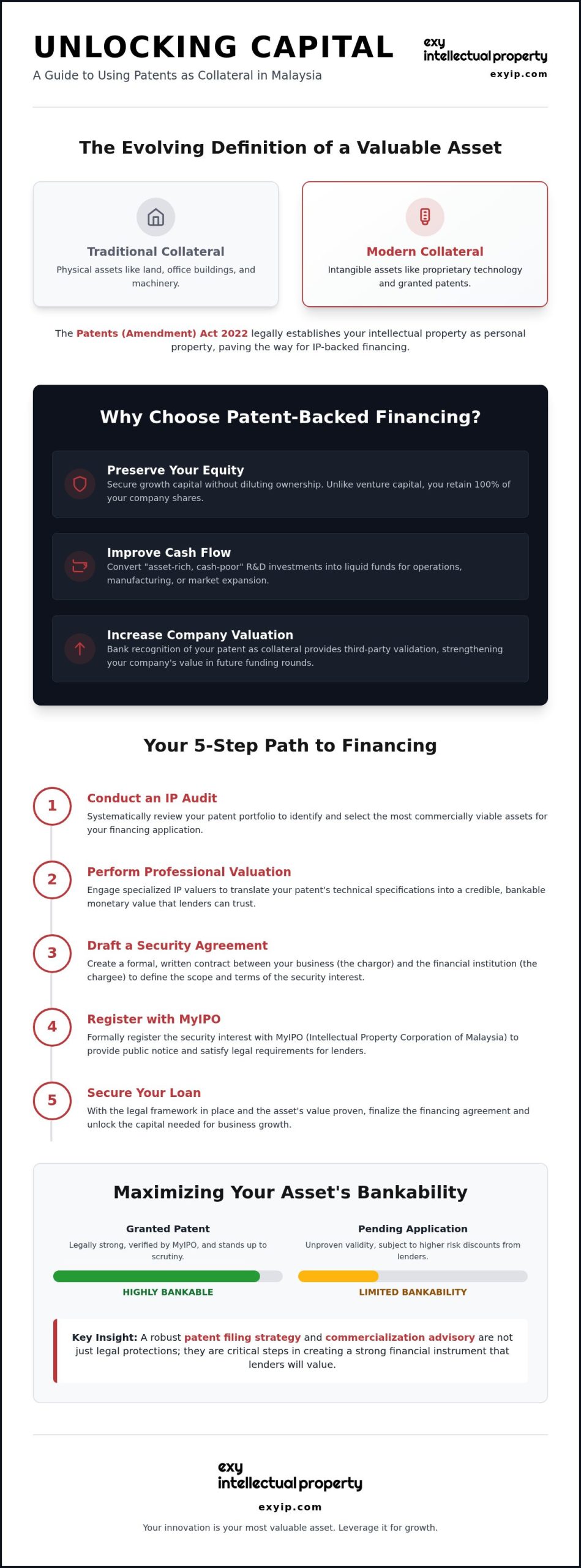
Preserve your equity. One of the most compelling reasons to choose IP-backed debt is the ability to retain control. Unlike venture capital, which often requires giving up a portion of your company, using your patent portfolio as security allows you to secure funding while keeping 100% of your shares. This is a strategic move for founders who believe in their long-term vision and don’t want to dilute their stake prematurely.
Improve your cash flow. High R&D costs can often leave a business "asset-rich but cash-poor." Leveraging these patents allows you to recycle that spent capital back into your operations, providing the necessary funds to scale manufacturing or expand into new markets. Additionally, having a bank recognize your patent as collateral can significantly increase your company’s valuation during future funding rounds, as it provides a third-party validation of your asset’s worth.
Current Trends in the Malaysian IP Landscape
Government initiatives are driving this change. Agencies like MyIPO and SME Corporation Malaysia have actively built a supportive ecosystem. For instance, the RM10 million IP Financing Fund established by SME Corp is a clear signal that the state views intellectual property as a cornerstone of national economic health. The 2026 regulatory environment has further streamlined how banks recognize these assets, making the application process more predictable for business owners.
Success depends on quality. Banks only accept assets they can value and verify. This makes a robust patent filing services Malaysia strategy essential. A poorly drafted patent is a weak financial instrument. By ensuring your filings are technically sound and commercially relevant, you create a bankable asset that stands up to the rigorous scrutiny of financial institutions and specialized IP valuers.
The Legal Framework: Creating Security Interests over Patents
Clarity is the foundation of credit. When using patents as collateral Malaysia, business owners must navigate a specific legal framework to ensure their intangible assets are recognized as bankable security. Under the Patents Act 1983, a patent is legally classified as a form of personal property. This classification is vital because it allows the asset to be pledged to a lender through a "Security Interest." This interest acts as a legal guarantee, providing the bank with a right to the asset if the borrower fails to meet their obligations.
The process begins with a formal written agreement. This contract between the chargor (the business) and the chargee (the bank) must be meticulously drafted to be enforceable. It defines the scope of the security and the conditions of the loan. Seeking professional legal advisory is a strategic necessity here. Expert guidance ensures that the documents are not merely generic templates but robust legal instruments that protect your commercial interests while satisfying the bank’s risk requirements.
Lenders prioritize certainty. For this reason, a granted patent is significantly more "bankable" than a pending application. A granted patent has already survived substantive examination by MyIPO, proving its technical validity and legal strength. While some specialized lenders may consider pending applications, they often apply much higher risk discounts, which can reduce the amount of capital you’re able to secure. Transitioning from a "patent pending" status to a granted right is the most effective way to maximize your borrowing power.
Registration with MyIPO
Public notice is mandatory. Once a security agreement is executed, the interest must be recorded in the Register of Patents at MyIPO. This step is known as "perfection." By registering the interest, you provide public notice to all other potential creditors. This establishes a clear priority of claims. If a business owner attempts to use the same patent as collateral for a second loan, the first registered creditor typically holds the primary right to the asset. A common pitfall is failing to register the interest promptly, which can leave the lender’s security vulnerable and may even lead to a technical default of the loan terms.
Due Diligence and Ownership Verification
Verify the chain of title. Before a bank accepts a patent, they’ll conduct thorough due diligence to ensure the business truly owns the asset. This involves checking that all assignments from inventors to the company are properly documented and that all maintenance fees are paid up to date. Lenders may also require a patent novelty search to confirm the asset’s uniqueness and ensure it hasn’t been weakened by newer, similar inventions. This level of scrutiny ensures that the patent remains a high-value, defensible asset throughout the life of the loan.
Strategic Patent Valuation: Determining Collateral Value
Precision defines value. To satisfy bank risk committees and international audit standards, patent valuation reports must adhere to International Valuation Standards (IVS 210 for Intangible Assets). Certified independent valuers apply income-based relief-from-royalty models to calculate both Fair Market Value and Liquidation Value.
Banks look at value through two distinct lenses. Fair market value represents what the patent is worth in a healthy, open market between a willing buyer and seller. However, for financing purposes, lenders often focus on "liquidation value." This is the estimated amount the bank could recover if they had to sell the asset quickly to settle a debt. Understanding this distinction helps you manage expectations regarding the loan-to-value ratio you might receive. Since patents are wasting assets with a finite lifespan, you should also expect periodic re-valuation. As the 20-year protection term nears its end, the asset’s ability to generate exclusive income decreases, which directly impacts its status as collateral.
Common Valuation Methodologies
The Income Approach is the most common for using patents as collateral Malaysia. It forecasts future cash flows directly attributable to the patent. If your technology reduces manufacturing costs or enables a premium price point, that specific profit is quantified and discounted to present value. The Market Approach compares your patent with similar licensed or sold assets. While this provides real-world context, it can be challenging in niche sectors where public data on IP transactions is scarce. Finally, the Cost Approach calculates what it would cost to recreate the innovation from scratch. This usually serves as the "floor" value, representing the minimum investment required to reach the current stage of development.
Factors That Influence Patent Value
Time and geography are your primary variables. A patent with 15 years of remaining protection is significantly more bankable than one with only three. Similarly, a portfolio that includes international filings offers a broader market for potential liquidation, increasing the lender’s security. Technical robustness is equally vital. The quality of the patent drafting determines how well the asset survives legal challenges and competitors’ attempts to "design around" your invention. A well-drafted patent provides the "freedom to operate" that lenders look for when assessing risk. For a deeper dive into these mechanics, you can review our intellectual property valuation methodology guide.
Steps to Secure a Loan Using Your Patent Portfolio
Execution is everything. Moving from a technical invention to a bankable asset requires a methodical approach. The journey of using patents as collateral Malaysia begins with a rigorous internal audit. Not every patent in your portfolio is suitable for financing. You must identify "hero" assets that demonstrate clear market demand and significant revenue potential. Once identified, you’ll need the professional valuation report discussed earlier to serve as your primary evidence of value. This document is the cornerstone of your application, providing the financial justification the lender needs to approve your facility.
Preparing Your Business for IP Financing
Align your assets with your ambition. Before approaching a bank, ensure your IP strategy mirrors your company’s five-year financial roadmap. Lenders look for consistency. They want to see that the patent you’re pledging is central to your revenue growth. It’s also vital to ensure the asset is in good standing. This means all maintenance fees must be paid to MyIPO. A single missed payment can jeopardize the patent’s validity and, consequently, its status as collateral. Finally, craft a compelling "commercialization story." This narrative explains how your technology dominates its niche and why it will continue to generate cash flow throughout the loan term.
Negotiating with Financial Institutions
Know your audience. Different lenders have varying risk appetites for intangible assets. While some may be hesitant, others are increasingly comfortable with IP-backed models. In 2026, with the RM10 million IP Financing Fund from SME Corp and the 2.75% Overnight Policy Rate influencing lending costs, the environment is more favorable than ever. If a lender is cautious, consider a "hybrid collateral" model. This involves combining your patent with physical assets, such as equipment or property, to lower the bank’s risk profile. This often results in better interest rates and higher Loan-to-Value (LTV) ratios.
Define the terms carefully. Negotiate "Events of Default" that are specific to intellectual property. For example, a temporary dip in market share shouldn’t necessarily trigger a seizure of your patent. Instead, focus on triggers like the loss of a key license or a successful legal challenge to the patent’s validity. Once terms are agreed upon, execute the security agreement and register it with MyIPO immediately to perfect the bank’s interest. To ensure your portfolio is ready for this process, you can explore our specialized Intellectual Property Financing advisory services to bridge the gap between innovation and capital.
Stay vigilant. After the loan is secured, your responsibility continues. You must monitor the patent’s lifecycle and enforce your rights against infringers. If the patent’s value drops due to neglect, the bank may require additional collateral. Proactive management keeps the asset strong and the lender satisfied.
Maximizing Asset Value with Exy IP Financing Solutions
Protection. Strategy. Growth. At Exy Intellectual Property, we don’t just view patents as legal certificates; we see them as powerful financial engines. Our role as your "Business-Savvy Guardian" is to ensure that your innovation isn’t just protected but is also positioned for maximum commercial leverage. In the context of using patents as collateral Malaysia, this means bridging the gap between technical brilliance and bankable reality. We provide the steady, supportive guidance needed to navigate the complexities of the Malaysian regulatory environment while keeping your long-term business health at the forefront.
Success in IP financing requires more than just a granted patent. It demands a portfolio that is structured to withstand the scrutiny of a bank’s risk department. We act as a proactive advisor, looking for ways to add value to your venture well before you approach a lender. Our firm’s national reach and deep familiarity with MyIPO’s security interest registration process provide the reliability you need to turn intangible ideas into tangible capital.
End-to-End IP Strategic Advisory
The journey to successful financing begins long before you enter a bank. It starts with a comprehensive patent search to confirm that your asset is truly unique and defensible. From there, our integrated approach covers the entire lifecycle of your intellectual property. We assist in drafting patent specifications that aren’t just legally sound but are also technically robust enough to withstand intense due diligence.
Value is often found in the details. We help you structure licensing agreements that demonstrate a clear revenue stream, which directly increases the patent’s valuation in the eyes of a lender. By managing the filing and maintenance process with a focus on commercial utility, we ensure your portfolio remains in good standing and ready for the perfection of security interests whenever the opportunity arises.
Your Partner in Commercial Success
Outcomes matter. While legal compliance is necessary, our focus is always on your practical business success. We believe that every innovation should be structured as a bankable asset from day one. This proactive mindset means we’re not just waiting for instructions; we’re actively identifying ways to strengthen your collateral and improve your borrowing power.
Successfully using patents as collateral Malaysia requires a partner who understands both the law and the ledger. Our team provides the elite skill and humble service necessary to support your growth. If you’re ready to unlock the hidden capital in your innovation, contact us for a tailored intellectual property financing strategy that aligns with your growth ambitions. We’re here to ensure your professional interests are always in safe, capable hands.
Future-Proof Your Growth with IP Capital
Vision. Strategy. Execution. Your intellectual property is no longer just a legal shield; it’s a dynamic financial engine ready to fuel your next stage of expansion. By using patents as collateral Malaysia, you can secure the funding your innovation deserves while maintaining the equity you’ve worked so hard to build. Success in this landscape requires a clear understanding of the MyIPO registration framework and a commitment to professional valuation. These steps ensure your intangible assets are recognized as bankable security by financial institutions.
At Exy Intellectual Property, we provide the specialized IP valuation expertise and national strategic advisory needed to navigate this transition. Our team applies a Red Dot level of attention to technical drafting, ensuring your assets are robust enough to satisfy the most rigorous bank due diligence. We’re here to act as your business-savvy guardian, bridging the gap between your R&D investments and bankable capital. We take the responsibility of protecting your interests seriously, allowing you to focus on scaling your operations.
Don’t let your intangible assets sit idle. Unlock your business capital with Exy IP financing solutions today and turn your proprietary technology into a catalyst for long-term commercial success. Your innovation has value; it’s time to leverage it.
Frequently Asked Questions
Can any type of patent be used as collateral in Malaysia?
Yes, both standard patents and utility innovations are recognized as personal property under the Patents (Amendment) Act 2022. However, lenders prioritize granted patents over pending applications because they’ve already passed substantive examination. The asset must be in force with all maintenance fees paid to MyIPO. Lenders typically look for patents with a strong commercialization track record or clear market demand to ensure the collateral has actual recovery value.
How do banks in Malaysia determine the value of a patent?
Banks rely on specialized IP valuation reports from certified valuers to determine worth. These reports typically use the Income Approach, which forecasts future cash flows directly linked to the patented technology. Valuers also consider the Market Approach by comparing similar IP transactions and the Cost Approach as a baseline. The bank then applies a loan-to-value ratio, often focusing on the liquidation value rather than just the fair market value to mitigate risk.
What happens to my patent if the company defaults on the loan?
If a default occurs, the lender can exercise its rights under the security agreement to seize and sell the patent. Since the security interest is perfected through MyIPO, the bank has the legal authority to transfer ownership to a third party or license it to recover the outstanding debt. It’s vital to define Events of Default clearly in your contract to avoid losing your innovation due to minor technicalities or temporary market fluctuations.
Is a pending patent application sufficient to secure financing?
While possible, it’s significantly more difficult to secure. Most Malaysian banks view patent pending status as high-risk because the application might be rejected or narrowed during examination. If a lender accepts a pending application, they’ll likely require additional physical collateral or offer a much lower loan-to-value ratio. Using patents as collateral Malaysia is most effective once the patent is granted, as this provides the legal certainty banks require for substantial financing.
Do I need to register the security interest with MyIPO or CCM?
You must register with both to ensure full legal protection. Perfection of the security interest requires recording it in the Register of Patents at MyIPO to provide public notice and establish priority among creditors. Simultaneously, companies must register the charge with the Companies Commission of Malaysia (CCM) under the Companies Act 2016. Failing to complete both registrations can leave the lender’s interest unperfected and potentially jeopardize your loan standing or priority status.
How long does the IP valuation process typically take?
A comprehensive IP valuation typically takes between four to eight weeks to complete. This timeline depends on the complexity of the technology, the availability of financial data, and the depth of market research required. The process involves a technical audit, market analysis, and financial modeling. Starting this process early is essential, as the resulting report is a mandatory document for your bank’s credit committee when they assess your IP-backed loan application.
Are there specific banks in Malaysia that specialize in IP financing?
Malaysian Industrial Development Finance Berhad (MIDF) is a leader in this space, having approved the first successful facility under the WIPO-MIDF IP-Backed Financing Pilot Programme in May 2026. Other commercial banks are increasingly participating, supported by government initiatives like the RM10 million IP Financing Fund from SME Corp. While not every bank has a dedicated department, many are now open to hybrid models that combine intellectual property with traditional physical assets.
Can I still license my patent to others if it is being used as collateral?
Yes, but you’ll usually need the lender’s written consent first. Most security agreements include clauses that restrict your ability to grant exclusive licenses, as this could reduce the patent’s liquidation value. However, non-exclusive licenses that generate steady royalty income are often encouraged because they prove the asset’s commercial viability. It’s important to structure these agreements carefully to satisfy the bank while maintaining your business’s operational flexibility and essential revenue streams.