


A domestic trademark offers zero legal protection the moment your goods cross an international border. Exporting into overseas markets exposes your business to immediate risks, from bad-faith trademark squatters to conflicting registrations in target export jurisdictions. Structuring an effective global trademark registration strategy often feels daunting, particularly when you’re weighing the centralized convenience of the Madrid Protocol against direct national filings across individual intellectual property offices. You want certainty, commercial momentum, and real legal security.
You shouldn’t have to risk your hard-earned assets to grow abroad. In this strategic guide, you’ll learn how to secure an exclusive right across foreign markets while avoiding costly procedural traps. We examine how to select the right filing pathway for your commercial goals, mitigate cross-border infringement risks, and build lasting brand value to anchor future licensing agreements. Here is your roadmap to protecting brand equity worldwide.
Key Takeaways
- Understand why domestic rights stop at national borders and how a coordinated global trademark registration strategy builds enforceable protection across foreign export markets.
- Compare the centralized reach of the Madrid Protocol with direct national filings to select the most strategic route for your commercial expansion.
- Identify prior conflicting marks through disciplined cross-border clearance searches to resolve likelihood of confusion challenges before committing capital.
- Follow an orderly filing roadmap that preserves Paris Convention priority dates and prevents administrative delays under current international classification standards.
- Convert protected assets into measurable brand value that strengthens overseas commercialization, foreign licensing structures, and each regional franchise agreement.
Fundamentals of Global Trademark Registration and Territorial Rights
Every commercial sign exists within a distinct legal boundary. A global trademark registration is the structured process of obtaining formal brand protection across selected foreign sovereign jurisdictions. A domestic grant does not create universal coverage. Instead, statutory rights remain strictly confined to the borders of the issuing state.
Operating internationally without dedicated registration invites immediate commercial vulnerability. Under intellectual property law, registering a trademark secures an exclusive right. This legal monopoly empowers a business to prevent competitors from using identical or confusingly similar signs in commerce. When you enter overseas markets without securing this baseline, you leave your enterprise exposed to predatory squatters who register your brand name first to block distribution or demand ransom settlements.
The Principle of Territoriality in Intellectual Property
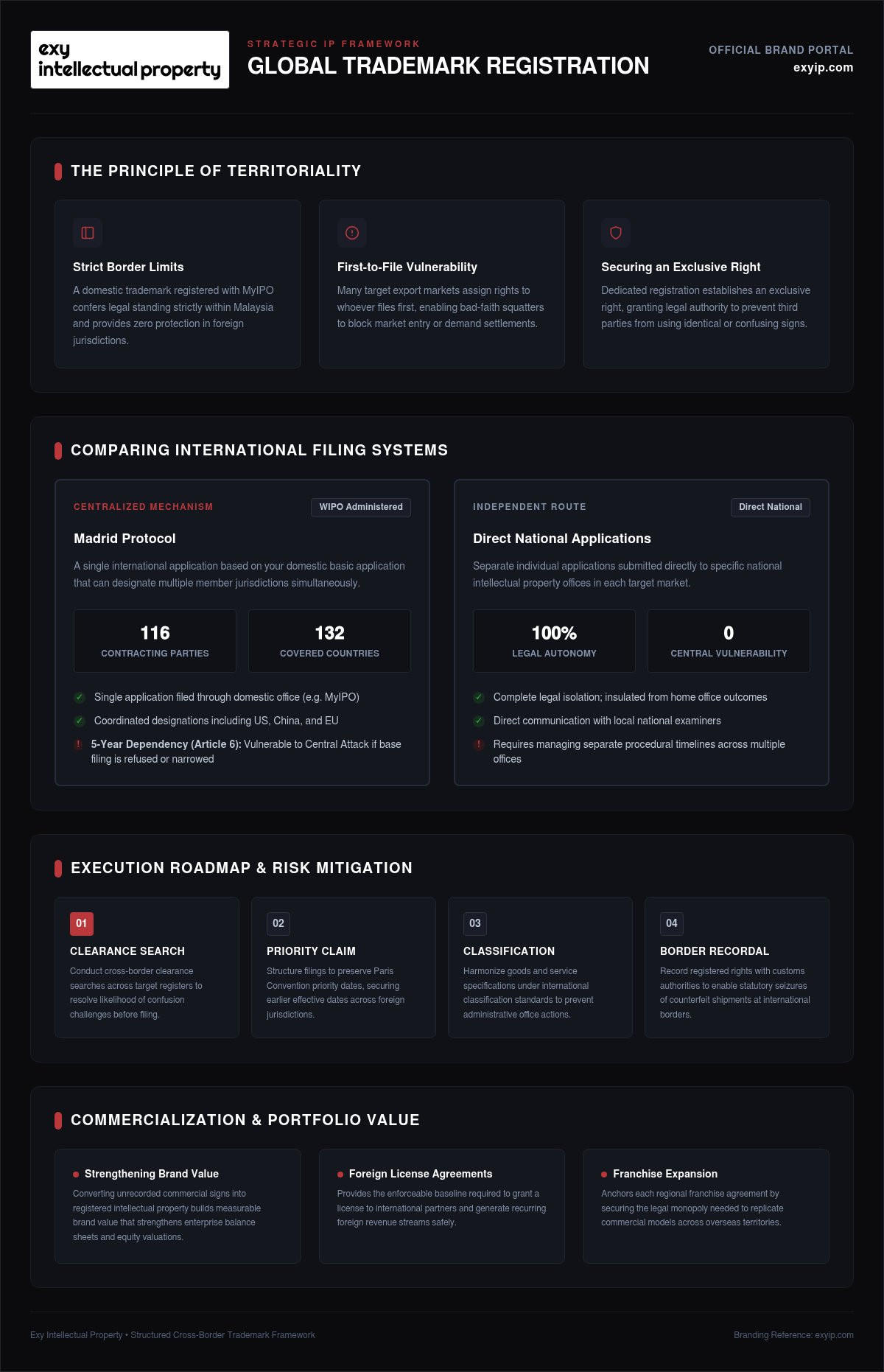
Territoriality defines the reach of modern trademark law. Securing a trademark with the Intellectual Property Corporation of Malaysia (MyIPO) protects your mark across Malaysia, but it confers zero legal standing in the European Union, China, or the United States. Many commercial destinations enforce a strict first-to-file rule. Under this system, the legal owner of a brand is whichever party files the application first, regardless of who used the sign initially in another market. Detailed treaty databases, including this Madrid System overview, demonstrate how multi-jurisdiction frameworks operate as administrative bundles rather than borderless legal regimes. Delaying your international filing leaves a vacuum that opportunistic local competitors can exploit.
Securing Brand Value and Commercial Exclusivity
Brand equity requires enforceable protection. An unrecorded mark cannot defend its distinct market position against aggressive imitation. Global trademark registration anchors your commercial reputation by establishing provable ownership across target export channels.
- Guarding enterprise assets: Securing foreign registrations builds measurable brand value that strengthens your balance sheet during licensing discussions or equity valuations.
- Enforcing border protections: Registered marks allow brand holders to record rights with national customs agencies, enabling statutory seizures of counterfeit shipments before they reach retail channels.
- Securing commercial growth: Formal registration provides the legal foundation needed to enter overseas joint ventures without risking the underlying identity of your enterprise.
International Filing Systems: Madrid Protocol Versus Direct National Applications
Selecting the right path for global trademark registration dictates your portfolio’s administrative efficiency and legal resilience. Expanding enterprises must choose between two distinct approaches: a centralized international filing or independent national applications. While treaty routes offer procedural convenience, direct filings deliver isolated legal security. Making the right choice requires aligning your export roadmap with regional administrative rules.
The Madrid Protocol Centralized Filing Mechanism
The centralized treaty system operates through the World Intellectual Property Organization. Administered under the WIPO Madrid System, which unites 116 Contracting Parties covering 132 countries, the treaty lets an applicant file a single international application based on their home-country registration. For Malaysian businesses, filing through MyIPO allows simultaneous designation of key export markets like the United States, China, and the European Union.
Centralization brings structural dependencies. Under Article 6 of the Madrid Protocol, an international registration relies entirely on the basic domestic application for five continuous years. If your home registration is refused, cancelled, or narrowed during this period, your entire international bundle collapses across every designated territory through a central attack. When structuring your international portfolio, aligning your base filing with an experienced team for global trademark registration prevents these systemic vulnerabilities from threatening your foreign coverage.
Direct National Filings Through Local Representatives
Direct applications provide complete jurisdictional autonomy. By submitting individual filings to national intellectual property offices, each mark stands on its own merits, entirely shielded from issues affecting your domestic filing. Direct national applications become essential when:
- Target markets sit outside the treaty: Key commercial destinations such as Saudi Arabia and Taiwan require direct domestic filings through licensed local practitioners.
- Goods specifications need tailored precision: Jurisdictions like the United States reject broad Nice Classification class headings, requiring narrow, evidence-backed identifications of actual commercial use.
- Dependency exposure is unacceptable: If your domestic filing faces contentious opposition, direct foreign filings eliminate the risk of a widespread central attack.
Applicants rely on the Paris Convention to preserve their priority date within a six-month window when filing direct overseas applications. This dual-track approach balances treaty-based reach with targeted jurisdictional stability. If you want clarity on which route suits your current export pipeline, consulting an advisory partner at exyip.com ensures your international intellectual property assets remain secure from day one.
Overcoming Cross-Border Clearance Obstacles and Likelihood of Confusion
Checking availability at home does not guarantee smooth passage overseas. Multi-jurisdiction clearance searches protect your capital before you commit inventory to foreign distribution channels. A disciplined pre-filing review identifies conflicting rights early, prevents emergency product rebrands, and smooths the path toward global trademark registration.
Assessing Likelihood of Confusion Across Different Markets
Trademark registries evaluate conflicts through the prism of consumer perception. In common law markets, examiners assess whether ordinary buyers would mistake one product source for another under the statutory standard of likelihood of confusion. In civil law jurisdictions, examiners often follow strict literal and visual comparisons against existing registry entries, even if the underlying commercial channels differ.
When an overseas office discovers an overlapping prior mark, it issues a provisional refusal. Rights holders can resolve these obstacles through practical legal remedies. If the competing goods do not directly overlap in the real market, you can negotiate coexistence agreements or obtain formal letters of consent from the prior registrant. For marks administered through the Madrid System for international trademark registration, answering a provisional refusal requires instructing qualified local counsel in the rejecting country within strict statutory deadlines, turning an administrative objection into an approved grant.
Cross-Cultural Branding and Transliteration Searches
Expanding into non-English speaking markets introduces complex linguistic challenges. Direct phonetic translations often produce unintended local meanings or clash with existing domestic trademarks registered in non-Latin scripts.
Securing your Latin script brand is only half the battle. If you don’t officially register local character equivalents, such as Chinese characters or Japanese katakana, local consumers and distributors will create their own informal names for your goods. Predatory entities and unauthorized local distributors frequently register these phonetic or conceptual adaptations under their own names, stripping your business of brand control. Conducting proactive transliteration clearance and registering foreign-character marks ensures your creative identity remains an uncompromised commercial asset across every export territory.
Step-by-Step Roadmap to Execute an International Trademark Filing
A systematic filing blueprint prevents procedural defects and unnecessary expenditures. To establish enforceable rights across foreign borders, brand owners must follow an orderly sequence that locks in priority dates, aligns product classifications, and survives substantive legal examination.
Establishing the Base Application and Priority Rights
Every effective international portfolio starts on solid ground. For Malaysian enterprises, the baseline requires filing an accurate national mark through the Intellectual Property Corporation of Malaysia (MyIPO) under the Trademarks Act 2019. Review our strategic framework for trademark registration in Malaysia to master these foundational procedural requirements.
Timing remains critical during this opening phase. Under Article 4 of the Paris Convention, filing your basic domestic application triggers a strict six-month priority window. Submitting corresponding foreign applications within this window allows you to backdate your international claims to your original home filing date. This priority mechanism cuts off intermediate predatory applications filed by competitors abroad during those six months, protecting your commercial trajectory.
Navigating Classification, Examination, and Registration
Precision in classification protects your legal scope. Effective January 1, 2026, all international filings must comply with the 13th Edition of the Nice Classification (NCL 13-2026). This revision introduces significant structural shifts:
- Healthcare and eyewear: Non-smart spectacles and contact lenses moved from Class 9 to Class 10, while smart eyewear remains in Class 9.
- Apparel and devices: Electrically heated garments shifted from Class 11 to Class 25, and electric personal care items like powered toothbrushes relocated to Class 21.
- End-use goods: Essential oils are now divided strictly by intended utility across Class 3 for cosmetics, Class 5 for medicine, and Class 30 for food flavoring.
After submission, designated intellectual property offices conduct substantive reviews under their domestic laws. In Malaysia, MyIPO holds an 18-month window under its Madrid Protocol declarations to issue provisional refusals. Navigating these regional timelines requires disciplined monitoring and prompt procedural responses. Once an overseas registry completes substantive review and resolves any third-party oppositions, it issues a formal Statement of Grant of Protection. To coordinate your multi-jurisdiction timeline and secure end-to-end filing management, partner with Exy Intellectual Property to protect your global trademark registration assets without administrative delay.
Commercialization, Portfolio Management, and Global Trademark Enforcement
Securing an exclusive right is the starting line, not the finish. A global trademark registration converts intellectual property into an active revenue engine, turning legal exclusivity into scalable commercial relationships across export territories.
Licensing and International Franchise Expansion
Brand monetization thrives on structured contractual arrangements. Granting an overseas partner a commercial license opens foreign markets without diluting your legal ownership. Under modern intellectual property rules, local compliance remains paramount. In Malaysia, under Rule 20bis(6)(b) of the Common Regulations, recording an international license directly with WIPO carries no legal effect locally. To remain enforceable against third parties in Malaysia, the transaction must be recorded directly with MyIPO under the Trademarks Act 2019.
When scaling a retail or service model overseas, integrating registered rights into a structured franchise agreement safeguards your brand’s unique identity. Precise quality control clauses prevent licensee abuses that could otherwise result in claims regarding the misuse of IP laws. These registered safeguards build undeniable brand value that attracts international investors, solidifying enterprise standing during high-stakes commercial transactions.
Proactive Enforcement and Portfolio Maintenance
Defending registered rights requires continuous market oversight. Rights holders must actively monitor international trade registers to identify infringing marks before statutory publication windows close. The Trademarks Act 2019 sets a strict two-month opposition period once an application is published in the Malaysian Intellectual Property Official Journal, demanding prompt legal action to block conflicting marks.
- Defending against non-use actions: Under Malaysian law, a mark becomes vulnerable to revocation if it lacks genuine commercial use for three continuous years following entry into the register. Maintain audited trails of overseas invoices, export freight bills, and local marketing collateral to prove ongoing trade use.
- Border control measures: Record registered marks with customs enforcement authorities to seize unauthorized grey-market and counterfeit shipments at ports before they penetrate local retail channels.
- Tracking portfolio health: Maintain your 10-year renewal schedules across national registries to ensure continuous statutory protection.
Transparent intellectual property portfolios generate lasting financial power. Review our detailed guide on intellectual property valuation to evaluate your global brand assets and position your business for resilient international growth.
Build and Defend Your Global Brand Footprint
Territorial boundaries define commercial ownership. Deciding between the centralized efficiency of the Madrid Protocol and targeted direct national filings dictates your legal exposure across export markets. When you combine proactive clearance searches with prompt priority filings under current classification standards, you preserve exclusive authority over your commercial identity. Executing a coordinated global trademark registration strategy turns brand equity into an enforceable asset across every overseas jurisdiction.
Your international expansion deserves experienced legal stewardship. Exy Intellectual Property features specialized intellectual property attorneys managing global brand portfolios with end-to-end support spanning clearance searches, filings, and intellectual property litigation. We deliver clear commercialization strategies that structure compliant overseas licensing and franchise agreements to grow your enterprise safely. Secure your international brand rights with Exy Intellectual Property and take your market expansion forward with absolute certainty.
Frequently Asked Questions
What is the difference between global trademark registration and domestic registration?
Domestic registration confers legal protection solely within your home country’s geographic borders, while global trademark registration secures an exclusive right across designated foreign jurisdictions. A certificate from MyIPO in Malaysia gives no enforceable rights in markets like China or the European Union due to the principle of territoriality. Executing an international registration framework extends brand ownership across export territories, preventing local competitors or distributors from claiming your brand as their own property.
Can a single trademark application protect a brand in every country worldwide?
No single worldwide application exists that instantly covers all countries across the globe. Trademark rights remain strictly territorial under international law. While treaties like the Madrid System centralize filings across 132 member countries, each designated intellectual property office retains sovereign legal authority to review the mark under its domestic legislation. Brand protection outside participating treaty member states requires separate, direct national applications through local associates.
How does the Madrid Protocol simplify international trademark filings for businesses?
The Madrid Protocol streamlines administration by allowing applicants to submit one standardized application, in one language, through their national office of origin. This treaty eliminates the immediate need to retain legal representation in every overseas destination at the initial filing stage. Rights holders manage international designations, official address changes, and decade-long portfolio renewals centrally through the World Intellectual Property Organization rather than tracking separate national filing dockets.
What happens if a foreign competitor files my trademark in another country first?
In first-to-file jurisdictions, the first applicant to file generally obtains legal ownership of the trademark regardless of who used it first elsewhere. If an overseas competitor or distributor pre-empts your registration, they can legally block your shipments at customs or demand significant buyout settlements. Reclaiming your sign requires proving bad faith through administrative opposition proceedings or formal intellectual property litigation before that country’s administrative courts.
Is it possible to register trademarks in countries that do not belong to the Madrid Protocol?
Yes, you can secure brand exclusivity in non-member countries by filing direct national trademark applications through licensed local counsel. Commercial jurisdictions such as Saudi Arabia, Argentina, and Taiwan operate outside the Madrid Protocol. Protecting your commercial assets in these regions requires tailored national submissions that adhere strictly to local classification guidelines, statutory language translations, and local power of attorney legalization procedures.
How long does it take to secure international trademark registration across multiple jurisdictions?
International registration timelines generally span between 12 and 18 months depending on examination practices across each designated registry. Under the Madrid System, national offices generally have 12 to 18 months to issue a provisional refusal, which is the exact period declared by MyIPO in Malaysia. If examiners issue statutory objections or third parties initiate opposition proceedings, securing final grants of protection may require additional months of procedural response.
What is the six-month priority rule under the Paris Convention?
The six-month priority rule allows you to backdate foreign trademark filings to the submission date of your first domestic application. Under Article 4 of the Paris Convention, filing in a member country like Malaysia grants you a strict six-month window to submit corresponding overseas applications. Those subsequent global trademark registration filings take precedence over any competing applications filed by third parties in foreign markets during that same six-month interval.