


What if your first response to a trademark opposition shapes the future of your application? If you’ve received a notice, you may be unsure what the opponent is alleging, how much time you have and what evidence could support your position. Knowing how to respond to a trademark opposition starts with identifying the notice and acting within the applicable deadline.
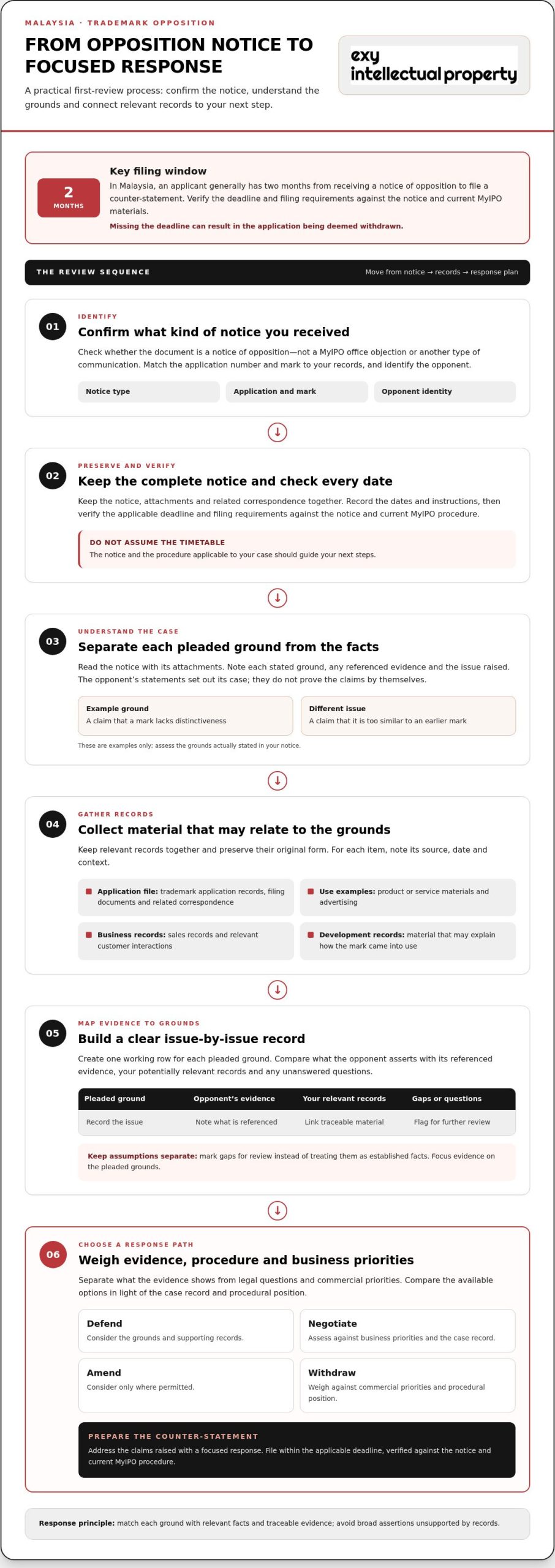
In Malaysia, an applicant generally has two months from receiving a notice of opposition to file a counter-statement. Missing that deadline can result in the application being deemed withdrawn. The grounds and evidence also matter: a focused response addresses the claims raised instead of relying on broad denials.
This guide explains the main steps, from preparing a counter-statement to responding to evidence and written submissions. You’ll learn how to assess the opponent’s case, compare your options against the available evidence and your commercial priorities, and plan a clear response. Exy Intellectual Property provides trademark-focused legal advisory and litigation support to help connect the opposition grounds with the evidence and business interests at stake.
Key Takeaways
- Identify whether the MyIPO notice is an opposition or a different type of proceeding before planning your response.
- Preserve the notice, check the dates and grounds, and verify the applicable deadlines and filing requirements.
- Learn how to respond to a trademark opposition by matching each ground with relevant facts and supporting evidence.
- Compare defending, negotiating, amending where permitted, or withdrawing against your evidence, business priorities and procedural position.
- Specialist review can help align your response strategy with the case record and your commercial goals.
What a trademark opposition means for your Malaysian application
A trademark opposition is a formal challenge by another party to your trademark application after it has been published for opposition. It differs from an office objection, which is raised by the Intellectual Property Corporation of Malaysia (MyIPO) during examination. An opposition puts the applicant and opponent into a dispute about whether the application should proceed. MyIPO administers the process and determines the matter under the applicable procedure.
A trademark is a sign which distinguishes a business or its products from others. General background on trademarks can help explain the concept, but the Malaysian notice and current MyIPO procedure determine the steps for your application.
First, confirm that the document is a notice of opposition, not an office objection or another type of communication. Match the application number and mark to your records, identify the opponent, and note every date and instruction. These checks establish what is being challenged and help you plan what to review next.
How to read an opposition notice
Read the notice alongside its attachments. Locate the application details, the opponent’s identity, each stated ground, any referenced evidence and the instructions for responding. Record the relevant dates in one place, then verify the deadline and filing requirements against current MyIPO materials. Don’t rely on an assumed timetable or a date calculated without checking the applicable procedure.
Keep allegations separate from established facts. The opponent’s statements set out its case, but they do not prove the claims by themselves. Preserve the notice and related correspondence so you can compare each allegation with your application records and other relevant evidence.
Why the grounds shape the response
Summarise each pleaded ground in plain language without changing its meaning or scope. For example, a claim that a mark lacks distinctiveness raises a different issue from a claim that it is too similar to an earlier mark. These are examples, not assumptions about what your notice alleges. Different grounds may call for different factual records and legal analysis.
This is why how to respond to a trademark opposition depends on the actual notice, not a generic template. Avoid answering claims that were not made or making broad assertions unsupported by records. A focused first review shows which allegations need a direct answer and what information may help you assess your options.
Trademark Opposition: A Careful First Review
Once you’ve identified the notice and its grounds, move from reading to preparation. A methodical review helps preserve relevant records, reveal information gaps and keep your response focused on the issues in dispute. Treat this as an evidence-gathering stage, not a reason to make quick admissions or broad claims.
Work through the initial review in order:
- Preserve the notice: Keep the complete notice and attachments together, including pages with filing instructions or dates.
- Confirm the dates: Record every date stated in the documents and verify the applicable deadline against the notice and current MyIPO procedure.
- Inspect each ground: Note what the opponent alleges and the issue raised by each allegation.
- Gather relevant records: Collect documents that may help establish use, ownership, reputation or other facts relevant to the pleaded grounds.
- Assess your options: Separate what the evidence shows from the legal questions and your commercial priorities.
Check deadlines and procedural requirements against current MyIPO materials. Don’t rely on an assumed timetable or dates remembered from another matter. The notice and the procedure applicable to your case should guide your next steps.
What to preserve and collect
Keep the notice, trademark application records, related correspondence and filing documents in one organised file. Add dated examples of how the mark has been used, such as product or service materials, advertising, sales records and relevant customer interactions. Records of brand development may also help explain how the mark came into use.
For each item, record its source, date and context. Preserve original records and avoid editing or annotating them in a way that could obscure their original form. A clear record trail makes it easier to assess what each document can support.
How to map evidence to opposition grounds
Create a working table with one row for each pleaded ground. Record the opponent’s assertion, any evidence it refers to, your potentially relevant records and unanswered questions. Mark assumptions and gaps for further review rather than treating them as established facts.
Persuasive evidence directly addresses the opponent’s pleaded grounds and supports the applicant’s position with relevant, traceable records. Keep factual evidence, legal analysis and commercial objectives distinct in your plan. An industry resource such as the International Trademark Association’s guide to defend, negotiate, amend, or withdraw can provide broader context. Assess Malaysian requirements separately.
Specialist review can connect the evidence to the grounds and the business priorities behind the application. Read about Exy Intellectual Property’s trademark legal advisory as part of planning a focused response.
Compare your options: defend, negotiate, amend, or withdraw
An opposition challenges an application. It is not, by itself, a finding of infringement or a final decision on the application. Your response strategy should account for the opponent’s grounds and the role the trademark plays in your business. Before deciding how to respond to a trademark opposition, consider the evidence, commercial value, practical feasibility and procedural effect of each option.
The comparison below is a starting point, not a statement that every route is available in every case. Consider any negotiation, amendment or withdrawal in light of the application, current MyIPO procedure and the stage of the matter.
| Option | Evidence and business value | Feasibility and procedural impact |
|---|---|---|
| Continue the defence | May suit an application with relevant evidence addressing the pleaded grounds and a mark important to current operations or planned growth. | Requires a focused response and attention to applicable procedural steps. The matter proceeds for consideration under the relevant process. |
| Negotiate a resolution | May be worth exploring if both parties can identify workable terms that protect important business interests. | Depends on the parties’ willingness and the terms they can agree. Assess any arrangement for its effect on the application and opposition process. |
| Seek a permitted amendment | Could be relevant if a narrower application still serves the business purpose and addresses the dispute. | Consider this only if the applicable procedure permits it and the proposed change is within the application’s scope. Verify the effect before relying on an amendment as a solution. |
| Withdraw the application | May be a deliberate choice if the mark’s business value does not justify continuing the dispute. | Withdrawal affects the application and should be assessed for its procedural and commercial consequences. It is not, by itself, an automatic admission of wrongdoing. |
When a defended response may fit
Assess whether reliable, relevant records can answer the specific grounds, rather than relying on general confidence in the mark. Consider its use across current products or services, its contribution to brand value and any planned expansion. Legal merits and commercial priorities both matter: evidence may support continuing, while the business’s plans help clarify what is at stake.
When resolution or a narrower position may fit
Negotiation can lead to terms both parties find workable, but an agreement should not be assumed or treated as guaranteed. An amendment is an option only where the applicable procedure and application scope allow it. Withdrawal, too, should be a considered business decision, weighed against the value of the mark and the consequences for the application. Specialist review can help compare these routes against the grounds, available evidence and commercial objectives.
Prepare a focused trademark opposition response
A strong response follows the applicable procedure and addresses the grounds actually raised. Before drafting, verify current MyIPO requirements and the instructions in the notice, including the required format, filing steps and any evidence requirements. Let the notice and applicable procedure guide the response, rather than a template from another case.
Keep the applicant’s position precise. Each factual statement should be consistent with the application record and, where relevant, linked to supporting material. Explain why the mark matters to the business, such as its role in current trading or planned growth, but don’t substitute promotional claims for legal analysis. The response should address the dispute, not simply describe the brand.
A clear structure for the response
Begin with accurate details identifying the application and opposition, using the format required for the proceeding. Then address each pleaded ground separately. For every ground, state the applicant’s position, explain the supporting facts and refer clearly to the evidence relied on. This structure shows how the applicant answers the opponent’s case.
Use consistent terms for the mark, goods or services, parties and documents throughout. Distinguish facts that are admitted from those that are disputed or have not yet been verified. If a point is uncertain, flag it for review rather than presenting it as established. A clear structure connects procedural compliance, evidence and legal analysis while keeping the business interests behind the application in view.
Common response weaknesses to avoid
- Overlooking a requirement: Check each ground, instruction, deadline and evidence requirement in the notice against current MyIPO procedure. Don’t assume a requirement from another case applies.
- Relying on general denials: A blanket statement that the opponent is wrong does not explain the applicant’s position. Answer the specific allegation and identify the facts or evidence that support the answer.
- Adding unsupported claims: Avoid speculation, unnecessary assertions or inconsistent descriptions of the mark and its use. Each claim should have a clear purpose and a sound factual basis.
- Including sensitive records without review: Consider whether each document is relevant and how confidential or commercially sensitive information will be handled before including it in materials for the proceeding.
Understanding how to respond to a trademark opposition means bringing the notice, grounds, evidence and business priorities into one clear plan. Exy Intellectual Property’s trademark-focused legal advisory can help assess those elements and organise a response strategy. Learn about trademark opposition support from Exy Intellectual Property.
Get specialist support and plan the next steps in Malaysia
A considered response connects four things: the procedure, legal grounds, evidence and commercial interests tied to the mark. Specialist review can help assess how these elements fit together, identify gaps in the record and compare possible strategies. The right approach depends on the notice, application, related documents and current Malaysian requirements. No single template suits every opposition.
Before a strategy discussion, organise the key materials and questions. This keeps the review focused on the issues that matter to your application and business.
What to prepare for a strategy discussion
- The complete notice and application details: Include all pages, attachments and documents relating to the application.
- Relevant correspondence: Gather communications with MyIPO and the opponent, including discussions about the dispute.
- A date-ordered timeline: List key filing dates, events and communications, and flag dates or deadlines that need verification.
- Brand and business context: Summarise how the mark is used, the purpose it serves and its connection to current operations or planned growth.
- Priority questions: Identify what you need to understand about procedure, evidence, available options and the commercial consequences of each route.
This preparation gives a specialist a clearer basis to assess the opponent’s grounds against the available record and your business priorities. It also helps distinguish urgent procedural questions from broader strategic decisions.
What happens after a response is filed
The next steps depend on the current procedure, the parties’ actions and any directions in the matter. Don’t assume a particular sequence or timetable applies without checking the requirements relevant to your case. Keep a central record of correspondence, dates, filed materials, evidence and procedural updates so that decisions are based on an accurate case history.
If you need general background on the registration process, the Trademark Registration in Malaysia strategic guide can provide related context. For application progress, see the guide to checking trademark status in Malaysia. Status information can help you track an application, but it does not replace careful review of an opposition notice or instructions in the proceeding.
Knowing how to respond to a trademark opposition means shaping a plan around the specific case, not relying on assumptions. Exy Intellectual Property provides trademark-focused legal advisory and intellectual property litigation support in Malaysia, connecting procedural considerations with evidence and commercial priorities. Learn about Exy IP’s trademark opposition support.
Protect your application with a clear next step
A trademark opposition calls for a considered response. Start by confirming the notice and applicable procedure, then assess each pleaded ground against relevant evidence. Next, compare the available options with your business priorities and the value the mark holds for your brand.
Knowing how to respond to a trademark opposition means more than preparing a document. It means building a focused position that addresses the claims, follows current requirements and reflects the commercial interests at stake. Exy Intellectual Property provides trademark registration, IP-focused legal advisory and intellectual property litigation services to support applicants in Malaysia.
With a clear view of the notice, evidence and objectives, you can approach the next step with greater confidence. Get support with your trademark opposition.
Frequently Asked Questions
What should I do first after receiving a trademark opposition notice in Malaysia?
First, confirm that the document is a notice of opposition and identify the application it concerns. Keep the complete notice and attachments, note when you received them, and review the opponent’s stated grounds and instructions. Verify the applicable deadline and response steps against current MyIPO requirements. Keep allegations separate from proven facts. These checks give you a sound basis for deciding how to respond to a trademark opposition.
How long do I have to respond to a trademark opposition in Malaysia?
Under the current procedure described for Malaysia, an applicant generally has two months from receiving the notice of opposition to file a counter-statement. Check the notice and current MyIPO requirements promptly to confirm the deadline and how it applies to your matter. Don’t calculate time from the date on the notice without verifying the relevant date and procedure. A specialist can help assess the notice and organise the next steps.
Can I negotiate with the opponent instead of defending the opposition?
Yes, you may explore a negotiated resolution if both parties are willing to discuss workable terms. Negotiations don’t automatically suspend procedural deadlines, so keep track of required response steps while discussions continue. Malaysia’s opposition procedure does not provide a formal cooling-off period. Before agreeing to terms, consider their effect on the application, your use of the mark and your wider commercial priorities.
What evidence can help me respond to a trademark opposition?
Relevant evidence depends on the grounds in the notice. Dated records may include examples of trademark use, marketing materials, sales documents, customer interactions, application records and documents showing how the brand was developed. These materials may help address facts such as use, ownership or reputation where relevant. Organise each item by source, date and context, then connect it to the specific assertion it may support. Avoid relying on unsupported claims.
Can I amend my trademark application after an opposition?
Possibly, but don’t assume an amendment is allowed or will resolve the opposition. Whether a change can be made depends on the current procedure and the scope of the application. Consider whether a narrower application would still meet your business needs and how a proposed change could affect the opponent’s claims. Verify the applicable requirements before taking this route, as an amendment may not be suitable or available in every case.
What happens if I do not respond to a trademark opposition?
If the applicant does not file a counter-statement within the applicable deadline, the application may be deemed withdrawn under the procedure described for Malaysia. That can put the application at risk, so check the deadline in the notice against current MyIPO requirements and act promptly. Non-response is a procedural consequence concerning the application; it is not, by itself, a finding that the applicant infringed someone else’s trademark.
Is a trademark opposition the same as an infringement claim?
No. An opposition challenges a pending trademark application through the registration process administered by MyIPO. An infringement claim concerns the alleged unauthorised use of a protected trademark. An opposition is not automatically a finding of infringement, and its outcome does not by itself establish every issue that could arise in a separate dispute. Check the document you received carefully, since the correct response depends on the type of proceeding.