


The obvious first move isn’t always to file a patent. If you’re asking how to protect my invention in Malaysia, start by considering what you can safely share and which parts of your innovation need protection. A public demonstration, pitch deck, or online post may affect your options, particularly for patent or industrial design protection.
It’s natural to be unsure whether your idea may qualify for a patent or whether a conversation could put it at risk. The right approach depends on what’s new, what’s visible, and how you plan to bring the invention to market. Taking practical steps before disclosure can help preserve your options while you assess the opportunity.
This guide explains what to do before sharing your invention, how patents differ from industrial designs, copyright, and trade secrets, and how to connect protection decisions with business goals. You’ll also learn how a patent novelty search and careful drafting can inform filing decisions, and how licensing and commercialization plans can shape your wider intellectual property strategy in Malaysia.
Key Takeaways
- Learn how to protect my invention in Malaysia by taking practical steps to preserve your options before sharing details publicly.
- Match patents, industrial design registration, copyright, and trade secrets to the different parts of your innovation and its commercial goals.
- Use an invention record and patent novelty search to help assess your options before patent drafting and filing.
- Plan protection around your intended markets: Malaysian patent rights are territorial, while the Patent Cooperation Treaty and Madrid Protocol serve different purposes.
- Consider how licensing and commercialization plans can shape an intellectual property strategy for your business.
How invention protection works in Malaysia, and what it can protect
An invention is a developed technical solution to a problem. Patent protection is a legal right that may protect that solution if it meets Malaysian requirements. A broad idea, such as “make water filters work better,” is not the same as a defined mechanism or process explaining how to achieve that result. Patent assessment focuses on the invention described, not simply the goal behind it.
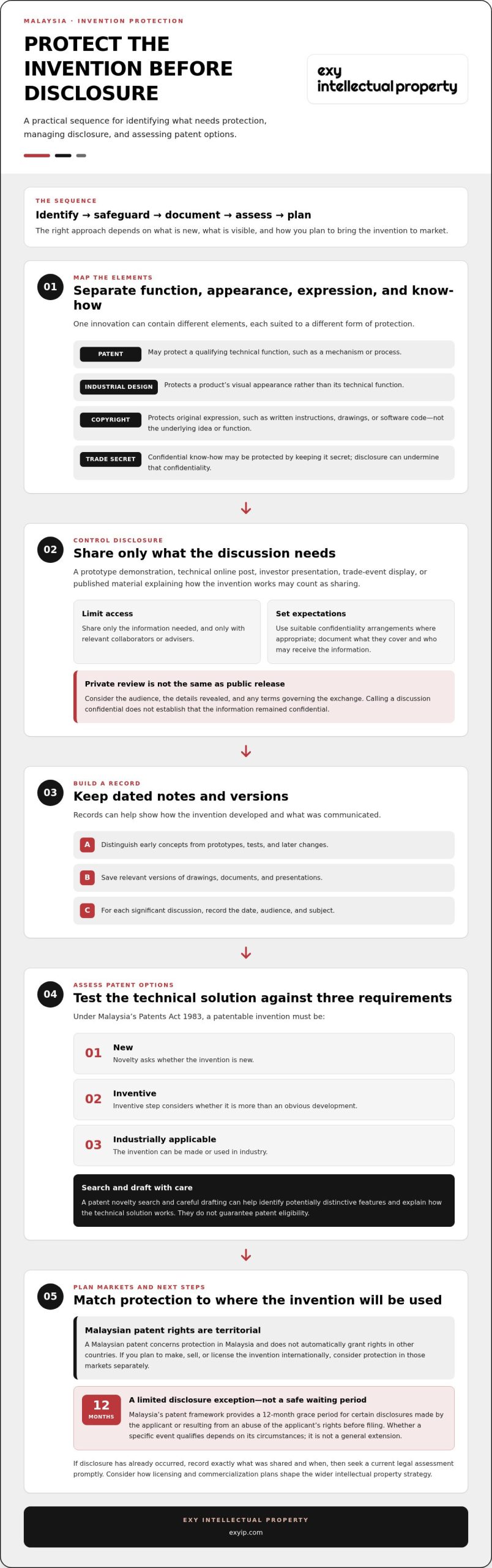
Patents sit within the wider system of intellectual property, which also includes rights such as copyright and trademarks. A Malaysian patent is territorial: it concerns protection in Malaysia and does not automatically grant rights in other countries. If you plan to make, sell, or license an invention internationally, consider protection in those markets separately.
What kinds of inventions may qualify for patent protection?
Under Malaysia’s Patents Act 1983, a patentable invention must be new, involve an inventive step, and be industrially applicable. In practical terms, novelty asks whether the invention is new; inventive step considers whether it is more than an obvious development; and industrial applicability concerns whether it can be made or used in industry. Each test needs to be assessed against the invention and relevant information.
For example, a redesigned water-filter component might use a particular internal structure to improve water flow. That is a technical concept to assess, not a guarantee of patent eligibility. A patent novelty search and careful drafting can help identify potentially distinctive features and explain how the technical solution works.
Patent, industrial design, copyright, or trade secret?
Different rights can protect different elements of one innovation. Identify what creates its technical value, what customers see, and what knowledge you need to keep confidential.
- Patent: may protect a qualifying technical function, such as a mechanism or process.
- Industrial design: protects a product’s visual appearance rather than its technical function. For appearance-focused protection, refer to the guide to industrial design protection.
- Copyright: protects original expression, such as written instructions, drawings, or software code, rather than the underlying idea or function.
- Trade secret: confidential know-how may be protected by keeping it secret. Disclosure can undermine that confidentiality.
A product could therefore involve a patentable mechanism, a registered industrial design for its appearance, copyright in its manual, and confidential manufacturing know-how. The right combination depends on the role each element plays in the business. If you’re considering how to protect my invention in Malaysia, identifying those elements is a practical first step toward a focused protection strategy.
Why confidentiality and timing matter before sharing an invention
Before filing a patent application, think carefully about what you reveal. Public disclosure can affect whether an invention is considered new, but its effect depends on what was disclosed, when it happened, and the rules that apply. A limited exception does not make early disclosure risk-free. For Malaysian context, the Malaysian IP Regulations Guide provides an overview. The effect of a particular disclosure should be assessed against current Malaysian patent law.
Malaysia’s patent framework provides a 12-month grace period for certain disclosures made by the applicant or resulting from an abuse of the applicant’s rights before filing. Whether a specific event falls within that exception depends on its circumstances. Don’t treat it as a general extension or assume a public reveal will have no effect. If disclosure has already occurred, record exactly what was shared and when, then seek a current legal assessment promptly.
What counts as sharing an invention?
Sharing can include demonstrating a working prototype, posting technical details online, presenting to investors, displaying a product at a trade event, or publishing material that explains how it works. A confidential discussion with a potential collaborator differs from an open demonstration or public marketing, but calling a discussion confidential does not establish that the information remained so. Consider the audience, the details revealed, and any terms governing the exchange.
For example, a pitch deck describing a product’s commercial purpose may reveal less than a public demonstration showing its internal mechanism. The details matter. Disclosure does not automatically rule out protection in every case, but it can affect the options available. Assess the circumstances before relying on a patent strategy.
How to prepare before speaking with others
Good records help show how an invention developed and what was communicated. Keep dated notes that distinguish early concepts from prototypes, tests, and later changes. Save relevant versions of drawings, documents, and presentations. For each significant discussion, record the date, audience, and subject.
- Limit access: Share only the information needed for the discussion, and only with relevant collaborators or advisers.
- Set expectations: Use suitable confidentiality arrangements where appropriate, and document what information they cover and who may receive it.
- Separate private review from public release: A restricted evaluation is not the same as a product launch, open demonstration, online post, or published technical description.
Confidentiality terms should fit the relationship and purpose. Before revealing technical details, a patent novelty search and drafting assessment can help inform filing decisions. This preparation gives you a clearer basis for considering how to protect my invention in Malaysia, without assuming every disclosure is harmless or automatically disqualifying.
How to choose between patents and other protection for an invention
Start with the asset, not the name of the right. A product may combine technical function, visual design, written materials, and confidential know-how. These elements can have different commercial value, so one protection route may not cover everything. Ask whether you expect to manufacture, license, or sell the invention, or keep its underlying process confidential.
The right depends on what needs protection: how the invention works, how it looks, how it is expressed, or what you can keep secret.
| Protection route | What it protects | Strategic purpose |
|---|---|---|
| Patent | A qualifying technical invention, such as a product mechanism or process | May support exclusive commercial rights over the claimed technical solution, subject to legal assessment |
| Industrial design | A product’s visual appearance | Helps protect distinctive appearance where design contributes to market appeal |
| Copyright | Qualifying original expression, such as written material, drawings, or code | Protects the particular expression, not a general monopoly over the underlying idea |
| Trade secret | Confidential know-how or information that derives value from remaining secret | Can preserve an advantage where secrecy can be maintained and controlled |
These routes can work together. For example, a smart irrigation controller might have a technical method to assess for patent protection, an exterior appearance that may suit industrial design protection, original software code and user instructions, and confidential calibration know-how. The right mix depends on disclosure plans, product appearance, and how you intend to earn value from the innovation.
When a patent may be relevant
A patent may be relevant if the core value lies in a technical solution that could meet Malaysia’s patent requirements. A novelty search helps identify existing technical material relevant to assessing the invention and shaping a filing strategy. Search findings, commercial objectives, and careful drafting should inform the application. A strategic patent filing guide can help connect these choices with business plans.
When design rights, copyright, or trade secrets may matter
Industrial design protection may suit a product whose appearance is commercially important. Copyright may apply to original expression such as software code or diagrams, not the function or idea itself. Confidential know-how may be valuable if access can be restricted and secrecy maintained. Assess each element separately, then consider how your choices support licensing or future commercialization.
What to do first: a practical invention-protection checklist
A clear record turns an early concept into something that can be assessed. This sequence can help you prepare to decide how to protect my invention in Malaysia. These are practical preparation steps, not a substitute for formal filing requirements. Review official intellectual property office forms, procedures, and applicable legal requirements against current guidelines before filing.
- Record the invention. Describe the problem it addresses, how the solution works, its technical features, and what you believe is different. Note development dates and who contributed, where relevant.
- Restrict disclosure. Keep access limited while you assess protection. Before sharing technical details with collaborators or potential business partners, consider suitable confidentiality arrangements for that relationship.
- Assess the rights that may fit. Separate the technical function from the product’s appearance, original materials, and confidential know-how. This helps identify whether patent protection or other intellectual property rights may be relevant.
- Search for existing material. Gather publications, products, patents, and other technical information that may relate to the invention. A patent novelty search can help inform assessment and filing decisions.
- Prepare a clear patent draft. Organize the technical explanation, drawings, and variations so the invention and the protection sought are expressed clearly.
- Plan the filing. Consider the intended markets and business objectives, then confirm the applicable Malaysian filing requirements and official office procedures before submission.
What information should an inventor organize?
Bring together development notes, sketches or drawings, test records, and descriptions of prototypes and changes. Explain how key features operate and why they address the problem. Keep relevant contributor information, too. A list of related publications, products, or technical material can help shape a novelty search and focus the assessment on features that may distinguish the invention.
How searches and patent drafting support decisions
A search can reveal existing material relevant to an invention, but it cannot guarantee that a patent will be granted or that the invention will succeed commercially. Drafting turns the technical disclosure into a clear application, including the boundaries of the protection being sought. Both steps can support more informed filing choices.
For a tailored assessment of your invention, explore Exy Intellectual Property patent search and drafting support. This preparation gives you a stronger basis for discussing protection options and planning the next step.
From Malaysian patent filing to licensing and commercialization
A Malaysian patent protects rights in Malaysia, not automatically in other countries. If you plan to sell, manufacture, or license an invention elsewhere, include protection in those markets in your wider business plan. The right route depends on where the invention may be commercialized and how you intend to reach those markets.
What does international patent protection involve?
No single patent provides automatic worldwide protection. The Patent Cooperation Treaty (PCT) offers a route for filing an international application, but it does not create a “worldwide patent.” Applicants still need to pursue protection in the countries or regions they select. For Malaysia, entry into the national phase under the PCT is generally within 30 months from the earliest priority date. Confirm current procedures and deadlines for the relevant filing route before acting.
The Madrid Protocol is different: it provides an international route for trademark registration, not patent protection. Keeping the two systems distinct helps prevent planning a patent strategy around a process intended for trademarks.
How can a protected invention support business plans?
Protection choices can shape discussions with manufacturing partners, investors, and potential licensees. A license is permission for another party to use defined rights under agreed terms. Before those discussions, clarify who owns the relevant intellectual property, what rights are available to license, and which markets or uses matter to your business. These points can help align negotiations with filing and commercialization plans.
Value is also a business consideration. An IP valuation guide can explain how assessing intellectual property value may inform licensing or commercialization discussions, although a valuation alone doesn’t determine commercial success.
If you’re deciding how to protect my invention in Malaysia while preparing for business use at home or abroad, Exy Intellectual Property can support the process with patent novelty searches, drafting and filing, as well as IP strategy, licensing, and commercialization advice. Explore tailored patent search, drafting, and filing support to plan your next step.
Turn your invention into a considered protection plan
Protecting an invention starts with informed choices. Before sharing technical details, keep records and consider how disclosure could affect your options. Then identify what needs protection: a technical solution, product appearance, original expression, or confidential know-how. Different rights can complement one another when an innovation has several valuable elements.
A patent novelty search can help assess relevant existing material, while careful drafting and filing support a strategy grounded in your invention and business goals. If you’re considering how to protect my invention in Malaysia, think ahead to intended markets, potential licensing, and how the innovation may reach customers.
Exy Intellectual Property brings together patent novelty search and drafting expertise, patent filing and IP advisory support, and licensing and commercialization strategy services. Discuss your invention protection strategy with Exy Intellectual Property to plan a practical next step for your innovation.
With a clear plan, you can move forward with greater confidence and give your invention a stronger foundation for future growth.
Frequently Asked Questions
Can I discuss my invention before filing a patent application?
Yes, but treat disclosure carefully. Public demonstrations, online posts, sales activity, or technical presentations may affect patent options, depending on what was revealed and the rules that apply. Malaysian law provides a limited 12-month grace period for certain disclosures by the applicant or resulting from abuse, but whether it applies depends on the circumstances. Keep discussions restricted, document what you share, and seek advice based on your invention before revealing technical details.
How do I know if my invention can be patented in Malaysia?
Patent eligibility depends on the invention and current Malaysian legal requirements. Assessment commonly considers whether it is new, involves an inventive step, and is industrially applicable, alongside applicable exclusions. A novelty search can identify relevant existing technical material and inform the assessment, but it can’t guarantee a patent grant. To decide how to protect my invention in Malaysia, have the technical solution and relevant prior material assessed together.
Does a Malaysian patent protect my invention worldwide?
No. Patent rights are territorial, so a Malaysian patent doesn’t automatically protect an invention in other countries. If you’re considering international markets, identify the countries where you may seek protection and plan the filing route early. The Patent Cooperation Treaty (PCT) provides an international application route, but it doesn’t create one worldwide patent. The relevant national or regional stages still matter, so confirm current procedures and timing before making filing decisions.
Should I file a patent or protect my invention as a trade secret?
It depends on the invention, disclosure risks, and your business plans. A patent application seeks formal protection for a qualifying technical invention, while a trade secret approach depends on keeping valuable information confidential. Consider whether the technical details can realistically remain secret and whether you need to disclose them to make, sell, or license the product. Different parts of one innovation may call for different protection strategies.
Can an idea be patented on its own?
An idea alone isn’t necessarily a patentable invention. Patent protection concerns a qualifying technical solution assessed under applicable legal requirements. Explain how the proposed solution works, which technical features it has, and how it may differ from existing material. For example, a general aim to reduce energy use needs a developed method or mechanism to assess. A novelty search and professional review can inform next steps, but neither guarantees a particular outcome.
What should I prepare before seeking patent filing advice?
Organize a clear explanation of how the invention works, its technical features, development notes, drawings or diagrams, and relevant test information. Record contributor details where relevant, and note any prior disclosure, publication, demonstration, or product launch, including what was shared and when. Avoid making unnecessary technical details public while assessing protection. These materials can help inform a patent novelty search, drafting strategy, and discussion of filing options.