


Your industry doesn’t determine your trademark class. The goods and services you actually offer do. If you’re unsure whether an activity belongs under goods or services, choosing a class in Malaysia can be less straightforward than expected. A trademark class Malaysia application also needs precise descriptions, so selecting a class number alone may not define the scope you intend.
A business may sell products, provide services, or do both. The right filing scope depends on how the mark is used in commercial activity. If the application’s descriptions don’t reflect your offerings, parts of your business may fall outside the scope you intended.
This guide explains how the class system works and how to prepare a clear list of the goods and services your application should cover. For new Malaysian trademark applications from 1 January 2026, the applicable framework is the 13th Edition of the Nice Classification. We’ll look at how to distinguish goods from services, translate everyday business descriptions into suitable specifications, and account for planned offerings. Exy Intellectual Property’s trademark filing support helps connect classification decisions with a considered filing strategy.
Key Takeaways
- Build your class shortlist from the specific goods you sell and services you perform, not your industry label.
- Separate current offerings from planned ones so your proposed filing scope reflects your business priorities.
- Use goods or services descriptions alongside class titles when assessing a trademark class Malaysia application.
- Compare a focused single-class filing with a multi-class scope based on the activities you intend to cover.
- Prepare an offering inventory, draft descriptions, and unresolved questions for a trademark professional to review against your filing objectives.
Understanding Malaysia Trademark Classes and Definitions
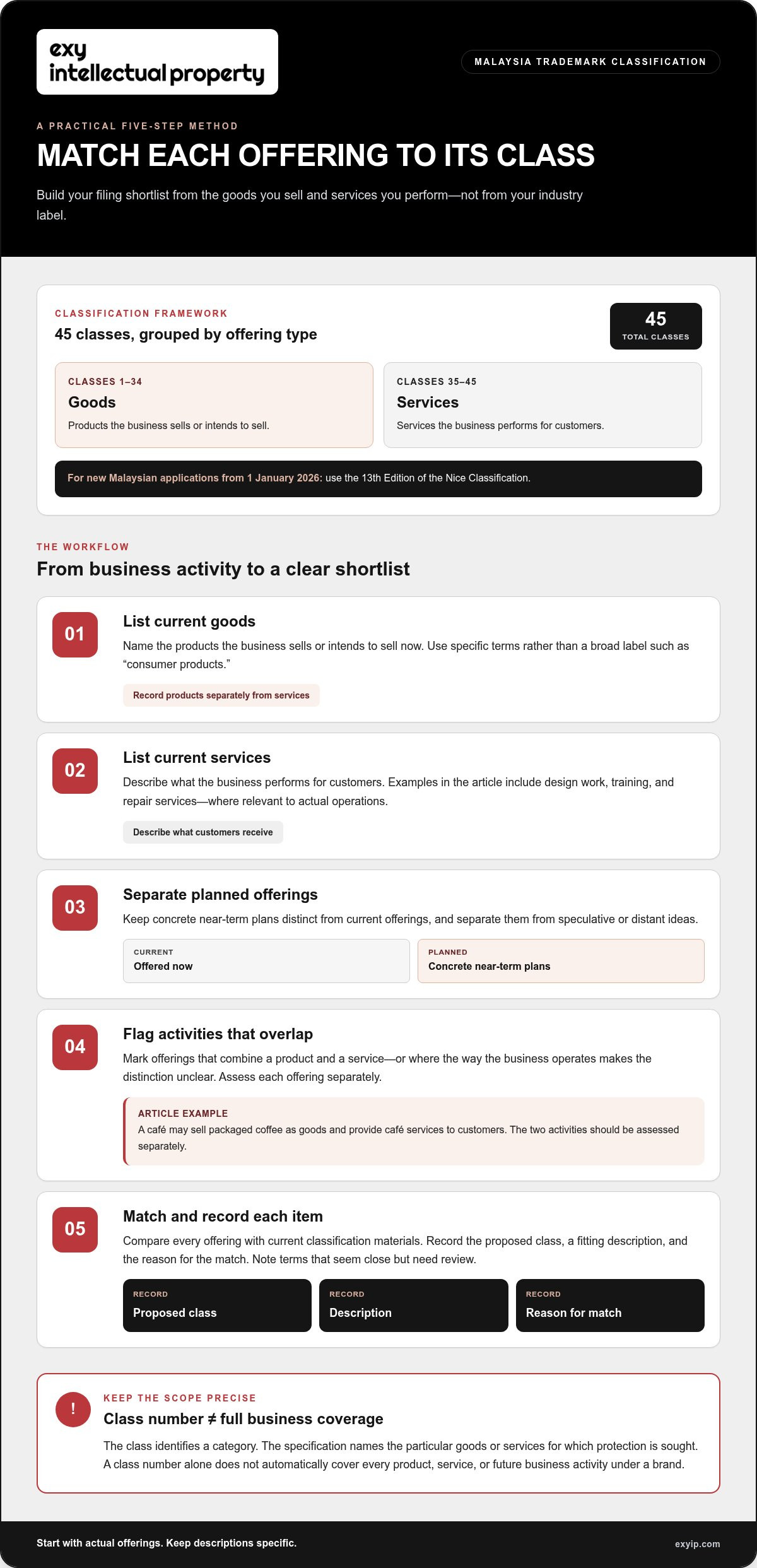
Trademark classes group goods and services into categories for trademark applications. They give applicants and examiners a shared framework for describing what a mark is used with. In Malaysia, new applications have followed the 13th Edition of the Nice Classification since 1 January 2026. The Nice system contains 45 classes: Classes 1 to 34 cover goods, while Classes 35 to 45 cover services.
A class is a category, not a guarantee of broad market protection. The application’s specification, which names the goods or services covered, matters too. A trademark class identifies the category; the specification identifies the particular goods or services for which protection is sought. The International Classification of Goods and Services offers an overview of how the Nice framework organizes these categories.
How the Nice Classification organizes goods and services
The Nice Classification provides a consistent way to group goods and services for trademark registration across participating jurisdictions. The class number is a starting point, not a substitute for describing the offering. Two businesses can fall within the same class while needing different specifications. Identify your actual goods or services, then use descriptions that fit them and the relevant class.
Why a class number does not describe your whole business
An industry label can conceal different activities. A café, for example, might sell packaged coffee as goods and provide café services to customers. These offerings need to be assessed separately rather than assumed to fit one category because they share a brand. A trademark class Malaysia application should reflect the specific goods and services named in its specification, not every activity associated with the business.
This distinction helps set a realistic filing scope. A class number alone does not automatically cover every product, service, or future business activity under a brand. Review each offering on its own terms, then match it to an appropriate class and description. This makes the relationship between the filing and the way the business uses its trademark clearer.
How to Identify the Right Trademark Class in Malaysia
Start with your business activity, not its industry label. A clear inventory of what you sell and perform gives you a practical basis for matching each offering to a class and suitable description. For a trademark class Malaysia filing, connect the specification to real commercial activity, while keeping planned expansion distinct from what the business currently offers.
MyIPO VA1-2026 Pre-Approved Specification Rules
Under MyIPO’s updated Guidelines of Trademarks (VA1-2026), examiners enforce strict scrutiny on custom specifications. Selecting terms directly from MyIPO’s Pre-Approved List of Goods and Services (aligned with NCL 13-2026) ensures faster examination and reduces the risk of receiving a provisional refusal for vague or improper classification. Custom descriptions outside the pre-approved list incur higher official filing fees and require manual examiner review.
Build a clear inventory of current and planned offerings
List products and services separately, using plain, specific terms. Record what is currently offered, then create a separate list for planned offerings. Distinguish active business plans from tentative ideas or distant possibilities. If an activity includes both a product and a service, flag it for closer review rather than assuming one description covers both.
- List current goods. Name the products the business sells or intends to sell now. Be more specific than a broad label such as “consumer products.”
- List current services. Describe what the business performs for customers, such as design work, training, or repair services, where relevant to its actual operations.
- Separate planned offerings. Note goods or services that are part of a concrete near-term plan, keeping them apart from speculative future ideas.
- Flag overlapping activities. Identify offerings that combine goods and services, or where the way the business operates makes the distinction unclear.
- Match and record. Compare each item with current classification resources, including the WIPO Nice Classification, and record the proposed class, description, and reason for the match.
Map each offering to a class and description
Search for terms that accurately describe each offering, then check that the wording reflects how the business sells a product or performs a service. Malaysia adopted the 13th Edition of the Nice Classification for new applications from 1 January 2026, so use current classification materials rather than relying on an old list or a remembered class number. If a term seems close but not exact, record the question for review.
Industry labels are too broad to set filing scope. Actual offerings are the better starting point because they show what customers receive, while an industry label may hide different goods and services. A trademark professional can review the shortlist and descriptions against your business activities and filing objectives. Exy Intellectual Property provides trademark registration and filing support to connect those choices with a considered filing strategy.
Single Class or Multiple Classes: Which Filing Scope Fits Your Business?
The right filing scope depends on the goods and services you want identified in the application, not on how many classes seem safest. Malaysia permits multi-class applications, but adding classes is not automatically better. Each class should relate to an offering you intend the application to cover, and its descriptions should accurately reflect your business activity.
| Business offering pattern | What to consider |
|---|---|
| One focused offering | A single relevant class may fit when the identified goods or services fall within one classification area and the description reflects the activity. |
| Related offerings | Review each related product or service against the classification terms. Related activities may fit one class or require separate consideration, depending on their descriptions. |
| Distinct goods-and-services activities | Where a business offers both products and separate services, assess each activity individually. More than one class may be relevant to the intended scope. |
When one class may reflect a focused offering
A business built around one defined service may have a focused filing scope if the relevant service description fits within a single class. The same principle applies to a business offering a specific type of product. The key is not the number of classes, but whether the application’s wording identifies the activity the business wants covered. A single class is not the right answer for every business.
When several classes may need consideration
Hypothetical example: A company sells skincare products and separately provides in-person skincare training under the same brand. These are distinct activities, so the company would assess the product offering and training service separately. That does not determine a particular class outcome. The appropriate scope depends on the exact goods and services and the applicable classification wording.
Business plans can inform the decision too. A concrete expansion plan may be worth including in filing strategy discussions, but a tentative idea should not be described as a current offering. A broad class heading also should not be treated as a promise of coverage for every item that might sit within that category. The application specification matters.
Procedural Trade-offs of Multi-Class Filings (Section 17)
While Section 17 of the Trademarks Act 2019 allows submitting a single multi-class application to cover both products and services, applicants must weigh procedural trade-offs. If MyIPO issues an Office Action or third-party opposition against a single class in a multi-class filing, the entire application is held up until resolved—unless the applicant pays an official fee to formally divide the application (Form TMA3) under Section 21 to let the undisputed classes proceed to grant.
For Malaysia, compare proposed terms with current official classification resources and filing requirements. The USPTO Nice Classification guide offers a separate example of how a national intellectual property office presents classification guidance, but it is not a substitute for Malaysian sources. For a trademark class Malaysia filing, align the class selection with the intended goods and services, then review the wording as part of the overall filing scope.
Common Trademark Class Selection Mistakes to Avoid in Malaysia
A class decision can look simple when it starts with a familiar industry label. The risk is that labels such as “retail” or “technology” may not describe the specific goods and services a business wants named in its application. Start with actual commercial activities, then check the relevant classification and wording.
Mistaking a class heading for complete protection
A class heading is a broad category label, not a list of every offering a business might associate with that category. Relying on the heading alone can leave the application description short of clearly identifying relevant goods or services. Assess the scope against the specific wording in the application rather than assuming a class number or title covers an entire line of business.
Use precise descriptions that reflect what customers receive. For example, a clothing retailer that also offers garment alterations should consider those activities separately when preparing its list, rather than assume the retail category captures both. The appropriate wording depends on the activity and current classification terminology. Compare relevant descriptions with the applicable Nice Classification and current Malaysian filing guidance before finalizing a trademark class Malaysia application.
Overlooking services, related activities, or future changes
Businesses sometimes list the products they sell but forget the services they provide alongside them. Training, installation, maintenance, or customisation may be distinct activities worth assessing, depending on the business’s actual offering. Leaving out a relevant activity can create a gap between the application specification and the business activities the owner intended to include. An omission does not necessarily result in refusal, but it can affect how closely the stated filing scope matches the intended coverage.
Separate current activities from credible near-term plans. A planned service that is part of an active business strategy may warrant discussion during filing preparation. A distant possibility should not be presented as though it is already offered. Keep the lists distinct so the filing strategy reflects real priorities.
Business offerings can change. New products, services, or delivery models may call for a fresh review of the trademark protection strategy, since an existing specification should not be assumed to cover activities it does not identify. Exy Intellectual Property’s trademark registration and filing support helps businesses review classification choices against their activities and filing objectives. Review your trademark filing scope as part of a considered classification strategy.
Prepare Your Malaysia Trademark Class Strategy Before Filing
A well-prepared trademark class Malaysia strategy begins with clear business information, not a guess at a class number. Organising the details in advance makes classification review more focused and ties the proposed filing scope to your business priorities.
What to prepare for a classification review
Gather the material that explains what the mark represents and how the business uses it. A working file can include:
- The mark you plan to register.
- A plain-language business description that explains what customers can buy or receive.
- An inventory of current goods and services, listed separately and described specifically.
- Relevant expansion plans, clearly distinguished from offerings that are only possibilities.
- Your draft class shortlist and descriptions, with questions beside any item whose classification or wording is unclear.
Keep proposed descriptions aligned with the real activity you intend the application to cover. If a term seems broad, ambiguous, or different from how the business operates, flag it for review rather than relying on it without explanation. A clear inventory makes it easier to identify where a class choice or description needs closer attention.
Connect class selection to wider brand protection
Classification is one part of a considered filing strategy. A trademark professional can review the shortlist against your business activities, proposed descriptions, and filing objectives, helping identify questions to resolve before preparing an application. This review can also distinguish immediate priorities from future plans, so the intended scope is clear without treating speculative offerings as current activity.
Consider how the mark supports the business now: which offerings are central to the brand, and where does consistent identification matter most? If the business has plans beyond Malaysia, its international objectives can inform the wider protection strategy. Global Trademark Registration: Strategic Guide for 2026 provides a related resource for considering multi-country plans. For a closer look at the Malaysian process, read Trademark Registration in Malaysia: 2026 Strategic Guide.
Exy Intellectual Property provides trademark registration and filing support in Malaysia, connecting classification choices with a considered filing strategy. Explore Exy Intellectual Property trademark registration support to plan the next step for your application.
Build a Filing Scope That Fits Your Business
A well-considered trademark class Malaysia strategy starts with what your business actually sells or performs. List goods and services separately, match each offering to an appropriate class, and use descriptions that reflect the activities you intend the application to cover. A class heading alone does not define the full scope.
One class may suit a focused offering, while distinct goods and services may call for several classes to be considered. The right choice depends on your filing objectives and the specific goods or services named in the application. Keep current activities separate from future plans, and review the strategy as the business changes.
Classification is one part of planning how your brand and intellectual property support business growth. Exy Intellectual Property provides trademark registration and filing support in Malaysia, with intellectual property advisory connected to business protection and growth. Explore Exy IP trademark registration support to develop a considered filing strategy for your business.
Frequently Asked Questions
What is a trademark class in Malaysia?
A trademark class in Malaysia is a category for grouping goods or services in a trademark application. It organizes the offerings identified for protection, but the class number alone does not define the full scope. The application’s goods or services description matters too. For example, a business should identify the specific products it sells rather than rely only on a broad class label. Review current Malaysian classification guidance before filing.
How many trademark classes are there in Malaysia?
Malaysia uses the Nice Classification, which has 45 classes: 34 for goods and 11 for services. New Malaysian applications have used the 13th Edition since 1 January 2026. Class numbers help organize an application, but choosing a number alone isn’t enough. Identify the relevant goods or services and ensure the descriptions fit your offerings, using current official Malaysian guidance when preparing the filing.
How do I find the right trademark class for my business?
Start by listing the goods you sell and services you provide, then separate current activities from realistic near-term plans. Search current official classification resources for relevant terms, and compare each description with what your business actually offers. For a trademark class Malaysia application, note any unclear item or possible overlap between goods and services. Exy Intellectual Property’s trademark filing support can review the shortlist against your activities and filing objectives before you finalize the scope.
Can one business register a trademark in more than one class in Malaysia?
Yes. A Malaysian trademark application can cover multiple classes when the identified goods and services fall into different classification areas. For instance, a business selling packaged products and providing separate training services may need to assess both activities. The right scope depends on the specific offerings and descriptions in the application. Don’t add classes simply because they sound relevant to your industry; assess each one against your business activities and current classification guidance.
Does a trademark class protect everything my business sells or does?
No. A class number shouldn’t be treated as automatic protection for every product or service associated with your business. The application’s specification identifies the goods or services for which protection is sought, so its wording matters. Prepare specific descriptions that reflect your actual offerings and intended filing scope. If your business sells products and performs services, assess both types of activity rather than assuming one class heading covers everything.
Can I change my trademark classes after filing in Malaysia?
Whether an application can be changed after filing, and what changes are permitted, depends on Malaysian law and the applicable filing procedure. Don’t assume you can freely expand a class or description once an application has been submitted. Identify the intended goods and services before filing, and consult current official Malaysian guidance if the proposed scope changes. Exy Intellectual Property’s trademark filing support can help assess classification choices and explain how they relate to your filing objectives.
Should I choose classes for products I may sell in the future?
Consider credible business plans, but keep them separate from current offerings and speculative ideas. A filing strategy can take near-term expansion into account, yet each proposed class and description should relate to the scope you intend the application to cover. Future plans don’t automatically make every possible class appropriate. Record what the business offers now, what it plans to add, and what remains uncertain, then review the shortlist against current requirements and objectives.