


What if someone else uses the name, logo or product customers recognise? For businesses in Malaysia, that can confuse customers and weaken trust in a brand. A practical brand protection Malaysia plan links the right legal protections to clear business priorities. It also sets out how to respond when suspected misuse appears.
It can be difficult to know which parts of a brand may be protected, or whether registration alone is enough. Different assets may need different forms of intellectual property protection, and those protections work best as part of an ongoing process.
This guide explains how trademarks, copyright, patents and industrial design rights may apply to business assets in Malaysia. You’ll learn how to inventory assets, prioritise registration and monitoring, preserve useful evidence, and assess proportionate responses to suspected misuse. It also covers how licensing, valuation and commercialization can connect protection with brand value and business growth.
Key Takeaways
- Map your brand assets first: names, logos, creative work and product appearance may call for different intellectual property rights.
- Choose protection based on the role each asset plays in your business. Each right has its own scope and limits.
- Assess suspected online impersonation or copying carefully. A suspicious use is not automatically proven infringement.
- Build a practical brand protection Malaysia plan by prioritising valuable assets, keeping evidence and setting out proportionate next steps.
- Connect registration and enforcement decisions with valuation, commercialization and licensing to support controlled use and future growth.
Why Brand Protection in Malaysia Starts with Identifying What You Own
A brand is more than a name or logo. It can include signs customers recognise, original content, product appearance, inventions and the online identities people use to find your business. Brand protection means safeguarding these assets and the commercial reputation associated with them. It helps a business reduce confusion, imitation and unauthorised use, while supporting the trust that contributes to brand value.
Brand protection is broader than cybersecurity: it addresses the legal and commercial protection of brand assets, not only the security of systems, accounts and data. Cybersecurity measures can help secure digital channels, but they don’t by themselves establish intellectual property rights in a business name, design or creative work.
Which parts of a Malaysian business brand need protection?
Start with an asset inventory. List business and product names, logos, product designs, marketing content, photographs, software and other creative work, inventions, and digital identities such as website domains and social media profiles. For each item, record who created or owns it, where it is used, and what the business could lose if another party copied or impersonated it.
Different assets call for different protection or response strategies, and listing an item doesn’t mean it qualifies for registration. For example, a distinctive logo on packaging may raise a trademark question, while a copied product photograph may call for a copyright assessment. A lookalike social profile may require evidence preservation and a review of the platform’s processes, alongside any intellectual property concerns.
For creative works, the Copyright Act 1987 is part of Malaysia’s copyright framework. The work and circumstances still matter when assessing what protection may apply.
What brand protection can and cannot do
An exclusive right can give its holder control over specified uses of protected subject matter. Its scope depends on the right and the asset it covers. It isn’t a blanket claim over every similar name, design or idea.
That distinction matters in practice. Protection for a particular sign or work doesn’t automatically extend to every asset, market or type of misuse. The appropriate rights and possible outcomes depend on the facts and current Malaysian law.
Careful identification is the starting point for brand protection Malaysia. It helps businesses focus on the assets most closely tied to customer recognition and trust, then consider suitable protection and response options without assuming that registration alone resolves every risk.
Which Intellectual Property Rights Can Protect a Brand in Malaysia?
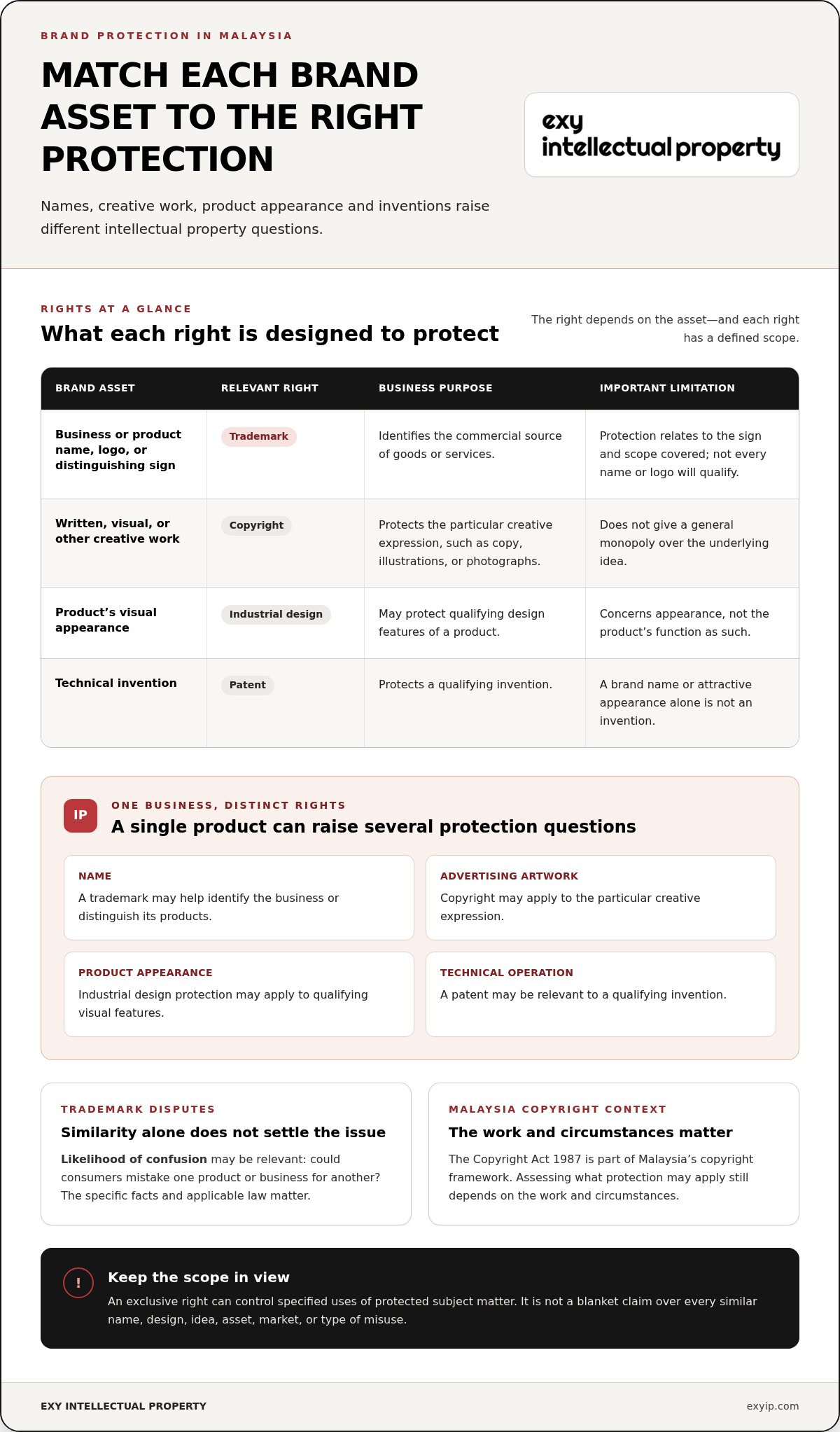
Different assets call for different rights. A trademark is a sign that distinguishes a business or its products from others. Copyright may apply to original creative expression, industrial design protection addresses product appearance, and patents relate to inventions. One business may use a trademark for its name, copyright for its advertising artwork, industrial design protection for a product’s appearance, and a patent for a qualifying invention.
| Asset | Relevant right | Business purpose | Important limitation |
|---|---|---|---|
| Business or product name, logo, distinguishing sign | Trademark | Identify the commercial source of goods or services | Protection relates to the sign and scope covered; not every name or logo will qualify. |
| Written, visual or other creative work | Copyright | Protect the particular creative expression | It doesn’t give a general monopoly over the underlying idea. |
| Product’s visual appearance | Industrial design | Protect qualifying design features of a product | It concerns appearance, not the product’s function as such. |
| Technical invention | Patent | Protect a qualifying invention | A brand name or attractive appearance alone is not an invention. |
Trademark protection for names, logos, and distinguishing signs
A trademark can help customers recognise a business or distinguish its products in the marketplace. In assessing a dispute, likelihood of confusion may be relevant: could consumers mistake one product or business for another? The specific facts and applicable law matter, so similarity alone doesn’t settle the issue. A considered Malaysia trademark registration strategy starts by identifying the signs customers rely on and the goods or services those signs identify.
Common Law Protection via Passing Off
Beyond statutory registration under the Trademarks Act 2019, Malaysian law protects established brand goodwill through the common law tort of Passing Off. To succeed in a passing off action against a lookalike brand, a business must prove three elements (the classic Jaffron trinity): established brand goodwill/reputation in Malaysia, misrepresentation by the competitor leading to public confusion, and actual or prospective damage to the business.
Copyright, industrial designs, and patents protect different subject matter
Copyright concerns a work’s particular creative expression, such as written copy, illustrations or photographs, rather than ownership of a broad idea. Industrial design protection may apply to the visual appearance of a product, while patents address inventions. These rights serve distinct purposes, and one doesn’t automatically replace another. Depending on its features and applicable requirements, a product may raise separate questions about its name, appearance, artwork and technical operation.
For an overview of Malaysia’s intellectual property framework, the U.S. International Trade Administration’s Protecting Intellectual Property in Malaysia guide discusses types of intellectual property and related practical considerations. Use this distinction to consider industrial design protection in Malaysia separately from trademark or patent questions.
Rights have defined scopes and don’t automatically cover every market or form of use. Exy Intellectual Property connects asset identification with registration and broader intellectual property decisions through its intellectual property advisory.
Digital Impersonation and IP Infringement: How to Assess Brand Threats
A suspicious online use can affect customer trust, but it isn’t automatically a proven legal infringement. First identify what appears to be happening, which asset may be involved, and what evidence you can preserve. A practical brand protection Malaysia response separates possible intellectual property concerns from account security and other business risks, then assesses the facts before taking action.
How to recognise brand misuse across digital channels
Different warning signs call for different questions:
- Misleading domains or fake profiles: An account or website that imitates your business may mislead customers. It can raise impersonation and cybersecurity concerns, as well as questions about trademark use.
- Copied logos or product names: These may raise trademark concerns. Whether the use infringes a right depends on the sign, the context and the relevant facts, including whether there may be a likelihood of confusion.
- Copied photographs, text or graphics: These may raise copyright concerns about creative work, distinct from a dispute over the business name or logo.
- Imitated product appearance: Similar-looking goods may prompt a review of design-related rights and other relevant intellectual property, depending on the product and protection held.
One incident can involve more than one issue. A fake profile using a business logo, for example, might create customer confusion while also attempting to obtain login details. Classifying the conduct helps determine whether to focus next on evidence, platform procedures, intellectual property advice, account security, or a combination of these.
What evidence should a business preserve?
Keep a clear, dated record before content changes or disappears. Where appropriate, preserve:
- Screenshots showing the content, account name and date captured.
- The full page address, domain or profile URL, plus relevant account details.
- Messages, emails and other correspondence connected to the suspected misuse.
- Customer reports and related business records that show the nature or impact of the incident.
- Original files and ownership records for the brand asset in question.
Consistent documentation helps an adviser compare the online material with the relevant asset, assess what happened, and consider a proportionate response. In complex cases involving online impersonation or unauthorized digital access, specialized firms such as International Investigative Group can assist by gathering electronic evidence and conducting forensic analysis. Avoid confronting the account holder or publishing accusations before the facts and legal position have been reviewed.
Any platform reporting or takedown procedure depends on that platform’s rules. Potential legal remedies depend on the circumstances and verified Malaysian law; don’t assume that content will be removed or that a particular outcome will follow. If suspected misuse crosses borders, international trademark planning may also be relevant. The World Intellectual Property Organization explains Malaysia’s accession in Malaysia Joins the Madrid System, a reference point for businesses considering trademark protection across countries.
How to Build a Practical Brand Protection Plan for Malaysia
A useful plan turns an asset inventory into priorities and next steps. It doesn’t need to treat every name, design or online account as equally urgent. Focus first on what customers recognise, what supports commercial activity, and where unauthorised use could have the greatest effect on the business.
Prioritise assets and protection needs
Work through these steps with the people responsible for your brand, products and intellectual property:
- Inventory assets. Record principal business and product names, logos, designs, content and inventions. Note what each asset does for the business.
- Assess exposure. Identify where each asset is used, which markets matter, who can access it, and any known instances of imitation or unauthorised use.
- Identify relevant rights. Consider whether a trademark, copyright, industrial design or patent may be relevant. The asset and its use determine which options warrant review.
- Document concerns. Keep ownership and creation records together with dated evidence of suspected misuse, customer reports and related correspondence.
- Review next steps. Decide whether to seek registration advice, strengthen records, assess a specific incident or plan for expansion.
Prioritise by commercial importance, geographic reach and the likely consequences of unauthorised use. For example, a core product name used across sales channels may deserve earlier attention than an asset with limited business use. Link each priority to its ownership records, current markets and known exposure so decisions reflect the business context.
Protection in Malaysia and plans for international growth are related, but they may require separate strategic consideration. If the business expects to enter other markets, consider where the brand will be used and what trademark strategy fits those plans. A global trademark registration strategy should reflect intended markets rather than assume that protection in one place applies everywhere.
Plan a measured response and review cycle
Seek registration advice when identifying suitable rights or planning an application. Legal advisory can help assess a specific concern and possible responses. If a dispute may require formal action, intellectual property litigation support may be relevant; the appropriate route depends on the facts and current law. Don’t treat every resemblance or online complaint as proof of infringement.
Review the inventory regularly, especially when products, markets or business arrangements change. Check that licenses still reflect intended use, and record incidents so recurring concerns inform future decisions.
Internal review checklist: For each priority asset, record its owner, business use, relevant markets, supporting records, known risks and next review action.
Exy Intellectual Property provides IP protection strategy advice to help align these priorities with your business.
How Exy Intellectual Property Supports Brand Protection and Growth
Brand protection works best as a connected business process. Identifying assets is only the start. A business also needs to consider which rights may apply, how to respond to suspected misuse, and how protected intellectual property can support commercial plans. Exy Intellectual Property brings these considerations together through registration, legal advisory, intellectual property litigation, valuation and commercialization strategy.
From registration and advice to enforcement
Exy Intellectual Property supports trademark, patent, industrial design and copyright matters, helping businesses assess protection for the assets they have identified. Services include trademark registration and filing, patent services, industrial design registration and Copyright Voluntary Notification. The right route depends on the asset, its use and the relevant facts.
Legal advisory can help a business assess protection options and consider a response to a specific concern. If a dispute calls for formal proceedings, Exy Intellectual Property’s litigation support focuses on intellectual property matters, not general litigation. These services connect registration decisions with an informed review of possible enforcement steps, without assuming a particular action will produce a particular result.
Connect protection with licensing and brand value
A license grants permission to use intellectual property under agreed terms. For example, a business may authorise another party to use a protected brand or creative asset and set out the permitted use in a licensing agreement. Clear terms help structure that commercial relationship and define the basis for authorised use.
Valuation and commercialization strategy bring a business perspective to portfolio decisions. An intellectual property valuation may help inform planning around licensing, investment or future growth, while commercialization advice considers how intellectual property may be brought to market. Neither valuation nor planning guarantees financial results. Both can help decision-makers compare options and understand how assets fit the wider business strategy. The intellectual property valuation methodology should be considered in light of the asset and the purpose of the assessment.
Statutory License Recordal at MyIPO (Section 69)
When commercializing brand rights through licensing agreements, recording the license in the Register at MyIPO under Section 69 of the Trademarks Act 2019 is essential. Formal recordal ensures the license is legally binding against third parties and enables registered licensees to join formal infringement actions against unauthorized copycats.
For businesses reviewing brand protection Malaysia-wide, linking registration, advice, enforcement and commercial planning can keep decisions aligned as the business develops. Exy Intellectual Property supports that process with advice shaped around your intellectual property priorities. Discuss your IP protection strategy.
Make Brand Protection Part of Your Business Strategy
Effective brand protection Malaysia starts with knowing which assets matter most, then matching them with suitable intellectual property rights. A business name, creative work, product appearance and invention may each need a different approach. Clear records and a measured response plan help you assess suspected misuse without assuming that every resemblance is infringement.
Protection can also support growth. Exy Intellectual Property assists with intellectual property registration and advisory for Malaysian and global matters, alongside valuation, license agreements, commercialization strategy and intellectual property litigation. These services connect protection decisions with how your business develops and uses its intellectual property.
Take the next step with a strategy shaped around your assets and business priorities. Discuss a brand protection strategy with Exy Intellectual Property.
Frequently Asked Questions
What does brand protection mean in Malaysia?
In Malaysia, brand protection means identifying and safeguarding the signs, creative works, product appearance and other intellectual property that contribute to a business’s identity and reputation. A plan may involve different rights, evidence of ownership, and a considered response to suspected misuse. It’s broader than cybersecurity alone: securing accounts and systems matters, but it doesn’t by itself address legal rights in a business name, logo, design or creative work.
Can a trademark protect my business name and logo in Malaysia?
A trademark may protect a business name, logo or other sign used to distinguish a business or its products, subject to applicable requirements and the scope of protection. Registration can help establish rights in the relevant sign, but it doesn’t automatically cover every similar name, product or market. If another party uses a similar sign, factors such as context and likelihood of confusion may matter when assessing the issue.
What is the difference between a trademark and copyright for brand protection?
A trademark identifies the commercial source of goods or services, such as a brand name or logo. Copyright concerns original creative expression, such as a photograph, illustration, written content or advertising artwork, rather than a general idea. In Malaysia, copyright protection is automatic upon creation, while a Copyright Voluntary Notification can provide prima facie evidence of ownership in court. A business may have both rights in different parts of its brand.
How can I protect my brand from fake websites and social media profiles?
Keep records of the suspected account or website, including dated screenshots, full URLs, profile details, customer reports and related messages. Secure relevant business accounts and use the platform’s reporting process where appropriate. A fake profile may raise account-security, impersonation and trademark concerns, but its presence alone doesn’t prove infringement. Review the evidence and rights involved before making public accusations or deciding on further action.
Does registering a trademark protect my brand in every country?
No. Trademark protection is territorial, so registration in Malaysia doesn’t automatically provide protection in every other country. Businesses planning to expand should consider the markets where they intend to use the brand and plan protection accordingly. The Madrid Protocol provides a route for seeking trademark protection across multiple countries through an international application, but it isn’t a single worldwide trademark. The relevant jurisdictions and application details still matter.
When should a Malaysian business seek intellectual property advice about brand protection?
Seek intellectual property advice when choosing rights for important brand assets, preparing to enter new markets, considering a license, or responding to suspected copying or impersonation. Advice can also help clarify ownership records and review registration or commercialization plans. Exy Intellectual Property supports Malaysian and global matters through registration, legal advisory, valuation, license agreements, commercialization strategy and intellectual property litigation focused on IP matters. Early review can help align decisions with business priorities.