


The most damaging trademark application errors can happen before a form is submitted. A mark may be too descriptive to distinguish a business, a search may miss a conflicting mark, or an application may name the wrong owner or cover the wrong goods and services. These common trademark registration mistakes can weaken the protection a business expects in Malaysia.
Choosing a name and completing the filing are only part of the task. The decisions behind the application matter just as much: what sign is being protected, who owns it, and how the relevant goods or services are described. Official authorities administer trademark registration in Malaysia. Registering a business name with the Companies Commission of Malaysia (SSM) does not automatically protect it as a trademark.
This guide explains where applications commonly go wrong and how to make better-informed decisions before, during and after filing. It covers distinctiveness, clearance searches, ownership details and classification, along with ways to connect filing decisions to longer-term commercial plans. It also explains how specialist trademark registration support from Exy Intellectual Property can help manage the process.
Key Takeaways
- Assess whether your mark can distinguish your business, and look beyond exact matches when checking for similar marks.
- Common trademark registration mistakes include unclear ownership details and goods or services descriptions that do not match your protection goals.
- Read official correspondence carefully. Identify whether it concerns the application or a third-party challenge before deciding how to respond.
- Use a clear filing sequence: settle the mark and applicant details, define the intended scope, then review the application record.
- Trademark registration support can help align filing decisions with longer-term brand plans in Malaysia and internationally, without guaranteeing registration.
Common trademark registration mistakes in Malaysia, and why they matter
A trademark is a sign which distinguishes a business or its products from others. It may be a name, logo or another sign used to identify a business’s goods or services. An application does more than record a preferred brand name: it identifies the sign and the goods or services for which protection is sought. For a general overview of the concept, see What is a Trademark?
The connection between the mark and the goods or services matters. If an application does not accurately reflect the mark a business uses or the products and services it plans to offer under that mark, the record may not match its commercial needs. Errors can affect examination, the scope of protection sought or later decisions about how the business presents and extends its brand. They do not all lead to the same outcome, and careful preparation does not guarantee registration. It does give an applicant a clearer basis for making informed choices.
Registration also has boundaries. A Malaysian registration does not automatically protect a brand in other countries or cover every product, service or use of a name. Its scope is tied to the registered sign, the goods or services covered and the territory in which protection is secured. Businesses with international plans need to consider protection in relevant markets separately.
Why small filing decisions can affect brand protection
Small details can shape what an application seeks to protect. A change in the mark, an unclear applicant name or a description of goods and services that is too broad or too narrow may leave the application misaligned with the brand’s actual use. For example, a business may use a distinctive word alongside a logo. How it identifies the mark in its application can affect whether the intended brand identity is reflected in the record. Accuracy helps connect the filing to real business activity, without promising a particular registration or enforcement result.
These choices can also matter as a business grows. A brand might later appear on additional products, be offered through a new channel or enter another market. An application based on a clear view of current use and commercial plans can help the business assess its protection strategy, but it cannot automatically cover every future development.
Which trademark mistakes deserve attention first?
It helps to group risks by when they arise, rather than assume every application is unusually complex:
- Before filing: choosing a mark without considering its distinctiveness or checking for relevant similarities.
- In the application: recording the applicant, mark or goods and services inaccurately or inconsistently.
- After filing: overlooking official correspondence or assuming that filing alone settles every protection question.
These are decision points to manage, not reasons to treat every filing as a crisis. The following sections examine choices about the mark, ownership and scope, then post-filing responsibilities. This helps show where attention is most useful without treating all risks as identical.
Early choices shape the application: define the mark, owner and intended scope before filing, then stay attentive to what follows.
Trademark application mistakes involving the mark, owner, and scope
Three decisions shape an application from the outset: what sign the business wants to protect, who should own it, and which goods or services it should cover. Treating these as separate form-filling details can leave the application out of step with the business’s brand and plans.
Choosing a mark and checking for similar signs
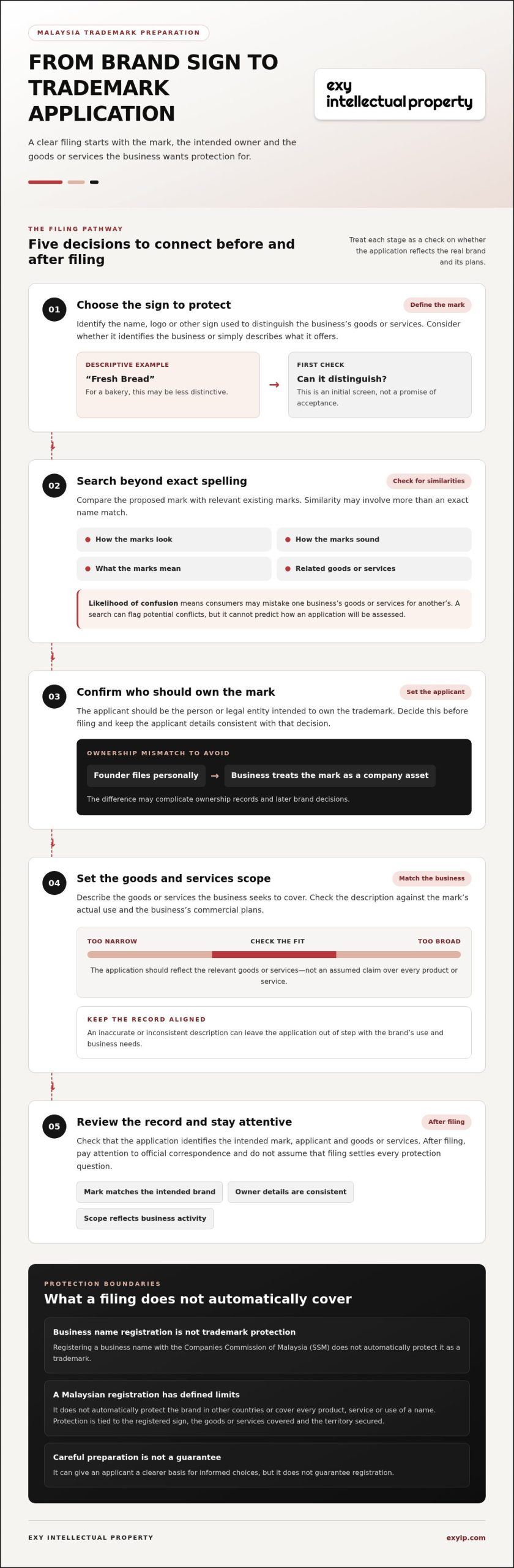
A distinctive mark helps customers identify one business’s offerings. Wording that simply describes a product or service, such as “Fresh Bread” for a bakery, may be less distinctive than a name with no direct connection to the goods. This contrast is a useful first screen, not a guarantee that any particular mark will be accepted.
Search beyond exact spelling. Similarity can involve how names look or sound, what they mean and the goods or services they relate to. Likelihood of confusion refers to the possibility that consumers may mistake one business’s goods or services for another’s. A search can help identify potential conflicts before a business commits to a name, but it cannot predict how an application will be assessed. Reviewing the findings as part of international trademark protection and the Madrid System planning can also help businesses consider where they may seek protection beyond Malaysia.
Before settling on a mark, compare the proposed sign with relevant existing marks and consider whether it distinguishes the business rather than merely describing its offering. These checks are central to avoiding common trademark registration mistakes.
Statutory Rejection Standards (Sections 23 & 24, Trademarks Act 2019)
MyIPO examiners assess applications under two statutory thresholds: Section 23 (Absolute Grounds) prohibits marks that are devoid of distinctive character or purely descriptive of the goods/services. Section 24 (Relative Grounds) prohibits marks that are identical or confusingly similar to earlier registered trademarks or pending applications.
Defining the owner and goods or services
The applicant should be the person or legal entity intended to own the trademark. If a founder files personally while the business later treats the mark as a company asset, the difference may complicate ownership records and future brand decisions. Confirm the intended owner before filing, and keep the applicant’s details consistent with that decision.
The scope of goods and services is a business decision, too. A description that is too narrow may not reflect planned activities. One that does not match actual offerings can create a gap between the application and the brand’s use. Malaysian applications organise goods and services using the Nice Classification. Consider the business activity alongside the protection intended, then make sure the filing description accurately reflects that purpose.
| Business activity | Intended coverage | Filing description to consider |
|---|---|---|
| Selling packaged tea | The tea products sold under the brand | Describe the relevant tea goods precisely |
| Operating a café | The café service offered under the brand | Describe the relevant café services |
| Planning branded merchandise | Merchandise the business intends to sell | Identify the specific goods planned |
These examples are prompts, not prescribed filing wording. Exy’s trademark registration support can help assess the mark, intended owner and scope together, including for businesses considering registration in Malaysia or globally.
MyIPO VA1-2026 Specification Rules
Under MyIPO’s Guidelines of Trademarks (VA1-2026), examiners enforce strict scrutiny on custom specifications. Selecting terms directly from MyIPO’s Pre-Approved List of Goods and Services (aligned with NCL 13-2026) accelerates examination and avoids provisional refusals issued for vague classification.
After filing: avoid response, scope, and protection assumptions
Submission is not the end of the process. Official correspondence may require attention, and assumptions about what a filing covers can leave gaps between the application and a business’s wider plans. Keep the notices and application documents together, and respond to each communication according to what it actually says.
Treating an application notice as something to act on
Read a notice carefully before deciding what to do. Identify who issued it, which part of the application it concerns, whether it requests information or a response, and any stated date or procedural step. A notice about examination of an application is different from a challenge brought by a third party. They arise in different contexts and should not be treated as interchangeable.
The required response depends on the notice and applicable Malaysian procedure. Do not assume every issue leads to the same remedy, or that a step taken for one type of matter will address another. Check the current requirements and the notice itself. If its meaning or implications are unclear, specialist legal advisory can help assess the next step. Keep relevant correspondence and records together so the application’s history is easy to follow.
Assuming one registration protects every market and use
Trademark protection is territorial. A Malaysian registration relates to Malaysia and the goods or services covered by that registration. It does not automatically extend to other countries. Businesses planning to trade overseas should consider which markets matter to their commercial plans rather than assume one filing secures every market.
The Madrid Protocol is an international treaty for seeking trademark registration across multiple countries through an international system. It provides a route to request protection in selected markets, not a single worldwide registration that automatically applies everywhere. The World Intellectual Property Organization’s overview of the Madrid System explains how the system works. When planning international applications, consider the destination markets and the goods or services intended for each.
There is another boundary to keep clear: trademark registration does not automatically protect every asset associated with a business. A company name, domain name and creative work are not interchangeable with a registered trademark. A domain may help customers find a website, while copyright may protect a qualifying creative work. Neither fact alone means the business has trademark protection for all related uses. Consider each asset according to what it is and how the business relies on it.
These distinctions make post-filing attention part of avoiding common trademark registration mistakes. Track correspondence, understand the scope recorded for the mark, and revisit protection needs as the business enters new markets or develops new offerings. Careful management can support informed decisions, but cannot guarantee a particular outcome in an examination or third-party challenge.
Practical Steps to Reduce Trademark Application Errors
A consistent process makes filing decisions easier to check and explain. Separate the facts your business can prepare from questions that depend on Malaysian requirements or legal assessment. The application can then be reviewed against both your records and the protection you intend to seek.
Prepare the brand and ownership information
Start with the business’s own records. Write down the exact sign intended for filing, including the wording or visual elements that form the mark, and describe how it is used or planned to be used. Identify the intended applicant and record why that person or entity should own the mark. Then list current and planned goods or services. This preparation gives the filing decisions a clear business basis.
Checking ownership and scope before submission helps align the application with the business’s intended brand protection.
Review the application before and after submission
Before filing, compare the proposed mark, applicant details and goods or services description with the information prepared by the business. Questions about classification, filing requirements or legal implications call for a procedural review against current Malaysian practice. Use an internal checklist to spot inconsistencies, but do not treat it as a substitute for that review.
After submission, save the application details and related correspondence in one organised record. Assign responsibility for monitoring official communications, noting any stated response requirements and arranging timely review. Keep the record current as the application progresses or new correspondence arrives. The aim is not to assume a particular outcome, but to make sure the business can understand what has been filed and what action may be needed.
Use this sequence to keep the process practical:
- Confirm the sign. Keep a clear copy of the mark and the version intended for filing.
- Set the ownership basis. Record the intended applicant and the business reason for that choice.
- Map the scope. List current and planned goods or services, then identify the intended protection.
- Review the filing details. Check consistency across the mark, applicant and scope, and have procedural or legal questions assessed against current Malaysian requirements.
- Maintain the record. Store the submitted application and correspondence, and assign someone to monitor notices and next steps.
This process helps address common trademark registration mistakes without treating every filing as a problem. For an overview of the wider filing journey, consult a Malaysia trademark registration guide alongside current MyIPO information, especially where procedural requirements need to be checked.
Exy supports businesses with trademark registration in Malaysia and internationally, including review of the mark, ownership details and intended scope before filing.
How Exy supports a more deliberate trademark registration process
A trademark application brings legal and business decisions together. Exy Intellectual Property helps businesses approach those decisions methodically, with attention to the mark, applicant details and intended goods or services. This helps connect the application with how a business plans to use and develop its brand.
What structured trademark filing support can address
Before filing, it helps to consider the business’s plans alongside the application information. Exy Intellectual Property’s trademark registration support addresses the decisions behind the filing, including the mark, intended applicant and scope of goods or services. Reviewing these elements together can help identify inconsistencies and clarify what the application is intended to cover.
This preparation can also distinguish business information from questions that call for legal or procedural review. A business can describe its products, services and planned brand use. The filing choices then need to reflect that information in a way that fits the application. The aim is a considered filing, not a promise of acceptance or a particular result.
Support can remain relevant after submission, too. Keeping application documents organised gives the business a clearer view of what it has filed and helps it assess later decisions. If a notice raises a procedural or legal question, consider the next step in light of the notice and current requirements rather than assuming an outcome in advance.
Plan trademark protection around business direction
Protection decisions are most useful when considered alongside the business’s direction. A company preparing to launch new products may need to assess whether its planned offerings are reflected in its filing scope. A business considering entry into new markets should think about where it plans to operate and how protection there fits its commercial plans. Global trademark registration can form part of that strategy, but does not guarantee registration in any market.
These choices also connect with longer-term brand protection and commercialization planning. The mark used today may later form part of product launches, partnerships or licensing plans. Reviewing current use and realistic business goals can help keep filing decisions aligned with those ambitions, without assuming an application covers every future product, market or use.
A deliberate approach can help reduce common trademark registration mistakes by giving the application a clear business foundation. Exy Intellectual Property’s trademark registration support helps businesses consider filing decisions in relation to their objectives, without treating registration as a guaranteed outcome.
If you are considering a filing or reviewing your trademark plans, Exy Intellectual Property can support your trademark registration and related IP strategy.
Take the next step in your brand protection plan
Your trademark strategy can develop alongside your business. As you plan new offerings, partnerships or expansion, consider how your intellectual property priorities fit those goals. Setting out the next stage of your brand’s development can help you make more deliberate decisions about protecting and commercializing its value.
Common trademark registration mistakes are easier to avoid when filing decisions reflect clear business priorities. Exy Intellectual Property provides IP advisory and commercialization services to help businesses consider how intellectual property can support their plans. The right approach depends on your objectives and circumstances; no filing can guarantee a particular result.
Ready to consider your next step? Discuss your trademark registration needs with Exy Intellectual Property.
Frequently Asked Questions
Is trademark registration in Malaysia valid worldwide?
No. A Malaysian registration does not grant protection in every country. If you plan to expand, prioritise the markets that matter to your business, such as countries where you expect to sell directly or work with distributors. The Madrid Protocol offers an international route for seeking trademark registration in multiple countries, but does not create automatic worldwide coverage. Consider which markets and filing routes fit your plans and circumstances.
Does registering a company name protect my trademark in Malaysia?
No. Do not rely on a company-name registration alone to protect the branding customers see. For example, a company may trade under a product brand that differs from its registered entity name. Make an inventory of the names and logos used on products, storefronts, websites and promotional materials. This can help identify which customer-facing signs deserve attention in your trademark strategy, rather than focusing only on the company’s formal name.
Can I change a trademark application after filing in Malaysia?
Possibly, but the answer depends on the change and the application’s status. A correction to an administrative detail may be treated differently from an attempt to replace the mark or substantially alter its claimed goods and services. Before requesting a change, identify precisely what should be different and why. Then get advice on the available route under current Malaysian procedure, rather than assuming a revision will be accepted.
How long does trademark registration take in Malaysia?
Processing time varies, so there is no one reliable completion date for every application. Examination, the application’s particulars and any issues requiring attention can affect progress. For business planning, avoid making a launch or packaging change depend on registration being completed by a particular date. Check current MyIPO process information and monitor the application’s progress, so decisions reflect its actual status rather than a general estimate.
Can I use the TM symbol before my trademark is registered?
The TM symbol is commonly used to signal that a sign is being claimed as a trademark, but its implications and appropriate use can depend on jurisdiction and context. Do not use any symbol in a way that misrepresents your registration status. Before placing it on packaging, advertisements or a website, consider where those materials will appear and what they communicate to customers. Seek Malaysia-specific advice if the intended use is uncertain.
Is a trademark different from copyright?
Yes, they address different aspects of a brand asset. For example, a business using a commissioned logo may need to consider both its use as a brand identifier and the creator’s rights in the artwork. Keep the design brief, creator details and written arrangements about ownership or permission together. This helps the business understand what rights it holds and whether separate steps are needed for its intended use.
What should I do if I discover an error after filing a trademark application?
First, assess whether the issue affects a key part of the application, such as the mark itself, the applicant’s identity or the description of goods and services. Avoid submitting an informal change before understanding the proper route, as the available options can depend on the error and the application’s status. A trademark professional can review the specific issue against current Malaysian procedure and help you consider an appropriate response.