


What if your software is protected as code, but uncertainty about ownership or a partner’s right to use it still puts its commercial value at risk? Protecting software IP in Malaysia takes more than a single filing. It calls for a considered mix of rights, safeguards and agreements.
It can be difficult to know where copyright ends and patent protection begins, or how to share technical information without exposing valuable know-how. In Malaysia, copyright is the primary, automatic protection for software code. A patent may be relevant to an invention involving software when it makes a technical contribution, while confidential information needs practical safeguards and clear obligations.
This guide explains how these protections differ and how they can work together. You’ll learn which assets to identify, what to consider before disclosing code or technical details, and how agreements can address ownership, confidentiality and commercial use. The goal is to help you choose practical next steps that support your business plans.
Key Takeaways
- Protecting software IP in Malaysia starts with mapping the assets your business owns, from code to technical know-how and commercial materials.
- Copyright, patents, confidentiality measures and contracts protect different interests. Match each option to the asset and business purpose.
- Before sharing code or technical information, clarify ownership, set disclosure limits and put suitable confidentiality safeguards in place.
- Review creator and contributor arrangements so ownership and permitted use are clear before commercialising the software.
- Align any license or other commercial agreement with your protection strategy, and seek IP advice when deciding on next steps.
Protecting software IP in Malaysia starts with identifying what your business owns
Before choosing a protection route, make an inventory of the assets behind your software. A product is rarely just code. It may also include user guides, a product name, visual elements, technical methods, development materials and confidential know-how. Identifying these assets helps you see what needs protection, who contributed to it and how each item supports the business.
Layered software IP protection in Malaysia means combining suitable intellectual property rights, confidentiality safeguards and commercial agreements, with each addressing a different asset or business risk. One filing will not cover everything. Build a practical plan around what you own, what you intend to share and how you plan to earn value from it.
Which parts of a software business may need protection?
Start by listing what the business has created or developed. Source code and object code are distinct from the ideas or functions a product may perform. User documentation, help content and original graphics are separate works. A product name or logo plays a different role: it identifies the offering in the market. Interface designs may also matter to the product’s presentation, while technical materials could include architecture diagrams, testing methods or implementation details.
Some information is valuable because it remains confidential. Examples might include unreleased features, internal processes or technical know-how shared only with a development team. Create an asset register that records each item, its creator or contributor, where it is stored, who can access it and how the business uses it. This gives you a clearer basis for deciding which rights, safeguards or agreements may be relevant.
- Code and documentation: record the versions and related written materials that form part of the product.
- Names and visual elements: distinguish market-facing identifiers from the software itself.
- Confidential technical material: identify information that should be restricted or shared only for a defined purpose.
These categories can overlap, but they are not interchangeable. A right connected with one asset does not automatically protect every other part of the product.
Why should protection planning begin before disclosure?
Planning early gives your team time to decide what a discussion needs to include and what should remain private. Before speaking with a potential partner, contractor or investor, identify the material relevant to the conversation, the purpose of sharing it and any limits on its use. Share only what supports that objective, and consider whether written confidentiality or project terms suit the relationship.
This preparation also helps clarify development roles. A contractor may need access to code to complete a defined task, while a prospective partner may need technical details to assess a collaboration. Documenting what each party receives and its intended use can reduce ambiguity and support later commercial discussions.
For protecting software IP in Malaysia, disclosure planning is part of business planning. It helps align safeguards with product development, funding discussions, partnerships and future licensing, rather than treating protection as an isolated filing decision.
How copyright, patents and confidentiality apply to software in Malaysia
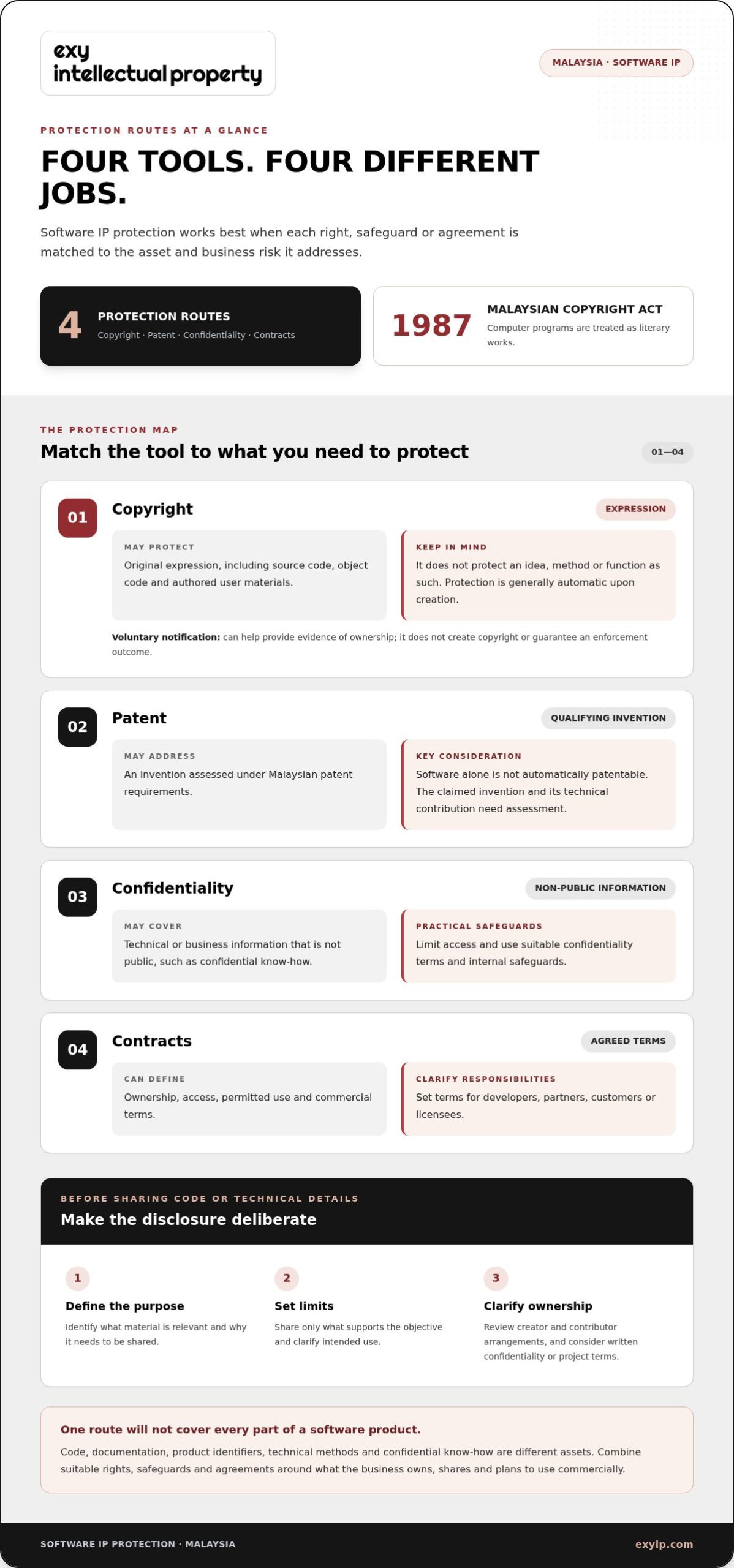
Each protection route addresses a different business interest. Copyright focuses on how work is expressed; patent protection may apply to a qualifying invention; confidentiality safeguards information kept secret; and contracts define how parties may use or share assets. When protecting software IP in Malaysia, the practical question is how these tools fit together, not which single option covers the whole product.
| Protection route | What it may address | Business consideration |
|---|---|---|
| Copyright | Original expression, including software code and authored materials | It does not protect an idea or function as such. Copyright Voluntary Notification can provide evidence of ownership, but does not create copyright or guarantee enforcement. |
| Patent | A qualifying invention assessed under Malaysian patent requirements | Software alone is not automatically patentable. The claimed invention and its technical contribution require assessment. |
| Confidentiality | Non-public technical or business information | Limit access and use appropriate confidentiality terms and internal safeguards. |
| Contracts | Agreed ownership, access, permitted use and commercial terms | Set clear responsibilities for developers, partners, customers or licensees. |
What can copyright protect in software?
Malaysia’s Copyright Act 1987 treats computer programs as literary works. Copyright applies to the expression recorded in a work, such as original source code, object code or written user documentation. It does not give an owner control over an underlying idea, method or function simply because that idea appears in the program.
Copyright protection is generally automatic upon creation, so a voluntary notification should not be mistaken for a registration that creates the right. The official IP office notification process can help provide evidence of ownership in a dispute, but that evidence does not guarantee a particular enforcement outcome. For a broader overview of the Malaysian IP environment, the U.S. Department of Commerce’s Protecting Intellectual Property in Malaysia guide discusses protection and enforcement considerations.
Statutory Evidence via Voluntary Copyright Notification (Section 26A)
Computer programs (both source code and object code) are protected as literary works under Section 3 of the Copyright Act 1987. To establish formal evidentiary proof in court, software developers can file a Voluntary Notification of Copyright with MyIPO under Section 26A. Obtaining a MyIPO notification certificate creates a statutory presumption of ownership, shifting the evidentiary burden onto any party claiming unauthorized copying.
Can software qualify for patent protection in Malaysia?
A patent is a separate route, not an automatic extension of copyright. Software “as such” is not patentable in Malaysia, but an invention involving software may qualify if it makes a technical contribution or produces a technical effect in a field of technology. Eligibility depends on the claimed invention and applicable legal requirements, so filing alone does not establish that a patent will be granted.
Because statutory interpretation and patent examination practice can change, have current Malaysian requirements and procedures reviewed by an IP specialist before relying on them. Exy Intellectual Property’s patent filing and IP advisory helps businesses assess protection options in the context of their commercial plans.
Patentability of Computer-Implemented Inventions (Section 13, Patents Act 1983)
While standalone mathematical algorithms or abstract business methods are non-patentable, software-driven innovations can be patented in Malaysia as Computer-Implemented Inventions (CII) under the Patents Act 1983. To qualify, the software must interact with hardware to produce a tangible "further technical effect" (e.g., optimizing industrial sensor arrays, enhancing data encryption hardware, or controlling automated physical machinery).
Choosing a software IP strategy: compare protection by business purpose
One registration or filing will not protect every asset or business interest. A software company may need to consider rights in code, a product name, confidential technical information and the terms under which others can use the product. The right mix depends on the asset, how the business plans to use it, what may need to be disclosed and how it expects to commercialise the software.
Use the table as a planning aid, not a legal opinion. A route that suits one asset may not address another, and the relevance of each option depends on the specific facts.
Match the protection route to the software asset
| Asset | Possible protection route | Business purpose |
|---|---|---|
| Original source code, object code or user documentation | Copyright | Addresses original expression in the code or written work. |
| A software-related technical invention | Patent assessment | Explores whether the claimed invention may qualify under applicable Malaysian requirements. |
| Non-public technical know-how or development information | Confidentiality safeguards and suitable agreements | Helps manage access and permitted use while information remains confidential. |
| Product name or logo | Trademark protection | Addresses a sign used to distinguish the product or business in the market. |
| Software provided to a customer or business partner | Commercial agreement or license | Sets out permission and conditions for use, alongside any relevant rights. |
Start with the intended outcome. If the priority is to restrict unauthorised use of a qualifying invention, a patent may provide an exclusive right, subject to examination and applicable requirements. If sensitive technical material must be shared with a development partner, confidentiality terms and controlled access may be more relevant. A product name used in the market raises a different question from code supplied to a customer.
Disclosure risk also affects the decision. Before a demonstration, pilot or technical review, consider what the other party needs to see and whether the disclosure fits the commercial purpose. This helps distinguish information the business intends to publish or supply from material it wants to keep confidential.
When do licensing and commercialization matter?
Ownership and permission are separate decisions. A business may own software rights while granting another party permission to use some or all of the software under a license. The agreement can define permitted use, access, limits and commercial responsibilities. Clear terms help align the grant with the intended relationship, whether the other party is a customer, distributor or collaborator.
Commercialization is the process of bringing intellectual property to market, for example through product sales, partnerships or licensing. A sound plan considers which rights the business will retain, what use it will permit and how those choices support its commercial objectives. When protecting software IP in Malaysia, map each asset to its business purpose, then assess suitable rights and agreements. Patent filing questions require a separate assessment of the invention and current Malaysian requirements.
Practical steps to protect software before sharing or commercializing it
A clear process turns protection planning into practical business preparation. Keep legal questions distinct from good record-keeping: an asset register or development log can help explain your position, but it is not a substitute for assessing applicable rights and agreements. Planning before disclosure supports informed decisions about what to share and which protection options to discuss with an IP specialist.
- Inventory the assets. List the software and related materials the business has developed or acquired, such as code, documentation, product names, technical designs and confidential information. Note where each item is stored, how it is used and whether it has already been shared externally. This business record helps frame later legal and commercial decisions.
- Identify the creators and contributors. Record who worked on each asset, what they contributed and when. Include employees, contractors, founders and external development partners where relevant. Keep project records, version histories and related agreements together so the business can trace how the work was created.
- Clarify ownership. Review the agreements and arrangements connected to development, including employment, contractor and collaboration terms. Do not assume a person’s role alone settles ownership. Questions about who owns work created during a relationship should be assessed against the relevant contracts and applicable Malaysian law. Avoiding the Independent Contractor Ownership Trap (Section 26) – Under Section 26 of the Copyright Act 1987, copyright in work created by a full-time employee in the course of employment automatically vests with the employer. However, independent freelance developers and third-party software agencies retain default ownership of all code they write—even if fully paid—unless a formal Written IP Assignment Deed is executed prior to project completion.
- Plan disclosure. Before a discussion with a partner, contractor or investor, define what information is needed, who will receive it and the purpose of sharing it. Consider whether a confidentiality agreement and access controls suit the circumstances. An agreement can set expectations, but it should not be treated as a guarantee that information cannot be misused or disclosed.
- Assess protection options. Match each asset and intended use to possible protection routes, then identify questions that need specialist review. If a software-related invention may warrant patent assessment, consider that before disclosure and seek advice on current Malaysian requirements. Copyright, confidentiality and contractual arrangements may also be relevant to other assets.
Document software creation and ownership
Good records support informed discussions. Retain dated project materials, contributor details, development milestones, version histories and signed agreements in an organised way. These records do not determine ownership by themselves, but they can help an IP specialist understand the development history and identify issues that need legal review.
Plan disclosure and commercial use
Set the scope of each disclosure in practical terms: what will be shared, with whom, for what purpose and under what agreed conditions. A potential investor may need a different level of detail from a contractor working on a defined task. If discussions move towards a product launch or license, review whether the proposed use fits the business’s ownership position and commercial objectives.
For protecting software IP in Malaysia, these steps provide a useful starting point for tailored advice, rather than relying on assumptions about ownership or protection. Discuss your software IP strategy with Exy to assess registration, legal advisory and commercial considerations.
How Exy supports software IP protection and business strategy in Malaysia
A software IP plan should reflect how the business builds, shares and earns value from its product. Once you’ve mapped your assets, contributors and planned disclosures, specialist advice can connect those findings to relevant protection routes and commercial decisions. Exy Intellectual Property provides patent and copyright protection, legal advisory, IP strategy consulting and licensing advisory, with a focus on practical business outcomes. Exy has assisted hundreds of businesses.
From protection choices to a practical IP strategy
Advice can start with the materials your business has already gathered: an asset inventory, development records, contributor agreements and planned disclosures. Reviewing them together can help identify questions about ownership, confidentiality or the suitability of a particular protection route. This is especially useful where work involves employees, contractors or development partners, since the relevant agreements and circumstances need to be considered.
Legal advisory can put those questions in context and shape a strategy around the product’s development and business goals. For example, a company preparing to demonstrate a software feature may need to consider what technical information is necessary to share and whether a related invention warrants patent assessment. The right analysis depends on the specific facts and current Malaysian requirements. No application or advisory process can promise a registration, enforcement result or commercial success.
When software rights become commercial assets
Protection is only part of the plan. A business may also decide how customers, partners or other parties can use its software. Licensing advisory can support arrangements that grant permission to use intellectual property, with terms suited to the intended relationship. This helps distinguish retaining ownership from authorising a defined form of use.
Commercialization planning connects those rights to the intended market activity. A business considering customer access, a technology partnership or wider distribution can assess which assets are involved, what use it plans to grant and how the arrangement fits its objectives. Exy’s IP strategy and licensing advisory can bring these considerations together, while patent and copyright protection address relevant rights in the software assets.
With a clear picture of your software assets and business objectives, you can make a more informed plan for protecting software IP in Malaysia. Discuss your software IP strategy with Exy and explore an approach shaped around your development, disclosure and commercialization plans.
Make IP planning part of your software’s next stage
Your software will change as the business develops. New features, contributors, partnerships or routes to market can shift which assets matter and how they are used. Build a regular IP review into product and commercial planning so your approach keeps pace with those changes, rather than waiting until a disclosure or deal is already underway.
For protecting software IP in Malaysia, turn your current asset and business priorities into a clear plan. Consider what you’re developing, what you expect to share and how you want others to use it. A focused discussion can help identify questions for further assessment and connect protection decisions with your business direction.
Exy’s IP advisory can help you consider a software IP strategy in light of your objectives. Discuss a business-focused software IP strategy with Exy and take the next step with clarity.
Frequently Asked Questions
Can software be patented in Malaysia?
Potentially, but a patent application should begin with a clearly defined invention, not simply a product name or a broad description of software. Prepare a concise account of the technical problem, the proposed solution and how the software contributes to it. Keep related diagrams, development notes and test materials together for review. The patent filing section explains further process considerations, while an IP specialist can assess the details of your proposed invention.
Does copyright protect a software idea in Malaysia?
Copyright generally does not give a business ownership of an idea on its own. Identify the specific work in question, such as a particular codebase, original interface illustrations or a written guide, rather than describing only the product concept. Similar functionality may be implemented in different ways; whether a particular use raises a copyright issue depends on the material and circumstances.
Should a business disclose software code before planning IP protection?
Before disclosure, decide how much access the discussion requires. For example, a technical evaluation might use a controlled demonstration or selected materials rather than access to an entire repository. Limit access to people involved in the discussion, keep a record of what was shared and review access when the project ends. These operational controls can support careful information handling alongside relevant written arrangements.
Who owns software developed by an employee or contractor in Malaysia?
The answer depends on the work’s circumstances, applicable law and governing documents, so avoid relying on assumptions. Review project records for provisions about pre-existing tools, newly created code, modifications and deliverables. Keep source-control histories, statements of work and acceptance records with the relevant agreements. These records can help identify which materials came from each contributor and which ownership questions need legal review before a product is transferred or licensed.
Does a non-disclosure agreement protect software by itself?
An NDA alone should not be treated as a complete safeguard. Before sharing technical material, consider pairing written terms with practical measures such as restricted repository permissions, individual access accounts and a record of downloads or shared files. These steps help a business manage exposure and understand what information was made available. Review the agreement’s scope against the actual material and discussion, rather than assuming one standard document addresses every disclosure.
Can a Malaysian business license software intellectual property to another party?
Yes, if the business has the relevant rights and the proposed arrangement suits its objectives. Before negotiating, consider practical terms such as whether the other party can modify the software, permit access to another party or use it only for a specific project. These choices can affect how the product is delivered and controlled. Licensing advisory can help businesses shape commercial terms around the rights involved and their intended market use.