


A similar-looking trademark does not automatically create a legal conflict, and registration does not settle every question. If another business is using a name like yours or has applied to register one, the right response depends on the marks, the goods or services involved, the timing and the evidence. In a trademark dispute Malaysia, a rushed accusation or missed procedural step could affect your options.
It’s understandable to worry about customer confusion, lost sales or damage to the identity you’ve built. But opposition, infringement and passing off are different routes, and each calls for a response that fits the facts. Acting carefully can help protect your position while keeping your brand and commercial priorities in view.
This guide explains how to assess a potential conflict, organise relevant evidence and consider the available routes in Malaysia. It also outlines how specialist intellectual property legal advisory or litigation support can help you plan a considered response and protect your brand’s continuity and reputation.
Key Takeaways
- A trademark dispute Malaysia may concern an application, use of a mark or competing claims to rights. Identify the issue before choosing a response.
- Opposition, infringement claims and passing off address different circumstances. Match the route to the facts and the rights involved.
- Organise registration and ownership records, dated examples of mark use, product presentation and relevant communications.
- Preserve evidence and review the facts before making public accusations or taking steps that may be difficult to reverse.
- Specialist intellectual property legal advisory can help assess response options. Litigation support may be appropriate where formal enforcement is being considered.
Trademark dispute Malaysia: what counts as a conflict?
A trademark dispute is a disagreement about who may register, use or claim rights in a sign that identifies a business or its goods or services. It may begin with a new application, an existing registration or a mark already appearing in the marketplace. The concern can be commercially serious: customers may confuse businesses, a brand may become less distinct, and the reputation associated with a name or logo may be affected.
In brief: A registration dispute challenges whether a mark should be registered. A marketplace-use dispute concerns whether someone’s use of a mark conflicts with another party’s rights. These are different issues, and an allegation alone does not establish infringement. Assess the facts, the rights claimed and the relevant Malaysian law before drawing that conclusion.
Which business situations can lead to a trademark dispute?
A conflict may surface when a business finds a similar mark in a new application or on the register. It can also arise when two businesses use similar signs in trade, particularly where their goods or services are related and customers could associate one business with the other. Similarity is not limited to identical names. A word, logo, packaging design or other brand element may be questioned if it creates a meaningful association or overlap in the market.
For example, a business might find that a competitor has applied to register a name resembling its own. Another business might discover similar branding on products already being sold. Those situations call for different analysis: one centres on registration, the other on use. In either case, visual resemblance is a reason to investigate, not proof that the other party has acted unlawfully.
Why likelihood of confusion matters
Likelihood of confusion is a consumer-focused legal standard that asks whether people may mistake one business’s goods or services for another’s, or believe the businesses are connected. The comparison may consider how the marks look, sound and convey meaning, alongside the commercial context in which customers encounter them.
Context matters. The same or similar word may carry different significance when used for unrelated offerings, while marks that differ in small details may still raise a concern if customers encounter them in closely connected markets. The assessment depends on the evidence and applicable Malaysian law, including the framework of the Trademarks Act 2019. A general Trademark Infringement Overview can help explain the concept, but it is not a guide to the application of Malaysian law.
For a trademark dispute Malaysia, separate the trigger from the legal conclusion. Identify whether the issue concerns an application, a registered mark or use in trade. Then compare the signs and the goods or services in their real commercial setting. This gives you a clearer basis for protecting brand continuity and reputation without making premature claims.
Which Malaysian legal route fits a trademark dispute?
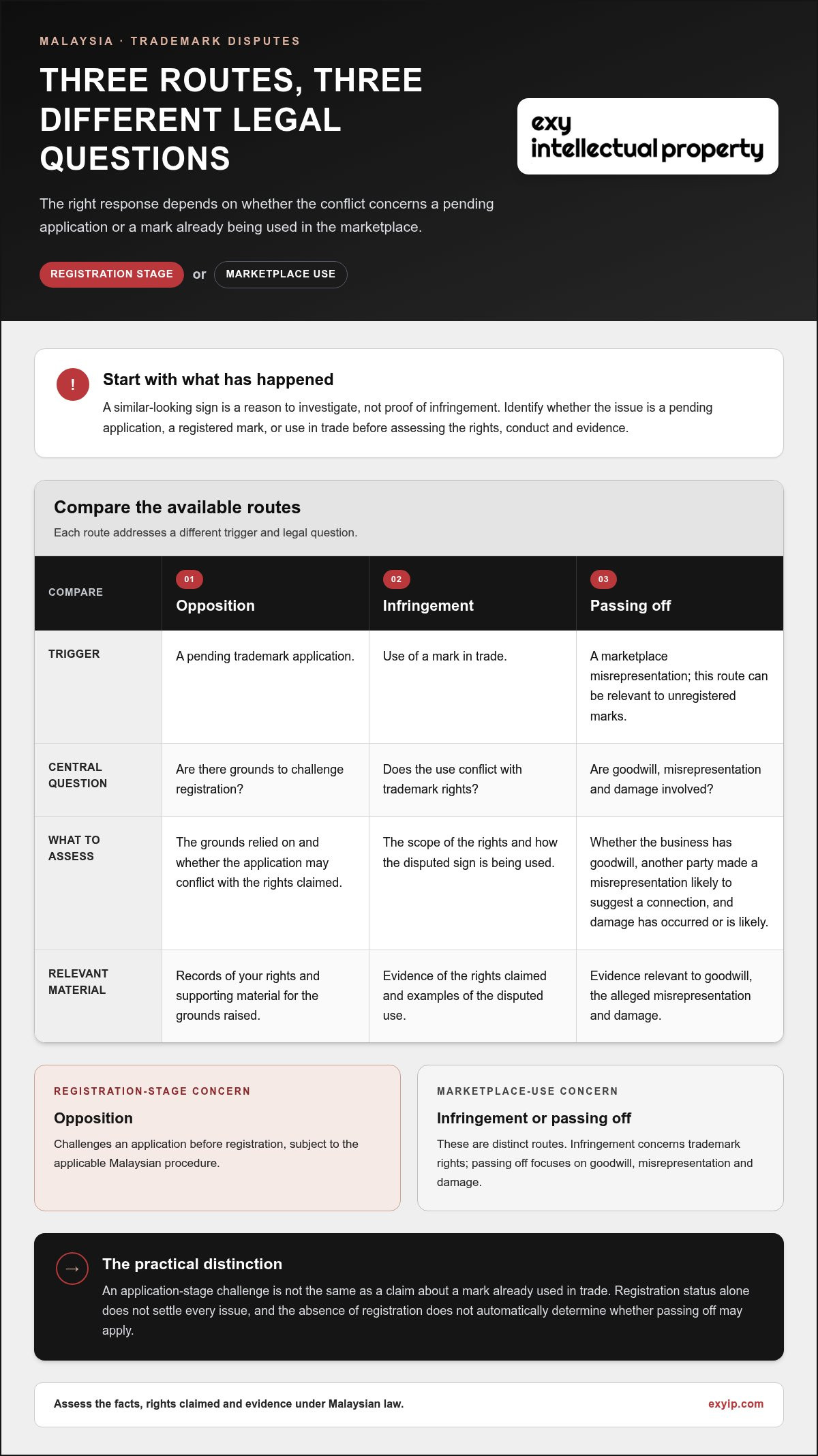
The right route depends first on what has happened. A similar sign may be the subject of a pending application, or it may already be used in trade. Opposition addresses a registration-stage concern; infringement and passing off concern conduct in the marketplace, though they involve different legal questions. Assess a trademark dispute Malaysia against the rights claimed, the parties’ conduct and the evidence available, not just the resemblance between two marks.
Trademark opposition and registration-stage conflicts
Opposition is a process for challenging a trademark application before registration, subject to the applicable Malaysian procedure. An opponent needs to identify the grounds relied on and support them with relevant material, such as records of its own rights or evidence showing why registration may conflict with those rights. This process is not the same as a claim about a mark already being used in trade. For application-stage context, consult the related Trademark Registration in Malaysia guide.
Statutory Opposition Window (Section 35, Trademarks Act 2019)
Under Section 35 of the Trademarks Act 2019, third parties have a strict two-month statutory window from the date a mark is published in the Intellectual Property Official Journal to lodge a Notice of Opposition (Form TMA5). Missing this non-extendable deadline forfeits the opportunity to challenge the mark at the examination stage, forcing the aggrieved party to seek costly High Court invalidation proceedings post-registration.
Infringement and passing off are not identical
An infringement claim concerns use of a mark that conflicts with trademark rights. The assessment may involve the scope of the rights and the way the disputed sign is used. Passing off is a separate common-law route that can be relevant to unregistered marks. At a high level, it concerns whether a business has goodwill, whether another party has made a misrepresentation likely to lead customers to believe there is a connection, and whether that misrepresentation has caused or is likely to cause damage. Registration status alone does not settle every issue, nor does the absence of registration automatically determine whether passing off may apply.
Statutory Infringement vs Common Law Passing Off
In marketplace disputes, registered trademark owners enforce their exclusive rights under Section 54 of the Trademarks Act 2019 in the specialized IP High Court, requiring only proof of registration and confusing similarity. Unregistered brand owners must instead prove the common law tort of Passing Off, requiring evidence of local goodwill, deceptive misrepresentation, and quantifiable commercial damage.
The Trademark Infringement and Passing Off resource offers a general explanation and a Malaysia-related example. It can help orient readers, but choosing a route requires consideration of Malaysian law and the specific facts.
| Route | Trigger | Central issue | Evidence and intended result |
|---|---|---|---|
| Opposition | A pending application | Whether there are grounds to challenge registration | Relevant rights and supporting material; seek to prevent registration |
| Infringement | Use of a mark in trade | Whether that use conflicts with trademark rights | Rights and examples of use; seek a legal response to the alleged conflict |
| Passing off | Misrepresentation in the marketplace | Goodwill, misrepresentation and damage | Evidence of goodwill, customer-facing conduct and actual or likely harm |
These routes may raise distinct or overlapping issues, but one should not be treated as a substitute for another without analysis. The appropriate grounds, process and potential outcome depend on current Malaysian law and the particular evidence. Intellectual property legal advisory can help connect the legal route to practical priorities, including brand continuity and reputation.
What evidence can strengthen a trademark dispute in Malaysia?
Good evidence helps turn a concern into a clear account of what each business owns, how the marks are used and what happened in the market. For a trademark dispute Malaysia, organise records by topic and date rather than relying on a folder of unlabelled screenshots. Keep original files where possible, note where each item came from and record how it relates to the issue being assessed.
Dated, traceable records can clarify when a mark was used, how it appeared to customers and what changed after a dispute arose. They also help distinguish what the documents directly show from what a party believes those facts mean.
Records showing ownership, use and reputation
Begin with records that identify the rights being claimed. Gather registration documents, application records and any material showing who owns or is entitled to use the mark. Then build a timeline of the brand’s use, drawing on dated sales records, invoices, advertising, packaging and distribution material where relevant. The aim is to show the mark in its actual business context, not simply that it existed.
Consistent records from different periods may help explain how a brand developed and became associated with a business. For a passing off issue, records of trading and promotion may also help explain the goodwill claimed. Sort the material into clear groups, such as:
- Ownership and status: registration or application documents, and records identifying the relevant owner.
- Use over time: dated product images, packaging, advertisements, invoices or distribution records.
- Business context: information showing the goods or services, intended customers and channels through which the mark appeared.
Evidence of similarity, confusion or commercial harm
Keep dated examples of both marks as customers encounter them. This may include product presentation, packaging, online listings, promotional material or other uses relevant to the dispute. Preserve the surrounding context as well as a close-up of the sign. The goods or services, wording, layout and presentation can all inform how a comparison is understood.
Record customer enquiries or mistaken associations accurately. A message asking whether two businesses are connected may be relevant, but one enquiry does not by itself establish widespread confusion. Preserve the original communication and note its date and context. Avoid editing it or presenting an inference as a proven fact.
Keep evidence of alleged harm separate from evidence of resemblance. If the concern is lost sales, reputational impact or business disruption, identify records that relate to that impact, such as dated sales information or customer correspondence. Avoid unsupported estimates. A useful evidence file makes clear which material relates to ownership, similarity, goodwill, misrepresentation or damage, so the response can be assessed on facts rather than assumption.
What should a business do when a trademark conflict arises?
Move carefully, but don’t let uncertainty cause avoidable delay. In a trademark dispute Malaysia, the first response should protect the facts and preserve options. Do not assume that a similar mark proves infringement or that an informal exchange will resolve the issue. A measured review helps you choose a response proportionate to the evidence, commercial risk and outcome you want.
Initial steps to preserve your position
Start by preserving material that could change or disappear. Save dated screenshots, product examples, correspondence and relevant application information. Keep original files where possible, and record each item’s source and date. Then prepare a factual timeline covering when you first discovered the issue, when and how each mark was used, and any communications that followed.
Next, define the issue precisely. Identify the mark in question, the goods or services involved, where the sign appears and whether the concern relates to an application, a registration or use in trade. Compare that information with your own registration documents, application records and business use. This separates known facts from assumptions and gives a legal review a focused starting point.
Before responding publicly or making a major operational change, pause. Avoid accusations on social media, discarding branded stock or changing a business name before the rights and risks have been considered. Such steps may affect customer confidence or business continuity, and could be difficult to reverse. Preserve relevant records and keep internal accounts of events factual.
Assessing resolution options and legal risks
Once the basic facts are organised, assess possible responses against the nature of the conflict. A direct, carefully considered approach may be suitable in some situations. A pending application may call for consideration of formal opposition, while a dispute over marketplace use may require a different legal assessment. Litigation may be considered where formal enforcement is appropriate. None of these routes guarantees a particular outcome.
Timing matters. Opposition periods and other procedural requirements can be strict, and the applicable steps depend on the kind of dispute. Have the relevant dates and documents reviewed promptly under current Malaysian law rather than relying on a general guide or assuming that the same timetable applies to every case. Record when you learned of the application or use, and preserve any notices or correspondence that refer to a response period.
Balance the strength of the evidence against business priorities. Consider the customer impact, the importance of the mark to daily operations, the risk of continued confusion and the result you are seeking. That may be a change in how a mark is used, a resolution that supports continued brand operations, or formal enforcement. A proportionate plan protects the business without treating every similarity as a reason for escalation.
For a case-specific assessment of rights, evidence and response routes, seek trademark dispute legal advisory from Exy Intellectual Property. A focused review can help align the next step with both the legal position and the business’s longer-term brand protection strategy.
How Exy supports businesses facing a trademark dispute
A trademark conflict can affect more than legal rights. It may influence customer confidence, brand reputation and a company’s ability to keep operating under a familiar identity. Exy Intellectual Property connects dispute analysis with those business priorities, helping companies consider their options as part of a wider trademark protection strategy.
From dispute facts to a practical strategy
Each matter starts with its own facts. Exy Intellectual Property’s legal advisory can assess the marks in question, the rights claimed, available records, the commercial context and the outcome the business wants to pursue. This analysis can clarify whether the issue centres on an application, use in trade or another claim, and which response routes may be relevant under Malaysian law.
That clarity supports better decisions. A business may need to understand the strength of its position, consider how a response could affect ongoing operations, or assess whether discussion or formal action is appropriate. Legal analysis can identify issues and risks, but it cannot guarantee how a dispute will resolve or how another party will respond.
Where the circumstances call for formal enforcement, Exy Intellectual Property provides litigation support. The decision should follow a review of the evidence, legal position, business objectives and potential effects on the brand. The focus is not escalation for its own sake. It is choosing a considered course that protects the business’s interests and supports a practical resolution where possible.
Protecting brand value beyond the immediate conflict
A dispute can also reveal gaps in a company’s wider trademark protection. For example, a business may need to review which marks it uses consistently, how its rights are recorded, or whether its future brand plans are reflected in its filing decisions. These lessons can inform trademark registration and portfolio planning, connecting an immediate response with the longer-term value and continuity of the brand.
For businesses considering how to protect a name or logo before a conflict arises, the Trademark Registration in Malaysia strategic guide provides useful registration context. Dispute planning and registration are connected parts of brand protection: understanding the rights held today can help shape decisions about future marks and business expansion.
Exy Intellectual Property’s support is grounded in the specific facts and commercial priorities of each matter. If your business is facing a trademark dispute Malaysia, discuss the situation with Exy Intellectual Property to consider the relevant rights, evidence and possible next steps. A clear, case-specific assessment can help you respond with greater confidence while keeping your brand’s future in view.
Make your next brand decision with confidence
A trademark conflict can prompt a useful question: how will your brand stay clear and recognisable as the business grows? Build regular reviews of brand use and ownership into planning for new offerings or changes, so future decisions support customer recognition as well as commercial direction.
For a trademark dispute Malaysia, the immediate response is only one part of that longer view. Use the experience to set a considered standard for how your business evaluates brand changes and protects the identity customers know.
Take the next step towards a more deliberate approach to your brand. Plan your next trademark protection step with Exy Intellectual Property, and move forward with greater confidence.
Frequently Asked Questions
What is a trademark dispute in Malaysia, and when does one arise?
A trademark dispute in Malaysia arises when businesses disagree over who may register or use a sign, or who holds relevant rights in it. For example, one business may object to an application for a similar mark covering related goods. A disagreement may also arise after similar branding appears on products in the market. A concern or allegation is not, by itself, proof of infringement.
Can I challenge a trademark application in Malaysia if my mark is unregistered?
Yes, an unregistered mark does not automatically prevent you from opposing a published application. The relevant question is whether you can support a valid basis for opposition with the facts and applicable law. Evidence of earlier use or business goodwill may be relevant, depending on the grounds. Malaysia’s opposition period generally runs for two months from publication, and an extension of up to two months may be granted.
What is the difference between trademark infringement and passing off in Malaysia?
Infringement generally concerns use that conflicts with rights in a registered trademark. Passing off may be relevant where a business relies on goodwill in an unregistered mark and alleges that another party’s misrepresentation caused, or is likely to cause, damage. The routes involve different legal questions. For example, a business trading under an unregistered name may need to assess evidence of goodwill and customer misrepresentation, not registration alone.
How do Malaysian decision-makers assess likelihood of confusion?
They assess likelihood of confusion in context, including the marks and the goods or services involved, rather than relying on one matching feature. Consider a shared brand word used on closely related products: customers may be more likely to infer a connection than if the businesses operate in clearly separate fields. The relevant consumer context and evidence matter, and the legal assessment depends on Malaysian law.
What evidence should I keep if another business uses a similar trademark?
Keep original records that show where and when the other mark appeared, such as a full webpage capture with its URL and capture date, or dated photographs of packaging. Save correspondence in its original form and retain any related order or listing records. A brief note recording how you obtained each item can help explain its context later. Avoid altering files or presenting assumptions as verified events.
What happens if someone files a trademark application similar to mine?
Check the published application details, including the mark and the goods or services it covers, then compare them with your own rights and business activity. If you intend to oppose, act promptly: the general opposition period is two months from publication, with an extension of up to two months potentially available. The grounds and supporting material need careful review under current Malaysian procedure before you decide how to proceed.
Can a trademark dispute be resolved without going to court?
Yes. Some disputes may be addressed through direct discussions or a negotiated agreement, though resolution cannot be assured. If terms are agreed, they can clarify practical matters such as how each party may use its mark and whether changes will be made. Legal review can help ensure the proposed terms address the rights and business concerns at issue. If discussions do not resolve the conflict, a formal route may still need consideration.