


What if the best response to an IP dispute isn’t immediately going to court? In IP litigation Malaysia, a sound strategy starts with identifying the intellectual property involved, the evidence available and the business outcome you want. A trademark dispute, for example, raises different questions from a claim involving copyright or a patent.
It’s understandable to feel pressure to act quickly. Key dates, records and the effect of a dispute on your business may shape the options available. But acting before you understand the right at issue and the commercial stakes can make a difficult situation harder to manage.
This guide explains the main stages of an IP dispute in Malaysia and practical steps for assessing your position. You’ll learn how to identify the rights and issues involved, organize relevant evidence, compare litigation with negotiated resolution, and align your response with business priorities. Focused IP legal guidance can help you make an informed decision about protecting your intellectual property and the value it supports.
Key Takeaways
- IP litigation Malaysia can involve disputes over alleged unauthorized use, ownership, validity or enforcement of protected rights.
- Start by identifying the right involved and organizing the facts, evidence and business objectives relevant to the dispute.
- Compare court proceedings, negotiation and other resolution approaches against your desired outcome, urgency and relationship priorities.
- Preserve relevant records, agreements, dated materials and communications. Take care with public statements about an active dispute.
- Exy Intellectual Property’s IP litigation and legal advisory services can help connect the rights at issue with the evidence, business priorities and potential next steps.
What IP litigation in Malaysia covers and when a dispute may arise
IP litigation Malaysia refers to legal action in Malaysia concerning rights in protected intellectual property. The issues and process depend on the right involved and the facts. A dispute may concern alleged unauthorized use, ownership, whether a right is valid, or whether it can be enforced in the circumstances. An allegation alone does not establish infringement or entitlement to a remedy.
Start by identifying the asset and the right said to protect it. A business may describe a product as “copied,” but that description does not establish which legal protection applies or whether the facts support a claim. The right involved helps define which facts need to be examined.
Which intellectual property rights can be involved?
Different rights protect different interests. A single product or business may involve more than one type of intellectual property, but one right does not automatically protect every feature.
- Trademark: A sign that distinguishes a business or its products from others. A dispute might involve a similar name or logo used for related goods or services, raising questions such as whether there is a likelihood of confusion. Brand owners can consult a trademark registration guide to understand how registration relates to protecting identifying signs.
- Patent: Protects an invention, subject to the scope and status of the relevant patent rights. A dispute may concern whether a product or process falls within the protection claimed, not simply whether two products look or function alike.
- Copyright: Protects qualifying original expression, such as text, artwork, photographs, music or software code. A business disagreement might concern whether material was copied, who owns rights in commissioned work, or whether its use was authorized.
- Industrial design: Concerns the visual appearance of a product, rather than automatically covering its name, technical function or every aspect of its construction. A dispute could involve similarities in a product’s appearance and the scope of the relevant protection.
Identify the relevant right first. It determines which facts matter and what the dispute is actually about.
What business situations can lead to an IP dispute?
Disputes can arise during ordinary business activity. A competitor may be alleged to have used a similar brand sign, reproduced creative material, or made a product that raises questions about a patent or registered design. These situations call for assessment, not assumptions. Resemblance or commercial overlap alone does not prove that a protected right has been infringed.
Ownership can also be contested. A business and a creator, for example, may disagree about rights in work produced under an arrangement. Business partners may dispute who controls an asset. Agreements, project records and the history of creation or use can help clarify the issue. A license may also shape whether a particular use was permitted and within what scope.
Other disputes may challenge the validity or scope of a right, or question whether enforcement is justified against a particular activity. Assess the specific right alongside the evidence, relevant agreements and commercial context. That clarity helps a business understand what is at stake before choosing how to respond.
How an IP litigation matter in Malaysia is assessed and progresses
A sound assessment separates what is alleged from what the available facts and rights can support. An early review helps clarify the dispute and possible responses. It does not by itself mean that court proceedings should begin or that a claim should be defended. That decision should follow an assessment of the evidence, applicable law, business objectives and practical implications.
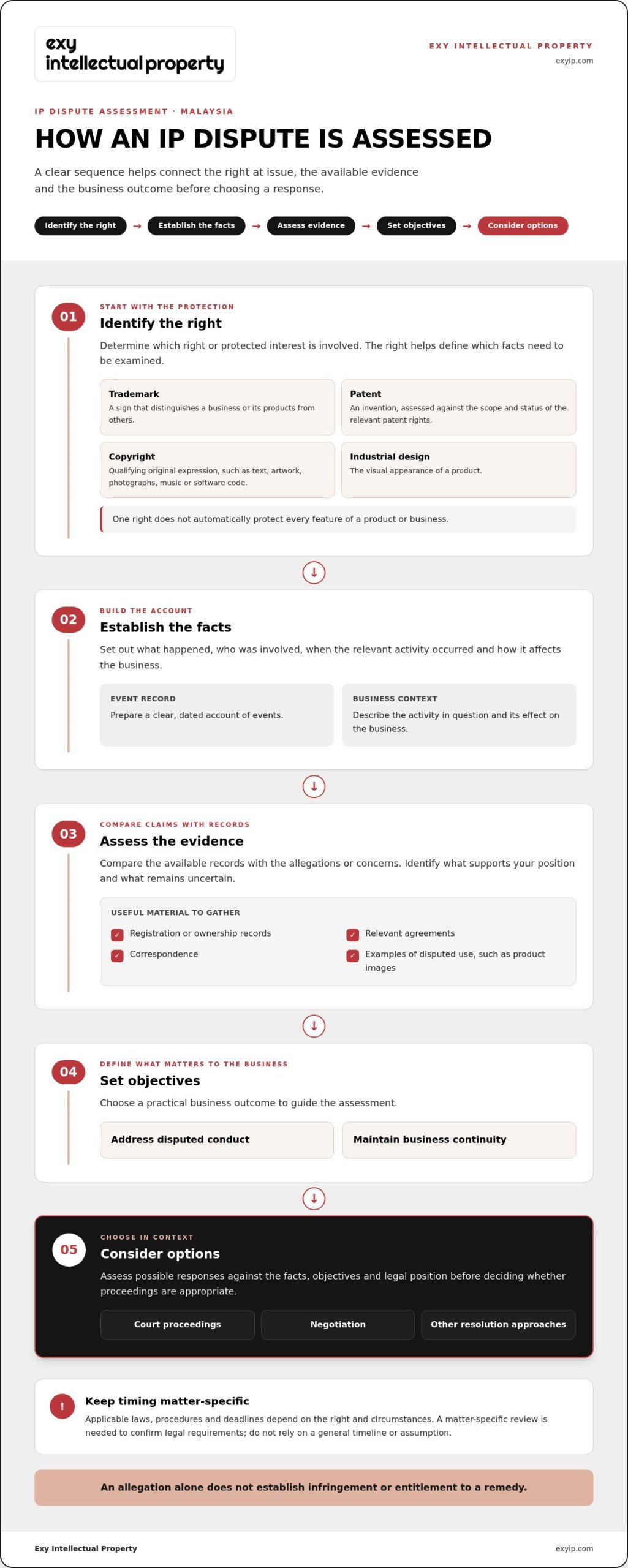
A high-level assessment usually moves through these stages:
- Identify the right. Establish whether the matter concerns a trademark, patent, copyright, industrial design, contract-related permission or another protected interest.
- Establish the facts. Set out what happened, who was involved, when the relevant activity occurred and how it affects the business.
- Assess the evidence. Compare the records with the allegations or concerns. Identify what supports your position and what remains uncertain.
- Set objectives. Define a practical business outcome, such as addressing disputed conduct or maintaining continuity.
- Consider options. Assess possible responses against the facts, objectives and legal position before deciding whether proceedings are appropriate.
The laws, procedures and deadlines that may apply depend on the right and circumstances. Don’t rely on a general timeline or assumption. A matter-specific review is needed to confirm legal requirements. The U.S. Department of Commerce, International Trade Administration provides a general overview of enforcement considerations in its guide to Protecting Intellectual Property in Malaysia. Read it as background, not as advice on an individual dispute.
What information helps an adviser assess an IP dispute?
Prepare a clear, dated account of events and gather records that help establish the right, the parties’ arrangements and the activity in question. Useful material may include registration or ownership records, relevant agreements, correspondence, and examples of disputed use, such as product images, webpages or promotional material.
Preserve original files and messages where possible. Keep relevant records in their original form, including dates and context, and avoid editing or annotating source material. Use a separate note for questions or observations so the underlying evidence remains unchanged. This helps an adviser assess what the material shows and what further facts may be needed.
Jurisdiction of the Specialized IP High Court & Threat Liability
In Malaysia, substantive intellectual property disputes (including infringement trials, patent revocations, and trademark cancellations) are tried before specialized IP High Courts. Before issuing formal demand letters, rights holders must ensure their claims are statutorily sound; issuing unsubstantiated demand letters can expose a business to statutory liability for groundless or unjustified threats of infringement proceedings under Section 62 of the Trademarks Act 2019 and Section 60A of the Patents Act 1983
How do objectives shape a dispute strategy?
Different priorities can point to different strategies. A business seeking to stop disputed conduct may focus on evidence relating to that activity. A business responding to an allegation may prioritize continuity while assessing its position. Protecting long-term rights may call for closer attention to ownership records, agreements and the asset’s commercial role.
Keep the objective realistic, evidence-led and aligned with business priorities. Available legal steps and potential outcomes depend on the matter and applicable law. Don’t assume a particular result from an allegation alone. An allegation alone does not establish infringement. A focused IP litigation legal advisory assessment can connect the rights, evidence and commercial objective before you decide on next steps.
Litigation or another resolution path: comparing options for an IP dispute
Choose a response that fits the business objective rather than treating court action as the automatic next step. In IP litigation Malaysia, court proceedings, direct negotiation and other resolution approaches may each be relevant, depending on the right, evidence and circumstances. Alternatives aren’t suitable or available in every matter, so assess them against the same practical questions.
Option
Objective and urgency
Evidence and relationship
Enforceability
Court proceedings
May suit a party seeking a formal legal outcome. Suitability and timing depend on the matter and applicable procedure.
The asserted right, supporting evidence and other party’s position need careful assessment. The process may affect an ongoing business relationship.
A court outcome is formal, but its effect and enforcement depend on applicable law and the specific decision.
Direct negotiation
May be considered where the parties can discuss practical terms and have room to reach an agreement.
Relevant evidence can inform the discussion. Direct engagement may help preserve a commercial relationship, depending on the parties.
Clearly record and assess any agreed terms for their legal effect. Discussions alone do not bind the parties to an outcome.
Other resolution approaches
A facilitated discussion or arbitration may be considered if appropriate to the dispute and available under the relevant arrangements.
The process, evidence and impact on relationships depend on the approach and the parties’ circumstances.
The effect of an agreement or decision depends on the process, its terms and applicable law.
When might court proceedings fit the business objective?
Court proceedings may warrant consideration when a party seeks a formal legal determination or outcome and other routes do not meet its objectives. That does not make litigation necessary or preferable in every dispute. An adviser should assess the right being asserted, the available evidence and the other party’s position, then consider how proceedings could affect business continuity and longer-term priorities. Decide whether to commence or defend a claim only after matter-specific legal advice.
Urgent Pre-Trial Injunctive Relief & Evidence Orders
Where ongoing infringement threatens immediate irreparable harm to a brand, a rights holder can apply to the IP High Court for an Interlocutory Injunction to halt infringing activities pending full trial. In cases involving digital piracy or illicit counterfeit operations where evidence risks destruction, the court may grant ex-parte search orders (Anton Piller Orders) to preserve physical and electronic evidence before notice is served on the opposing party.
When might a negotiated resolution be considered?
Negotiation may be worth considering where the parties’ objectives and circumstances leave room for an agreed solution. For example, if continued use of intellectual property is acceptable to the rights holder, a license with agreed terms might address how that use can proceed. Other terms may also be considered, depending on the dispute. Discussions don’t guarantee agreement or remove the need to assess the legal position, preserve relevant evidence and consider applicable deadlines.
Compare each path against the outcome you need, how pressing the issue is, the strength and gaps in the evidence, the importance of the business relationship and the legal effect of any resolution. A focused assessment can clarify which options are realistic without assuming a particular result.
Practical steps to prepare for an IP dispute in Malaysia
Good preparation gives an adviser a clearer view of the dispute and the decisions your business may face. Before discussing IP litigation Malaysia, create a concise, factual record of the right involved, the events and their business impact. Organize the material rather than trying to reach a legal conclusion yourself.
Early organization helps an adviser assess the facts and options more clearly. A practical starting sequence is:
- Gather rights records. Collect registration documents or other records that may help establish ownership, along with related filing or creation records.
- Find relevant agreements. Include contracts, licenses, assignments, commissioned-work terms or other documents that may explain who could use or control the intellectual property.
- Build an event timeline. Record dates, people involved and what happened. Use emails, messages, invoices, project files or other source documents where available.
- Keep examples of the disputed material. Save relevant product images, online pages, packaging, advertisements or other examples, with the date and context in which you observed them.
- Record business impact and objectives. Note operational disruption, customer questions or effects on commercialization, then describe the outcome the business hopes to achieve.
What records should a business organize?
Group records by type and keep a simple index so an adviser can locate material without relying on memory. For example, separate ownership documents from agreements, communications and examples of disputed use. Preserve source files in their original form where possible. Keep explanatory notes separately and label them with their date and author.
The records needed vary with the right and facts. A trademark matter may call for records showing use of a brand sign, while a copyright concern may involve the original work and documents about its creation or use. These materials help explain the situation, but they do not by themselves decide legal ownership or liability.
What should a business avoid while a dispute is developing?
Don’t delete, alter or selectively present potentially relevant records. Keep complete copies and retain context, including communications that may not support your preferred account. Avoid public statements about the dispute that could complicate discussions or affect the business position. The appropriate response depends on the circumstances and should be considered with tailored legal advice.
An accusation is not a final legal finding. Treat it as a concern to assess, not proof that infringement occurred or that a claim has no merit. Avoid making admissions or promises before the facts and relevant rights have been reviewed.
Organized records can help Exy’s IP-focused legal advisory and litigation services connect the evidence with your business priorities. Discuss your IP dispute with Exy to consider a matter-specific assessment and potential next steps.
How Exy supports IP litigation planning and next steps
A dispute involving intellectual property can affect more than a legal right. It may influence a brand’s position, a product’s commercial plans, a creator relationship or the value of an asset. Exy provides specialized IP litigation and legal advisory services in Malaysia, helping businesses assess the issues and consider next steps in light of their commercial priorities. No two matters are identical, and an assessment does not guarantee a particular outcome.
The starting point is the specific right and the facts surrounding the dispute. A matter-specific review can bring together ownership or registration records, relevant agreements, communications and examples of the disputed activity. The business objective then helps frame the questions to address: Is the priority to challenge a use, respond to an allegation, protect ongoing operations or preserve longer-term options for the asset?
What an IP-focused advisory approach contributes
IP-focused advice examines the right alongside the way the business uses or plans to use the asset. That context matters. A trademark connected to a central brand, for instance, may raise different commercial considerations from a dispute about a design used in one product line. The relevant evidence, agreements and legal issues still need individual assessment.
A clear advisory process helps separate established facts from disputed claims and unanswered questions. It can also help explain strategic choices and their implications without treating court proceedings as automatic. Registration records may clarify the rights being asserted, while valuation or commercialization context may help frame the asset’s role in the business. These factors inform planning, but they don’t decide liability or determine the result.
Exy’s work focuses on intellectual property matters, including litigation planning and legal advisory. This keeps the discussion centred on the relevant IP right, the evidence available and the business decision at hand, rather than treating the dispute as a general legal issue.
How to take the next step with Exy
Prepare a concise account of what has happened, the parties involved and the key dates. Gather relevant rights records, agreements, communications and examples of the disputed material. You don’t need to resolve every uncertainty before seeking advice. Identify what is known, what is contested and what information is still missing.
State the business objective clearly. You might want to understand whether a particular use is authorized, protect ongoing commercial activity or assess a response to an allegation. A defined objective helps focus the discussion, while the legal assessment determines what options may be available in the circumstances.
For businesses across Malaysia, Exy’s IP litigation and advisory support can connect the right, evidence and commercial priorities in a matter-specific discussion. Discuss your IP dispute with Exy to consider the issues and potential next steps.
Move forward with a clear business objective
An IP dispute can shape decisions well beyond the immediate disagreement. Decide what your business needs to protect, what uncertainty requires legal input and which choices need careful consideration. A measured approach can keep the response connected to your priorities rather than driven by pressure or assumptions.
In IP litigation Malaysia, a sound decision isn’t defined only by whether court proceedings begin. It should also reflect the purpose of the response and the future of the intellectual property within your business. Consider what outcome would support your operations and longer-term plans, then bring that objective into the legal discussion.
Exy provides specialized IP litigation and legal advisory services to clients nationally across Malaysia. A focused discussion can help you consider the matter in its commercial context and identify potential next steps without assuming a particular outcome.
Discuss your IP litigation matter with Exy and take the next step with a clearer view of your options.
Frequently Asked Questions
Can an IP dispute in Malaysia be resolved without going to court?
Yes. Parties may resolve a dispute through direct discussions or, where suitable and available, a facilitated process such as mediation. Any proposed settlement should clearly state the agreed terms, including what use is allowed, by whom and under what conditions. For example, a settlement might address how a brand can continue to appear on existing materials. Whether an alternative is practical depends on the dispute, the parties’ positions and the legal issues.
What should a business do first after receiving an IP infringement allegation?
Preserve the allegation and related records, then arrange a prompt legal assessment before responding on the merits. Keep the original notice, note how and when it arrived, and identify any response date stated in it. Don’t assume the allegation is correct, but don’t ignore it. Avoid admissions or public commentary while the facts are being assessed. The appropriate response depends on the right asserted, the evidence and any applicable procedural requirements.
Can a business pursue an IP dispute if its rights are not registered?
Possibly. Registration requirements and the basis for asserting rights differ between types of intellectual property. In Malaysia, copyright protection is generally automatic upon creation of a qualifying work, while voluntary notification may provide supporting ownership evidence. A business relying on an unregistered brand may need to examine its history of use and supporting records. Whether those materials support a particular claim depends on the facts and applicable law, so registration status alone doesn’t settle every dispute.
What remedies may be available in Malaysian IP litigation?
Possible remedies depend on the right, claim and evidence. Depending on the applicable law, a court may consider orders intended to stop or limit specified conduct, or financial relief connected with a proven claim. The type and scope of any remedy can’t be assumed from an allegation or from the fact that proceedings have begun. An IP adviser can assess which remedies may be relevant and what evidence would be needed to support them.
How long does IP litigation take in Malaysia?
There’s no reliable single timeframe for every IP litigation Malaysia matter. Duration can depend on the right involved, the issues in dispute, the evidence required, procedural steps and whether the parties resolve some or all issues before a final decision. A dispute with contested technical or ownership questions may follow a different path from one focused on a narrower issue. A case-specific assessment is needed to discuss a realistic timeline without promising a particular duration.
Can a Malaysian IP dispute involve more than one type of intellectual property?
Yes. A product launch could raise separate questions about a brand name, the product’s appearance and artwork used in its packaging. Those features may relate to different rights, each with its own scope and evidence. A dispute should identify the specific features and uses at issue, rather than treating the whole product as protected by one right. Whether multiple claims are available depends on the facts and applicable law.
What information should I prepare before discussing an IP dispute with an adviser?
Prepare a short account of the issue, the people or businesses involved, key dates and what you want the business to achieve. Add a few representative records that help explain the concern, such as the relevant agreement, a notice received or an example of the disputed material. Note what remains uncertain and any upcoming date mentioned in correspondence. This gives the discussion a practical focus without requiring you to decide the legal position in advance.