


What if protecting your app starts with letting go of the idea of owning the idea? The concern is understandable: a developer, partner or competitor might take your concept and build something similar. But in Malaysia, an abstract app concept generally isn’t protected on its own. The practical question of how to protect a mobile app idea starts with identifying the specific assets that may qualify for protection and putting safeguards in place before you share them.
An app is made up of distinct pieces. Copyright may protect original code and creative assets, a trademark can distinguish the app’s name and brand, and patent protection may be relevant where a technical invention meets the requirements. Confidential workflows and project details call for careful documentation and clear agreements with developers or collaborators. If an independent developer creates your code, a written assignment can help establish who owns the copyright.
This guide explains which parts of an app may qualify for intellectual property protection in Malaysia, what to document before discussing your concept, and how to plan next steps. A practical IP strategy clarifies ownership and matches each asset with an appropriate form of protection as you develop and commercialize your app.
Key Takeaways
- To understand how to protect a mobile app idea, list its separate assets, such as code, branding, visual design and technical features, then consider which rights may apply to each.
- Copyright, trademarks, patents and industrial design rights protect different things; an abstract concept alone generally isn’t enough.
- Before sharing details, document development, limit access to confidential material and set out ownership terms clearly with developers and collaborators.
- An NDA can support controlled disclosure, but it can’t guarantee that others won’t copy an idea.
- Build a Malaysia-focused plan by organising records and disclosure first, then getting professional advice on ownership and suitable protection options.
Can You Protect a Mobile App Idea? Start With What the Idea Includes
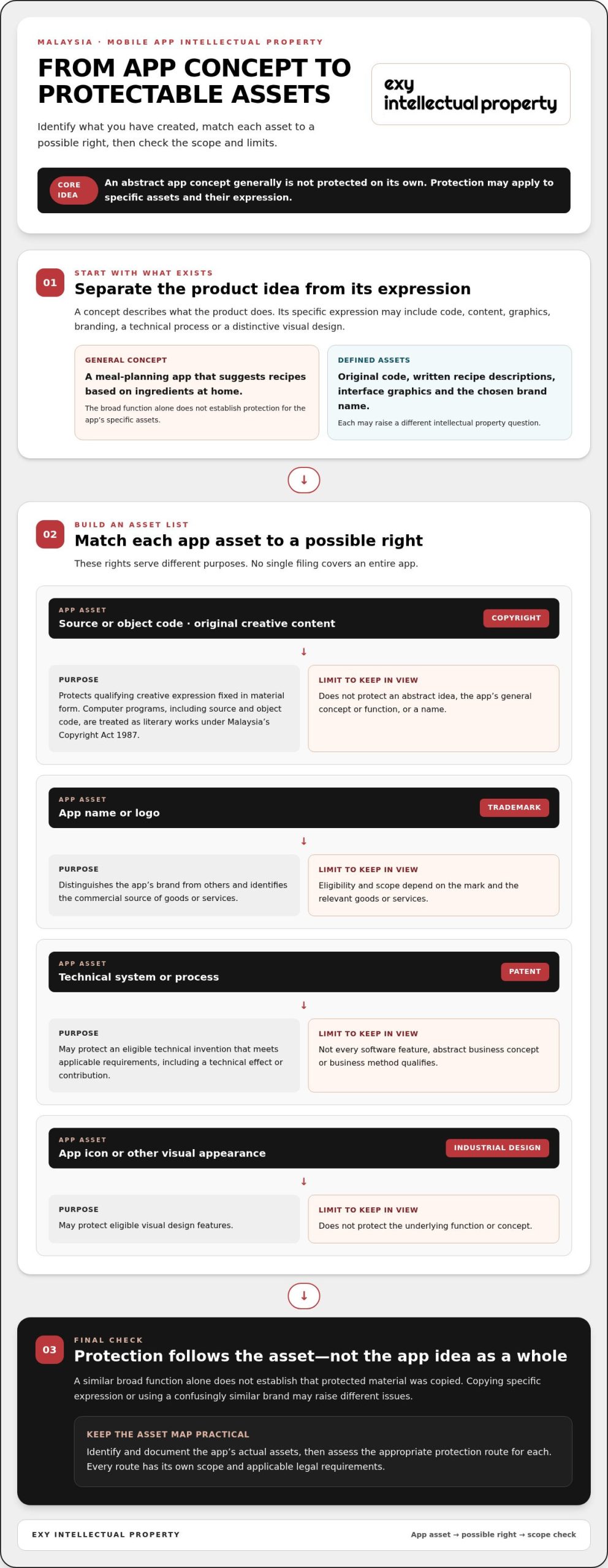
Protection generally applies to specific app assets, not an abstract concept on its own. An app can include code, written content, graphics, branding, a technical process and a distinctive visual design. Each may raise different intellectual property questions, so start by identifying what you have actually created.
An app concept describes what the product does; its specific expression is the code, content, design or other defined material through which that concept is realised. This is the core of the idea-expression distinction: copyright can apply to an expressed work, not the general concept behind it.
Which parts of a mobile app may qualify for protection?
Consider each asset separately. In Malaysia, the Copyright Act 1987 treats computer programs, including source and object code, as literary works. Copyright protection arises automatically when a work is fixed in material form. Original graphics, interface artwork and other creative content may also qualify, depending on the work. This does not mean every screen, feature or coding choice is protected.
An app’s name and logo are branding, so they may be considered for trademark protection. A technical invention may raise patent questions, but software alone or an abstract business concept is not enough: the invention must meet applicable requirements, including a technical effect or contribution. A distinctive visual design is a separate possibility for industrial design registration. Each route needs a legal assessment.
| App asset | Potentially relevant right | Purpose and key limitation |
|---|---|---|
| Source or object code; original creative content | Copyright | Protects qualifying expression, not the app’s general concept or function. |
| App name or logo | Trademark | Distinguishes the app’s brand; eligibility and scope depend on the mark and relevant goods or services. |
| Technical mechanism | Patent | May apply to a qualifying technical invention; not every software feature or business method qualifies. |
| Distinctive visual appearance | Industrial design | May protect qualifying design features, not the underlying function or idea. |
Why an app idea alone is not the same as an IP asset
Take a meal-planning app that suggests recipes from ingredients a user has at home. That broad function is a concept. The app’s original source code, written recipe descriptions, interface graphics and chosen brand name are specific assets that may raise different protection questions. A technical method for processing information could require separate assessment; calling it a feature does not make it patentable.
Another founder could independently develop a meal-planning app without copying your protected code, graphics or brand. Similarity in a broad function alone does not establish that protected material was copied, while copying specific expression or using a confusingly similar brand may raise different issues. So, how to protect a mobile app idea starts with identifying and documenting its actual assets, not assuming every feature can be made exclusive.
How Copyright, Trademarks, Patents, and Design Rights Apply to Apps
Once you’ve identified your app’s assets, match each one to the right that may address it. These protections serve different purposes, and no single filing covers an entire app. Understanding the distinctions also helps founders focus on the assets that support the product’s identity and commercial plans.
| App asset | Potentially relevant right | Purpose | Key limitation |
|---|---|---|---|
| Original source code, graphics, text or audio | Copyright | Protects qualifying creative expression fixed in material form. | Does not protect an abstract idea, name or general function. |
| App name or logo | Trademark | Distinguishes the app’s brand from others. | Registration and scope depend on the mark and relevant goods or services. |
| Technical system or process | Patent | May protect an eligible technical invention. | Not every software feature or business method qualifies. |
| App icon or other visual appearance | Industrial design | May protect eligible visual design features. | Does not protect the underlying function or concept. |
This asset-based approach reflects the different core intellectual property rights, each with its own scope and limits. In Malaysia, the appropriate route depends on the asset and applicable legal requirements.
Copyright and trademarks: protecting expression and app identity
Under Malaysia’s Copyright Act 1987, computer programs, including source and object code, are treated as literary works. Copyright can also apply to original creative material, such as interface graphics, illustrations, text or audio, once fixed in material form. It protects the particular expression, not the idea behind it. An app name, business concept or feature description is not automatically protected by copyright.
A trademark serves a different role: it identifies the commercial source of goods or services. A distinctive app name or logo may be considered for trademark registration, helping distinguish the brand in the relevant market. Before building a brand around a name, assess its suitability and the goods or services it will represent.
Statutory Evidence via Voluntary Copyright Notification (Section 26A)
Source code and object code are protected as literary works under Section 3 of the Copyright Act 1987. To establish formal evidentiary proof in court or during platform takedown disputes (e.g., Apple App Store or Google Play Store removals), app developers can file a Voluntary Notification of Copyright with MyIPO under Section 26A. Obtaining a MyIPO notification certificate creates a statutory presumption of creation date and ownership.
When patents or industrial design protection may be relevant
A patent is not automatic protection for every app feature. In Malaysia, software “as such” and abstract business concepts are excluded from patentability. A computer-implemented invention may be considered where it produces a technical effect or makes a technical contribution beyond ordinary execution, but eligibility depends on the invention and a legal assessment. Founders exploring a technical invention can review this Malaysia patent filing guide.
Industrial design protection concerns visual appearance rather than how an app works. A distinctive visual feature may warrant assessment, while a functional mechanism belongs to a different analysis. If relevant visual elements are central to the app’s identity, the industrial design protection guide explains the registration context.
Choosing among these routes is a practical part of deciding how to protect a mobile app idea. Specialist legal advisory can help founders assess which assets matter to the business and which protection options fit their development plans.
Patentability of Computer-Implemented Inventions (Section 13, Patents Act 1983)
Standalone business algorithms or user interfaces "as such" are non-patentable. However, software-driven architecture can be patented in Malaysia as a Computer-Implemented Invention (CII) under Section 13 of the Patents Act 1983 if it generates a tangible "further technical effect" (e.g., novel server-side data compression, biometric security authentication, or IoT hardware communication protocols).
NDAs, Ownership, and Documentation: What Actually Reduces Risk?
Before sharing an app concept, separate four practical safeguards: confidentiality terms, written ownership arrangements, access controls and development records. Each addresses a different risk. None, on its own, guarantees that an app or its underlying assets cannot be copied.
| Safeguard | What it helps with | Key limitation |
|---|---|---|
| Non-disclosure agreement (NDA) | Sets expectations for handling information shared in confidence. | Its effect depends on the wording and circumstances; it does not create ownership or stop every form of copying. |
| Written ownership terms | Clarifies who owns project materials and how rights may be assigned or licensed. | Terms need to address the actual contributors and work; payment alone may not transfer copyright. |
| Access controls | Limit who can view or use sensitive files, code and specifications. | Practical security does not establish legal ownership or prevent all disclosure. |
| Dated development records | Help show how work developed and who contributed to it. | Records support an ownership position but do not, by themselves, create every legal right. |
What an NDA can and cannot do before you share an app concept
An NDA is intended to set confidentiality obligations for information disclosed under agreed conditions. In Malaysia, confidentiality may also be addressed through contractual terms and the common law duty of confidence. The agreement’s effect depends on its wording and applicable law, so describe the information and intended limits clearly.
For example, identify what counts as confidential, the purpose for which the recipient may use it, who may receive it, and any limits on further disclosure. Tailor the level of detail to the conversation: an early business discussion may not require the same technical information as a development brief. An NDA can support controlled sharing, but it doesn’t guarantee that a recipient won’t copy information or independently create something similar.
Document development and clarify ownership from the outset
Ownership deserves attention before work begins. Under Malaysia’s Copyright Act 1987, an employer generally owns copyright in software created by an employee in the course of employment, unless agreed otherwise. For work created by an independent contractor, freelancer or external software house, copyright remains with the developer unless it is transferred in writing through an express assignment. A project contract should therefore state who owns deliverables and how any retained materials may be used.
Build a clear record as the app takes shape. Keep dated versions of specifications, wireframes, design iterations and code contributions. Record key decisions, contributor roles and approvals in project documents. Use access controls that reflect each collaborator’s role, and keep a record of what materials were shared and with whom.
Documentation supports an intellectual property strategy, but it cannot create every legal right or replace a required agreement. These steps put how to protect a mobile app idea into practice: control disclosure, clarify ownership and preserve a reliable account of development. For Malaysian projects involving multiple contributors, legal advisory can help align written terms with the work and intended ownership.
Preventing Contractor Title Defects (Section 26, Copyright Act 1987)
Under Section 26 of the Copyright Act 1987, copyright in software written by a full-time employee automatically vests with the employer. However, freelance developers, outsourced software houses, and UI/UX agencies retain default copyright ownership over all code and graphics they create—even after full invoice payment—unless a formal Written IP Assignment Deed is executed before project handover.
A Practical Malaysia-Focused Plan Before Sharing or Launching Your App
Once you’ve considered foundational safeguards, connect IP decisions to the app’s business plan. Set the order according to what the product must achieve, which markets it is intended to serve and when key commercial decisions will be made. Founders can organise these priorities themselves; questions about legal eligibility and Malaysian filing options call for professional assessment.
- Set the business objective. Define the user problem the app addresses and the qualities that distinguish it from alternatives. This helps identify which parts of the product are central to its commercial value.
- Map development and release stages. Note the decisions expected at prototype, testing and launch, and decide where an IP review fits into that schedule.
- Identify intended markets. List where the app is expected to be offered, since a plan for Malaysia alone may differ from one that anticipates expansion elsewhere.
- Rank priorities by business impact. Decide which product or brand elements matter most to customer recognition, partnerships or future growth.
- Get advice on legal choices. Have a specialist assess which Malaysian protection routes may fit the app’s actual assets and commercial direction.
Before discussing the idea with developers, partners, or investors
Prepare for each conversation by setting a clear business purpose. A developer discussion may focus on technical feasibility and development stages, while an investor meeting may centre on the product’s market position, growth plans and commercial model. Decide in advance what outcomes you need from the meeting and which decisions can wait until the product is further developed.
This preparation keeps early conversations focused without turning every meeting into a legal exercise. Founders can define the app’s intended users, core problem and next development milestone themselves. If a discussion is likely to shape the product’s technical direction or commercial structure, legal advisory can help assess the IP implications before the business commits to a course.
Before launch: review app assets and protection priorities
At launch planning, compare protection priorities with the product roadmap and intended markets. For example, if the business plans to build recognition under a particular name, brand protection may deserve attention before a wider marketing push. If a technical feature is still changing, assess its status and potential relevance before deciding whether patent-related advice is appropriate. These are points to evaluate, not automatic reasons to file.
Set a review point when the app’s scope, target markets or commercial model changes. Malaysian legal requirements and procedures can affect the available options, so avoid treating an early assessment as a permanent answer. If you suspect unauthorised use after launch, preserve the relevant details and review the reporting process for the platform involved before taking action.
A practical approach to how to protect a mobile app idea keeps business priorities and legal decisions aligned as the app develops. The Exy Intellectual Property website provides information about planning IP priorities in line with commercial goals.
Build a Mobile App IP Strategy That Supports Your Business
IP decisions are most useful when they serve a clear business objective. Consider how the app is expected to reach users, generate revenue and grow over time. A strategy can connect legal work to commercial milestones, rather than treating protection as a separate task that ends at launch.
For example, a business planning to license its technology may need to consider how rights and permissions will be handled in future agreements. A product intended to build a recognisable market presence may call for decisions that support a consistent brand as it expands. The right priorities depend on the business model and plans.
When specialist IP advice can help app founders
Specialist advice can help founders assess how IP decisions fit the product roadmap, intended markets and commercial relationships. It can also help identify questions to resolve before a partnership, licensing arrangement or investment discussion progresses, giving the business a clearer basis for negotiation and planning. For enterprises expanding into overseas jurisdictions such as Ireland, direct-access platforms like barristersdirect.ie make it possible to instruct legal counsel directly for formal opinions on contracts and commercial protection without an intermediary solicitor.
For technical inventions, a patent novelty search and patent drafting may be relevant after the invention has been assessed for suitability. Copyright Voluntary Notification can also be considered for qualifying works, without treating notification as a guarantee of ownership or enforcement. The appropriate steps depend on the materials and business context.
Turn protection decisions into a longer-term business plan
Build IP review points into the company’s planning cycle. Revisit priorities when the business changes its revenue model, enters a new market, forms a strategic partnership or prepares to license technology. These events may affect how the business uses its rights and what terms it needs in commercial agreements.
That forward-looking approach makes how to protect a mobile app idea part of responsible business planning, not a promise of complete control. Exy Intellectual Property supports founders with IP strategy consulting and legal advisory to connect decisions with commercial goals. Include IP review in the app’s plans for growth and commercial relationships.
Make IP Decisions Part of Your App’s Next Stage
Your app’s intellectual property plan should grow with the business. As the product develops, new contributors, features, markets or commercial arrangements can change which assets need attention. Set a regular point in your planning process to review those changes, keep ownership records current and decide whether existing protection still supports your direction.
That forward planning turns how to protect a mobile app idea into an ongoing business decision, not a one-time filing exercise. It can also help founders prepare for licensing discussions, partnerships or future commercialization with a clearer understanding of the assets involved. No single step can secure every aspect of an app, but well-considered decisions can give the business a more informed foundation for growth.
Exy Intellectual Property states that it has assisted hundreds of businesses with intellectual property matters. Bring your app’s current stage and commercial priorities into the conversation, and discuss your app’s intellectual property strategy with Exy Intellectual Property to plan the next step with your business goals in view.
Frequently Asked Questions
Can you copyright a mobile app idea?
No. Copyright concerns original expression rather than an app concept. Founders should also review whether the app contains material created by someone else, such as stock illustrations, commissioned music or code libraries. Keep an inventory of those components and the terms governing their use. This helps distinguish your team’s contributions from material whose use or modification may be subject to separate conditions.
Can someone steal my app idea if I tell a developer?
There’s no way to remove every risk from a development relationship, but you can reduce avoidable misunderstandings. Agree on the project’s scope, expected deliverables and review points so both sides share an understanding of what the developer is being asked to build. For example, specify whether the work includes a prototype, a particular feature or a production-ready release. Clear milestones make project discussions more precise.
Does an NDA protect an app idea?
An NDA’s practical value depends partly on who is bound and what information it covers. Before signing, consider whether it addresses relevant recipients, such as advisers or team members, and how it treats information already public or independently known. The appropriate terms depend on the relationship and circumstances. Legal review can help align the document with the intended disclosure, rather than relying on a generic form for every discussion.
Can you patent a mobile app?
Possibly, if the app includes a technical invention that meets the applicable requirements. To make an initial assessment more useful, prepare a concise account of the technical problem, how the proposed system works and what technical contribution it may make. Diagrams of system architecture or device interactions can help explain the invention to a patent specialist. This preparation doesn’t establish eligibility, but it gives the review a clearer starting point.
Should I trademark my app name before launch?
It’s worth considering the name as part of launch planning, including the goods and services the app will actually provide. In Malaysia, downloadable application software is associated with Nice Classification Class 9, while software-as-a-service and software design may relate to Class 42. The right classification depends on the business model, and other classes may be relevant to the app’s services. Plan the application around intended use, not just the product label.
What should I document when developing a mobile app?
Alongside project materials, keep a separate inventory of third-party code, fonts, images and other components used in the app. Record their source and any applicable license terms, including conditions relevant to distribution or modification. This gives the team a clearer view of what can be included in a release and helps inform future product changes. Review the inventory when dependencies or creative assets are replaced, added or updated.
How do I protect an app idea in Malaysia?
Consider where the business expects to operate, not only where development takes place. Malaysian protection does not automatically create protection in every overseas market, so intended expansion can affect the order and scope of IP decisions. For trademarks, the Madrid Protocol provides a route to seek registration in multiple countries through an international application based on a home application. The markets and filing strategy still need careful assessment against current requirements.