

Filing a Malaysian patent application without a lawyer still involves more than submitting paperwork. You need to explain the invention clearly and prepare the technical material with care.
Wanting a straightforward way to protect an invention is understandable. But the application must communicate its technical details clearly and consistently, so preparation matters as much as filing.
This article explains the steps and considerations involved in filing independently in Malaysia. You’ll learn what preparing an application involves, how applicant status relates to the process, and when professional support may help you proceed with greater clarity.
Key Takeaways
- Distinguish Malaysian patent procedures from fee categories used in other jurisdictions.
- Prepare a clear technical account of the invention and keep its supporting materials consistent.
- Consider how applicant type relates to the Malaysian application process rather than assuming business size determines eligibility.
- Weigh the responsibility of managing application documents and examination correspondence independently.
- Explore professional patent support if you need help presenting your invention and planning its protection.
Government filing fees for small entities
“Small entity” is a category for United States patent applications, not a universal applicant status. The U.S. definition described here covers individuals and companies with fewer than five hundred employees. That threshold belongs to the United States system; it does not establish how Malaysian applicants are classified or treated.
The United States Patent and Trademark Office (USPTO) distinguishes large, small, and micro entities. Applicant status may be one of several factors affecting the fees or requirements associated with an application. Consider the relevant category alongside the filing method and the application’s claims. A small-entity label alone does not explain every procedural requirement.
Claims matter because applications can differ in their number and type. For example, two applicants with the same entity status may face different application requirements if one seeks protection for more claims. The filing method and eligibility for any special treatment can also affect the applicable USPTO process. Keep these factors distinct when reviewing United States guidance.
Malaysia is a separate jurisdiction. Do not use the USPTO’s employee threshold to determine local eligibility or assume United States categories apply to a Malaysian patent application. First identify the country where you seek protection, then use that jurisdiction’s rules to understand applicant classification and application stages.
For a Malaysian filing, distinguish local requirements from overseas classifications. Identify the intended applicant and the relevant application route. A company applying in the United States may need to assess its status under USPTO categories. These are separate questions, even when the invention is the same.
- Identify the jurisdiction: Separate a Malaysian application from a United States application.
- Establish applicant status: Apply the relevant country’s categories, not a foreign threshold.
- Review application details: Consider filing method and claim structure for a USPTO application.
- Keep processes distinct: Do not assume a classification in one country determines treatment elsewhere.
Long-term obligations also vary by jurisdiction. According to the United States Patent and Trademark Office, a U.S. patent has three maintenance fees due during its life. This U.S. requirement does not describe Malaysian patent obligations. If you are considering protection in several countries, record each application’s jurisdiction and applicant category to keep the processes clear and avoid mistaking overseas terminology for a Malaysian rule.
For U.S. patent fee purposes, a small entity means individuals and companies having fewer than five hundred employees. The U.S. government filing cost for a patent application is around $800 for small entities, while the U.S. patent issue fee for a small entity is about $800. These are separate charges at different stages, so applicants should account for both when planning a U.S. filing. USPTO filing fees depend in part on whether the applicant qualifies as a large entity, small entity or micro entity. They also vary with applicant status, filing method, the number and type of claims, and eligibility for special treatment; the entity label alone does not determine every fee.
Patent application preparation requirements
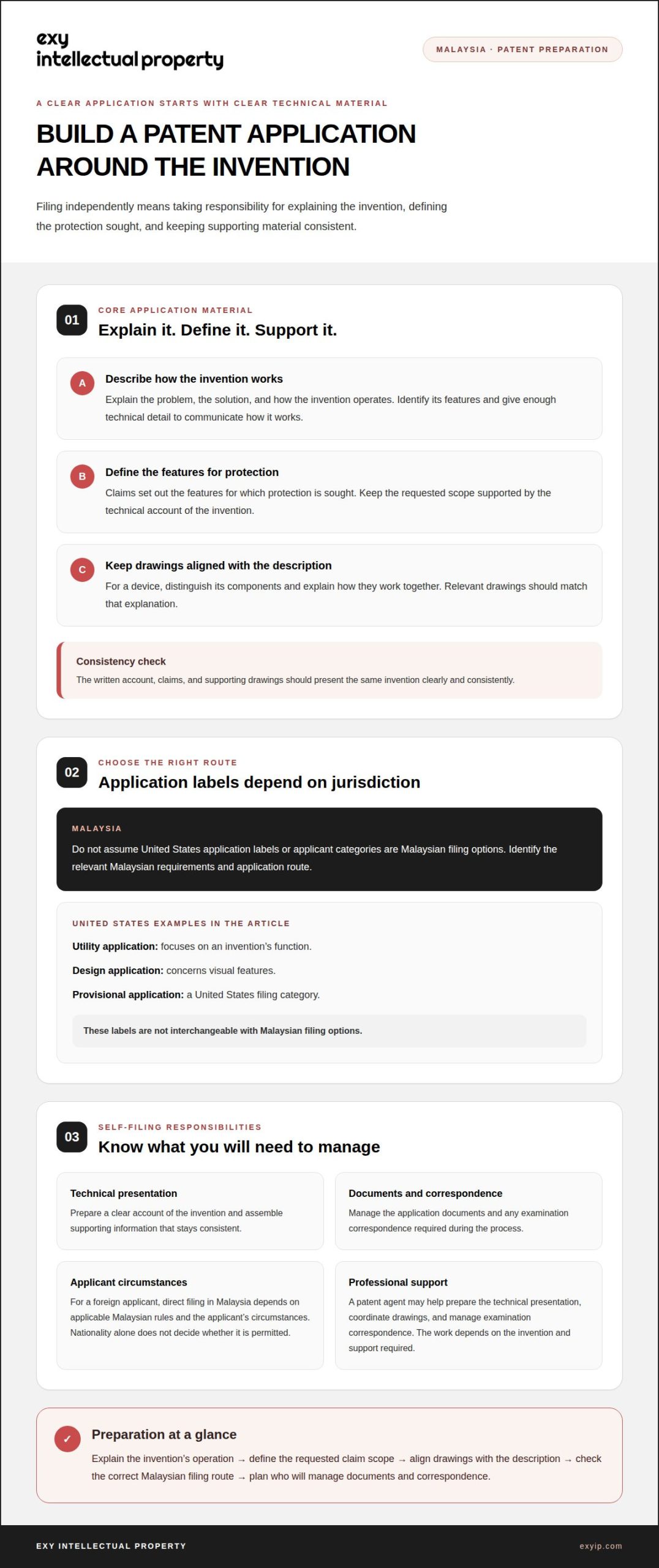
A patent application needs more than a description of what an invention does. Its technical account must explain how it works, identify its features, and support the protection requested. For example, a device description should distinguish its components and explain how they work together. Relevant drawings should match that explanation. Missing details can make the invention harder to define clearly.
Preparation also involves choosing the correct application type and assembling consistent information. A U.S. utility application, provisional application, and design application serve different purposes. A utility application focuses on an invention’s function, while a design application concerns its visual features. A provisional application is a U.S. filing category. These labels are not interchangeable with Malaysian filing options.
Professional fees are separate from government charges. In the United States, patent attorney work can include assessing the invention, preparing a description and claims, producing or coordinating drawings, and handling examination correspondence. The work required depends on the technical subject and application scope. Filing independently may avoid attorney fees at the outset, but the applicant takes on drafting and procedural responsibilities.
For a Malaysian applicant, the main difference between self-filing and hiring a patent agent is who prepares and manages the application. Self-filing avoids a professional service charge but leaves the applicant responsible for the technical presentation and filing requirements. A patent agent’s fees are separate from government fees, and the work involved depends on the invention and support required.
A foreign applicant’s ability to file in Malaysia without a local patent agent depends on the applicable Malaysian filing rules and the applicant’s circumstances. Nationality alone does not determine whether direct filing is permitted, so consider the relevant representation requirements before preparing the submission.
For an international Patent Cooperation Treaty (PCT) application from Malaysia, distinguish international-stage charges from later national-stage charges in each chosen jurisdiction. The total depends on applicable filing and search charges, the application’s characteristics, and where protection is pursued. PCT filing does not remove the need for a clear technical disclosure and claims.
Preparation commonly includes:
- Technical disclosure: Explain the problem, the solution, and how the invention operates.
- Claim scope: Define the features for which protection is sought.
- Supporting materials: Align examples and drawings with the written explanation.
- Filing details: Keep applicant and invention information consistent throughout the documents.
Careful patent application preparation can help align technical details with the intended scope of protection.
How much does it cost to file a Malaysian patent application without a lawyer, including search and examination fees?
For a Malaysian patent application, plan for separate filing, search, and examination stages. Applications typically involve two to three fee categories, according to the research facts for this topic. These are types of government charges, not a single combined amount. The applicable schedule and application route determine what the applicant needs to account for.
The filing stage covers submission of the application. It is the starting point, not a complete picture of every government charge that may arise. For example, a budget that covers only document submission may overlook separate search and examination stages. List each stage separately in your application plan.
A search stage examines relevant patent information in relation to the invention. It is distinct from filing because it serves a different part of the application process. Examination is another separate category. Keeping the stages distinct helps explain why a patent application may involve more than one government charge, even when the applicant prepares and submits the documents independently.
Filing without a lawyer changes who handles preparation and submission. It does not remove government charges attached to application stages. For practical planning, list filing, search, and examination separately, then identify which charges apply to the intended Malaysian application. Do not confuse professional service charges with government charges, or assume removing one removes the other.
The number of categories may vary because the process can involve two or three separate charges. The key question is whether the application includes filing, search, and examination charges, or only some of those categories at the stage being considered. A headline “filing” amount can therefore mislead: it may cover submission without representing the other stages.
Use this simple framework to organise the expected charges:
- Filing: Identify the government charge for submitting the Malaysian application.
- Search: Account for the separate search stage where it applies.
- Examination: Include examination as its own category where required.
- Professional work: Keep any drafting or representation work separate from government charges.
For example, an applicant preparing a mechanical invention should still separate the government stages, even when writing the technical description themselves. Self-preparation changes the work the applicant takes on; it does not combine separate filing, search, or examination charges. The clearest budget is a stage-by-stage plan based on the Malaysian application, not a single figure borrowed from another jurisdiction.
Prepare and submit the application yourself, then budget separately for any search and examination charges that apply to your application route.
Are there reduced patent fees in Malaysia for individuals, startups, or small businesses?
An individual, startup, or small business should not assume its business label automatically reduces Malaysian patent fees. The small-entity category discussed for the United States applies to that system; it does not establish eligibility for a Malaysian application. Keep the jurisdictions separate when planning government charges.
For a Malaysian filing, ask whether the applicable fee rules provide a concession for the applicant and application concerned. Applicant type alone is not enough to calculate a reduced amount. A newly formed company and an individual inventor may have different circumstances, but neither label by itself shows that a lower fee applies.
Separate government fees from document-preparation costs. Filing independently changes who performs the drafting and submission work; it does not, by itself, reduce a government charge. An inventor who prepares an application without an agent still needs to account for the applicable filing stages.
Make a clear comparison before committing funds. First, identify that the application is for Malaysia. Next, establish who is named as applicant, such as an individual inventor or a company. Then assess whether the relevant Malaysian fee rules recognise that applicant category for any concession. Finally, distinguish any reduced charge from professional service expenses.
- Individual inventor: Identify the person who will be the applicant; do not infer a discount from individual status alone.
- Startup: Treat the company’s age or startup label as separate from fee eligibility.
- Small business: Confirm how the applicant category is treated under Malaysian fee rules before using a reduced figure.
- Self-filing: Keep government charges separate from any drafting or agent work avoided.
Fee categories and professional work answer different questions. A concession, if applicable, concerns a government charge; self-filing concerns who prepares and handles the application. Evaluate these issues independently instead of treating “small business” or “no lawyer” as a single discount category.
For example, a founder applying personally and a startup applying through its company should first clarify who the applicant is. Then identify which Malaysian application stages carry government charges and whether any relevant concession applies. This avoids relying on a United States small-entity threshold or assuming a business-size description determines Malaysian eligibility.
Build a fee estimate only after separating applicant status, jurisdiction, and application stage. Record any applicable concession against the specific government charge it affects, and list drafting and representation work separately. This gives Malaysian inventors a clearer comparison between filing independently and obtaining professional assistance, without mistaking an overseas entity category for a local fee rule.
What are the risks of filing a patent application without a lawyer or patent agent?
Self-filing leaves the applicant responsible for the application’s technical and procedural details. A patent application must explain how an invention works and define the protection requested. If these parts do not align, the application may fail to communicate its intended scope clearly. For example, a claim may describe a feature that the written explanation does not adequately support.
Drafting is a central risk area. An inventor may know a product thoroughly but still find it difficult to describe the invention in precise, consistent language. A description focused only on the preferred version could miss other relevant configurations. Conversely, broad wording without enough technical explanation may leave uncertainty about what the application covers. These challenges can affect how clearly the document presents the invention.
Filing details are another source of avoidable difficulty. Applicant names, invention descriptions, drawings, and claims need to remain consistent throughout the application. For instance, a drawing that labels a component differently from the written description can make the document harder to follow. Missing information or unclear presentation can also create extra work during the process.
Examination correspondence also requires attention. An applicant filing alone must understand the issues raised and prepare a response that addresses them. Changing the technical explanation without considering the claims may create further inconsistencies. According to the research finding for this topic, patent prosecution tends to proceed more smoothly and quickly with an attorney.
Self-filing may reduce professional involvement at the start, but it does not remove your responsibility for decisions and follow-up. Before proceeding independently, consider whether you can:
- Explain the invention: Describe its operation, components, and technical differences consistently.
- Define the requested scope: Draft claims that match the supporting description.
- Coordinate materials: Keep drawings, examples, and terminology aligned.
- Manage examination: Read and answer official correspondence in a focused way.
These risks matter most when an invention has several interacting parts or depends on a specific technical distinction. For example, if a system combines a sensor, control method, and mechanical assembly, the application needs to explain how those elements relate. A brief product summary may not capture the detail needed to present the invention effectively.
Professional review can help address drafting and application-management challenges before submission. If you want support shaping the technical description and claims, consider patent drafting assistance as part of preparing your filing.
Cost is another consideration when deciding whether to seek professional help. Drafting a U.S. patent application typically requires a significant investment depending on the complexity of the technology.
The amount also varies with invention type: a simple mechanical invention’s U.S. filing costs differ substantially from the expenses associated with complex software or biotechnology patents. These figures frame the expense of professional assistance, but the decision still turns on whether the applicant can prepare a clear, consistent application and manage follow-up.
Exy Intellectual Property
Exy Intellectual Property helps Malaysian innovators assess their intellectual property needs and plan the next step for an invention. If you’re weighing self-filing against professional support, its patent services can help with application preparation and filing considerations. A patent novelty search can inform decisions before filing, while patent drafting supports preparation of application documents.
The right support depends on what you need to resolve. You may want help understanding the invention’s filing path, preparing its technical description, or managing the application process. Exy Intellectual Property also handles other forms of intellectual property protection, including Trademark Registration, Industrial Design Registration, and Copyright Voluntary Notification.
For guidance on your patent filing options, contact Exy Intellectual Property to discuss your situation.
Choose the support that fits your next step
Deciding how to protect an invention is also a business decision. The cost of filing a patent without a lawyer is only one part of that choice. Consider how much responsibility you can take on for preparing and managing the application, and how the protection supports your plans for the invention.
You can proceed independently or seek guidance on the work involved. Exy Intellectual Property offers Patent Filing, alongside Trademark Registration and Industrial Design Registration for other forms of intellectual property protection. A discussion can help you identify which support fits your priorities and where to focus next.
If you’re ready to discuss your intellectual property plans, contact Exy Intellectual Property. A considered next step can help you move ahead with greater clarity.
Frequently Asked Questions
What Makes Patents so Expensive?
Patent expenses often reflect the specialist work needed to describe an invention precisely and define meaningful protection. A complex invention may require careful explanation of how its components interact, along with revisions to keep the description and claims aligned. The cost of filing a patent without a lawyer may exclude professional drafting support, but the applicant still needs to prepare accurate documents and manage the application process. Planning for this work helps clarify the full commitment.