


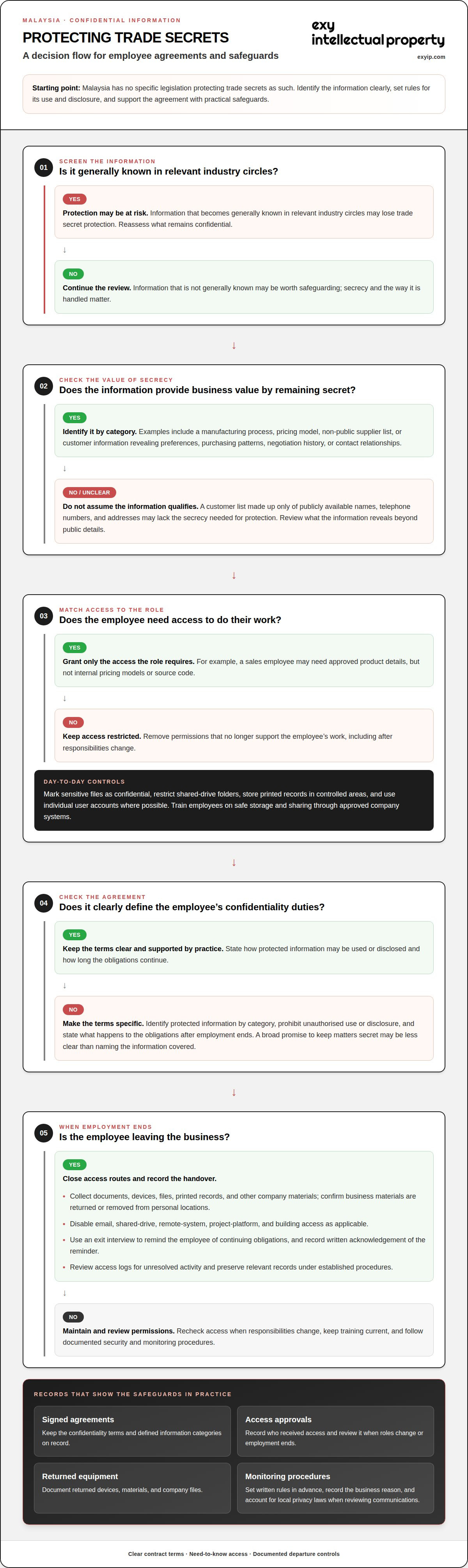
What protects a trade secret when an employee leaves? In Malaysia, protecting trade secrets with employee agreements starts with identifying confidential information clearly and setting out how employees may use or disclose it. Malaysia has no specific legislation protecting trade secrets as such, so practical safeguards matter.
A signed agreement is a useful foundation, but it must work alongside day-to-day controls. Limit access to sensitive information and train employees to recognise and protect it, so confidentiality expectations are clear.
This article explains how to identify information your business needs to safeguard, draft useful confidentiality terms, and support them with access controls and employee training. It also covers NDAs for employees and other business relationships, as well as steps to take when an employee leaves. Together, these measures can help protect business information and clarify employees’ responsibilities.
Key Takeaways
- Identify confidential information by category and state clearly how employees may use or disclose it, including after employment ends.
- Limit access to sensitive information, train staff on confidentiality, and include privacy safeguards in monitoring procedures.
- Assess whether customer and business information gains value from remaining secret, and handle price-sensitive information with care.
- Tailor NDAs for employees, contractors, vendors, and partners to cover the information they may access, including code, data, and AI assets.
- Set out specific examples of protected information in employment agreements, then pair those terms with practical steps for returning materials and removing access.
How to Protect Trade Secrets?
In Malaysia, protecing trade secrets with employee agreements starts with identifying valuable information and restricting its use. Examples include a manufacturing process, a pricing model, or a non-public supplier list. Keep each category confidential through clear contract terms and practical safeguards. Information that becomes generally known in relevant industry circles may lose trade secret protection.
What should a Malaysian employee confidentiality agreement include? Define confidential information using specific categories, prohibit unauthorised use or disclosure, and state how long the obligations continue. Include requirements to return company materials and remove system access when employment ends.
Clarity supports enforcement. In Ecooils Sdn Bhd v Raghunath Ramaiah Kandikeri, the High Court held that a confidentiality clause in an employee’s appointment contract imposed an express obligation of faithfulness alongside the implied duty to act in good faith. The case illustrates why a clause should identify protected information instead of relying only on a broad promise to keep matters secret.
Current employees must follow their contractual obligations when handling protected information. Former employees may also remain bound by confidentiality duties after departure. In Schmidt Scientific Sdn Bhd v Ong Han Suan, the Court held that an employee’s duty of fidelity continued after employment ended. A contract may also state that confidentiality obligations continue perpetually while identifying the information they cover.
Distinguishing True Trade Secrets from Mere Confidential Information
Applying principles established in Faccenda Chicken Ltd v Fowler and adopted by Malaysian courts, employment law separates workplace knowledge into distinct tiers:
- Public or Trivial Information: Freely usable by anyone.
- Mere Confidential Information (Know-How): Operational knowledge such as general pricing structures, supplier contacts, or internal workflows. This is protected by an implied duty of fidelity during employment, but once employment ends, a former employee may generally use it unless restricted by a clear, express post-termination confidentiality clause.
- True Trade Secrets: Highly sensitive assets—such as chemical formulas, proprietary source code, or secret manufacturing processes—that remain protected both during and indefinitely after employment, even without an express post-termination term.
Because Malaysian courts strictly void non-compete clauses under Section 28 of the Contracts Act 1950, well-drafted confidentiality schedules are the primary lawful instrument for protecting tier-2 commercial data after an employee departs.
Make departure procedures specific. Require employees to return documents, devices, files, and other company materials. Remove access to email, shared drives, remote systems, and role-specific platforms. An exit interview can remind departing employees of their continuing obligations, with written acknowledgement recording that reminder. These steps help close access routes and clarify ongoing duties.
Apply equivalent safeguards to vendors who receive confidential information. A vendor agreement can identify materials such as product specifications or supplier data, restrict their use to the agreed work, and require their return or deletion when that work ends. Review the agreement if the vendor’s access changes. Clear terms document permitted use and disclosure for both parties.
Keep records of protections in place, such as signed agreements, access approvals, and returned equipment. Review these records when an employee changes roles or leaves. Specific documents and procedures can help show how the business treated information as confidential.
Need-to-know access, security controls and employee training
Start with a need-to-know rule: employees should access only the information their roles require. For example, a sales employee may need approved product details, but not internal pricing models or source code. Review permissions when responsibilities change and remove access that no longer supports the employee’s work. This keeps access aligned with business needs.
Training turns the rule into daily practice. Explain which files are confidential, where employees may store them, and how to share them safely. For example, require sensitive documents to be sent only through an approved company system. Written notices, workplace rules, and training can communicate confidentiality requirements to current and former employees.
Apply practical security controls to physical and digital materials. Mark sensitive files as confidential, restrict shared-drive folders, and store printed records in controlled areas. Where possible, assign individual user accounts instead of shared credentials. These measures help businesses trace access and reduce unnecessary disclosure without blocking authorised work.
Monitoring should follow documented processes, not be improvised after a concern arises. Set written monitoring rules in advance and record the business reason for each measure. Review access logs for unusual downloads, repeated access to unrelated folders, or activity after a role change. If reviewing employee email or other communications, account for local privacy laws and limit the review to a defined business purpose.
PDPA Governance in Workplace Monitoring (Personal Data Protection Act 2010)
When auditing departing employees’ corporate emails, cloud drives, or access logs, employers must comply with the Personal Data Protection Act 2010 (as amended in 2024). Employers should issue a formal PDPA Employee Privacy Notice and IT Acceptable Use Policy at onboarding explicitly stating that corporate systems belong to the company and are subject to security auditing. Documenting the legitimate business purpose for forensic log reviews ensures audit evidence remains admissible in civil or Industrial Court proceedings.
Plan access changes before the departing employee’s final working day. Use a checklist covering email, remote access, shared drives, project platforms, and building credentials. Assign someone to disable each account and record completion. The employment contract can also require the return of company devices, documents, and digital files when employment ends.
Close the process with a return and access review. Collect laptops, storage devices, printed records, and company files; confirm that business materials are returned or removed from personal locations. Check access logs for unresolved activity and preserve relevant records under established procedures. A documented sequence helps protect confidential information and apply consistent controls across teams.
Customer information as a potential trade secret
A customer list is not automatically a trade secret. Its contents and handling matter. A compiled record of customer preferences, purchasing patterns, negotiation history, and contact relationships may have commercial value if competitors cannot readily access it. By contrast, a list containing only publicly available names, telephone numbers, and addresses may lack the secrecy needed for protection. Consider what the information reveals beyond public contact details.
For information to qualify, it should not be generally known, should provide a business advantage through secrecy, and should be subject to reasonable efforts to keep it confidential. Label sensitive customer records, restrict access to staff who need them, and record confidentiality obligations in employment terms. These measures create evidence of how the business treated the information. A “confidential” label helps communicate its status, but works best alongside practical safeguards.
Malaysia has no specific legislation protecting trade secrets as such. Malaysian courts have relied on English case law and common-law definitions in employment disputes involving confidential information. Separate statutory protections may apply in particular circumstances. This distinction matters: customer preferences or a non-public sales strategy may raise trade-secret questions, while personal employee records may instead be protected under employment or data protection law.
Price-sensitive information has a separate statutory context. Section 188 of Malaysia’s Capital Market and Services Act 2007 prohibits a person with access to non-public price-sensitive information from using it in connection with securities transactions or disclosing it for that purpose. A person convicted of an insider-trading offence may be imprisoned for up to 10 years. Businesses should control access to such information and keep records showing who received it and when.
Company information also connects with directors’ duties. Section 218(1) of Malaysia’s Companies Act 2016 sets out duties that include restrictions on misuse of company information. The Act’s definition of “director” includes a chief executive officer, chief operational officer, or another individual with primary responsibility for managing the organisation. Clear internal classifications can help distinguish customer trade secrets, employee records, and market-sensitive information, then direct each category to suitable safeguards.
NDAs for employees, contractors, vendors, and partners
Use an NDA to set rules for confidential information shared with employees, contractors, vendors, or business partners. Identify the permitted purpose, restrict unauthorised use and disclosure, and explain how recipients must handle the information. For example, a supplier reviewing a product specification should use it only for the agreed work. Include return or deletion requirements and state how confidentiality obligations continue after the engagement ends.
A trade secret agreement focuses on keeping valuable information secret and limiting its use. An NDA creates confidentiality duties for information shared between parties, while an intellectual property assignment agreement addresses ownership of creations, such as software code written by an employee. A business may need more than one type of term to protect information and establish ownership.
Contracts should reflect the assets people can actually access. For a software contractor, address source code, technical documentation, algorithms, and project data. For a team developing AI tools, identify models, training data, and internal processes as protected information where appropriate. Specify permitted access and use, how copies should be handled, and what happens to files when the project ends. Clear categories help recipients understand what the agreement covers.
Malaysia’s Contracts Act 1950 matters when drafting restrictions on future work. Section 28 provides that a clause in restraint of trade is void, subject to exceptions. It does not prevent an employer from requiring an employee to provide services exclusively during the employment contract. In Polygram Records Sdn Bhd v The Search, the High Court held that section 28 applies to restraints on carrying on a trade or profession after the contract, not while it remains in effect. Confidentiality terms should protect information, not simply disguise a restriction on future competition.
For vendors and partners, tailor the NDA to the information being exchanged. A customer sharing sales data with a service provider may need limits on access, use, onward disclosure, and retention. Review third-party agreements when project scope or data access changes, so the written terms match the working relationship.
Apply the same internal process to signed agreements, access approvals, and departures. Keep records of who received a current NDA, what information was shared, and whether materials were returned. Consistent documentation can clarify obligations if a dispute arises and help distinguish confidentiality protections from ownership terms.
Drafting employment agreements to identify trade secrets
Start with information employees can identify in their daily work. Name categories such as product formulas, manufacturing steps, pricing models, supplier terms, and non-public customer strategies. For a software team, specify source code, algorithms, technical documentation, and internal testing data. A clear description links confidentiality duties to real business assets instead of leaving employees to guess what the agreement protects.
Use a schedule or appendix to give concrete examples without including sensitive information itself in a widely circulated contract. For instance, identify “the current production process for Product A” or “unpublished discount rules in the sales system.” Review these categories when work changes or new information becomes valuable. Protecting trade secrets with employee agreements works best when contract language matches the information employees actually handle.
State the required conduct clearly. Employees should not use protected information for unauthorised purposes or disclose it without approval. Explain approved handling, such as storing design files in a restricted company system rather than personal cloud storage. Define how confidentiality obligations continue after employment ends, and describe permitted exceptions for information that becomes public without a breach or was independently developed.
Address practical departure duties in the same agreement. Require employees to return company documents, devices, storage media, and work files when employment ends. State that access to email, shared drives, and project platforms will be removed. These measures make responsibilities clear for former employees and give managers a defined process to follow.
Separate confidentiality from ownership. If employees create software code, designs, or inventions in their roles, include suitable intellectual property assignment terms alongside confidentiality clauses. An employment agreement can clarify which work belongs to the business and which information must remain confidential. For example, a developer’s code may need ownership terms, while a pricing strategy needs secrecy protections.
Statutory Ownership Defaults: Employees vs. Contractors (Section 26 CA / Section 20 PA)
Under Section 26 of the Copyright Act 1987 and Section 20 of the Patents Act 1983, copyright works and patentable inventions created by full-time employees in the course of their employment vest automatically in the employer by operation of law. Including an express IP ownership confirmation clause in employment contracts reinforces this statutory right and covers edge cases (such as work created outside normal hours using company resources). Conversely, independent contractors, freelance developers, and external consultants retain default ownership of their work—requiring a separate, signed IP Assignment Deed alongside their NDA.
For technical inventions that may need patent protection, discuss patent drafting as a separate step from employment confidentiality terms.
Exy Intellectual Property: Licensing Agreements
Exy Intellectual Property supports businesses with licensing agreements, trademark registration, patent filing, and industrial design registration. These services address different business needs. A licensing agreement sets terms for another party’s authorised use of intellectual property, while registration services concern protecting particular rights. The right path depends on what the business owns, what it plans to share, and how the other party will use it.
Licensing advice can be useful when a business wants to commercialise technology, designs, or a brand while retaining ownership. For example, a company may permit a manufacturing partner to use specified technical material for an agreed purpose. The agreement can clarify which information or rights are covered, permitted use, confidentiality expectations, and how the relationship ends. Separating licensed material from information that must remain secret helps distinguish authorised use from unrestricted disclosure.
Before preparing terms, organise the deal around practical questions. Identify the intellectual property or confidential material involved, the intended user, and the business purpose. Define which activities are allowed, whether the recipient may share information with others, and how copies or records will be handled. If a business shares a production method with a licensee, the agreement should distinguish access needed to make the product from permission to reuse the method elsewhere.
Registration may also form part of a commercialisation plan. A business developing an invention can consider patent filing, while a distinctive sign used to identify products may call for trademark registration. A product’s visual appearance may make industrial design registration relevant. These options address different forms of intellectual property; they do not replace careful confidentiality terms for information that remains secret.
Exy Intellectual Property provides licensing agreements alongside relevant registration support, helping businesses align documentation with the intended use of their assets. This is a practical next step when a partner is preparing to use protected material or a business is moving from internal development toward commercial use. Contact Exy Intellectual Property to discuss the agreement or registration support suited to your business needs.
Make confidentiality part of business planning
Trade secret protection should keep pace with the business. A new product, role, supplier relationship, or technology project can change who needs access and what information requires protection. Build a review into plans for those changes, so contract terms and workplace practices stay aligned with how information is actually used.
Protecting trade secrets with employee agreements is most effective when it supports a wider business strategy. Consider how confidential information will be handled as the business develops, shares, or commercialises its intellectual property. This forward-looking approach helps decision-makers address confidentiality before new work begins, rather than treating it solely as an exit procedure.
Where agreements or intellectual property decisions need attention, contact Exy Intellectual Property to discuss a suitable next step. A clear plan can help your business move forward with greater confidence.
Frequently Asked Questions
How to Protect Trade Secrets?
Protect trade secrets by identifying valuable, non-public information and applying consistent safeguards. For example, record which version of a product formula or launch strategy is restricted, who approved access, and when that approval changes. Use written employee and third-party terms alongside practical controls. Keep dated records of access decisions and training so the business can show how it treated the information before a dispute arose.
Can a former employee use general knowledge they learned at my company?
A former employee can generally draw on ordinary skills and experience, but that differs from using specific confidential material. Sales experience, for example, is not the same as copying a private customer strategy or an unreleased pricing file. Define protected information carefully and distinguish it from general professional knowledge. If concerns arise, focus on evidence of specific use or disclosure, not merely the former employee’s continued work in the industry.
Do I need to mark every document confidential to protect it?
No. Marking every document is not the only way to protect confidential information. Labels can help, but businesses should also communicate confidentiality rules and apply safeguards suited to the material. A restricted project folder, for example, can show controlled handling even if every file lacks a stamp. Consistent labels on key files, combined with access restrictions and clear employee guidance, make it easier to show which information the business treated as sensitive.
What can you do if an ex-employee is discovered to have breached the confidentiality clause or agreement?
Act promptly to preserve relevant evidence and limit further disclosure. Record what information may have been used, when the concern arose, and which systems or recipients are involved. Preserve relevant emails, access records, and company documents through authorised processes. Avoid altering records or accessing personal accounts without proper authority. Legal advice can help assess the agreement, available evidence, and appropriate next steps, including whether intellectual property litigation is relevant.
What if my employee signed an NDA, but I never told them what was confidential?
A signed NDA may be harder to apply clearly if employees were never told which materials it covered. Identify examples tied to their work, such as a non-public product roadmap or an internal supplier assessment, and communicate the rules directly. Keep a record of relevant training or written notices. For existing staff, explain the categories and handling expectations now, then align future project access with those instructions.
What if the information is only valuable for a short time, like a launch plan?
Confidentiality terms can cover information whose commercial value changes quickly. A launch plan, for example, may be sensitive before release but lose its secrecy once product details become public. Describe the material and explain that confidentiality applies while it remains non-public, subject to the agreement’s terms. Restrict access during planning and update permissions after launch, so former restrictions do not create confusion about information already made public.
Would such confidentiality clauses be void for being in restraint of trade?
A confidentiality clause is not automatically the same as a restraint on future work. Section 28 of Malaysia’s Contracts Act 1950 makes a clause in restraint of trade void, subject to exceptions. The clause’s purpose and effect matter: protecting confidential information differs from preventing someone from carrying on a profession after employment. Draft terms around specific information and its permitted use, rather than a broad ban on working for competitors.
What laws protect trade secrets in Malaysia?
Malaysia has no specific legislation protecting trade secrets as such, and courts have relied on common-law principles in employment disputes. Other laws may protect business information in particular situations. For example, section 188 of the Capital Market and Services Act 2007 addresses non-public price-sensitive information, while section 218(1) of the Companies Act 2016 covers directors’ duties, including restrictions on misuse of company information. The applicable protection depends on the information and circumstances.