


Your product’s visual identity is often its most valuable asset, yet it remains the most vulnerable to imitation. A single "look-alike" competitor can erode years of brand equity in weeks. If you feel overwhelmed by the technicalities of design patent registration MY, you aren’t alone. Many leaders struggle to distinguish between functional patents and aesthetic protections, often leaving their most distinctive designs exposed to the market.
We understand that securing your intellectual property isn’t just about legal compliance; it’s about building a defensible market monopoly. This guide provides the clarity you need to master industrial design registration in Malaysia. You’ll learn exactly how to evaluate if your design is "new" enough for MyIPO standards and how to transform that registration into a tool for commercial growth. We’ll walk through the essential 2026 frameworks for protection, ensuring your creative investments stay firmly in your hands. From understanding the initial five-year protection term to navigating the novelty grace period, we provide the strategic roadmap your business deserves.
Key Takeaways
- Understand the legal distinction between functional patents and industrial designs to secure the correct protection for your product’s unique visual identity.
- Evaluate your design’s eligibility against the “World-wide Novelty” standard required for successful registration under 2026 intellectual property regulations.
- Leverage design patent registration MY as a strategic commercial asset that increases your company’s total valuation for funding or exit opportunities.
- Master the essential MyIPO application steps, including the critical preparation of a Statement of Novelty to define your design’s unique characteristics.
- Convert your registered intellectual property into a scalable growth engine by exploring commercialization avenues such as licensing and franchising.
Understanding Design Patent Registration in Malaysia (Industrial Designs)
Visual identity is a silent salesman. In a crowded marketplace, the way a product looks often influences a purchasing decision before a customer ever considers how it functions. For businesses looking to secure this advantage, design patent registration MY is the essential first step. It’s vital to recognize that in Malaysia, the legal system uses the term "Industrial Design" rather than "design patent." This protection is governed by the Industrial Designs Act 1996, which provides a robust framework to safeguard the aesthetic aspects of your innovation.
Unlike a standard patent that focuses on technical utility, an industrial design registration protects only the outward appearance. This focus on aesthetics ensures that your competitors cannot simply replicate the look and feel of your product to confuse customers or dilute your brand. An Industrial design right serves as a strategic barrier, turning your creative investment into a proprietary business asset that competitors cannot legally ignore.
The Terminology Bridge: Design Patents vs. Industrial Designs
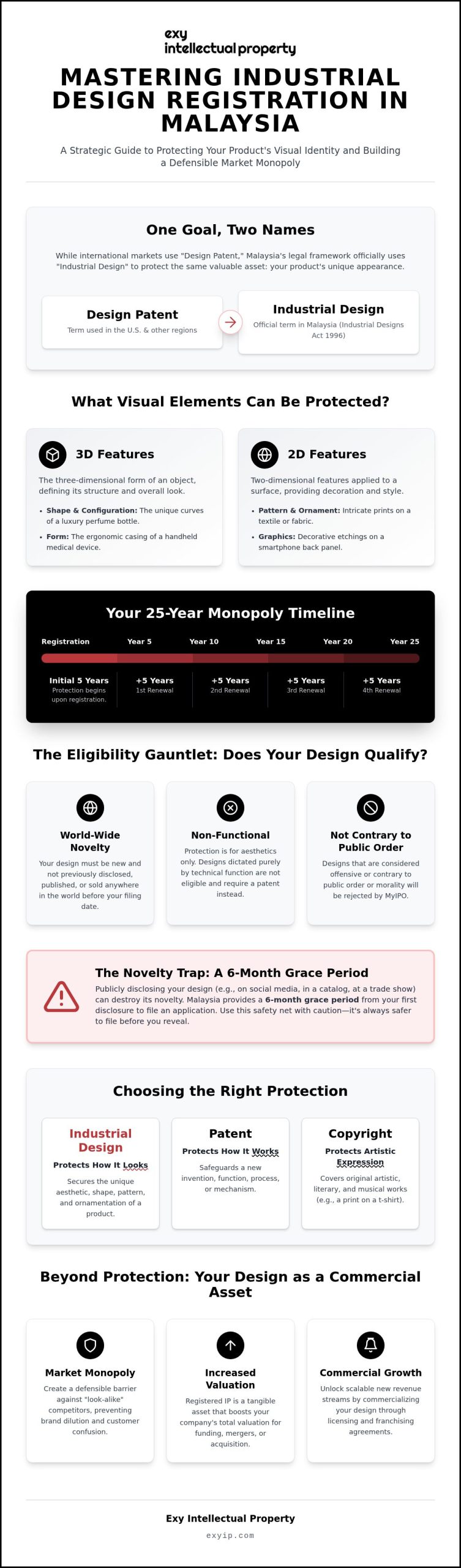
Business leaders often encounter confusion when searching for intellectual property terms across different regions. While international markets like the United States utilize the term "design patent," MyIPO adheres to the "Industrial Design" nomenclature. Both legal instruments serve the same purpose: protecting the 2D or 3D features of a product. In Malaysia, once your design is registered, you gain an initial five-year period of protection. This can be extended through four subsequent renewals, providing a maximum of 25 years of market exclusivity.
What Can Be Protected Under Malaysian Design Law?
Malaysia’s legal framework identifies specific visual elements that qualify for protection. These elements must be applied to an article and must be visible in the finished product. Registrable features typically include:
- Shape and Configuration: The three-dimensional form of an object, such as the unique curves of a luxury perfume bottle or the ergonomic casing of a handheld medical device.
- Pattern and Ornament: Two-dimensional features like the intricate prints on a textile or the decorative etchings on a smartphone back panel.
Whether you are protecting the 3D structure of furniture or the 2D graphics of wallpaper, the design must be applied via an industrial process. An industrial process is the method by which these designs are mass-produced and integrated into the final commercial article. By securing these rights, you ensure your product remains distinct in the eyes of the consumer and the law alike.
Criteria for a Registrable Design: Is Your Innovation Eligible?
Eligibility isn’t just about creativity. It’s about novelty. To qualify for design patent registration MY, your innovation must meet two primary legal thresholds: it must be "new" and "original." In the context of 2026 IP standards, MyIPO applies a "World-wide Novelty" test. This means your design cannot have been published, disclosed, or sold anywhere in the world before your filing date. Even if your product is unique to the Malaysian market, its existence in a foreign catalog or an international trade show could disqualify it.
Beyond novelty, your design must be capable of industrial application. This requirement ensures that the aesthetic features can be reproduced through an industrial process. It’s what separates a commercial product from a one-off piece of fine art. Certain exclusions also apply; MyIPO will reject designs that are purely functional or those deemed contrary to public order or morality. Protecting a design that cannot be mass-produced or one that offends public standards is simply not possible under the current Act.
The Novelty Requirement and Prior Disclosure
Public disclosure has evolved in the digital age. A single LinkedIn post or a viral TikTok showcasing your prototype can constitute a disclosure that destroys novelty. Malaysia provides a specific safety net: a six-month grace period. If you disclose your design, you have exactly six months to file your application before that disclosure becomes a legal barrier. Malaysia provides a narrow six-month grace period for public disclosures under Section 12(3) of the Act. However, this only covers disclosures made at officially recognized exhibitions or unlawful disclosures by third parties (such as a breach of NDA). Commercial sales or public social media posts by the owner prior to filing generally destroy novelty. Relying on this is risky, however. It’s often safer to perform a preliminary novelty search to ensure no prior art exists that could jeopardize your filing. You don’t want to discover a conflict after you’ve already invested in manufacturing.
Functionality vs. Aesthetics: The "Method of Construction" Rule
The law creates a clear boundary between form and function. If a product’s shape is dictated solely by how it works, it fails the "Eye Appeal" test used by examiners. This is known as the method of construction rule. According to the World Intellectual Property Organization (WIPO), industrial design protection is intended for the visual character of an object. A simple rule of thumb helps clarify the distinction: if the innovation makes the product work better, it’s likely a utility patent; if it makes the product look better, it’s a design. Understanding this helps you choose the right protection for your specific business goals.
Industrial Design vs. Patent vs. Copyright: Choosing the Right Protection
Choosing the right legal shield is a strategic decision. It’s not just about filing paperwork; it’s about building a wall around your revenue. While design patent registration MY secures your product’s visual appeal, other forms of intellectual property protect its technical "brain" or its brand "identity." For a business leader in 2026, the goal is often a multi-layered defense. This approach ensures that if one layer of protection is challenged, others remain intact to safeguard your market share. Relying on a single type of IP is rarely enough in a sophisticated global economy.
Industrial Design vs. Patent: The "How" vs. the "Look"
Think of a smartphone. The complex internal circuitry and the software algorithms that power the device are protected by utility patents. They define how the device works. In contrast, the sleek outer casing, the specific curve of the corners, and the placement of the buttons fall under industrial design. Patents are generally more expensive and take longer to grant due to rigorous technical examinations. Industrial designs are typically faster and more cost-effective to register. If you’re looking for technical protection, consult our Strategic Patent Filing Services in Malaysia for a deeper dive into utility protections.
The Role of Copyright in Product Aesthetics
Copyright is an inherent right for artistic works, but it has significant limitations for mass-produced items. Once a design is applied to more than 50 articles by an industrial process, copyright protection often ceases to be effective for the product’s shape; Under Section 7(2) of the Copyright Act 1987, once an artistic design is industrially mass-produced (applied to more than 50 articles), copyright protection for the visual shape ceases, making formal Industrial Design registration mandatory to maintain legal exclusivity. This is why industrial design registration is non-negotiable for manufacturers. However, copyright voluntary notification can still serve as a useful secondary layer for the original sketches or digital models. To complement your design protection with a strong brand identity, see our Trademark Registration in Malaysia: 2026 Strategic Guide.
Modern innovations often blur these lines. Graphical User Interfaces (GUIs) or complex machinery might require a combination of design, patent, and trademark filings. By treating IP as a cohesive portfolio rather than isolated filings, you increase your company’s overall valuation. This strategic alignment makes your venture more attractive to investors and provides a clear deterrent to potential infringers. We help you navigate these overlaps to ensure no aspect of your innovation is left vulnerable.
The Step-by-Step Registration Process with MyIPO
The journey toward legal certainty begins with a formal filing. To initiate design patent registration MY, you must submit Form ID 1 to the Intellectual Property Corporation of Malaysia (MyIPO). This document captures essential details about the applicant and the article. Accompanying this is the Statement of Novelty. This statement is a concise declaration that pinpoints exactly which features of your design are new. It serves as the primary legal boundary for your protection.
When filing Form ID 1, your design must be categorized under the Locarno Classification, an international classification system for industrial designs. Choosing the correct Locarno class and sub-class ensures your product is accurately indexed in MyIPO’s register. Proper classification prevents administrative objections and ensures your protection covers the full commercial scope of the intended article.
Once submitted, MyIPO conducts a formalities examination. They ensure all technical requirements are met and that the design fits the legal definition of an industrial design. If the application passes this stage, MyIPO issues a registration certificate and publishes the design in the Intellectual Property Official Journal. This publication notifies the public of your exclusive rights. There is currently no official fee for the grant of the registration, making the process highly accessible for growing ventures.
Preparing Your Application: Drawings and Representations
Clarity is your best defense. The representations you provide define the exact scope of your monopoly. Professional drawings or high-resolution photographs must show the product from multiple perspective views. Consistency is vital. If the top view contradicts the side view, you’ll likely face an office action that delays your grant. Malaysian law typically follows a "one design per application" rule. If you have a range of products, such as a set of matching furniture, you’ll likely need multiple filings. Ensuring that every visual detail is captured correctly from the start prevents competitors from finding loopholes in your protection.
Optimizing Scope with Line Drawings vs. Photographs
Visual representation choice directly dictates your scope of protection. While MyIPO accepts high-resolution photographs, submitting clean black-and-white line drawings is generally preferred by IP specialists. Color photographs limit your legal monopoly strictly to the specific color scheme shown. In contrast, line drawings secure protection over the underlying shape and configuration regardless of future color or surface finish variations, giving you a broader shield against competitors.
Timeline and Maintenance of Your Design Rights
Speed matters. The registration process typically doesn’t exceed twelve months from your filing date. This relatively fast turnaround allows you to enforce your rights while the design is still at its peak market value. Your initial protection lasts for five years from the filing date. To maintain your exclusivity, you must renew the registration every five years. You can achieve a maximum protection period of 25 years through four subsequent renewals. You should pay the renewal fee up to six months before the current period expires. If you miss the deadline, a six-month late renewal window is available, though it requires a penalty payment. If you’re ready to secure your product’s future, our team can manage your Industrial Design Registration from initial filing to final renewal.
Strategic Management: Maximizing the Value of Your Design Patent
Registration is the foundation, not the finish line. Once you’ve secured your design patent registration MY, the focus shifts from protection to profit. Intellectual property is a dynamic business tool that can drive revenue through multiple channels. For a proactive leader, managing these assets means looking beyond legal compliance to see the commercial potential inherent in every registered curve and pattern. We act as your "Business-Savvy Guardian," ensuring these aesthetic rights are integrated into your broader corporate strategy to create a defensible market position.
A well-managed IP portfolio does more than just stop copycats. It builds equity. By treating your industrial designs as strategic assets, you transform "the way a product looks" into a proprietary engine for growth. This transition requires a shift in mindset from seeing IP as a legal cost to viewing it as a high-value investment that yields measurable returns over its 25-year lifespan.
Licensing and Franchising Your Registered Designs
Passive revenue is the hallmark of a mature IP strategy. Licensing allows you to grant third parties the right to manufacture or sell products using your protected design in exchange for royalty payments. This expands your market reach without the capital expenditure of new production lines. In a franchise model, the visual distinctiveness of your products is often as critical as your trademark. Well-drafted licensing agreements are essential here. They define the scope of use and include strict quality control clauses to prevent brand dilution. These contracts ensure that while others use your design, you remain in total control of its market integrity.
Valuation: What is Your Design Worth?
Intangible assets often outweigh physical ones in modern company valuations. A registered industrial design is a quantifiable asset that appears on your balance sheet, directly increasing the book value of your company. This is particularly vital during funding rounds or when preparing for a business exit. Investors look for a defensible "moat" that prevents competitors from eroding margins. Beyond investor appeal, registered designs can serve as collateral for intellectual property financing. This allows you to leverage your creative success to secure capital for future expansion. We provide the commercialization strategy and legal advisory needed to turn these legal certificates into tangible growth. By linking registration with valuation and licensing, we help you maximize the return on every design you bring to market.
Turning Aesthetic Innovation into Market Leadership
Protecting your product’s appearance is more than a legal formality; it’s a strategic move to secure market share. By mastering design patent registration MY, you transform creative effort into a proprietary asset that directly increases business valuation. Success depends on navigating the world-wide novelty standard and ensuring your visual representations are precise enough to withstand legal scrutiny. You now have the framework to distinguish between functional patents and aesthetic designs, ensuring every layer of your innovation is shielded.
Exy Intellectual Property stands as your proactive partner in this journey. We provide the technical expertise needed for rigorous patent novelty searches and professional drafting, ensuring your application is robust from day one. Our team doesn’t just register designs; we build commercialization strategies that turn intellectual property into revenue through licensing and strategic valuation. We understand the high stakes of the Malaysian market and are dedicated to the long-term health of your venture.
Don’t let your visual identity remain vulnerable to imitation. Secure your product’s future with Exy Intellectual Property’s expert design registration services. We’re here to handle the technical complexities so you can focus on scaling your business with total confidence.
Frequently Asked Questions
What is the difference between a design patent and an industrial design in Malaysia?
In Malaysia, "Industrial Design" is the specific legal term used for what is internationally known as a design patent. While the terminology differs, the function remains the same: protecting the visual characteristics of a product. This includes its shape, configuration, pattern, or ornament. If you are searching for design patent registration MY, you are essentially looking to register an industrial design under the Industrial Designs Act 1996.
How long does design patent registration last in Malaysia?
A registered design in Malaysia provides an initial protection period of five years from the filing date. You can extend this protection for four additional five-year terms, reaching a maximum of 25 years. This long-term exclusivity allows you to fully capitalize on your aesthetic innovation. To maintain these rights, you must pay renewal fees before each five-year block expires, ensuring your product’s "look" remains a defensible market monopoly.
Can I register a design if I have already started selling the product?
You can still register a design if the public disclosure occurred within the last six months. Malaysia offers a specific grace period for disclosures made by the creator. However, relying on this is risky because it doesn’t protect you against independent disclosures by third parties. It’s always best to file your application before any commercial launch to ensure your design patent registration MY meets the strict world-wide novelty requirements enforced by MyIPO.
Is a Malaysian design registration valid in other countries?
No, industrial design registration is territorial, meaning it only provides legal protection within Malaysia. If you intend to sell your product globally, you must file separate applications in each target country. You can claim "conventional priority" if you file these international applications within six months of your Malaysian filing date. This strategic move allows you to use your original filing date as the benchmark for novelty in foreign jurisdictions.
What happens if someone copies my registered design?
If a competitor replicates your registered design, you have the legal right to pursue an infringement claim. This can result in a court injunction to stop further sales, along with the recovery of damages or an account of profits. Having a registered right simplifies the enforcement process, as the registration certificate serves as prima facie evidence of your ownership. For a comprehensive understanding of your enforcement options, our guide on industrial design infringement Malaysia provides the legal roadmap you need to act decisively. We recommend seeking professional legal advisory to manage these disputes and protect your commercial interests.
Do I need a professional IP agent to file my design application?
While local applicants can technically file their own applications, engaging a registered patent attorney is a strategic advantage. For foreign applicants, it’s a legal requirement to appoint a Malaysian agent. Professionals ensure that your Statement of Novelty and visual representations are technically sound. This precision reduces the risk of office actions or future litigation loopholes, ensuring your creative investments are protected by the most robust legal framework possible.
Can I protect the "feel" or material of a product through design registration?
No, industrial design registration specifically protects the visual features of a product rather than its tactile properties or material composition. The law focuses on features that appeal to the eye, such as shape or decorative patterns. If the "feel" of your product is tied to a technical innovation or a specific manufacturing method, you might need to explore utility patent protection or trade secret protocols instead of an industrial design filing.
How much does it cost to maintain an industrial design registration?
Maintaining your registration requires the payment of renewal fees every five years. These official fees must be paid to MyIPO to keep the protection active for the full 25-year maximum term. While we don’t quote specific government rates, it’s important to budget for these periodic costs to avoid the accidental expiration of your rights. If a deadline is missed, a six-month window for late renewal exists, though it carries a penalty.