


What if the true value of your startup isn’t found in your monthly revenue or your user growth, but in the intangible rights you have yet to quantify? For many tech founders entering a Seed or Series A round, the fear of undervaluation is a constant weight. You know your technology is revolutionary. However, if you cannot translate that innovation into a clear dollar amount, you’re likely leaving equity on the table. It’s a common frustration to see complex formulas and feel like you’re guessing at your own worth.
Value. Security. Clarity. We understand that your intellectual property is the lifeblood of your company. This 2026 guide provides a strategic roadmap for ip valuation for tech startups, helping you move from technical concepts to commercial assets. You’ll discover how to quantify your intangible portfolio to attract high-caliber investors, secure financing, and maximize your market presence. We’ll break down the primary valuation methodologies, address the anxiety of due diligence, and show you how to build a robust report for your next pitch deck. By the end of this article, you’ll have the strategic foundation needed to turn your clean IP ownership into a powerful tool for negotiation.
Key Takeaways
- Quantify the intangible assets that represent the majority of your startup’s market value in the 2026 economy.
- Master the income and market methodologies used in ip valuation for tech startups to build a data-driven pitch deck.
- Ensure “clean ownership” across your portfolio to eliminate the risks that often cause investors to walk away during due diligence.
- Execute a comprehensive internal audit to organize your patents and trademarks into a clear, professional valuation report.
- Leverage your valuation results to secure intellectual property financing and negotiate superior licensing or acquisition terms.
Why IP Valuation is the Cornerstone of Tech Startup Success in 2026
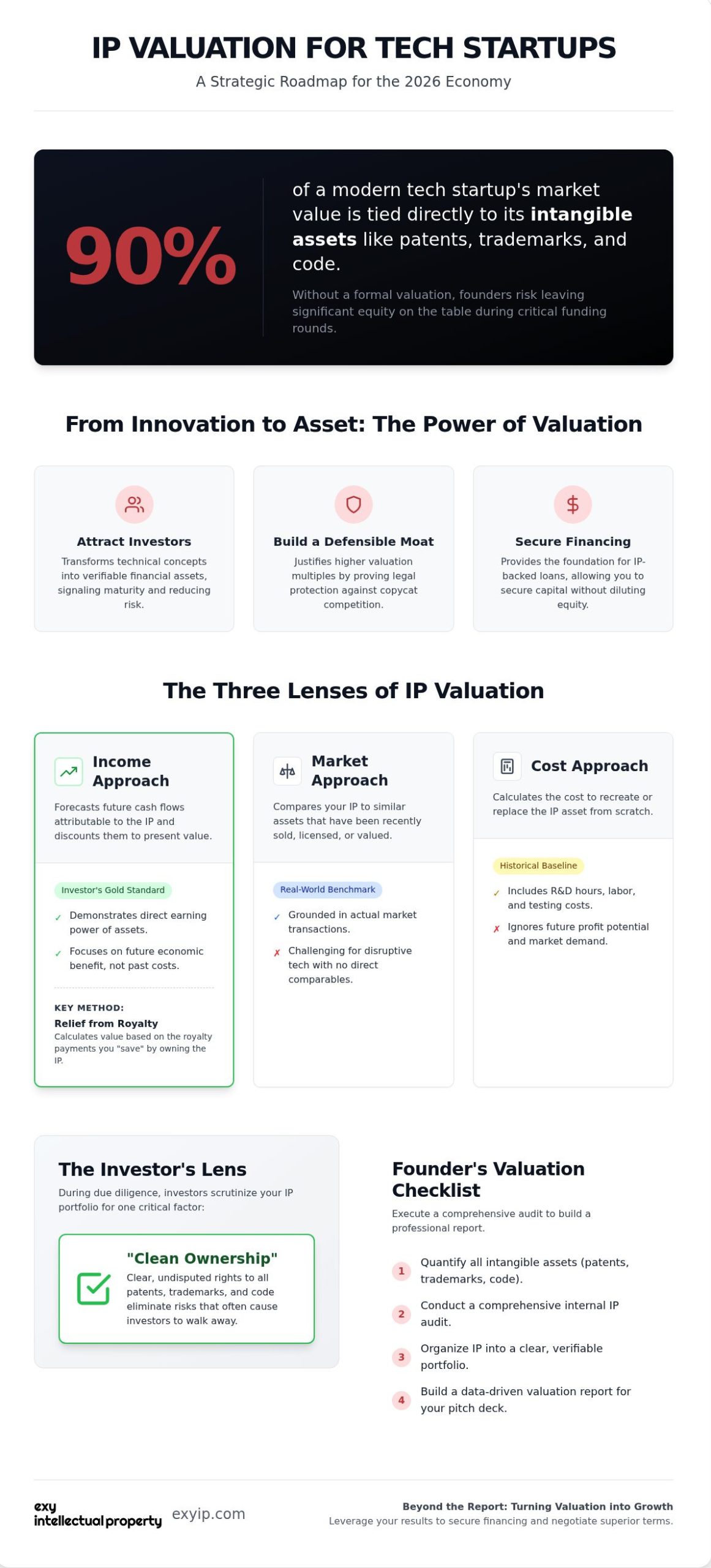
Intangible assets are no longer secondary. They are the primary driver of enterprise value. In the tech sector, physical equipment often accounts for only a small fraction of a company’s total worth. Industry data indicates that roughly 90% of a modern startup’s value is now tied directly to its intellectual property. This shift means that your balance sheet is incomplete if it only lists hardware and cash reserves.
Intellectual property valuation is the formal process of determining the fair market value of these intangible assets. It provides a commercial anchor for high-stakes negotiations. Without a professional assessment, founders often base their equity asks on general market sentiment, while investors rely on conservative benchmarks. A formal report bridges this gap. It transforms abstract technical code into a concrete financial asset that can be audited and verified.
IP creates a "defensible moat" around your innovation. This protection justifies higher valuation multiples because it significantly reduces the risk of copycat competition. When you can prove your assets are legally protected and financially quantified, you signal a level of maturity that reassures institutional partners. It turns a speculative venture into a calculated investment.
The Economic Lifespan of Tech Assets
Software code and algorithms don’t wear out like physical machinery, but they do face functional obsolescence. Patents, conversely, can appreciate in value as the market matures and your technology becomes an industry standard. Effective ip valuation for tech startups focuses on future economic benefits rather than historical development costs. Investors rarely care what you spent on R&D; they care about the revenue the IP will generate over its remaining legal life. Intellectual property valuation is a strategic tool that allows 2026 tech founders to convert technical innovation into measurable commercial leverage.
Valuation as a Fundraising Catalyst
Equity is your most expensive currency during Series A and B rounds. A robust valuation report helps you defend your ownership stake by proving the underlying worth of your patents and trademarks. It moves the conversation from pre-revenue speculation to asset-backed growth. Beyond equity, these assets serve as the foundation for intellectual property financing. This approach allows you to secure capital for scaling without further diluting your control. Specialized patent valuation services identify these opportunities early, ensuring your startup is prepared for the intense scrutiny of institutional due diligence.
Core Methodologies: How to Calculate the Economic Value of Your IP
Determining the financial worth of an idea requires more than a standard spreadsheet; it demands a structured, defensible framework. For most founders, ip valuation for tech startups involves navigating three primary pillars: income, market, and cost. Each lens offers a different perspective on risk and potential. Organizations like WIPO emphasize that Valuing IP assets accurately requires a deep understanding of both legal protection and market demand.
The Income Approach remains the gold standard for many investors. It forecasts the future cash flows directly attributable to your intellectual property, discounting them back to their present value. This method effectively demonstrates the earning power of your software or hardware patents. Conversely, the Market Approach compares your assets to similar transactions within the tech industry. While this provides a "real-world" benchmark, it often proves challenging for truly disruptive technologies that lack direct peers. Finally, the Cost Approach calculates the exact expense required to recreate the asset from scratch. This includes R&D hours, specialized labor, and testing. Because no single method captures the full story, many specialists utilize a hybrid intellectual property valuation methodology to provide a balanced, risk-adjusted figure.
The Relief from Royalty Method
A specialized subset of the income approach is the Relief from Royalty method. It calculates the value of an asset by estimating the royalty payments you’d "save" by owning the IP rather than licensing it from a third party. To determine a fair royalty rate, experts analyze industry standards for similar proprietary software or hardware designs. This method is particularly persuasive in licensing negotiations because it translates technical utility into a standard commercial fee structure.
Compliance with IVS 210 (Intangible Assets)
For an IP valuation report to be accepted by institutional VCs, Big 4 auditors, or cross-border tax authorities, it must adhere to International Valuation Standards (IVS 210). Compliance with IVS 210 ensures that risk-adjusted discount rates (WACC plus technological obsolescence factors) and Tax Amortization Benefits (TAB) satisfy institutional due diligence requirements.
Choosing the Right Method for Your Stage
Your startup’s maturity dictates the most appropriate approach. The Cost Approach is typically best for pre-revenue R&D startups. At this stage, your value is rooted in the tangible investment made to reach a proof-of-concept. As you scale, Venture Capitalists shift their focus toward the Income Approach. For a scaling SaaS company, the ability to generate recurring revenue from a proprietary algorithm is far more relevant than the initial coding costs. Engaging a professional for Intellectual Property Valuation ensures you select the right framework to reflect your true market potential during every funding round.
The Investor’s Lens: IP Due Diligence and Valuation Impact
Investors aren’t just buying your code; they’re buying the exclusive right to profit from it. This is why due diligence is the most critical phase of ip valuation for tech startups. A "Clean Ownership" requirement is the non-negotiable baseline for any serious funding round. If a former developer or co-founder still has a valid claim to your core algorithm, the financial risk is often too high for institutional capital. Messy IP chains don’t just delay deals. They lead to significant valuation haircuts where investors slash their offer to account for future legal fees or potential settlements.
Freedom to Operate (FTO) is another pillar of risk assessment that directly affects your market worth. Even if your patent is granted, you must ensure your product doesn’t infringe on existing rights held by others. A negative FTO analysis can reduce a startup’s perceived value to nearly zero in the eyes of a Venture Capitalist. Conversely, a strong offensive IP strategy commands a valuation premium. This involves holding patents that actively block competitors from entering your specific niche. Specialized patent valuation services provide the data needed to quantify these risks and opportunities before they become deal-breakers.
Securing the Chain of Title
In Malaysia, navigating national intellectual property frameworks requires meticulous documentation from the moment of conception. You must ensure all employee and founder IP assignments are legally binding and clearly recorded. For software startups, relying solely on trade secrets is often insufficient for high-level fundraising. Utilizing copyright voluntary notification creates a public record of ownership that reassures investors during the due diligence process. This step proves that your company, not an individual, owns the foundational assets that drive your revenue.
The Role of Patent Novelty Searches
Investor skepticism is high when technical claims aren’t backed by third-party validation. A comprehensive patent novelty search validates the uniqueness of your asset within the global landscape. This search reduces the likelihood of an application being rejected or challenged by competitors later in the commercialization cycle. By presenting a clean novelty report, you provide the technical evidence necessary to support a higher ip valuation for tech startups. It shifts the burden of proof from your pitch deck to verified, objective data that stands up to professional scrutiny.
Surviving Post-Grant Challenges
In 2026, valuation model risk factors must account for post-grant validity challenges. Under Sections 55A and 56A of Malaysia’s Patents (Amendment) Act 2022, competitors have a strict six-month window post-grant publication in the IP Official Journal (IPOJ) to file administrative oppositions directly with MyIPO. Patents that include multi-layered dependent claims retain higher valuations because they present significantly lower invalidation risk during this window.
Preparing for a Valuation: Checklist for Tech Founders
Preparation determines the outcome. A valuation report is only as robust as the data backing it. For founders, this means moving beyond high-level pitches to granular asset management. You must conduct a thorough internal audit to identify every piece of intellectual property your company claims. This includes patents, trademarks, trade secrets, and even proprietary databases. Identifying these early prevents assets from slipping through the cracks during intense negotiation rounds. It ensures you aren’t leaving equity on the table because of an overlooked innovation.
Documentation serves as your primary evidence. You need to organize every filing receipt, registration certificate, and licensing agreement into a single source of truth. If your records are fragmented, investors will view your venture as high-risk. Your preparation for ip valuation for tech startups must be methodical and transparent. Additionally, you must perform deep market research. Understanding industry trends and competitor filings allows you to position your IP within the broader 2026 tech landscape. Finally, select a valuer with specific tech-sector expertise. A generalist often misses the unique economic drivers of specialized software or hardware innovations. A proactive approach to intellectual property asset management ensures your portfolio remains organized, current, and ready for the scrutiny of any funding round.
Step 1: Formalize Your IP Portfolio
Assets that exist only as "unregistered ideas" are difficult to value and nearly impossible to defend. To maximize your company’s worth, you must formalize your portfolio through official channels. This begins with trademark registration and patent filings. Registered assets command a significantly higher valuation than unregistered ones because they carry legal weight and clear ownership. In Malaysia, ensuring your filings are correctly processed through the national intellectual property office provides the statutory protection that institutional financiers demand. It transforms a concept into a protected commercial asset that can be leveraged for growth.
Step 2: Financial Projections and Market Data
Numbers provide the necessary context. You need to prepare detailed 3-5 year revenue forecasts that are linked specifically to your IP-protected products. This proves how your technology drives cash flow. Identify "comparable" exits or funding rounds in your specific tech niche to ground your expectations. You should look for deals involving similar technology stacks or market applications from the last 18 to 24 months. When your projections align with verified industry data, the ip valuation for tech startups becomes a powerful tool for growth. It moves the conversation from speculation to a data-driven investment case.
Solidifying your legal standing is the first step toward an accurate valuation. Consult with our specialists to formalize your IP portfolio today.
Beyond the Report: Turning IP Valuation into Growth
A formal valuation report shouldn’t gather dust on a digital shelf. It’s a dynamic instrument for expansion. Once you’ve established the financial worth of your portfolio, you can transition from defensive protection to proactive commercialization. In the Malaysian market, this often begins with intellectual property financing. This specialized financial approach allows you to secure working capital by using your patents or trademarks as collateral. It’s a sophisticated way to fund growth without sacrificing equity. We act as your "Business-Savvy Guardian" throughout this journey, ensuring every step strengthens your company’s long-term health.
Strategic commercialization also involves identifying underutilized assets. You might find that certain algorithms or designs aren’t core to your current mission but hold high value for other industries. These can be spun off or sold to generate immediate liquidity for your primary venture. Additionally, a clear report provides the leverage needed to negotiate more favorable licensing agreements. When you know the exact economic utility of your technology, you can demand royalty rates that reflect its true market impact. You aren’t just guessing; you’re negotiating from a position of data-backed strength.
Unlocking New Revenue Streams
Growth requires diversity. By utilizing trademark valuation, your startup can explore franchising models that were previously out of reach. A strong brand valuation proves to potential partners that your identity has measurable commercial pull. This opens doors to new geographic markets with reduced capital expenditure. IP-backed debt financing further supports this journey by providing non-dilutive scaling options. It allows you to maintain control while accessing the resources needed to dominate your niche.
Preparing for a Strategic Exit
Acquisition is the ultimate goal for many founders. A robust portfolio increases acquisition premiums because it guarantees the buyer exclusive rights to your innovation. Industry professionals report that companies with well-documented, highly-valued IP often see their purchase price rise significantly compared to those with messy portfolios. You position your startup as a "must-have" asset rather than a risky gamble. By the time a corporate acquirer begins their due diligence, your ip valuation for tech startups has already set a high benchmark for the final sale price. It ensures your innovation translates into maximum shareholder value.
Securing Your Startup’s Future Through Strategic Valuation
The transition from a technical concept to a commercially quantified asset is a defining moment for any founder. We’ve explored how a rigorous approach to ip valuation for tech startups does more than just satisfy investor curiosity. It establishes a defensible market position and unlocks non-dilutive capital. By mastering core methodologies and maintaining a clean chain of title, you move from a position of speculation to one of strategic authority.
Value. Growth. Security. These aren’t just abstract goals; they’re the tangible results of a well-managed portfolio. Whether you’re preparing for a Series A round or positioning your company for a high-premium acquisition, the data provided by a formal valuation is your most powerful negotiation tool. Exy Intellectual Property stands as your "Business-Savvy Guardian." We combine national expertise with a global mindset to navigate the complexities of the 2026 intellectual property landscape. From specialized IP financing solutions to strategic advisory, we ensure your professional interests are in capable hands.
Unlock the true value of your startup with Exy Intellectual Property Valuation Services. Your innovation deserves a valuation that reflects its full economic potential. We’re ready to help you turn your intellectual assets into your greatest competitive advantage.
Frequently Asked Questions
Why do tech startups need a formal IP valuation report?
Formal reports provide a defensible financial anchor for fundraising and negotiations. They bridge the gap between founder expectations and investor offers by translating technical code into a concrete dollar value. This documentation is essential for securing intellectual property financing or preparing for a Series A round. It turns abstract innovation into a verified commercial asset that institutional partners can audit and trust.
What is the most common valuation method for software startups?
The income approach is the most prevalent methodology for established software companies because it focuses on future cash flow. It calculates the present value of the revenue your proprietary algorithms or platforms are expected to generate over their economic life. For earlier stages, many specialists use the Relief from Royalty method to estimate what a competitor would pay to license your tech. This approach provides a clear commercial benchmark for ip valuation for tech startups.
Can I value my IP if I haven’t generated revenue yet?
Yes, you can value intellectual property even in the pre-revenue stage using the cost or market approach. The cost approach calculates the total investment required to recreate your technology from scratch, including R&D and specialized labor. Alternatively, the market approach looks at comparable funding rounds or acquisitions within your specific tech niche. These methods help early-stage founders quantify their intangible assets to attract seed investors and justify initial equity stakes.
How long does a professional IP valuation process take?
A comprehensive valuation typically takes between four to eight weeks depending on the complexity of your portfolio. This timeframe includes the initial audit of your patents and trademarks, deep market research, and the application of financial modeling. Messy documentation or unrecorded ownership chains can extend this duration. Maintaining organized filing receipts and registration certificates ensures the process remains methodical and meets the tight deadlines of a fundraising cycle.
Will a patent novelty search increase my startup’s valuation?
A patent novelty search increases valuation by providing third-party validation of your asset’s uniqueness. It reduces investor skepticism by proving that your technology doesn’t infringe on existing global rights. This technical evidence lowers the risk profile of your venture, which often leads to a higher valuation premium. By confirming that your innovation is truly novel, you create a more defensible moat that justifies higher investment multiples during due diligence.
What is the difference between IP valuation and business valuation?
Business valuation assesses the entire company, including cash, hardware, and goodwill, while IP valuation focuses exclusively on intangible assets. In the 2026 tech economy, intangible assets like software and patents often represent up to 90% of a startup’s total worth. While a business valuation provides an overall price tag, an ip valuation for tech startups isolates the specific economic drivers of your technology. This distinction is critical for negotiating licensing agreements or securing asset-backed financing.
Does a trademark registration in Malaysia impact my global valuation?
Local trademark registration provides the statutory foundation for global expansion and impacts your overall valuation by securing your brand’s clean ownership. It allows you to leverage international treaties to protect your identity in multiple markets. A registered trademark in Malaysia proves to global investors that your brand is a formal commercial asset rather than an unregistered idea. This legal security increases your acquisition premium and simplifies the process of entering new territories through franchising.
How often should a tech startup update its IP valuation?
Tech startups should ideally update their valuation every 12 to 18 months or after significant milestones like a product launch or a new patent filing. The fast-paced 2026 market means that technical obsolescence or new competitor filings can shift your asset’s value rapidly. Regular updates ensure your pitch deck remains accurate for upcoming funding rounds. Keeping your valuation current allows you to respond quickly to licensing opportunities or strategic acquisition offers as they arise.