


A company name can be registered without securing the brand customers know. If you’re working out how to secure a brand name legally in Malaysia, the distinction matters: company-name registration and trademark protection serve different purposes. A trademark is a sign which distinguishes a business or its products from others. Registering one can give the owner stronger legal protection for that identity, within the scope of the registration.
Before investing in a name, assess whether it may conflict with an existing mark and identify the goods or services it will represent. Filing without those checks can leave important questions unanswered. A practical plan starts with the proposed name, how the business will use it, and where it intends to operate.
This guide explains how trademark protection works, what to consider before filing with Malaysia’s Intellectual Property Corporation of Malaysia (MyIPO), and why company registration alone may not protect your brand. It also covers the territorial limits of protection and when international planning, including consideration of the Madrid Protocol, may be relevant.
Key Takeaways
- Learn how to secure a brand name legally by treating ownership, current use, and intended goods or services as connected planning decisions.
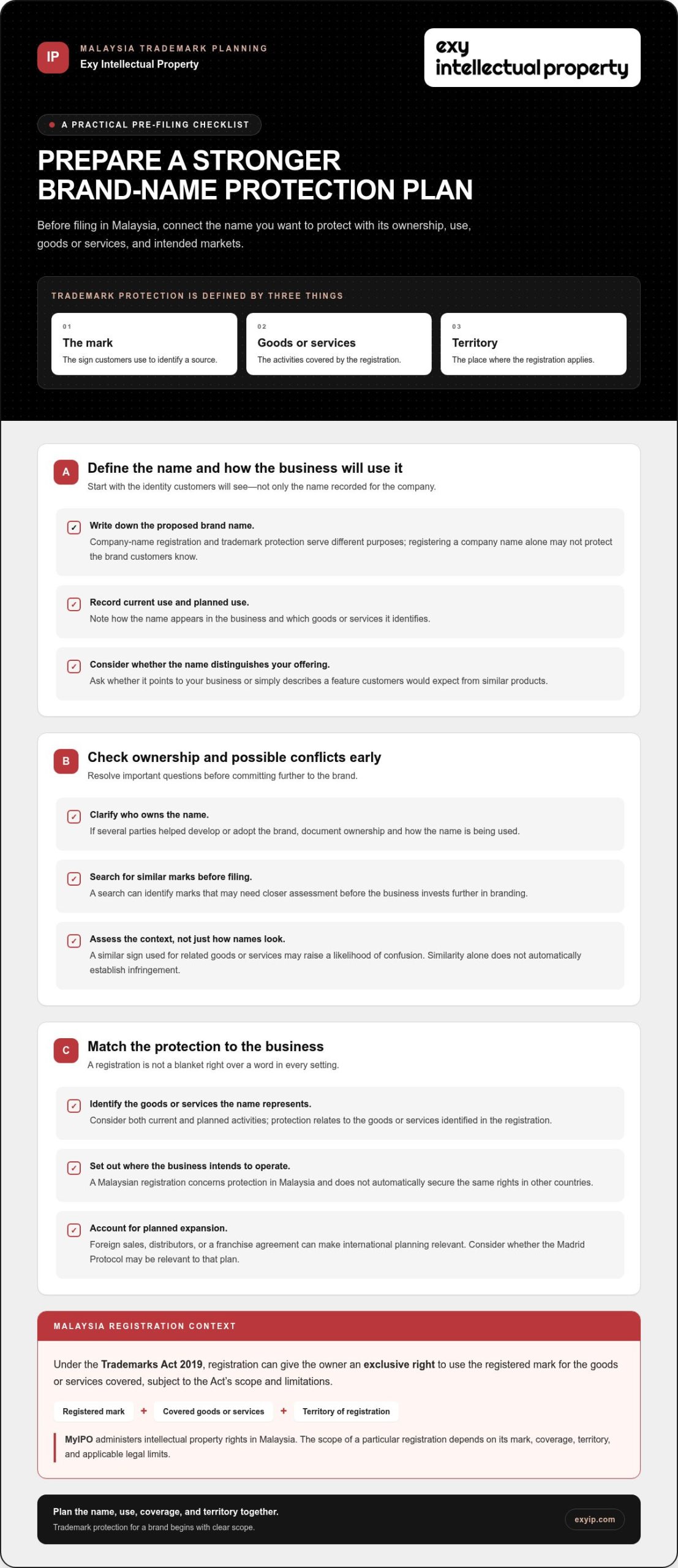
- Understand how a trademark’s protection depends on the mark, the goods or services covered, and the territory where it is registered.
- See what a trademark, company name, domain name, and copyright each identify or protect, so you can plan the right safeguards.
- Follow a practical sequence for preparing a trademark application, including checking for potentially conflicting marks before filing.
- Explore how trademark searches, registration, and international planning can support your wider business strategy.
How to Secure a Brand Name Legally: Start with What the Name Does
A memorable name can become one of a business’s most valuable identifiers. Customers may use it to recognise a product, recommend a service, or distinguish one business from another. But customer recognition and legal protection are different things. A name can be familiar to customers without its owner having registered trademark rights.
A trademark is a sign which distinguishes a business or its products from others. In Malaysia, protection under the Trademarks Act 2019 can give a registered owner an exclusive right to use the mark for the goods or services covered, subject to the law’s scope and limitations. It does not automatically give the owner control over every use of the same word in every context.
The name is only one part of the picture. A business choosing a name should consider whether it can distinguish its particular goods or services. A general overview of the trademark concept can help explain its role, but the specific protection available in Malaysia depends on the relevant legal rights and registration.
What makes a brand name a trademark?
A brand name functions as a trademark when it helps customers identify the source of goods or services. For example, a distinctive name on packaged food can help consumers tell one supplier’s products from another’s. Distinctiveness is a key consideration: ask whether the name points to your business or simply describes a feature customers would expect from similar products.
The commercial identity is the meaning and reputation customers attach to the name. Legal rights are separate: they depend on the applicable basis of protection and have a defined scope. Keeping that distinction clear helps prevent the assumption that using a name or building goodwill around it automatically provides registered protection.
Why protecting the name early matters
Early planning reduces the risk of committing to a name before considering its ownership, existing use, or potential conflicts. If several parties helped develop or adopt the brand, document who owns it and how it is being used. A search can help identify similar marks that need closer assessment before the business invests further in branding.
Plan around what the business offers and where it intends to operate. A name used for one type of service may need a different protection strategy from a name applied to products or a wider range of activities. You don’t need to be expanding nationally or internationally to start: record the name, current use, intended goods or services, and future markets to create a practical foundation for informed decisions.
What Legal Protection Can a Trademark Give a Brand Name in Malaysia?
A registered trademark can give a business a legal basis to control certain uses of its brand name. That protection is more specific than general recognition or reputation: it is tied to the registered mark, the goods or services covered, and the territory where the registration applies.
In Malaysia, registration under the Trademarks Act 2019 gives the owner an exclusive right to use the registered mark for the goods or services covered, subject to the Act’s scope and limitations. This is the legal distinction between building brand value and securing registered rights. Customer familiarity may support a brand’s commercial standing, but it does not define the reach of a registration.
The Intellectual Property Corporation of Malaysia (MyIPO) administers intellectual property rights in Malaysia. The International Trade Administration’s overview of Intellectual Property Protection in Malaysia also describes the country’s intellectual property framework. Use these references as a starting point, then assess how the law applies to the particular mark and business activity.
What does an exclusive right mean in practice?
An exclusive right gives the registered owner a legal basis to prevent unauthorised use of the mark within the protection granted. It is not a blanket right over a word in every setting. The goods or services, the sign used, and the circumstances all matter when assessing a potential conflict.
For example, if another trader adopts a similar name for related products, the question is not simply whether the names look alike. Malaysian trademark law addresses use of an identical or similar sign in relation to goods or services where it creates a likelihood of confusion. Whether that standard is met depends on the facts; similarity alone is not automatic proof of infringement.
How territory and business activity shape protection
Trademark rights are territorial. A Malaysian registration concerns protection in Malaysia; it does not automatically secure the same rights in every other country. A business planning to sell abroad, appoint distributors, or expand through a franchise agreement should factor those markets into its intellectual property strategy rather than assume domestic registration extends with the brand.
Protection also relates to the goods and services identified in the registration. For example, a name used for software should be considered in light of the business’s actual and planned activities, not just its current logo or website. Clear planning helps align protection with how the brand earns revenue and where it may grow.
For filing detail, the separate guide, “Trademark Registration in Malaysia: 2026 Strategic Guide,” can sit alongside this overview. If the mark’s scope or international plans need coordination, Exy Intellectual Property’s trademark advisory support can help connect registration planning with wider business goals.
Trademark vs. Company Name, Domain, and Copyright: What Secures Your Brand?
A business can register its name, secure a matching web address, and commission a logo, yet still need to consider trademark protection. Each step serves a different purpose. Treating them as interchangeable can leave a gap between the identity customers recognise and the rights the business holds.
| Item | What it generally identifies or protects | What it doesn’t automatically secure |
|---|---|---|
| Trademark | A sign that distinguishes a business or its goods or services, within the registration’s scope and territory. | Every use of the name, all goods and services, or rights in every country. |
| Company or business name | The registered entity or business name recorded through the Companies Commission of Malaysia (SSM). | Trademark rights in the name for particular goods or services. |
| Domain name | Control of a web address under the relevant domain registration arrangement. | Trademark ownership or a right to use the name without conflict. |
| Copyright | Qualifying original creative expression, such as artwork used in a logo. | Exclusive rights over a brand name merely because it appears in creative material. |
Does registering a company name protect the brand?
No. Company-name registration and trademark registration have different functions. SSM records company and business names; MyIPO administers trademark registration in Malaysia. A name accepted for company or business registration does not, by itself, grant the trademark rights associated with registration of a mark. Likewise, trademark registration does not register a company. Consider both processes for their separate purposes.
This distinction matters before investing in signs, packaging, advertising, or a new product range. A name’s appearance in a company record does not replace assessing whether it can be used and protected as a trademark for the relevant goods or services. Each record answers a different question.
Does owning a domain or logo protect the name?
A domain gives its registrant control of a web address under the applicable domain arrangements. It doesn’t establish trademark ownership, confirm that the name is available for use, or automatically prevent another business from registering or using a similar mark. A matching domain can support a consistent online presence, but it is only one part of brand planning.
A word mark concerns the name or words themselves; a logo mark concerns a particular visual presentation of a sign. They protect different aspects of a brand, so don’t assume that rights in a logo necessarily provide the same scope as rights in its wording.
Copyright is also distinct. It may protect qualifying creative expression, such as original artwork in a logo, but it should not be treated as protection for the brand name as a business identifier. When considering how to secure a brand name legally, treat the name, visual identity, company records, and online presence as related assets with separate legal roles.
How to Secure a Brand Name Legally in Malaysia: A Practical Sequence
A sound process starts before an application is filed. Organise the business decisions first, then check the legal and filing details against current Malaysian requirements. This sequence helps you gather the right information, investigate potential conflicts, and plan protection around the way the brand will be used.
- Record the brand and its use. Write down the exact name, spelling, spacing, and any word or logo versions the business plans to use. Note where it appears now, such as on products, packaging, service materials, or a website. Keep examples of current use together so the proposed mark is clear and consistent.
- Identify the intended owner. Decide which person or legal entity should own the mark, and record the reason for that decision. Clarifying ownership early can prevent confusion if a founder, company, or another party has helped develop or use the brand.
- Map the goods and services. Describe what the business offers under the name and what it reasonably plans to offer. These details help define the scope of an application. Malaysia’s trademark system allows applications covering goods and services in multiple classes, but check the appropriate classification and wording against current MyIPO practice.
- Search for relevant earlier marks. A trademark search can identify identical or similar marks that may be relevant to the proposed name and planned activities. Review results in context, including the mark itself and the goods or services involved. A search helps assess risk; it does not guarantee acceptance or prove that no conflict exists.
- Confirm the filing route and requirements. Once the name, owner, and intended scope are organised, review current filing procedures and requirements with the Intellectual Property Corporation of Malaysia (MyIPO). The application should reflect the mark and goods or services the business intends to protect. If accepted and published in the Intellectual Property Official Journal, an application may face opposition from a third party during the applicable opposition period.
- Plan separately for overseas markets. A Malaysian application does not automatically protect a mark elsewhere. Malaysia is a member of the Madrid Protocol, an international treaty governing trademark registration across multiple countries. Whether an international application is suitable depends on eligibility, the chosen territories, and the relevant filing requirements. The “Global Trademark Registration: Strategic Guide for 2026” can help frame that planning.
Turn preparation into a protection plan
Keep a concise record of the proposed mark, owner, current use, goods and services, search findings, and intended markets. This gives filing decisions a business context rather than treating registration as an isolated form. Exy Intellectual Property supports trademark searches and registration planning in Malaysia and internationally, connecting search findings with the business’s intended use of its brand. Explore Exy’s trademark search and registration support.
Build a Brand-Name Protection Strategy with Exy Intellectual Property
A trademark decision can shape how a business presents itself, enters new markets, and builds value over time. Professional support brings commercial aims together with the practical work of searching, filing, and planning protection. Exy Intellectual Property advises on trademark registration in Malaysia and globally, trademark searches, and intellectual property strategy, helping businesses assess their options while recognising that registration is not guaranteed.
What an advisory process can help organise
A useful planning discussion connects the proposed name with the business behind it. Identify the intended owner, how the name is being used, and the goods or services associated with it. These details give a trademark search and filing strategy a clearer commercial context, especially if the business plans to use different versions of a name or expand its offerings.
Search findings can inform whether to proceed with the proposed mark, consider an alternative, or assess a potential conflict more closely. A search helps clarify risk; it does not promise that an application will be accepted or that a third party will never object. Exy’s technical search support and intellectual property advisory help businesses interpret findings alongside their plans for brand use.
Registration is one part of a wider intellectual property strategy. A business may also need to consider how the name fits with its visual identity, product development, licensing plans, or future commercialization. Coordinating these decisions helps keep protection aligned with the way the business intends to grow, rather than treating an application as a stand-alone administrative task.
When to plan beyond Malaysian protection
Consider overseas planning when the business expects to sell products or services in other countries, appoint distributors, enter licensing arrangements, or build a presence in new markets. For entrepreneurs looking to establish an operational presence in international commercial hubs like Dubai and the UAE, corporate advisors such as advisorszone.ae handle business setup requirements, which should be coordinated with targeted brand protection. A Malaysian registration is territorial and doesn’t automatically extend protection abroad. Planning early helps the business identify which markets matter and how trademark protection fits its expansion priorities.
For eligible applicants, the Madrid Protocol may provide an international filing route. It does not create one worldwide trademark right. Eligibility, designated territories, and the requirements that apply to an application need careful assessment against current rules and business objectives. Exy supports global trademark registration planning so businesses can consider international protection in relation to their intended markets.
If you’re deciding how to secure a brand name legally, a structured review of ownership, use, search findings, and growth plans can clarify the next steps. Discuss brand-name protection with Exy Intellectual Property and plan a strategy suited to your business interests.
Make Brand Protection Part of Your Next Growth Decision
A brand strategy should keep pace with the business. New products, a change in ownership, a licensing opportunity, or plans to enter another market can all affect how a name is used and where protection may be relevant. Build a simple review into major business decisions: ask who owns the brand, how it will be used, and whether existing protection still fits the business’s direction.
This forward-looking approach makes how to secure a brand name legally an ongoing commercial consideration, not just a one-time filing question. It can also help founders and teams make consistent decisions before a new offer or partnership reaches customers.
If you’re preparing to launch, expand, or formalise a brand, plan your brand-name protection with Exy Intellectual Property. A considered strategy can help your business move ahead with greater clarity.
Frequently Asked Questions
Can I use ™ before my trademark is registered?
Yes, businesses commonly use ™ to signal that they are claiming a name or sign as a trademark, even before registration. The symbol doesn’t mean MyIPO has registered or approved it, and using it doesn’t establish that the mark is available or prevent others from challenging its use. For example, a business may place ™ beside a brand name on packaging while assessing its registration plans.
Can I use ® before my trademark is registered in Malaysia?
No. Use ® only after the specific mark has been registered in the relevant territory and for the relevant goods or services. An application that is still pending isn’t a registration. Using ® prematurely could give customers or business partners a mistaken impression of the mark’s status. Confirm the registration record and its scope before adding the symbol to labels, websites, or promotional material.
Can an individual own a trademark instead of a company?
Yes, an individual can generally be named as the owner of a trademark, rather than a company. Decide on the intended owner before filing, because ownership affects who controls the mark and may later grant permission for its use. For example, if a founder owns the mark personally but a company uses it, the parties should consider how that use is authorised and whether ownership should change as the business develops.
Can I protect a brand name that includes my personal name?
A personal name may form part of a proposed trademark, but including your name doesn’t guarantee registration. Assess the mark in context, including how it distinguishes the relevant goods or services and whether earlier rights could raise a conflict. A founder using a name such as “Aisha Rahman” for a product line should consider the full wording and intended use, rather than assume personal identity alone settles the question.
Should I use the same trademark application for my name and logo?
Decide based on how the brand will be used and which elements need to remain consistent if the visual design changes. If the business expects to refresh its logo but keep the same name, consider whether the wording needs protection in a form that stands independently of the artwork. Before filing, prepare the exact version of each sign the business intends to submit, then review how current application rules handle those representations.
Does trademark registration protect a brand name on every online platform?
No registration can ensure that every platform will automatically identify or remove a disputed account. If a user copies your brand identity, preserve dated screenshots, account names, messages, and examples of customer confusion. Then use the platform’s reporting process and provide clear evidence of your rights and legitimate account details. Keeping official brand profiles consistent can also help customers distinguish your business’s communications from unrelated accounts.
Can a foreign business apply to protect a brand name in Malaysia?
A foreign business can seek trademark protection in Malaysia. Before beginning, decide which legal entity will own the mark and use that owner’s details consistently in its records and application materials. This can be especially useful where a parent company, trading subsidiary, or distributor is involved. Changes in ownership or company structure may require additional planning, so consider how the chosen owner fits the business’s long-term arrangements.