


While global tech filings saw shifting momentum in early 2026 following major international fee restructurings, the core mandate for tech founders remains unchanged: claim your intellectual territory before competitors do. This statistic might suggest a cooling market, but for the proactive entrepreneur, it represents a clear opportunity to claim territory while others hesitate. You likely know the anxiety of watching a competitor’s product launch and wondering if they’ve borrowed your hard-earned logic. It’s a common fear. Confusion over filing costs and the mystery of processing timelines often keep brilliant innovations unprotected and vulnerable.
Success requires a shift in perspective. Reliable patent protection for tech companies is not just a legal hurdle; it’s a strategic engine for growth. This guide will help you master the essentials of securing your technological breakthroughs and building a defensible IP portfolio that attracts serious investors. We’ll clarify the patenting process, demonstrate how to use IP assets to secure funding, and provide a roadmap for expanding your protection across global markets. Your innovations deserve more than a hope for safety. They deserve a strategy that creates lasting commercial value.
Key Takeaways
- Transform intangible research and development into tangible corporate assets that provide a statutory right to market exclusivity.
- Identify whether your innovation meets the essential criteria of novelty and an inventive step before committing to the filing process.
- Evaluate the strategic benefits of patent protection for tech companies against trade secrets to determine the best long-term defense for your hardware or software.
- Utilize a methodical five-step roadmap, beginning with professional novelty searches and precise drafting, to secure the broadest possible claims.
- Integrate intellectual property valuation into your business strategy to build a defensible portfolio that enhances your standing during funding rounds.
What is Patent Protection for Tech Companies?
Exclusivity. Patent protection for tech companies is the legal foundation for technological market exclusivity. It’s a statutory right that grants your business the power to exclude others from making, using, or selling your technical invention for a limited period. This right isn’t just a defensive shield. It’s a proactive tool. By securing a patent, you transform intangible research and development into a tangible, tradable, and valuable corporate asset. Whether you’ve developed a new product, a unique process, or a technical improvement that offers a new solution to a problem, this legal framework ensures your innovation remains your own.
Protection covers specific technical solutions to complex problems. In a market where digital and hardware breakthroughs happen daily, having a clear legal claim is essential. It allows you to operate with the confidence that your core logic won’t be legally replicated by a competitor overnight. This security is what allows a company to move from the lab to the global marketplace with its intellectual integrity intact. It’s the difference between owning a market and simply participating in one.
The Strategic Value of a Patent Portfolio
Value creation. Building a robust portfolio is a primary requirement for attracting venture capital. Investors don’t just look for good ideas; they look for proof of innovation and a clear barrier to entry for competitors. A patent portfolio provides that proof. It signals market defensibility, ensuring that copycat products won’t easily erode your market share. Beyond protection, patents offer a clear pathway to licensing revenue. You can generate steady passive income by allowing others to use your technology under a formal agreement, turning your legal rights into a direct profit center.
Patents vs. Utility Innovations in Malaysia
Choosing the right path is vital for firms operating within the Malaysian legal framework. Standard Patents are the traditional route for major breakthroughs. They require novelty, an inventive step, and industrial applicability. Once granted, they provide 20 years of protection. This is the gold standard for complex tech where the solution is far from obvious to a person with ordinary skill in the field.
Utility Innovations offer a faster, more accessible alternative. Often called "petty patents," these only require novelty and industrial applicability. They don’t need to meet the high bar of an "inventive step." This makes them ideal for incremental developments or hardware refinements. When evaluating software patent eligibility or specific hardware tweaks, this path provides a practical way to secure your steady stream of improvements. The Intellectual Property Corporation of Malaysia (MyIPO) facilitates both paths under the Patents Act 1983, allowing founders to tailor their protection based on the degree of technical advancement.
Determining Patentability: What Tech Can Be Protected?
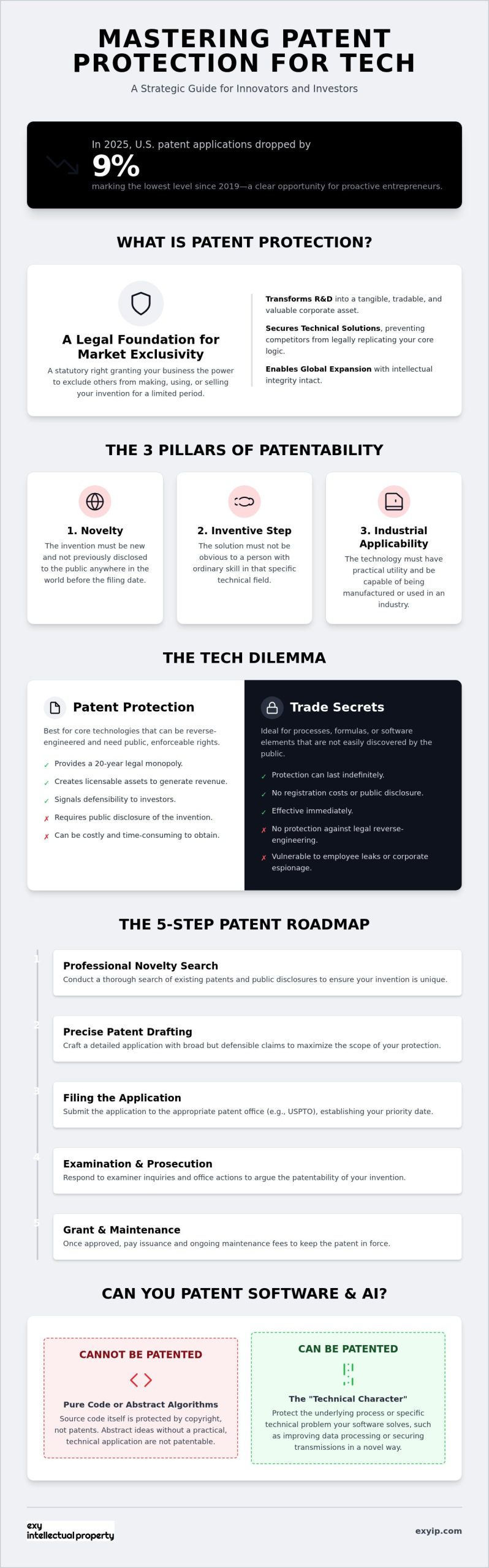
Securing robust patent protection for tech companies involves more than just filing paperwork; it requires a deep understanding of what the law considers an "invention." To qualify for a patent, your technology must meet three fundamental pillars: novelty, an inventive step, and industrial applicability. Organizations like the U.S. Patent and Trademark Office provide foundational resources on these requirements, which are mirrored in most global jurisdictions. If your tech doesn’t meet these benchmarks, it remains legally vulnerable.
Novelty is absolute. Your invention must not have been disclosed to the public anywhere in the world before your filing date. This includes white papers, conference presentations, or even social media teasers. The inventive step is equally critical. The solution you’ve developed must not be obvious to a person with ordinary skill in that specific technical field. Finally, industrial applicability ensures the technology has practical utility. It must be capable of being manufactured or used in an industry, moving it beyond the realm of abstract theory.
Can You Patent Software and AI?
Software patentability is a complex area that often confuses entrepreneurs. You cannot patent pure code, as that falls under copyright. Instead, patenting focuses on the "technical character" of the software. You’re protecting the underlying process or the specific technical problem your algorithm solves. If your AI improves image processing speeds or secures data transmission in a unique way, it’s likely patentable. Framing these innovations correctly is essential. Many firms find success by utilizing professional patent drafting services Malaysia to ensure their software is described as a technical solution rather than a mere business scheme.
Hardware and Industrial Design
Hardware protection often requires a multi-layered approach. While a standard patent protects the functional mechanics of a device, industrial design registration protects its aesthetic appearance. Distinguishing between these two is vital for a strong IP moat. For example, the internal cooling mechanism of a server might be a patentable invention, while the unique casing design is protected as an industrial design. Combining these protections prevents competitors from mimicking either your performance or your brand’s visual identity. Patent protection for tech companies is most effective when it covers every unique angle of the product.
It’s important to remember that some subjects remain non-patentable. Pure mathematical methods, business schemes, and discoveries of natural substances are generally excluded. However, for tech that doesn’t meet the high threshold of an "inventive step," Malaysia offers a vital alternative: the Utility Innovation. This pathway is faster and focuses solely on novelty and utility. A preliminary patent search can clarify your invention’s standing before you invest in a full application.
The Tech Dilemma: Patent Protection vs. Trade Secrets
Security. Choosing between transparency and secrecy is a pivotal decision for any innovation-led business. Patents provide a powerful, 20-year legal monopoly, but they come at a cost: full public disclosure. Once you file, your technical blueprints become public record. In contrast, trade secrets offer indefinite protection without any disclosure requirements. However, they provide zero legal recourse if a competitor independently discovers your technology or successfully replicates it. This lack of protection against independent discovery makes trade secrets a high-stakes gamble for many.
Clarity. Evaluating the risk of reverse engineering is the most critical step in this decision. If a competitor can buy your product, take it apart, and understand its logic, a trade secret is effectively useless. In these scenarios, patent protection for tech companies is the only viable way to maintain a market advantage. A "Business-Savvy Guardian" views these tools as complementary rather than mutually exclusive. You might patent the core hardware architecture while keeping the internal backend algorithms as trade secrets. Effective strategic IP management involves balancing these two methods to create a multi-layered defense for your brand.
When to Choose a Patent
Patents are essential when your technology is visible in the final product sold to consumers. If the "magic" of your device is accessible through physical or digital analysis, you need a legal shield to prevent clones. You also need patents to signal value to external stakeholders. Potential acquirers and venture capital firms view a granted patent as a verified, tradable asset that significantly de-risks their investment. It’s a clear marker of technical authority. Finally, choose this route when your tech involves a significant inventive step that is exceptionally hard for competitors to bypass without infringing on your specific legal claims.
When a Trade Secret Suffices
Secrecy. It’s often the superior choice for manufacturing processes kept entirely in-house. If your competitive edge lies in a proprietary assembly method or a unique backend data-processing routine, keeping it confidential avoids the 20-year expiration date of a patent. It’s also a practical choice for technology with a very short lifecycle. If your software will likely be obsolete in less than three years, the lengthy patent examination process might outlast the product’s relevance. In these cases, your defense relies on robust non-disclosure agreements (NDAs), segmented access to source code, and strict internal security protocols to prevent unauthorized leaks.
The 5-Step Patent Roadmap for Tech Companies
Methodical execution. A roadmap isn’t just a list of tasks; it’s a strategic sequence that de-risks your R&D investment. For leaders seeking patent protection for tech companies, understanding the chronological flow of filing is vital for managing budgets and expectations. This process moves from initial validation to long-term asset maintenance, ensuring your technical breakthroughs are legally anchored before they reach the public domain. Following a structured path prevents the common pitfalls that lead to rejected applications or narrow, unenforceable claims.
The journey to securing your intellectual property follows these five essential phases:
- Step 1: Conduct a comprehensive Patent Search to ensure your tech is truly unique before investing in a full application.
- Step 2: Professional Patent Drafting to define the scope of your legal claims with technical and legal precision.
- Step 3: Filing the application with the national patent office to secure your priority date and begin the formal protection process.
- Step 4: Examination and Prosecution, where you respond to technical queries and potential objections from patent examiners.
- Step 5: Grant and Maintenance, which involves the timely payment of annual fees to keep your patent in force for its full term.
Defending Against Post-Grant Opposition
In 2026, receiving a patent grant is no longer the final step in securing your monopoly. Under post-grant opposition rules enforced in key jurisdictions like Malaysia (Sections 55A/56A of the Patents (Amendment) Act 2022), third parties have a strict six-month window post-grant publication in the IP Official Journal to file an administrative opposition directly with the registrar. Ensuring your patent claims are drafted with multi-layered dependent claims during prosecution ensures your asset survives post-grant competitor attacks.
The Critical Role of the Novelty Search
Refining your invention starts with a thorough search. Many founders mistakenly view the search as a hurdle, but it’s actually a strategic tool that saves thousands in failed filings. Searching before you file prevents you from infringing on existing patents and helps you identify "prior art," which includes any evidence that your invention is already known. By analyzing these search reports, you can refine your technical claims to be more robust. This proactive step strengthens your application, making it much harder for competitors to challenge your novelty during the examination phase.
Going Global: The PCT Pathway
Global expansion requires a structured approach to intellectual property. If your market extends beyond Malaysia, the Patent Cooperation Treaty (PCT) is the gold standard for international growth. It allows you to seek protection in over 150 countries simultaneously through a single filing. This pathway offers a significant "Priority Date" advantage, securing your spot in the global queue while you evaluate market demand. Managing costs becomes easier because the PCT allows you to delay expensive national phase entries for up to 30 months, giving you the time needed to prove your commercial concept before committing to heavy international fees.
Securing your innovation requires expert precision. You can begin by reviewing our strategic patent search guide to ensure your technology is ready for the global stage.
Maximizing Tech Value through Strategic IP Management
Asset management. A patent is far more than a legal certificate; it’s a versatile financial engine. For many founders, patent protection for tech companies is the primary driver of their total market value. Once granted, these rights transform into tradable instruments that dictate your company’s trajectory. You must evaluate the most effective commercialization path for your specific goals. Manufacturing the tech yourself allows for total control over the user experience. Alternatively, licensing the rights to established industry players can generate immediate, low-risk passive income. In some cases, selling the patent rights entirely provides the liquidity needed to fuel your next innovation.
Vigilance. A patent only retains its value if you’re willing to defend it. Proactive enforcement involves monitoring the market for potential infringers who might be encroaching on your technical territory. This isn’t just about litigation; it’s about maintaining the integrity of your monopoly. When you identify and address unauthorized use, you preserve the scarcity of your solution. This steady, supportive approach to market monitoring ensures that your IP remains a high-value barrier to entry for years to come. It’s a sense of responsibility toward the long-term health of your venture.
Patent Valuation for Tech Startups
Value. It’s the language of the modern investor. For startups, patent assets significantly impact the balance sheet and can even enhance borrowing capacity. During intense funding rounds, regular Intellectual Property Valuation provides the objective data needed to justify higher valuations. It’s a critical asset during M&A negotiations or when seeking Series A and B funding. Professional investors often pay a premium for companies with a robust, verified IP portfolio because it directly correlates with higher exit multiples. By quantifying the future economic benefit of your breakthroughs, you transition from a position of speculation to one of hard financial evidence.
Partnering with Exy Intellectual Property
Guidance. Exy Intellectual Property acts as your "Business-Savvy Guardian." We prioritize your professional interests by aligning every legal filing with your commercial objectives. Our team offers the specialized technical expertise necessary for complex patent drafting and global filing strategies. We move beyond the traditional role of a service provider to help you unlock the economic power of your tech through IP financing and valuation services. We don’t just secure your rights; we help you turn patent protection for tech companies into a scalable business asset. This partnership ensures your innovations aren’t just legally sound, but strategically positioned for maximum growth.
Securing a Competitive Advantage for Your Tech
Your innovation represents years of dedicated research and a bold vision for the future. Establishing robust patent protection for tech companies is the most effective way to transform that vision into a tangible, high-value corporate asset. By navigating the strategic roadmap from initial novelty searches to global filing, you move beyond simple technical development and into a position of market leadership. A well-managed portfolio does more than just shield your ideas; it actively attracts venture capital and provides the legal foundation necessary for international expansion.
Success in the fast-paced technology sector requires a proactive advisor who understands the intersection of law and business. It’s not just about filing papers; it’s about building long-term value. Whether you need specialized Patent Novelty Search expertise or a comprehensive IP Valuation for your tech assets, professional support ensures your interests are in capable hands. Our global filing support through the PCT network provides the infrastructure you need to scale across borders with confidence. Secure your innovation with Exy IP’s expert patent services today. Your breakthroughs are the lifeblood of your venture. Give them the protection they deserve to thrive as you build your legacy.
Frequently Asked Questions
How long does it take to get a patent for a tech product in Malaysia?
Standard substantive examination typically takes 24 to 36 months. However, tech companies can significantly compress this timeline to under 12 months by leveraging Patent Prosecution Highway (PPH) pilot programs. MyIPO maintains active PPH work-sharing agreements with foreign partners like the USPTO, JPO, EPO, and IPOS. If corresponding claims are allowed by a partner office, MyIPO re-uses that examination work to fast-track your grant.
Can I patent an app idea or just the software code?
You cannot patent a bare idea or a pure business scheme. Patenting focuses on the technical solution your application provides to a specific problem. While copyright protects the literal software code, a patent protects the underlying technical process or algorithm. For successful patent protection for tech companies, the app must demonstrate a technical character, such as improving data security or optimizing hardware performance, rather than just automating a manual task.
How much does it cost to protect a patent globally?
Global protection costs vary significantly based on the number of target jurisdictions and the complexity of the technical claims. Filing through the Patent Cooperation Treaty (PCT) allows you to delay heavy national phase fees for up to 30 months. This strategic approach gives your business time to validate market demand before committing to translation and local attorney fees in multiple countries. Balancing these expenses is a core part of a long-term commercialization strategy.
What happens if someone infringes on my tech patent?
If infringement occurs, you have the legal right to take enforcement action to stop the unauthorized use. This process typically begins with a formal cease and desist letter supported by evidence of the violation. If the matter remains unresolved, you can pursue intellectual property litigation to seek an injunction and monetary damages. Monitoring the market for potential infringers is essential to maintaining the integrity and value of your exclusive market monopoly.
Is a patent search really necessary before I file?
A comprehensive novelty search is an absolute necessity before you invest in a formal application. It identifies existing prior art that could block your grant or lead to an expensive infringement suit later. By conducting this search early, you can refine your technical claims to be more robust and unique. This proactive step saves significant time and capital by ensuring you don’t pursue patent protection for tech companies for an invention that is already public.
Can I get a patent if I have already launched my product?
Launching your product before filing generally destroys the novelty required for a patent grant. Most jurisdictions follow a strict novelty rule, meaning any public disclosure makes the tech unpatentable. While some countries, including Malaysia, offer a limited grace period for specific types of disclosure, it’s a risky strategy for global protection. It’s always safer to secure your priority date with a filing before any public demonstration or commercial sale occurs.
What is the difference between a patent and a utility innovation?
The primary difference lies in the requirement for an inventive step. A standard patent requires your tech to be novel, useful, and non-obvious to an expert in the field. A utility innovation, often used for incremental improvements, only requires novelty and utility. While utility innovations offer a shorter protection term, they are often faster to obtain. This makes them a practical choice for hardware refinements or software updates that don’t meet the high non-obviousness threshold.
How do investors evaluate a tech company’s patent portfolio?
Investors view a patent portfolio as a verified, tradable asset that de-risks their investment. They evaluate the breadth of your claims, the strength of your freedom to operate in key markets, and how well your IP aligns with your revenue model. A strong portfolio signals technical authority and creates a high barrier to entry for competitors. During funding rounds, professional IP valuation provides the objective data needed to justify higher exit multiples and better terms.