


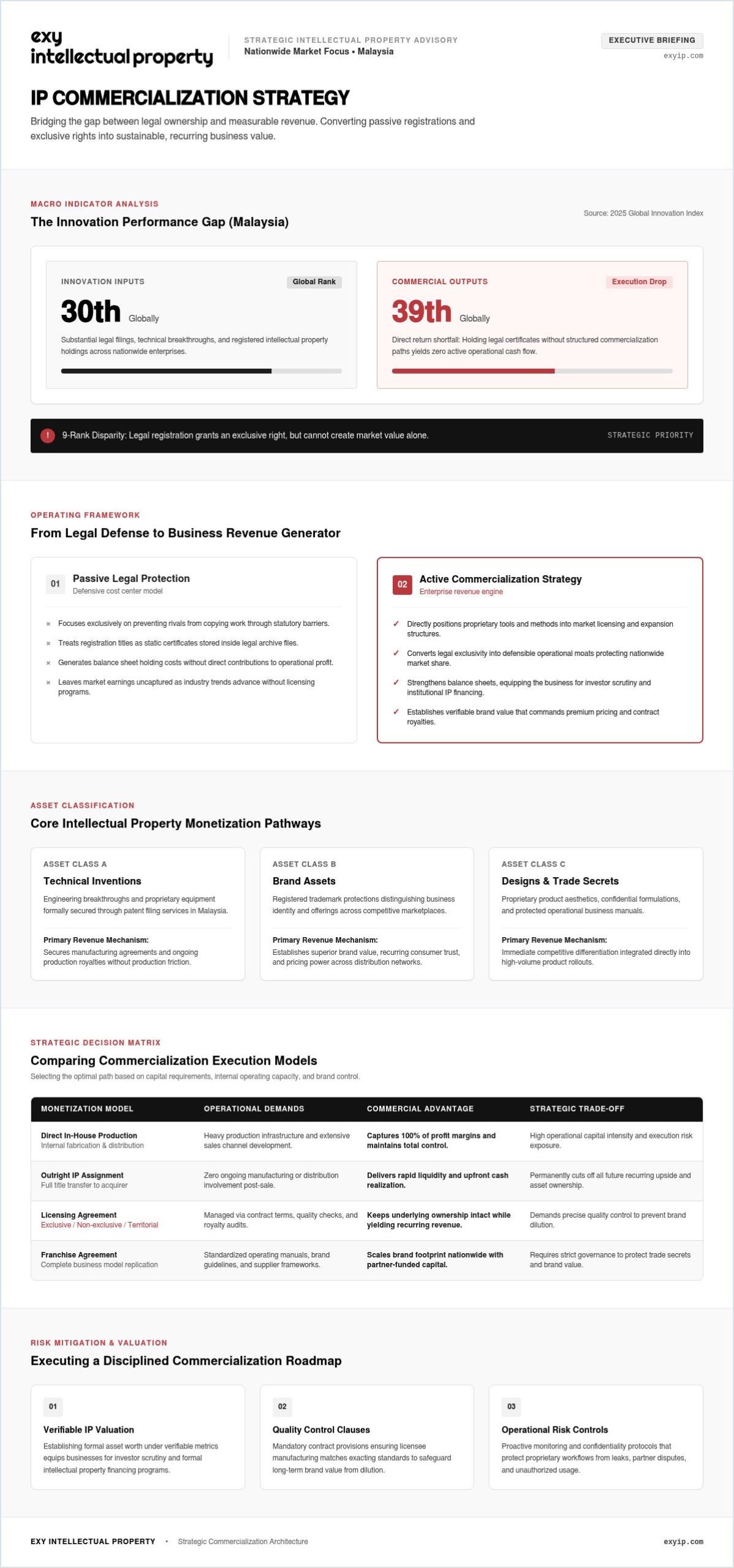
Malaysia ranked 30th globally for innovation inputs in the 2025 Global Innovation Index, yet slipped to 39th for tangible commercial outputs. That gap captures a familiar executive frustration: holding registered intellectual property that generates zero direct return. Securing registration grants an exclusive right, but a legal certificate alone does not build enterprise value. Moving from defensive legal protection to recurring market cash flow demands a clear, disciplined IP commercialization strategy.
You already know the friction points. It’s difficult to determine whether to license protected technology to industry partners, scale through a franchise agreement, or position assets for institutional IP financing. That hesitation often comes with legitimate concerns about trade secret leaks, contractual disputes, and underestimating your real brand value. This guide provides a structured roadmap to turn protected assets into reliable revenue streams through practical licensing models, sound expansion planning, and defensible asset valuation. Here is how you can bridge legal ownership and commercial profitability in 2026.
Key Takeaways
- A structured IP commercialization strategy bridges the gap between registered titles and measurable revenue, converting passive legal protections into active business drivers.
- Choosing between direct production, licensing agreements, or a franchise agreement depends on your operational capacity, desired brand control, and capital requirements.
- Formal intellectual property valuation establishes verifiable asset worth, equipping your business for investor scrutiny and intellectual property financing programs.
- A disciplined execution roadmap ensures proprietary assets align directly with market demand before committing deployment capital.
- Proactive risk controls and monitoring protect proprietary workflows from operational leaks, brand dilution, and partner disputes across commercial networks.
What Is an IP Commercialization Strategy?
Commercialization brings intellectual property to the market to generate measurable business returns. A formal registration gives you an exclusive right, which stops rivals from copying your work. That protection is essential, but it won’t produce cash on its own. An IP commercialization strategy is a structured roadmap for extracting financial value from protected intangible assets. Rather than treating titles as static certificates stored in legal files, this discipline focuses on turning legal ownership into operational revenue.
Passive protection focuses only on defense. Active commercialization focuses on market exploitation. In expanding markets across Malaysia, resting on defensive rights leaves potential earnings untapped. Bridging this gap often involves partnering with external specialists or an intellectual property broker to identify viable pathways for monetizing proprietary tools, brand equities, or proprietary methods before market trends shift.
From Legal Defense to Business Revenue Generator
Shifting your corporate perspective from viewing legal filings as simple overhead to seeing them as revenue engines changes how you allocate capital. Strong intangible assets reinforce balance sheets, which gives businesses measurable leverage during capital raises. When you can demonstrate legally secured market exclusivity, institutional investors view your projections with far greater confidence. Registered rights build defensible operational moats, protecting your nationwide market share from encroachment.
Core Types of Intellectual Property Ready for the Market
Different classes of intellectual property require different commercial monetization paths:
- Technical inventions: Securing engineering breakthroughs through formal patent filing services Malaysia allows companies to enter lucrative manufacturing agreements or collect production royalties without operational friction.
- Brand assets: A registered trademark distinguishes your company in crowded marketplaces, allowing you to establish superior brand value, secure recurring consumer trust, and command premium pricing.
- Industrial designs and trade secrets: Proprietary product aesthetics and confidential operational formulas can be integrated into high-volume product rollouts, creating instant differentiation that competitors cannot legally match.
Aligning these assets under a single IP commercialization strategy ensures your innovations deliver sustainable commercial returns instead of remaining idle legal assets.
Strategic Pathways to Commercialize Your Intellectual Assets
Every commercial journey is unique. Selecting the right monetization pathway depends on your access to capital, internal operating capabilities, and the degree of control you want to retain over your intellectual assets. While direct manufacturing captures full profit margins, it demands heavy production infrastructure and extensive sales channels. An outright IP assignment offers fast liquidity by selling all title rights, but it permanently cuts off future recurring upside. For most scaling enterprises, collaborative structures strike the ideal balance between low overhead and lasting revenue within a forward-thinking IP commercialization strategy.
Structuring Profitable Intellectual Property Licensing Agreements
A formal license grants targeted permission to an external partner while keeping your underlying ownership intact. You can tailor these contracts around exclusive, non-exclusive, or sole territorial rights depending on your market goals. Royalty models should reflect commercial realities, whether calculated as a percentage of net sales revenue or as a fixed fee per unit produced. Precise quality control clauses are mandatory; they protect your long-term brand value by ensuring third-party production never compromises the customer experience or dilutes your market reputation.
Scaling Operations Through Franchising Consultancy
Replicating a proven business model requires a synchronized legal package. Unlike standalone licensing, a franchise agreement grants the operator permission to adopt your complete operational ecosystem, from registered marks to supplier frameworks. Engaging professional franchise consultancy Malaysia ensures your business manuals, trade secrets, and compliance standards align nationwide. Rigorous legal governance across every franchisee safeguards service consistency, protecting your commercial standing as the footprint grows.
Statutory Registration under the Franchise Act 1998
Before executing a franchise agreement in Malaysia, franchisors must register the franchise system with the Registrar of Franchises via the MyFOP portal under the Franchise Act 1998. A prerequisite for this registration is holding a granted or pending trademark registration with MyIPO for the brand identity. Operating an unregistered franchise network exposes franchisors to severe statutory penalties and renders franchise agreements unenforceable.
Joint Ventures and Direct Commercial Exploitation
Strategic alliances bridge production gaps. Entering a joint venture allows you to contribute intellectual assets as equity while your partner supplies manufacturing plants or existing retail distribution networks. Because these collaborations require sharing proprietary know-how, tight non-disclosure terms and clear operational boundaries are non-negotiable from the initial meeting. If you are exploring how to monetize your portfolio through structured licensing agreements or commercial ventures, speaking with the specialists at exyip.com can help clarify the safest, most profitable structure for your operating goals.
Valuation and Financial Readiness for IP Transactions
Negotiating commercial deals without an independent appraisal is a major business gamble. If you don’t know the exact fiscal worth of your proprietary assets, you risk signing away lucrative licensing rights or divesting technology far below market value. Beyond private dealmaking, financial institutions require standardized, defensible methodologies before they approve growth capital against intangible assets. A practical IP commercialization strategy treats financial readiness as a foundational requirement, ensuring your balance sheet reflects your true commercial power.
Documenting realistic revenue generation helps satisfy corporate acquirers and institutional lenders alike. Knowing the exact framework used in an intellectual property valuation methodology gives management teams the numbers they need to negotiate from strength during major commercial transactions.
Standard Intellectual Property Valuation Methodologies
Professional valuation specialists rely on three primary financial techniques:
- The Income Approach: This model projects future economic earnings generated by the asset over its remaining legal lifespan, discounting those cash flows back to present value. It’s the preferred route for established software, patented machinery, and branded retail lines with steady sales histories.
- The Market Approach: This technique estimates asset value by benchmarking against recent transactions, licenses, or sales involving comparable intangible properties in your industry.
- The Cost Approach: This baseline calculation tallies the historic expenses required to recreate or replace the asset from scratch, including research, testing, prototype development, and legal registration fees.
Compliance with IVS 210 Standards
To ensure an IP valuation report is accepted by institutional credit committees (such as MIDF) or Big 4 audit teams during M&A due diligence, the assessment must adhere to International Valuation Standards (IVS 210 for Intangible Assets). Compliance with IVS 210 ensures that income-based models (such as Relief-from-Royalty or Discounted Cash Flow), risk-adjusted discount rates (WACC plus technological obsolescence factors), and Tax Amortization Benefits (TAB) meet strict regulatory scrutiny.
Using Protected Assets for Intellectual Property Financing
Intangible assets are no longer just legal shields; they are viable borrowing collateral. Across Malaysia, initiatives like the joint WIPO-MIDF pilot program, funded by SME Corp, have made intellectual property financing a tangible reality by allowing enterprises to pledge granted patents and registered trademarks for commercial expansion debt.
Securing debt or attracting institutional private equity requires clean records. Lenders won’t approve financing if chain-of-title records show administrative gaps or disputed rights. Maintaining audit-ready filings across domestic offices and international registries under the Madrid Protocol proves unquestioned ownership, giving underwriting teams the structural security they need to release capital under your IP commercialization strategy.
Step-by-Step Roadmap to Build Your Commercialization Plan
Bringing intangible assets to market requires a disciplined sequence rather than improvised deals. A practical commercialization plan aligns proprietary assets with validated market demand. Skipping early diligence often results in costly disputes, regulatory delays, or wasted capital expenditure. Executing a structured IP commercialization strategy ensures your internal innovations translate into durable market advantages.
Moving from internal research to scalable commercial operations follows three distinct, practical phases.
Phase 1: Internal IP Audit and Chain of Title Verification
Clean title is the absolute starting point. Catalogue every patent, registered trademark, industrial design, and proprietary trade secret across your business. Review historical vendor agreements and employment contracts to confirm every invention or branding element has been properly assigned to the company. Identify and prune inactive or low-value registrations that consume annual maintenance fees without supporting current business goals.
Phase 2: Market Assessment and Competitive Landscaping
Confirming freedom to operate protects your rollout before committing capital. Study rival filings to identify open market niches and ensure your proposed product lines avoid infringing on active third-party rights. When evaluating branding, verify your trade dress and names create no likelihood of confusion with existing market players. Map potential commercial partners who already own established distribution channels and actively need your proprietary solutions to solve manufacturing bottlenecks.
Phase 3: Deal Structuring and Partner Negotiations
Establish strict operational guardrails during transaction discussions:
- Commercial floors: Set defined baseline expectations, including minimum annual royalty payments, upfront milestone triggers, and audit rights.
- Performance requirements: Insert clear development milestones to prevent a licensee from deliberately shelving your technology to protect their legacy products.
- Defensible contracts: Detail precise termination rights and intellectual property return protocols if commercial volume targets are missed.
Bridging the distance between raw innovation and profitable deployment requires specialist commercial guidance. Partner with Exy IP to structure your commercialization strategy, safeguard your corporate ownership, and secure measurable returns on your intellectual assets.
Managing Commercial Risks and Safeguarding Market Exclusivity
Every commercial collaboration carries exposure. Bringing external partners into your business model inevitably reveals proprietary trade secrets, internal formulations, and specialized production know-how to third-party teams. Without tight contractual governance, unmonitored partner distribution can quickly cause counterfeiting, brand erosion, or gray-market leaks. Maintaining market exclusivity requires continuous operational vigilance alongside formal registration.
Sustainable commercial expansion depends on a balanced IP stance. Being overly restrictive blocks valuable distribution partnerships. Conversely, being too lenient invites competitor infringement. A sound IP commercialization strategy establishes clear boundaries that protect foundational assets while giving trusted operating partners the commercial room they need to scale successfully.
Preventing Infringement and Contractual Default
Dispute prevention starts with unambiguous, enforceable contract drafting. Strong partnership agreements contain explicit audit provisions granting your business the right to inspect external sales records, manufacturing tallies, and facility conditions without advance notice. When scaling outside domestic borders, securing international registrations via treaties like the Madrid Protocol prevents regional partners from claiming your trademark in export destinations. Make sure every contract defines specific financial remedies for late royalty reporting alongside swift termination triggers for quality shortfalls.
Staying vigilant against digital threats is just as vital. In Malaysia, brand owners must use official platforms like the Integrated Enforcement Management System (IEMS 2.0) to register assets and lodge commercial infringement complaints efficiently.
Partnering with Dedicated Strategic IP Advisors
Long-term protection demands specialized support. Working with advisors who integrate commercial literacy with formal legal advisory gives leadership teams a major strategic advantage:
- Customized agreements: Generic boilerplate templates leave gaps around technical improvement ownership, reverse-engineering bans, and cross-territorial sublicensing rights.
- Pre-deal risk assessments: Professional advisors evaluate portfolio vulnerabilities before you show confidential documents or enter term negotiations with corporate prospects.
- Enforcement coordination: Having dedicated commercial counsel ensures swift escalation if a partner breaches exclusivity, preventing lengthy disputes from damaging overall brand value.
Commercializing proprietary assets is an ongoing journey of strategic alignment. By combining proactive risk controls with professional commercialization strategy, your business retains complete market dominance while extracting maximum financial return from its intellectual assets.
Transform Your Intangible Assets into Scalable Commercial Engines
Legal ownership is only the first step. True enterprise resilience comes from converting registered titles into active, scalable cash flows. Whether your growth path relies on structuring targeted licensing agreements, expanding through a disciplined franchise agreement, or securing debt via intellectual property financing, long-term success requires deliberate financial preparation. Defensible valuation and structured commercial contracts protect your proprietary advantages while keeping your brand value intact across competitive markets.
Executing an effective IP commercialization strategy bridges the gap between statutory rights and balance sheet strength. As a dedicated nationwide Malaysian advisory firm, Exy IP provides the end-to-end support your enterprise needs to thrive. From professional valuation to complete franchising and licensing advisory, our specialists ensure your proprietary innovations are safeguarded and monetized for sustainable profitability.
Partner with Exy IP to design your commercialization strategy today, and turn your protected assets into enduring business growth.
Frequently Asked Questions
What is the difference between IP monetization and IP commercialization?
IP commercialization is the broader strategic process of bringing intellectual creations to market through direct production, partnerships, or business models. Monetization specifically refers to the financial extraction phase, converting those deployed rights into cash flow through royalties, outright sales, or licensing fees. Commercialization establishes market adoption, while monetization captures the resulting monetary yield. A complete IP commercialization strategy coordinates both elements seamlessly.
Can a business commercialize intellectual property before a patent is granted?
Yes, companies routinely commercialize pending inventions by marketing them under "patent pending" status or via trade secret protections. Operating before formal grant requires strict non-disclosure agreements during all partnership discussions. Because a pending application doesn’t provide an enforceable exclusive right until grant, commercial contracts usually include contingent royalty adjustments. These clauses adjust financial compensation depending on whether the patent successfully passes examination.
How do I choose between licensing my innovation and manufacturing it directly?
Direct manufacturing suits companies with existing capital, supply chains, and distribution capacity who want to retain 100% of their operational margins. Conversely, licensing agreements suit businesses aiming to scale rapidly without committing capital to production facilities, warehousing, or retail logistics. If your enterprise excels at research and design rather than factory floor operations, granting a license allows an established market player to handle manufacturing while paying you predictable royalties.
What factors determine the royalty rate in an IP licensing agreement?
Royalty rates depend on industry benchmarks, commercial readiness, profit margins, and the scope of rights granted. An exclusive license across an entire country commands higher rates than a non-exclusive grant covering limited territories. Other critical factors include the remaining statutory life of the intellectual property, existing competitor alternatives, and whether the licensee must invest substantial capital to build manufacturing tooling or marketing infrastructure.
How does an intellectual property valuation support business financing?
A formal intellectual property valuation translates technical and brand intangibles into audited financial figures that underwriters recognize. Commercial banks and institutional lenders cannot accept proprietary assets as borrowing collateral without an objective monetary appraisal. Providing a recognized appraisal demonstrates verifiable balance sheet strength. This validation proves debt service capability, which is necessary to secure loan approvals under emerging intellectual property financing initiatives nationwide.
What is the biggest risk when entering a commercial IP partnership?
Uncontrolled operational disclosure is the primary danger when collaborating with external commercial partners. Sharing proprietary workflows or trade secrets without restrictive contractual boundaries invites leaks, unauthorized copying, or direct competition once agreements expire. To protect your market position, every IP commercialization strategy should incorporate strict operational audits, tightly defined field-of-use clauses, and explicit ownership rules regarding improvements developed during the partnership.
Why is a formal trademark registration necessary before franchising a brand?
Franchising fundamentally revolves around licensing a distinctive brand identity alongside an operating method. Without registered trademark status, your business cannot grant a defensible exclusive right to franchisees, leaving your network vulnerable to copycats. In Malaysia, franchise authorities and prospective franchisees require proof of registered ownership before approving a franchise agreement, ensuring the underlying brand value remains legally enforceable across all operating locations.