


Automatic legal protection can be an expensive illusion for a growing business. Under Malaysia’s Copyright Act 1987, original creative works receive statutory recognition the moment they are recorded in writing or digital storage. You likely assume that this automatic right is sufficient to safeguard your proprietary software code, technical diagrams, and commercial media. Yet when commercial disputes flare up, relying on unrecorded assumptions often triggers costly conflicts over asset ownership, particularly when independent contractors or former personnel claim rights to your intellectual property.
You shouldn’t have to guess whether your commercial creations are legally secure. In this guide, you will understand how the Copyright Act 1987 safeguards creative assets, commercial works, and software across Malaysia. We examine how statutory categories operate, how filing a copyright voluntary notification establishes an indisputable evidentiary paper trail, and how clear contracts defend your exclusive rights and commercial brand value.
Key Takeaways
- Understand which categories of commercial works and software qualify for automatic protection under the Copyright Act 1987 once fixed in material form.
- Discover why securing official documentation through MyIPO copyright voluntary notification turns informal ownership claims into prima facie legal evidence.
- Learn the boundaries of your exclusive rights across reproduction, public distribution, and commercial adaptation to protect against unauthorized exploitation.
- Recognize primary and secondary infringement triggers early to enforce statutory remedies and stop illicit commercial dealing swiftly.
- Structure strategic licensing agreements to expand market presence and strengthen corporate brand value without losing control of core assets.
What Is the Copyright Act 1987 and What Does It Protect?
Every commercial venture relies on original creations. Enacted as the primary statutory framework nationwide, the Copyright Act 1987 (Malaysia) governs how these operational assets gain legal recognition and enforcement against unauthorized use. The statute does not protect bare concepts, strategic plans, or business models floating in conversation. Instead, protection demands that an author originates an idea and fixes it into a tangible, material medium.
Clarity drives value. To establish enforceable rights, a business creation must fall within designated statutory classes while satisfying basic evidentiary thresholds under the copyright act 1987.
Statutory Categories of Eligible Works
Malaysian law defines explicit boundaries for protectable creations across commerce:
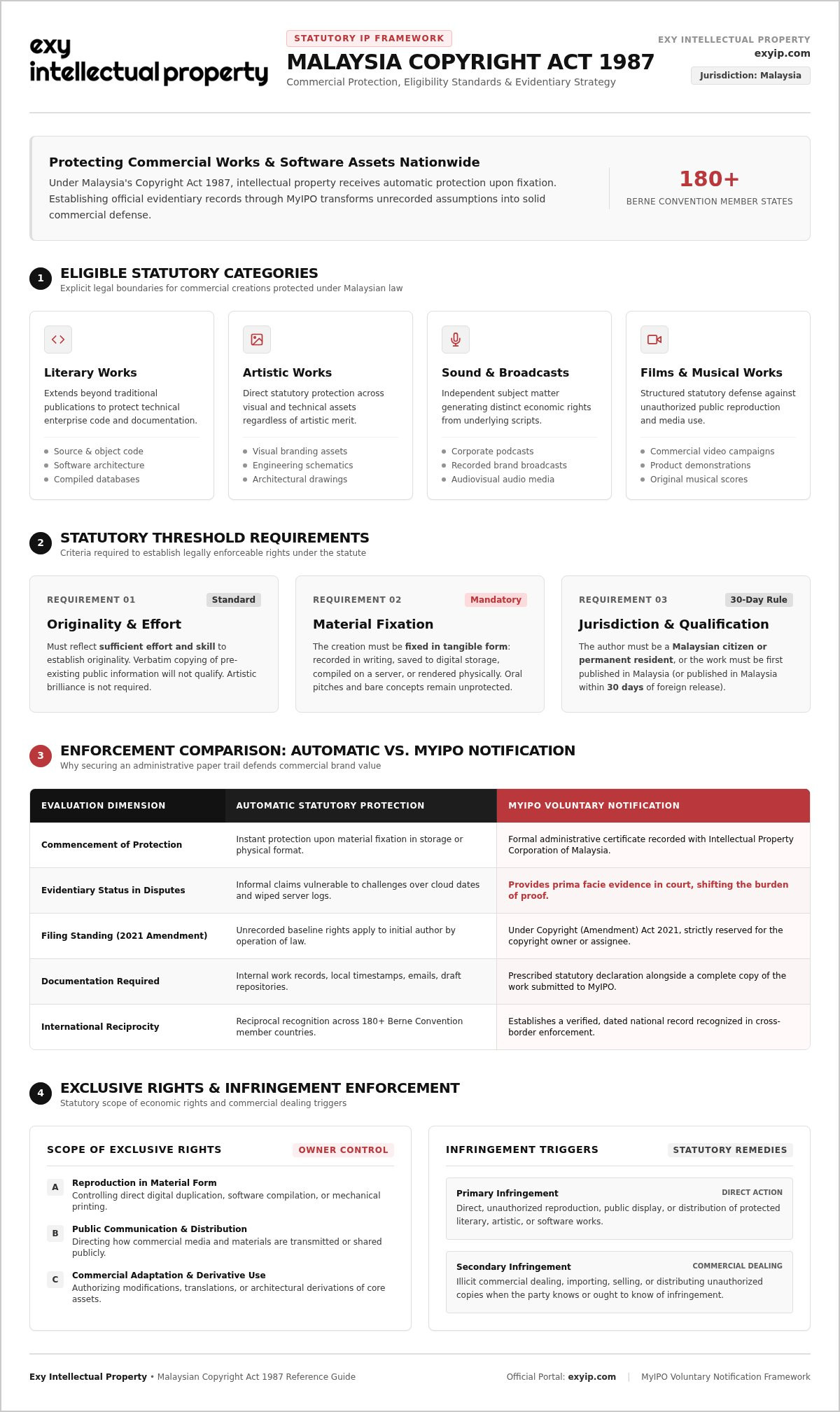
- Literary works: This category extends far beyond traditional publications to protect proprietary source code, object code, software architecture, technical manuals, and compiled business databases.
- Artistic works: Visual branding materials, architectural drawings, technical engineering schematics, logos, and promotional graphic layouts receive direct statutory coverage regardless of artistic merit.
- Sound recordings and broadcasts: Corporate multimedia, podcasts, recorded brand broadcasts, and promotional audiovisual files qualify as independent subject matter, creating distinct economic rights separate from any underlying script or musical composition.
- Films and musical works: Commercial video campaigns, product demonstrations, and original musical scores receive structured statutory defense against unauthorized public reproduction.
Threshold Requirements for Legal Protection
Protection requires effort. A work does not need to show artistic brilliance, but it must reflect sufficient effort and skill to establish originality under statutory interpretation. Mere verbatim copying of pre-existing public information will not qualify.
Fixation remains non-negotiable. An asset must be recorded in writing, saved to digital storage media, compiled onto a server, or rendered into a tangible physical state. Oral pitches or unrecorded ideas remain outside statutory cover.
Jurisdiction matters as well. The statute requires that the author be a qualified person, such as a Malaysian citizen or permanent resident, at the time of creation. Alternatively, works first published in Malaysia, or published here within 30 days of initial foreign release, secure nationwide protection automatically under statutory provisions.
Automatic Protection vs. Copyright Voluntary Notification at MyIPO
Ownership without proof invites unnecessary conflict. Under the copyright act 1987, original material automatically gains statutory rights the instant it is recorded. No mandatory registration exists to activate these basic protections. Even so, relying purely on this unrecorded status leaves expanding companies vulnerable when legal disputes arise. Proving who drafted software architecture, authored marketing graphics, or finalized product blueprints requires undeniable evidence, not informal assertions.
The Intellectual Property Corporation of Malaysia (MyIPO) resolves this vulnerability by administering an official documentation framework. Submitting your assets establishes an authoritative paper trail that transforms ambiguous claims into concrete corporate security.
How Automatic Protection Functions in Practice
Malaysia’s adherence to the Berne Convention ensures reciprocal recognition across more than 180 signatory countries. Your eligible assets enjoy nationwide cover immediately upon creation without paying government grant fees or awaiting formal gazetting.
Enforcement, however, demands clear evidence. In legal conflicts, relying on local hard drive dates, internal emails, or basic cloud timestamps exposes your business to aggressive counterclaims. Digital records can be altered, server logs get wiped, and former team members can challenge the precise creation timeline. Establishing that your enterprise authored the asset first quickly turns into an uphill battle without independent administrative verification.
The Strategic Role of MyIPO Voluntary Notification
Official recordal changes the dynamics of enforcement. Under Section 26A of the Copyright Act 1987 (as amended by the Copyright (Amendment) Act 2022), the right to apply for voluntary notification rests strictly with the copyright owner or their assignee. By submitting the prescribed notification forms and depositing a complete copy of the work directly with MyIPO (without needing a separate statutory declaration), you generate an official certificate that serves as prima facie evidence of ownership in court.
This filing provides several strategic advantages for growing enterprises:
- Shifted evidentiary burden: Presenting an official MyIPO certificate places the burden of disproving your title directly onto the competing party.
- Defensible asset valuation: Formal administrative records substantiate corporate balance sheets, giving prospective investors and lenders confidence during financing reviews.
- Streamlined deal execution: Securing proof of title accelerates commercial licensing transactions and acquisition negotiations without protracted ownership audits.
To eliminate procedural errors and verify proper applicant standing, business leaders often engage specialist counsel for copyright voluntary notification filings before bringing major intellectual assets to market.
Scope of Exclusive Rights, Duration, and Statutory Exceptions
Control defines business value. Under the copyright act 1987, ownership grants an exclusive right over protected materials. This legal monopoly empowers companies to reproduce, publicly distribute, perform, broadcast, and commercially adapt their creations while prohibiting unauthorized competitors from doing the same. It also separates economic rights, which companies can freely transfer, from an individual creator’s personal moral rights of attribution and integrity.
A balanced IP stance anchors Malaysian law. The statutory framework pairs strong rights holder protections with deliberate time limits and statutory exceptions that preserve competitive innovation.
Economic Rights and Statutory Ownership Timelines
Protection lasts for fixed periods before an asset enters the public sphere:
- Literary, musical, and artistic works: Protection endures for the author’s life plus 50 years after their death.
- Sound recordings, films, and broadcasts: Protection lasts for 50 years computed from the beginning of the calendar year following first publication or fixation.
- Published editions: The typographical arrangement of published editions receives statutory coverage for 50 years from initial release.
When these statutory terms lapse, assets enter the public sphere, permitting unrestricted public use.
First Ownership Rules for Employees and Contractors
Statutory defaults can catch growing companies off guard. Under Malaysian law, when an employee creates original material during their normal course of employment, the employer is deemed the first owner of the copyright, subject to any agreement to the contrary.
Independent contractors follow a completely different legal standard. When you hire external software engineers, graphic designers, or marketing agencies, the default statutory presumption leaves initial copyright ownership with that independent contractor, even if your firm paid the invoices in full. Without a written assignment agreement explicitly assigning title to your company, the contractor retains economic rights. Securing these written assignments protects your enterprise brand value and prevents costly operational standoffs later.
Statutory Exceptions and Fair Dealing
Exclusive rights do have statutory limits. The copyright act 1987 contains specific fair dealing exemptions that permit non-infringing use under controlled circumstances. These provisions cover non-profit research, private study, criticism, review, and current event reporting, provided sufficient acknowledgment accompanies the work.
Commercial exploitation never qualifies as fair dealing. Competitors cannot replicate proprietary software code or corporate collateral under the guise of research. While the statute permits limited activities such as incidental background inclusion in media or decompilation strictly necessary for software interoperability, commercial appropriation of core assets remains actionable in court.
Identifying Infringement and Statutory Remedies under Malaysian Law
Asset theft demands swift action. Infringement compromises your revenue and dilutes market standing. Under the copyright act 1987, unlawful actions divide into two statutory classifications. Primary infringement occurs when an unauthorized party reproduces, performs, broadcasts, or distributes your protected asset without permission. Secondary infringement targets commercial dealing; it applies when an entity imports, exhibits, sells, or distributes infringing copies while knowing, or having reasonable grounds to know, that the items infringe another’s intellectual property.
Digital violations present sharp operational threats. Illicit streaming, unauthorized software redistribution, and bypassing technological protection measures fall squarely under statutory prohibitions. Malaysian law provides decisive civil actions alongside state-led criminal measures to shut down these operations.
Civil Remedies Available to Rights Holders
Corporate plaintiffs can access effective court mechanisms to halt infringement and recover commercial losses:
- Interlocutory and permanent injunctions: Courts can grant immediate orders restraining defendants from selling, marketing, or distributing contested materials while litigation unfolds.
- Damages or an account of profits: You can claim actual financial damage sustained from lost enterprise revenue, or elect an account of profits to confiscate the illicit net gains made by the infringing party.
- Delivery up and destruction: The High Court can order the immediate seizure and destruction of infringing stock, production plates, and related promotional inventory.
- Statutory damages: In cases where measuring exact commercial loss proves difficult, the court retains statutory discretion to award damages based on the flagrancy of the violation.
Criminal Sanctions and Enforcement Actions
State agencies wield potent government tools against commercial piracy. The Enforcement Division of the Ministry of Domestic Trade and Cost of Living investigates corporate offenses across the country. Between 2021 and 2025, authorities recorded 194 copyright infringement cases nationwide, seizing RM4.73 million worth of illicit items.
Criminal offenses carry severe statutory penalties. Fines apply to each infringing copy, and corporate directors risk custodial sentences for persistent commercial violations. Enforcement officers can execute search and seizure warrants on premises, servers, and warehouse facilities without advance notice.
Enforcement requires methodical legal preparation to succeed. If competitors or former partners are unlawfully exploiting your assets, partner with Exy Intellectual Property for strategic intellectual property litigation representation to assert your statutory rights and protect company value.
Strategic Commercialization and Managing Copyright Assets
Creation is only the beginning. Successful commercialization transforms creative works, digital code, and technical drawings into revenue streams across Malaysia. The copyright act 1987 provides the statutory structure to accomplish this by allowing rights holders to grant a license to commercial partners. A structured license gives third parties defined permissions to replicate or deploy your assets while your enterprise retains complete underlying ownership, preserving enterprise equity over the long term.
Protection works best as an integrated network. Relying on a single statutory right rarely shields a modern business. By combining copyright protection for original manuals, media, and source code with registered trademarks and industrial design filings, you build an ironclad portfolio that deters copycats and reassures equity partners.
Structuring Robust Licensing and Assignment Deals
Contractual precision determines commercial control. When expanding into new markets, your business must establish clear boundaries across all partner agreements:
- Exclusive versus non-exclusive terms: An exclusive grant prevents all other parties, including your own enterprise, from exploiting the asset in that territory, whereas a non-exclusive model lets you onboard multiple commercial distributors simultaneously.
- Operational boundaries: Contracts must clearly restrict geographic territory, operational duration, royalty calculation formulas, and mandatory financial audit rights.
- Franchise networks: Corporate operating manuals, standard operating procedures, and training collateral form the backbone of national network scaling, making proper copyright licensing indispensable when preparing for franchise consultancy Malaysia expansion.
Valuation and Enterprise Protection with Exy IP
Intangibles drive corporate net worth. Documented portfolios of creative assets and proprietary code represent valuable balance sheet entries that can unlock commercial growth and institutional funding. To discover the financial worth of these holdings, companies apply recognized economic models outlined in intellectual property valuation methodology.
Overlapping protections also prevent costly commercial gaps. Two-dimensional technical design sketches hold protection under the copyright act 1987, but the physical products manufactured from them require separate registration to avoid losing coverage under industrial design laws. You can examine how to balance these statutory frameworks by reviewing industrial design infringement Malaysia protections.
Working alongside an experienced intellectual property advisor allows you to identify which assets require immediate voluntary notifications, draft airtight assignments for independent software contractors, and structure long-term commercialization plans that defend corporate brand value nationwide.
Securing Your Corporate Creations for Long-Term Growth
Protecting creative output requires decisive business action. While the copyright act 1987 grants statutory rights upon creation, leaving key assets unrecorded invites ownership conflicts that can stall commercial expansion. Securing an official paper trail through voluntary notifications, executing precise contractor assignments, and structuring strategic licenses ensures your software code, technical diagrams, and corporate media remain exclusively yours.
Every commercial innovation deserves dependable protection. Exy IP delivers specialized intellectual property advisory services across Malaysia, supporting your business through administrative filings, commercial contracts, and formal valuation. Whether you’re commercializing proprietary technology or expanding nationwide operations, you can protect your commercial assets with Exy IP to establish lasting security and brand equity.
Frequently Asked Questions
Is copyright registration mandatory under the Copyright Act 1987 in Malaysia?
No, registration isn’t mandatory. Under the copyright act 1987, statutory protection arises automatically the moment an eligible work is reduced to material form. While formal registration doesn’t exist, rights holders can file an administrative voluntary notification with MyIPO. This step generates official certification that serves as prima facie evidence of ownership in court, simplifying enforcement against unlawful copying.
What is the difference between a trademark and a copyright under Malaysian law?
A trademark protects distinctive brand identifiers, including business names, logos, slogans, and symbols that identify the commercial source of goods or services. Copyright protects original expressions fixed in material form, such as written text, software code, graphic illustrations, and multimedia recordings. Trademarks require formal registry examination and grant, whereas copyright protection arises automatically upon creation.
Does the Copyright Act 1987 protect proprietary software and computer programs?
Yes, software is explicitly protected. The copyright act 1987 classifies computer programs, source code, object code, and preparatory design materials as literary works. Protection extends to proprietary application software and databases, shielding them from unauthorized decompilation, redistribution, or duplication. However, bare programming concepts, algorithms, and system functions remain unprotected unless expressed in concrete code.
Who owns the copyright for work created by an external contractor or agency?
The contractor owns the copyright by default. Unlike regular employees whose creations belong to their employer, independent vendors, freelancers, and design agencies retain ownership of commissioned works unless a written agreement states otherwise. Paying contractor invoices doesn’t transfer legal title. Your enterprise must execute an explicit, written assignment agreement to transfer complete economic rights to your business.
How long does copyright protection last for commercial businesses in Malaysia?
Protection duration depends directly on the work’s statutory category. Literary, musical, and artistic assets remain protected throughout the author’s lifetime plus 50 calendar years after their death. For corporate broadcasts, films, sound recordings, and works published anonymously or by corporate entities, protection lasts for 50 years calculated from the start of the year following initial publication.
What legal actions can an owner take against online copyright infringement?
Rights holders can initiate both civil lawsuits and state enforcement actions. You can seek High Court injunctions, delivery up orders, and statutory damages against infringing distributors. Alternatively, you can lodge formal complaints with the Ministry of Domestic Trade and Cost of Living to initiate criminal investigations, or request digital take-downs through domain hosts and online platforms distributing unauthorized copies.
How does MyIPO voluntary notification help in intellectual property disputes?
A voluntary notification certificate acts as presumptive legal proof of ownership. During commercial disputes, the document shifts the burden of proof to the competing party, who must disprove your title. This official administrative record eliminates evidentiary ambiguities regarding creation dates, strengthens settlement negotiations, and provides verified documentation necessary for formal intellectual property valuation and licensing deals.