


A software license can grant access without transferring ownership. Understanding software licensing agreement essentials starts with this distinction: the agreement states who owns the software and what the user is permitted to do with it.
The terms cover more than access. They can also set out which warranties apply, what disclaimers limit those promises, and how liability is allocated if something goes wrong.
This guide explains what a software license agreement covers in a Malaysian business context. It outlines the difference between ownership and usage rights, and the role of warranties, disclaimers, and liability limits. Understanding these essentials helps you assess each party’s obligations and see where careful drafting can protect the software’s value and the business relationship.
Key Takeaways
- A software license grants defined rights to use software; it does not automatically transfer ownership.
- Clear limits on users, devices, copying, modification and sublicensing help set expectations for permitted use.
- Ownership terms can distinguish the software itself from related materials and other intellectual property.
- Warranties, disclaimers and liability limits allocate risk and clarify what each party is responsible for.
What Is a Software License Agreement?
A software license agreement is a contract that sets the terms for installing, accessing, and using software. It grants defined permissions and sets limits on use, copying, and access.
For a Malaysian business, these boundaries help distinguish authorised use from activity the agreement prohibits.
License Grants and Use Restrictions
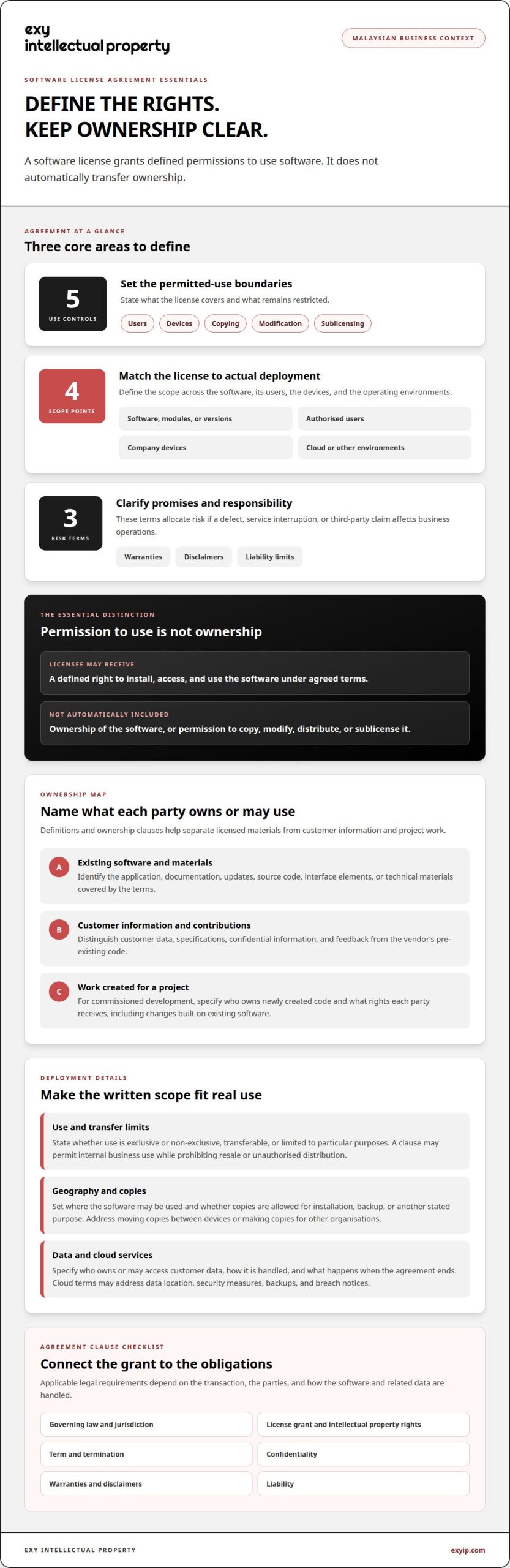
A license grant identifies the actions a licensee may take with the software and the restrictions that apply. A right to use software does not automatically include the right to copy, modify, distribute, or sublicense it.
For example, a clause may permit installation for internal business use while prohibiting resale or unauthorised distribution. It can also state whether the license is exclusive or non-exclusive, transferable, or limited to particular purposes. These terms define the scope of the grant and clarify which actions are not permitted.
Scope, Users, and Environments
License scope defines which software, users, devices, and operating environments the grant covers. This matters when a business needs access across teams, locations, or systems.
A license may identify specific modules or versions and restrict use to authorised employees or other permitted users. It can distinguish installation on company devices from access through a cloud service. The agreement should match the actual deployment, so changes to users or environments do not unintentionally exceed the agreed scope.
Geographic Limits and Copying Permissions
Geographic clauses state where the software may be used, while copying clauses define whether and how copies are permitted. Both matter when staff work across borders or a business needs backups or additional installations.
The agreement can set territorial limits and clarify whether copying is allowed for installation, backup, or another stated purpose. It can also address whether users may move copies between devices or make copies for other organisations. Clear wording helps ensure that the license’s geographic reach and copying permissions match the business’s intended use.
Applicable Laws and Agreement Clauses
In Malaysia, applicable legal requirements depend on the transaction, the parties, and how the software and related data are handled. The agreement should identify its governing law and jurisdiction, and address the license grant, intellectual property rights, term, termination, confidentiality, warranties, and liability.
For data protection, specify who owns or may access customer data, how it must be handled, and what happens when the agreement ends. A cloud software clause may also address data location, security measures, backups, and breach notices. These details connect privacy obligations to the service and clarify each party’s responsibilities.
Software intellectual property ownership
A software agreement separates ownership of the software from permission to use it. Clear definitions and ownership clauses identify what each party controls, including related materials and feedback.
Software and Intellectual Property Definitions
The agreement’s definitions specify which software and intellectual property the ownership clauses cover. This matters because a product can include more than its executable program.
For example, the defined software might include a named application, its documentation, and specified updates. The agreement can separately define intellectual property rights in source code, interface elements, technical materials, or related documentation. Clear boundaries distinguish licensed materials from the customer’s own information and work.
Definitions should also distinguish existing materials from work created during a project. A customer might supply business data or specifications, while the vendor provides pre-existing code. Naming these categories links each item to the relevant ownership and usage terms, rather than leaving rights to broad references to “the software.”
Ownership and Feedback Rights
Ownership clauses state which party retains intellectual property rights and what usage rights the other party receives. They matter because paying for access does not, by itself, establish ownership of the software.
A license can state that the licensor retains ownership while the licensee receives a limited, non-transferable right to use the software. For example, a business may use an application under the agreed terms without owning its underlying code. The agreement should make this distinction clear.
Feedback needs separate treatment. If a customer suggests a feature or reports a defect, the contract can state whether and on what terms the vendor may use that feedback. It can also distinguish general suggestions from customer materials, confidential information, or data. This clarifies both parties’ responsibilities before product improvements are developed.
Protection clauses can address unauthorised copying, distribution, modification, or disclosure. For example, the agreement may restrict sharing installation files beyond authorised users and specify how confidential technical materials must be handled. These terms protect intellectual property while defining what ordinary use permits.
For commissioned development, the agreement should identify whether newly created code belongs to the customer, the vendor, or another party, and what rights each receives. It can also address changes built on existing software. Clear wording helps prevent a project deliverable from being mistaken for a transfer of all underlying intellectual property rights.
Warranties, disclaimers, and liability limits
These clauses state what the software provider promises and how the parties allocate risk. Their wording matters when a defect, service interruption, or third-party claim affects business operations.
Warranties and Disclaimers
A warranty is a contractual promise about the software or related services. A disclaimer states which promises are excluded or restricted. Clear wording distinguishes covered problems from risks the customer accepts.
For example, a contract might promise that the software will substantially match its documentation and define how reported defects are handled. It should state whether that promise covers updates, installations, or particular operating environments. If the provider disclaims uninterrupted or error-free operation, make those limits clear rather than burying them among general terms.
Proprietary software may depend on third-party components or systems outside the provider’s control. The agreement can explain how those dependencies affect warranties and support. In consumer contracts, disclaimers and remedies should be fair and consistent with applicable consumer protections. A broad disclaimer should not obscure the contract’s specific commitments.
Indemnity and Liability Limits
An indemnity allocates responsibility for defined claims or losses, while a liability limit restricts the amount or types of recoverable loss. Each party needs to understand which risks it takes on.
For instance, an intellectual property indemnity may address a claim that authorised use of the software infringes another party’s rights. The clause should describe covered claims, required notice, cooperation, and who controls the response. Separate terms may address losses caused by a customer’s unauthorised modification or use outside the licence restrictions.
Contracts can distinguish direct losses from indirect or consequential damages. Clear allocation helps businesses assess exposure before accepting obligations. The clauses should work together: an indemnity may be subject to the general liability cap, or the contract may give certain claims separate treatment.
Liability Caps and Excluded Damages
A liability cap sets a maximum amount for covered claims, while an exclusion removes specified damages from recovery. The distinction matters because a cap may limit a claim without excluding that category of loss.
For example, a contract could cap liability by reference to fees paid under the agreement and exclude indirect, consequential, or incidental damages. The parties should define how the cap applies across claims and whether it is mutual. A limit that applies only to the provider allocates risk differently from one that covers both parties.
Consumer-facing terms need particular care: liability restrictions should not unfairly disadvantage consumers or remove protections preserved by applicable law. The agreement can identify exceptions to its cap, such as confidentiality breaches or intellectual property infringement, and explain how they interact with indemnities. Reading these clauses together shows the practical limits of each party’s responsibility.
Subscription, periodic and one-time payment models
Payment terms connect the licence’s access period with the customer’s payment obligations. They should define when payment is due, what triggers renewal, and how ending access affects other contractual duties.
Subscription and One-Time Payment Models
A subscription ties software access to recurring payments, while a one-time model sets payment for a defined licence grant. The structure matters because it affects renewal, continued access, and each party’s ongoing responsibilities.
For example, a subscription may continue for successive periods unless cancelled under the agreement. A one-time payment may instead relate to a defined licence, without necessarily including support or future updates. Periodic arrangements can also tie payments to agreed stages or periods. The contract should distinguish these models and state what the end user receives under each.
Payment Schedules and Invoicing
Payment schedule clauses define due dates, invoicing procedures, and how disputed invoices are handled. Clear terms help each party manage payment and understand the consequences of late or incomplete payment.
For example, an agreement may require payment by electronic funds transfer within 45 days after receipt of an undisputed invoice. It should explain how the invoice is delivered, what information it contains, and how a dispute is raised. The parties can also define when an undisputed portion remains payable, so an invoice query does not obscure the payment process.
These details support compliance with the contract. They also help distinguish a payment breach from a genuine billing dispute and link any remedy to the agreed procedure.
Renewal Fees and Terms
Renewal terms explain whether a subscription continues, how renewal is handled, and when revised payment terms take effect. They matter because access may continue unless the agreement’s cancellation process is followed.
One agreement may allow support fees to change after the initial 24 months following first productive use. It requires 60 days’ prior written notice and limits revisions to no more than once in any 12-month period. These are agreement-specific terms, not a standard schedule for every software licence. Clear renewal clauses identify the applicable notice, timing, and cancellation process.
Support and Maintenance Payments
Support and maintenance payment clauses define the services covered and when payment is due. This distinction matters when software access and ongoing assistance are governed by different terms.
An agreement may invoice support separately from the software subscription and set a due date for that invoice. It should link payment to defined support responsibilities, such as patches, bug fixes, or scheduled maintenance, where included. The terms should also explain whether support continues after a subscription ends or a licence is terminated.
Finally, the contract should state how non-payment affects access, support, and termination. A clear sequence, notice, an opportunity to remedy the breach, then the specified consequence, helps the parties understand how payment disputes affect the software relationship.
Definition of a software license agreement
A software license agreement is a legally binding contract between a software vendor and an end user. It defines the terms for installing, accessing, using, and managing software. The practical distinction is that the agreement grants permission to use software under stated conditions, while ownership and usage rights remain separate matters.
Its scope depends on the transaction. A negotiated business-to-business deal may use a master Software License Agreement with terms for a particular product or relationship. An end-user license agreement, or EULA, is a specific, generally non-negotiable agreement presented to the end user. For online subscription access, the relevant terms may instead appear in SaaS conditions. The format varies, but each sets out obligations and permitted activity.
Acceptance connects the written terms to access. An end user may need to accept a EULA before installing software, while an organisation may agree to negotiated terms before deployment. For example, an employee installing a workplace application may accept terms that apply to the organisation’s use. Businesses should identify who accepts the terms, which users they cover, and whether separate terms govern administrators or other authorised users.
A useful definition also describes what the contract covers. It can identify the software, versions or modules, relevant documentation, permitted users, and support services. These details distinguish a software license from a separate development or service arrangement. If a company receives access to an application but not its source code, the contract should make that boundary clear.
The agreement then explains how the relationship operates over time. Renewal, updates, support, confidentiality, and termination provisions define each party’s duties and what happens when the arrangement changes. For example, a subscription ending may stop access without automatically ending every remaining contractual obligation. Clear terms help parties understand which duties continue.
For Malaysia-based parties, the contract can identify its governing law and jurisdiction, alongside the applicable commercial terms. The right structure depends on whether the software is installed, downloaded, or accessed as a service, and whether the deal is negotiated or presented to end users. These distinctions give the document its meaning, not its title alone. For tailored terms, get support with software licensing agreements.
Exy Intellectual Property: License Agreements
Exy Intellectual Property provides license agreements for businesses that need to define software access, usage rights, ownership, and risk allocation. Use this service when preparing a new software arrangement, negotiating terms with a vendor or customer, or clarifying rights in existing software.
A carefully structured agreement connects the license grant with practical details such as authorised users, permitted environments, updates, confidentiality, warranties, and termination. This clarifies each party’s responsibilities and how the terms fit the commercial relationship. Where software forms part of a broader intellectual property strategy, coordinated terms can also support the management of related rights.
Contact Exy Intellectual Property to discuss your software license agreement needs.
Put the Agreement to Work for Your Business
A software arrangement should support how your business plans to develop, distribute, or access technology. Before signing or renewing, consider whether the terms still fit your commercial plans, including future product changes, new users, or a shift in how the software is delivered. Software licensing agreement essentials are most useful when translated into clear, practical responsibilities, not left as broad legal language.
Where the wider business relationship also depends on protecting other innovations or brand assets, Exy Intellectual Property offers trademark registration, patent filing, and industrial design registration. These services support distinct parts of an intellectual property strategy alongside license arrangements.
For guidance on terms that fit your software relationship, contact Exy Intellectual Property. A clear next step can help you move forward with greater confidence.
Frequently Asked Questions
SaaS, On-Prem And API Licensing – What’s Different?
SaaS provides access to software hosted by a provider, on-premises licensing covers software installed in the user’s environment, and API licensing governs access to defined interfaces or functions. A SaaS agreement should address service access and customer data handling. On-premises terms should identify installation and operating environments. API terms can define permitted calls, use cases, and technical limits, helping ensure an integration stays within its authorised purpose.
What is a software licensing agreement and what does it cover?
A software license agreement is a contract setting the terms for a vendor’s software to be installed, accessed, or used by an end user. In practice, a business should read it alongside any order form, product schedule, or online terms incorporated into the contract. For example, an order may identify selected modules, while the main agreement sets the rules for the relationship.
What software usage rights, restrictions, and user limits should be specified?
Specify what users may do, who qualifies as an authorised user, and any limits tied to accounts, devices, or environments. For example, a company might distinguish employees from contractors who access a shared platform. Address whether users may make test copies, connect integrations, or allow affiliates to access the software. These details align the license with real workflows and help prevent accidental overuse.
How do perpetual, subscription, SaaS, and open-source software licenses differ?
A perpetual license generally grants ongoing use under its terms, while a subscription ties access to a continuing term. SaaS describes a delivery model in which software is accessed as a service, often through a subscription. Open-source software is licensed under terms that may permit source code access and certain reuse, subject to conditions. These categories can overlap, so identify both the license rights and the delivery method.
What warranties, support, maintenance, and service levels should the agreement specify?
Describe the software commitments, support channels, maintenance coverage, update handling, and any service levels the parties agree to measure. For example, specify how users report an outage, what information a support request should include, and how scheduled maintenance is communicated. If the agreement includes availability targets or response categories, define how they are measured and what remedy applies if a commitment is missed.
Who owns software, customisations, updates, and user data under a software license?
Allocate rights separately for the underlying software, customer-created materials, customisations, updates, and user data. For example, a business may retain its uploaded records while the vendor retains pre-existing software code. A customised report or integration can raise a separate ownership question. State who may use, maintain, export, or adapt each item, especially when the relationship ends or the software changes.
What are the liability limits, indemnities, and intellectual property infringement protections?
These terms allocate responsibility for claims and losses, including claims that authorised software use infringes another party’s intellectual property rights. For example, the agreement can explain how a party gives notice of a claim, cooperates, and participates in resolving it. Read indemnities alongside liability caps and exclusions. A defined exception for a particular type of claim can change how the general limit applies.