


Choosing a name that simply describes what you sell is the fastest way to lose your legal protection before you even start. In Malaysia, MyIPO receives over 50,000 trademark applications annually; however, many face rejection because they lack the inherent distinctiveness required by the Trademarks Act 2019. Understanding what makes a trademark strong isn’t just a legal exercise. It’s the difference between owning a generic label and securing a valuable commercial asset. You need a name that commands the market rather than one that blends into the background.
It’s natural to feel uneasy about complex legal jargon or the risk of choosing a name that’s too common. We recognize that your brand is the heartbeat of your business. This guide will show you how to build a legally resilient brand that secures your exclusive right and maximizes your long-term brand value. We’ll examine the spectrum of distinctiveness, the 2026 MyIPO procedural updates, and how solid intellectual property provides the foundation for a future license or franchise agreement. We’ll also look at how the Madrid Protocol helps you expand your reach beyond Malaysia’s borders.
Key Takeaways
- Learn what makes a trademark strong by focusing on legal distinctiveness rather than descriptive popularity to ensure your brand is enforceable.
- Identify your position on the spectrum of distinctiveness to move away from weak generic terms toward high-protection fanciful or arbitrary marks.
- Protect your market share by understanding the likelihood of confusion and preventing others from using similar signs that mislead consumers.
- Build long-term brand value by securing an exclusive right that facilitates future growth through a strategic license or franchise agreement.
- Navigate the MyIPO registration process with expert legal advisory to turn your creative identity into a resilient piece of intellectual property.
Defining the Exclusive Right: What is a Strong Trademark?
A trademark is a sign which distinguishes a business or its products from others. It’s the commercial signature of your company. Many business owners believe that a popular name is a powerful one. This is a common misconception. In legal terms, what makes a trademark strong is not how many people recognize it, but how easily it can be defended in court. Strength is measured by enforceability. A strong mark creates a clear legal barrier. It ensures that your competitors cannot benefit from the reputation you have built.
When you achieve successful registration, the state grants you an exclusive right. This is a legal monopoly granted to the holder, preventing others from using the protected subject without permission. This protection is the bedrock of your brand value. It’s the commercial worth of your brand, derived from its legal right to replicate success. Without this strength, your brand is merely a name that anyone can use. A strong trademark transforms an idea into a tangible business asset that you can eventually license or franchise.
The Role of Intellectual Property in Business
Intellectual property refers to the legal rights that protect creations of the mind, such as inventions, designs, and artistic works. Trademarks are the most visible application of these rights. They act as a badge of origin for consumers. In Malaysia, navigating these rights requires a balanced IP stance. This policy approach seeks equitable protection of rights while allowing public access and innovation. It’s a delicate equilibrium. By securing a strong trademark, you’re utilizing one of the most effective government tools available to stimulate national economic progress and protect your specific commercial interests.
Why Weak Marks Fail in the Public Sphere
The public sphere is the domain where works enter after the expiry of a monopoly, allowing free use by the public. It also includes words that are simply too common to be owned by one entity. Weak marks often fall into this category. If your brand name is purely descriptive, it stays in the public sphere. This means you cannot stop others from using it. To build a resilient brand, you must navigate the spectrum of distinctiveness. Strong marks are proprietary. They don’t just describe what you do; they identify who you are. Moving your brand away from the public sphere and into the realm of exclusive protection is the first step toward long-term commercial success.
The Spectrum of Distinctiveness: From Generic to Fanciful
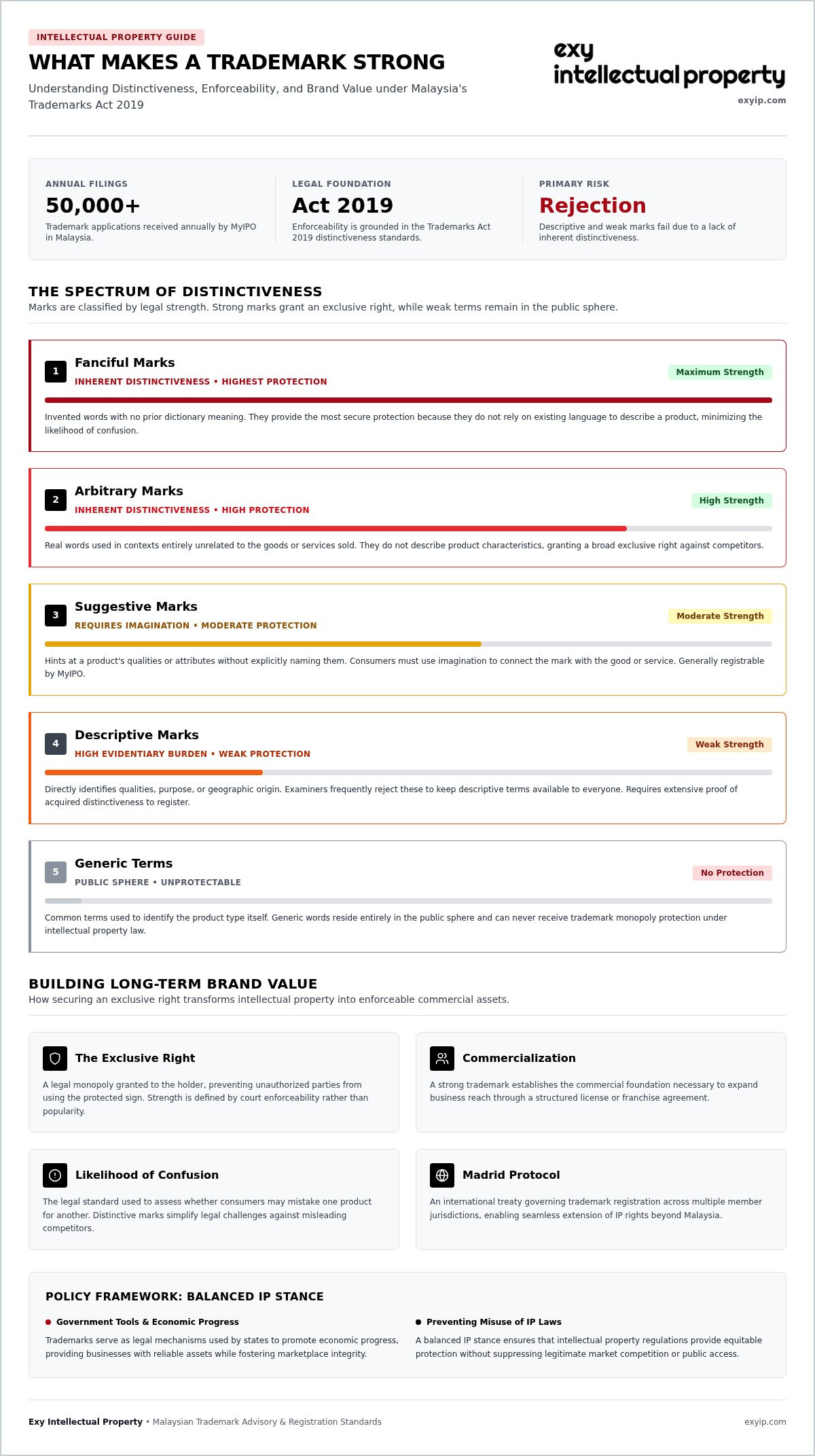
Legal distinctiveness is the primary factor in what makes a trademark strong. It determines how easily your sign distinguishes your business from others in the marketplace. This spectrum ranges from generic terms that belong to the public sphere to fanciful marks that provide absolute proprietary control. Understanding where your brand falls on this scale is the first step toward securing a resilient commercial asset. If your mark is too close to the descriptive end, you risk rejection by MyIPO or facing constant challenges from competitors.
Inherently Distinctive Marks: Fanciful and Arbitrary
Fanciful marks are the gold standard of intellectual property. They consist of entirely invented words that have no prior dictionary meaning. Arbitrary marks use real words in contexts that are completely unrelated to the goods or services sold. Both categories are considered inherently distinctive. They provide the most secure exclusive right because they don’t rely on existing language to describe a product. By choosing a name in these categories, you minimize the likelihood of confusion with existing players. For a broader perspective on these legal categories, the USPTO guide to strong trademarks offers a clear breakdown of why these marks are legally superior for global enforcement.
Suggestive vs. Descriptive Marks
Suggestive marks are strategic. They hint at a product’s attributes or quality without explicitly naming them. This requires the consumer to use a bit of imagination to make the connection. These are generally registrable and offer good protection. Descriptive marks, however, face significant hurdles. They directly describe the quality, quantity, intended purpose, or geographic origin of a product. MyIPO examiners often reject these because descriptive language should remain free for all businesses to use. To protect a descriptive mark, you must prove "acquired distinctiveness" through years of documented market use. This is a heavy evidentiary burden that most small businesses should avoid.
Generic terms are at the bottom of the spectrum. These are the common names for products, such as "Smartphone" for a mobile device. These terms can never be protected because they are essential for public communication. Choosing a generic or descriptive name limits your brand value and prevents effective commercialization. If you’re unsure where your current brand identity sits on this scale, a professional Trademark Filing strategy can help you pivot toward a name that offers long-term legal security.
MyIPO’s VA1-2026 Examination Standards
Under MyIPO’s updated Guidelines of Trademarks (VA1-2026), examiners enforce stricter scrutiny on goods and services specifications. Filing overly broad or vague item descriptions alongside descriptive terms increases the likelihood of receiving a formal Office Action (provisional refusal). Ensuring that specifications strictly align with the current Nice Classification edition minimizes examination delays.
Proving Acquired Distinctiveness (Section 23(2))
If a mark is initially descriptive, Section 23(2) of the Trademarks Act 2019 allows registration only if the applicant proves that the mark has acquired distinctiveness through extensive use prior to the filing date. This requires submitting a formal Statutory Declaration backed by 3 to 5 years of Malaysian sales figures, advertising expenditure, media coverage, and market penetration evidence to convince the Registrar that consumers associate the term exclusively with your business.
Building Brand Value through Legal Strength
Legal distinctiveness is the foundation of commercial success. When you ask what makes a trademark strong, you aren’t just looking for a legal definition. You’re looking for market power. A strong mark simplifies commercialization, which is the process of bringing together intellectual property to the market in order to generate revenue. It acts as a clear signal to investors that your brand is a stable asset rather than a liability. Secure brands grow faster.
Investors prioritize security. A trademark that meets high likelihood of confusion standards is easier to defend, which significantly reduces legal risk. This protection directly impacts your brand value. It’s the commercial worth of a brand, derived from its legal right to replicate success. A resilient mark ensures that your market share remains yours alone. To understand how these intangible assets are measured for the balance sheet, you can read our detailed post on IP Valuation: A Strategic Business Guide (2026).
Preparing for a Franchise Agreement
A franchise agreement is a contract granting the right to replicate a brand’s business model and expand its presence. It’s impossible to scale this way without a strong trademark. The mark is the identity the franchisee buys into. If the mark is weak or descriptive, a franchisee risks local competitors using similar names with little recourse. High distinctiveness ensures the brand remains unique across multiple territories. It protects the integrity of the business model and provides a safe environment for partners to invest their capital.
Licensing and Revenue Generation
A license is a permission granted by a licensor to a licensee as an element of a broader commercial strategy. Strength equals negotiating power. A strong mark commands higher royalty rates because it offers the licensee a guaranteed exclusive right in their specific niche. This is where intellectual property becomes a revenue engine. Governments use these protections as government tools to promote economic benefit by encouraging businesses to invest in unique identities. By securing your mark, you aren’t just filing paperwork; you’re building a scalable financial instrument that generates passive income through strategic partnerships.
Avoiding Weakness: Likelihood of Confusion and Misuse
Likelihood of confusion is the primary legal standard used to assess whether consumers might mistake one product or service for another. This concept is central to what makes a trademark strong. If your mark is too similar to an existing registration in sound, appearance, or meaning, it creates market noise. This noise weakens your position. It prevents your brand from serving as a clear badge of origin. A strong mark must be distinct enough to avoid any overlap that could mislead the public.
Over time, even a strong mark can lose its power through genericization. This happens when a brand name becomes the common, everyday term for a product category. When a mark becomes generic, it falls into the public sphere. You lose your exclusive right, and the name becomes free for everyone to use. Vigilance is required to prevent your brand from becoming a victim of its own success. Additionally, businesses must avoid the misuse of IP laws. Using intellectual property regulations to suppress legitimate competition or silence fair criticism can lead to legal backlash and damage your reputation.
Conducting a Thorough Search
Searching the MyIPO database is a non-negotiable first step in your branding journey. You need to identify potential conflicts before you spend capital on marketing and signage. A professional search reveals if similar marks already exist in your class of goods or services. This proactive approach saves you from future litigation and costly rebranding exercises. If your business involves unique product aesthetics, you should also consider how your branding aligns with Industrial Design Protection in Malaysia to ensure a comprehensive shield for your assets.
The Rogers Test and Free Speech
Trademark rights often intersect with creative expression. The Rogers test is a legal mechanism used to determine if the use of a trademark in an artistic work is infringing or protected as free speech. While the First Amendment is a U.S. constitutional provision, the principle of a balanced IP stance is recognized globally. It ensures that trademark enforcement does not stifle artistic freedom. A strong trademark is one that can coexist with expressive works without causing a genuine likelihood of confusion. Understanding these boundaries helps you build a brand that is legally resilient without overstepping into the rights of others.
Securing your brand requires more than just a creative name; it requires a strategic legal foundation. If you are ready to verify the strength of your mark, our team provides expert Legal Advisory to help you navigate the complexities of registration.
Strategic Steps to Secure a Strong Trademark in Malaysia
Registration is the final step in turning a creative idea into a legal shield. In Malaysia, formal registration with MyIPO under the Trademarks Act 2019 is the only way to secure a statutory exclusive right. While common law rights exist, they require a heavy evidentiary burden to prove goodwill. A registered mark provides immediate, nationwide protection for 10 years, which can be renewed indefinitely. This legal certainty is a core part of what makes a trademark strong. Without a certificate, your brand value remains vulnerable to market shifts. To understand the specific steps of the Malaysian process, see our Trademark Registration in Malaysia: 2026 Strategic Guide.
International Expansion via the Madrid Protocol
The Madrid Protocol is an international treaty governing trademark registration across multiple countries. It allows Malaysian businesses to use MyIPO as an office of origin to file in over 130 member jurisdictions. This streamlined process is highly efficient. However, the strength of your international application depends entirely on your home registration. If your Malaysian mark is weak or descriptive, a central attack could cause your entire global portfolio to fail. A strong local mark simplifies international filing by providing a clear, defensible foundation. For businesses looking beyond Southeast Asia, our Global Trademark Registration: Strategic Guide for 2026 provides a roadmap for worldwide expansion.
Partnering with an IP Specialist
Professional drafting is a strategic investment. An IP specialist ensures your application avoids common pitfalls that lead to office actions or third-party oppositions. In Malaysia, you have a 2-month window to oppose a mark after it is gazetted. Expert advisory helps you navigate these timelines. Beyond the application, a specialist acts as a guardian for your intellectual property. They help you identify opportunities for commercialization and ensure your licensing agreements are legally sound. This long-term partnership turns a simple registration into a growing financial asset. By focusing on what makes a trademark strong from the start, you build a business that is ready for franchising, licensing, and eventual valuation. Secure your future by building on a foundation of legal excellence.
Securing Your Brand’s Commercial Future
Building a brand is a significant investment of time and resources. You’ve learned that legal distinctiveness is the foundation of long-term success. Moving away from descriptive terms toward arbitrary or fanciful marks ensures your brand remains outside the public sphere. This transition is essential for establishing an exclusive right that competitors cannot easily challenge. Understanding what makes a trademark strong allows you to transform a creative name into a defensible commercial asset.
We’re here to act as your business-savvy guardian throughout this journey. Whether you need expert MyIPO registration services, professional IP valuation reports, or strategic franchise consultancy, our team provides the steady support you need to grow. Proactive protection is the key to lasting market authority. Secure your brand with Exy Intellectual Property today and take the next step toward commercializing your vision with confidence.
Frequently Asked Questions
What is the difference between a strong and a weak trademark?
A strong trademark is inherently distinctive; it uses fanciful or arbitrary words that have no direct connection to the product. A weak trademark is usually descriptive; it uses common words that tell the consumer exactly what is being sold. Understanding what makes a trademark strong involves looking at legal enforceability. Strong marks are easier to defend in court and receive a wider scope of protection than those that merely describe a service.
Can a descriptive word ever become a strong trademark?
Yes; a descriptive word can become protectable if it acquires distinctiveness through extensive market use. This is known as "secondary meaning." You must prove to MyIPO that consumers now associate the word specifically with your business rather than its literal meaning. However; this process is difficult and requires significant evidence of sales and advertising. It’s usually safer and more efficient to choose a mark that is inherently distinctive from the start.
What is the likelihood of confusion in trademark law?
Likelihood of confusion is a legal standard assessing whether consumers may mistake one product for another; violating trademark law. It occurs when two marks are so similar in sound; appearance; or meaning that the public believes they come from the same source. This standard is the primary tool used to prevent brand infringement. Strong trademarks minimize this risk by remaining unique and clearly separated from existing identities in the marketplace.
How does the Madrid Protocol help my Malaysian business?
The Madrid Protocol is an international treaty governing trademark registration across multiple countries. It allows Malaysian businesses to file a single application through MyIPO to seek protection in over 130 member nations. This simplifies global expansion by reducing administrative burdens and centralizing the management of your portfolio. It ensures your brand maintains a consistent exclusive right across international borders; supporting your long term commercialization strategy and global brand value.
Why should I worry about my trademark becoming generic?
Genericization happens when your brand name becomes the common name for the product itself. When this occurs; the mark enters the public sphere and loses all legal protection. You can no longer stop competitors from using the name to describe their own goods. This destroys your exclusive right and eliminates the commercial worth of your brand. Vigilant enforcement and proper usage are required to prevent your trademark from losing its legal strength.
What role does a franchise agreement play in brand strength?
A franchise agreement is a contract granting the right to replicate a brand’s business model and expand its presence. A strong trademark is the core asset of this agreement. It provides the legal certainty that a franchisee is paying for a unique; protectable identity. If the trademark is weak or descriptive; the entire franchise model becomes vulnerable to local competition. High legal strength ensures the brand remains a valuable; replicable asset for growth.
How is brand value calculated for a trademark?
Brand value is the commercial worth of a brand; derived from its legal right to replicate success. It is calculated by assessing the future economic benefits the mark is expected to generate. Specialists look at market position; legal strength; and the potential for revenue through a license or franchise. Understanding what makes a trademark strong is vital because strong marks command a higher valuation by offering better security against infringement and a stable foundation for commercialization.
What is an exclusive right and how do I get one?
An exclusive right is a legal monopoly granted to the holder; preventing others from using the protected subject without permission. You obtain this right in Malaysia by successfully registering your trademark with MyIPO. This registration confirms that your sign is distinctive and doesn’t conflict with existing rights. Once granted; it gives you the legal authority to sue for infringement and serves as the primary tool for protecting your market share.